
a package manager for git projects with private repositories

Project description
Qaviton Package Manager






Qaviton Package Manager (qpm)
is a package management tool integrated with git.
to enable management of packages both public & private,
from git repositories, in addition to the standard package manager.
Replace redundant packaging systems using qpm:
Package everything using git tags:
>qpm --build
         |
branch: dev
         |
branch: tests
         |
[tag 2019.9.1]
         |
[tag 2019.9.2]
         |
branch: release/latest


>qpm --install "git+https://url/owner/project.git@release/latest#egg=package:>=2019.9.2"
  |       |      |   |           |                     |             |              |
qaviton install vcs+protocol://project_url          @branch   #egg=package      (optional)
package method  type                                              directory   pep-440 pep-508
manager                                                             path     :version_specifier
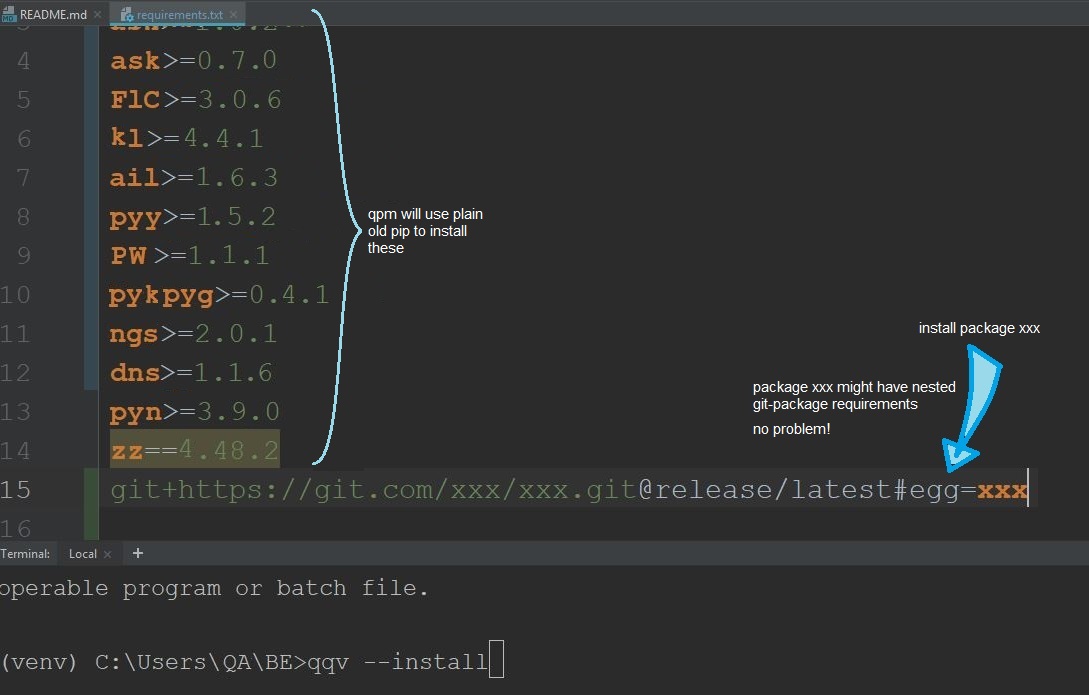
Installation
pip install --upgrade qaviton_package_manager
Requirements
- git 2.16+
- Python 3.6+
Features
- CI CD workflow ✓
- managing private+public packages ✓
- managing nested private packages ✓
- cli + scripting ✓
- pip capabilities ✓
- git capabilities ✓
- pypi capabilities ✓
- automatic builds ✓
- secure credentials ✓
- cross-platform ✓
- nested/multiple packages ✗
- pip -e installs ✗ (coming soon)
- docker build ✗ (but can be used with the run function)
- docker push ✗ (but can be used with the run function)
Usage
creating a manager:
(venv) windows> qpm ^
--create ^
--url "https://github.com/owner/project.git" ^
--username "user1" ^
--password "pass@#$" ^
--email "awsome@qaviton.com" ^
--pypi_user "supasayajin" ^
--pypi_pass "final space"
(venv) bash$ qpm  \
--create  \
--url "https://github.com/owner/project.git"  \
--username "user1"  \
--password "pass@#$"  \
--email "awsome@qaviton.com"  \
--pypi_user "supasayajin"  \
--pypi_pass "final space"  \
/
this should leave you with the following project structure:
project/
  ├ package/
  │   └ __init__.py  # with __author__, __version__, __author_email__, __description__, __url__, __license__
  ├ tests/
  │   └ __init__.py
  ├ .gitignore
  ├ LICENSE
  ├ README.md
  ├ requirements.txt
  ├ requirements-test.txt
  ├ setup.py
  └ package.py  # ignored by .gitignore
now let's build a package:
# package.py
from qaviton_package_manager import Manager
from qaviton_package_manager import decypt

# if this is not secure enough, you can add cache_timeout=3600
# and store credentials in memory
# manager = Manager(cache_timeout=3600)
# and we need to insert the credentials in run time: > python package.py --username "x"  --password "z"
manager = Manager(**decypt(
    key=b'xxxxxxxxxxxxxxxxxxxxxxxxxxxxxxxxxxxxxxxxxx==',
    token=b'xxxxxxxxxxxxxxxxxxxxxxxxxxxxxxxxxxxxxxxxxxxxxxxxxxxxxxxxxxxxxxxxxxxxxxxxxxxxxxxxxxxxxxxxxxxxxxxxxxxxxxxxxxxxxxxxxxxxxxxxxxxxxxxxxx==',
))


if __name__ == "__main__":
    # running with lambdas will protect you from processes getting stuck
    manager.run(
        lambda: manager.update(), # pip install -r requirements.txt --upgrade
        lambda: manager.update_test(), # pip install -r requirements-test.txt --upgrade
        lambda: manager.test(), # python -m pytest --junitxml=test_report.xml tests
        lambda: manager.build(), # git commit, tag & push (internal logic is more complicated)
        lambda: manager.upload(), # upload to pypi
    )
make sure you have at list 1 passing test for your package
# tests/my_package_test.py
def test_with_100p_coverage():
    print("testing my package!\nPASS")
# we can now create a package
python package.py
CLI:
we can call any method and send any parameter to the manager through cli:
# release a version if all tests pass
qpm --username "" --password "" --update --update_test --test --build --upload

# build a stable version if all tests pass
qpm --username "" --password "" --update --update_test --test --build "stable/latest"

# install cachetools using pip and save the requirement in requirements.txt
qpm --install cachetools

# cache credentials in memory
qpm --username "" --password "" --cache_timeout "-1"

# using the system & python to execute tests
qpm --test "system" "echo success" --test "python" "-c" "print(\"py success\");"
CLI short cuts:
we can call any method and send any parameter to the manager through cli:
# install cachetools using pip and save the requirement in requirements.txt
qpm i cachetools

# uninstall cachetools using pip and remove the requirement in requirements.txt
qpm un cachetools

# build a stable version
qpm b "stable/latest"

# run tests
qpm t

# upload to pypi
qpm up

# install cachetools using pip and save the requirement in requirements.txt
qpm install cachetools

# build package
qpm build "stable/latest"

# upload to pypi
qpm upload
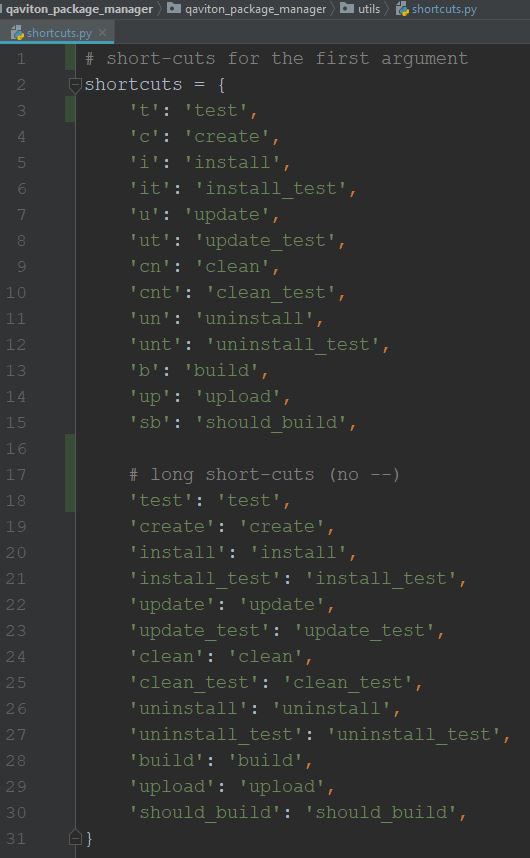
Script:
# ci_cd.py
from qaviton_processes import run, escape, python
from package import manager
from datetime import datetime


d = datetime.utcnow()
docker_url = manager.vars['docker_url']
docker_user = manager.vars['docker_user']
docker_pass = manager.vars['docker_pass']
docker_email = manager.vars['docker_email']
SSH_PRIVATE_KEY = manager.kwargs['SSH_PRIVATE_KEY']
docker_tag = manager.kwargs['docker_tag']
branch_build = "ci_cd/latest"
dev_branch = "dev"

manager.run(
    lambda: manager.should_build(from_branch=dev_branch, to_branch=branch_build),
    lambda: manager.install(),
    lambda: manager.install_test(),
    lambda: manager.test.pytest("tests/ci_cd"),
    lambda: manager.build(to_branch=branch_build, version=f'{d.year}.{d.month}.{d.day}'),
    # docker distribute
    lambda: run(f"docker login --username=\"{escape(docker_user)}\" --password=\"{escape(docker_pass)}\" --email=\"{escape(docker_email)}\" \"{escape(docker_url)}\""),
    lambda: run(f"docker build --force-rm -t test-multi-stage-builds --build-arg SSH_PRIVATE_KEY=\"{escape(SSH_PRIVATE_KEY)}\" ."),
    lambda: run(f"docker tag {docker_tag} yourhubusername/verse_gapminder:firsttry"),
    lambda: run("docker push yourhubusername/verse_gapminder"),
    # deploy script
    lambda: python("deploy.py")
)
# schedualer.py
from time import time, sleep
from datetime import datetime, timedelta
from qaviton_processes import python_code_async

d = datetime.utcnow()
date = datetime(year=d.year, month=d.month, day=d.day, hour=22)
delta = timedelta(days=1)

# build a package once a day at 22pm
while True:
    python_code_async('import ci_cd')
    date += delta
    sleep(date.timestamp()-time())
warnings
-
this manager is meant for automated ci cd purposes
and should not be used instead of regular git commit/push/merge.
make sure to avoid using it on unstable branches
to avoid failed packaging requests or potential data loss.
we recommend using it from a CI CD dedicated branch. -
the manager defaults to encrypted credentials,
if encrypted credentials on the disk are not secure enough,
please make sure to enable caching, to store credentials in memory
Release history Release notifications | RSS feed


Download files
Download the file for your platform. If you're not sure which to choose, learn more about installing packages.
Source Distribution
Built Distribution
Filter files by name, interpreter, ABI, and platform.
If you're not sure about the file name format, learn more about wheel file names.
Copy a direct link to the current filters
File details
Details for the file qaviton_package_manager-2019.10.16.16.17.56.318679.tar.gz.
File metadata
- Download URL: qaviton_package_manager-2019.10.16.16.17.56.318679.tar.gz
- Upload date:
- Size: 23.8 kB
- Tags: Source
- Uploaded using Trusted Publishing? No
- Uploaded via: twine/2.0.0 pkginfo/1.5.0.1 requests/2.22.0 setuptools/39.1.0 requests-toolbelt/0.9.1 tqdm/4.36.1 CPython/3.6.7
File hashes
| Algorithm | Hash digest | |
|---|---|---|
| SHA256 |
60c3404172767602a0d3ef7bb4d8493941e86a130c7f64923ca579db5343c5f6
|
|
| MD5 |
affec5c34faf8515761b3e60ce3637e7
|
|
| BLAKE2b-256 |
cc1a1f15830f3d85c0fe7dab213f38aa41c8557a83c22c040ca49e019de55ff4
|
File details
Details for the file qaviton_package_manager-2019.10.16.16.17.56.318679-py2.py3-none-any.whl.
File metadata
- Download URL: qaviton_package_manager-2019.10.16.16.17.56.318679-py2.py3-none-any.whl
- Upload date:
- Size: 36.5 kB
- Tags: Python 2, Python 3
- Uploaded using Trusted Publishing? No
- Uploaded via: twine/2.0.0 pkginfo/1.5.0.1 requests/2.22.0 setuptools/39.1.0 requests-toolbelt/0.9.1 tqdm/4.36.1 CPython/3.6.7
File hashes
| Algorithm | Hash digest | |
|---|---|---|
| SHA256 |
7af0968da467c97189e4268b06c80a12d946f355d818793374df9e0a97a64804
|
|
| MD5 |
567f0d8792f71b56b2ccc8dfebdac46b
|
|
| BLAKE2b-256 |
6e2c793681af9270eaa6ab6cbcc844f734c7aeb84ca6b10192d0ccfc8ed3f012
|






