
Qiboml
👋 Welcome to Qiboml, the quantum machine learning package of the Qibo ecosystem!
🎯 Our goal is to integrate Qibo within the most commonly used machine learning frameworks, allowing the definition and usage of quantum or hybrid classical-quantum models keeping the same high-level language proposed by the most used libraries (Pytorch, Tensorflow).
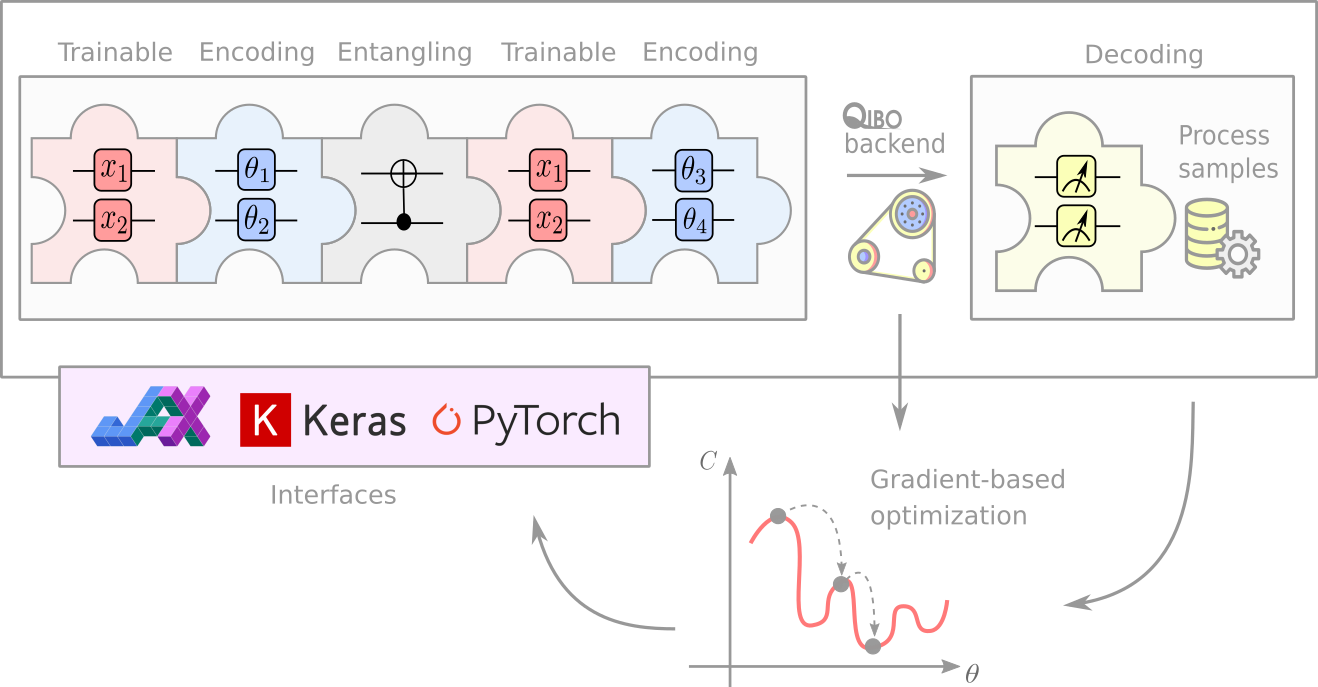
Documentation

📖 The Qiboml documentation can be found in our organization webpage.
Minimum working example
You can quickly build a QML model using one of the currently supported interfaces. For instance, to train a VQE to find the ground state of an Hamiltonian $H=\sum_i Z_i$:
from qiboml.models.ansatze import hardware_efficient
from qiboml.models.decoding import Expectation

nqubits = 2
circuit = hardware_efficient(nqubits)
# By default Expectation sets Z_0 + Z_1 + ... + Z_n as observable,
# any Hamiltonian can be used though
decoding = Expectation(nqubits)

# using pytorch
import torch
import qiboml.interfaces.pytorch as pt

pt_model = pt.QuantumModel(circuit_structure=[circuit,], decoding=decoding)
optimizer = torch.optim.Adam(pt_model.parameters(), lr=0.05)
for iteration in range(100):
    optimizer.zero_grad()
    cost = pt_model()
    cost.backward()
    optimizer.step()

# using keras
import keras
import tensorflow as tf
import qiboml.interfaces.keras as ks
tf.keras.backend.set_floatx('float64') # set the dtype to float64, which is qibo's default

ks_model = ks.QuantumModel(circuit_structure=[circuit,], decoding=decoding)
optimizer = keras.optimizers.Adam(learning_rate=0.05)
for iteration in range(100):
    with tf.GradientTape() as tape:
        cost = ks_model()
    gradients = tape.gradient(
        cost, ks_model.trainable_variables
    )
    optimizer.apply_gradients(zip(gradients, ks_model.trainable_variables))
Citation policy


If you use the package please refer to the documentation for citation instructions.
Contacts
To get in touch with the community and the developers, consider joining the Qibo workspace on Matrix:

If you have a question about the project, please contact us with 📫.
1 maintainer

Metadata
1 maintainer
Release files for qiboml 0.1.1
For a detailed explanation of source distributions (sdists) and built distributions (wheels), please see the package formats documentation.
Source distribution (sdist)
| File | Size | Uploaded | |
|---|---|---|---|
| qiboml-0.1.1.tar.gz | 48.3 kB | Details |
Built distribution (wheel)
| File | Interpreter | ABI | Platform | Reset |
|---|---|---|---|---|
| qiboml-0.1.1-py3-none-any.whl | Python 3 | none | any | Details |
Total release size: 111.3 kB
Release files / qiboml-0.1.1.tar.gz
| Download URL | qiboml-0.1.1.tar.gz |
|---|---|
| Size | 48.3 kB |
| Tags | Source |
|
SHA-256 checksum How to use checksums |
a5f9e14dbc675b315430675ce62e89c2b75c218523a2e13921d82d757fda530e
|
|
BLAKE2b-256 checksum How to use checksums |
75b06b24e27b67f7eeb516fb002c6148e3bc3d43f1b56cdf304f4f71b92e82ca
|
| Upload date | |
|
Uploaded using Trusted Publishing? What is trusted publishing? |
No |
| Uploaded via |
twine/6.2.0 CPython/3.11.14
|
Release files / qiboml-0.1.1-py3-none-any.whl
| Download URL | qiboml-0.1.1-py3-none-any.whl |
|---|---|
| Size | 63.0 kB |
| Tags | Python 3 |
|
SHA-256 checksum How to use checksums |
a43452c20352639bad73308e146a6e32951de2380b2107d5936daa596b5b8936
|
|
BLAKE2b-256 checksum How to use checksums |
cbf183e8f6302352c9bdce7c2cc8363d62e579e956be80c0e41d613ee0aa7415
|
| Upload date | |
|
Uploaded using Trusted Publishing? What is trusted publishing? |
No |
| Uploaded via |
twine/6.2.0 CPython/3.11.14
|














