
qnmlab
Black-hole quasinormal modes with quantum algorithms


Developed by AiQC — Ai and Quantum Community
When a black hole is disturbed, it rings down like a struck bell. The tones it rings at — its
quasinormal modes — depend only on the black hole itself, so they are its fingerprint.
qnmlab measures these frequencies with quantum algorithms: you choose a black hole, a size
in qubits, a representation and a simulated or real quantum backend, and compare the result
with trusted reference values.
pip install qnmlab
About AiQC
AiQC (Ai and Quantum Community) is a research community working on quantum computing and artificial intelligence. Its motto is its method — we do science — and its mission is to use the minds and the collective intellectual strength of its members to do research, regardless of age, academic rank or background.
Recent work and recognition, from aiqcommunity.org:
- First place globally in the Advanced Rigetti Computing Challenge at the international Q-Volution Hackathon hosted by Girls in Quantum (March 2026), with a solution based on Pauli Correlation Encoding.
- Represented Algeria and Africa at MIT's iQuHACK 2026 quantum hackathon in Cambridge, Massachusetts.
- Organised AiQuest — Quantum Edition, the first AI and quantum computing contest in Algeria and the Arab Maghreb, featured by UNESCO for the International Year of Quantum Science and Technology.
- Eleven research projects across quantum machine learning, quantum random number generation, quantum reservoir computing, physics-informed hybrid quantum networks and applied AI, several run on IBM, Xanadu and Rigetti quantum hardware.
Explore the projects at aiqcommunity.org/research · GitHub · LinkedIn · contact@aiqcommunity.org
Authors
| role | |
|---|---|
| Abir Chekroun | AiQC Co-Director, Head of Quantum Projects — lead author |
| Hamed Al-Yoorby | Research partner |
| Mouadh Abderrahmane Assal | AiQC Co-Director, Head of Advanced AI Research |
| Zakaria Lourghi | AiQC Co-Director, Principal AI Engineer |
| Achraf Boussahi | AiQC Co-Director, Chief Scientific Officer |
How it works
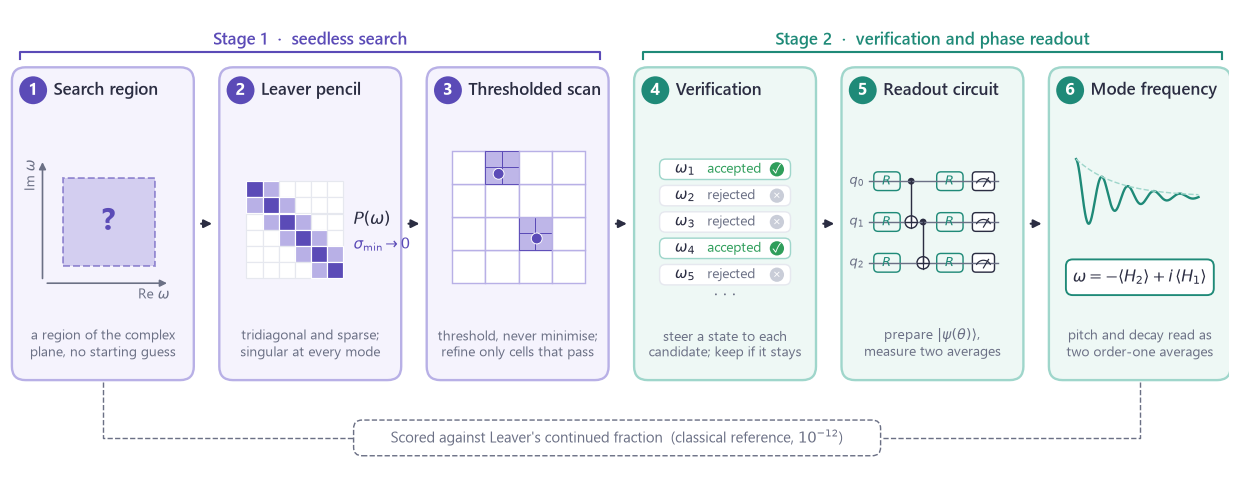
The pipeline has two stages and needs no starting guess.
Stage 1 — seedless search.
- Search region. You give a rectangle of the complex frequency plane — nothing else.
- Leaver pencil. At a trial frequency ω, a sparse, tridiagonal matrix P(ω) becomes singular exactly when ω is a mode.
- Thresholded scan. At every grid point a variational quantum solver estimates how close P(ω) is to singular, and the scan keeps the points that pass a threshold. It thresholds instead of minimising, because near a mode the true value is so small that the minimum of a noisy map is set by noise. Only cells that pass are refined.
Stage 2 — verification and phase readout.
-
Verification. The scan returns a shortlist, false candidates included. For each one, a quantum state is steered towards it; a real mode keeps the state nearby, a false candidate lets it drift away and is rejected.
-
Readout circuit. On hyperboloidal slices, every mode is an eigenvalue of one fixed operator A, so the prepared state is (close to) an eigenvector.
-
Mode frequency. The frequency is read from two measured averages,
Re ω = −⟨H₂⟩, Im ω = ⟨H₁⟩, with H₁ = (A + A†)/2 and H₂ = (A − A†)/2i.
Every result is scored against Leaver's continued fraction, the classical reference.
Why read a phase instead of a magnitude
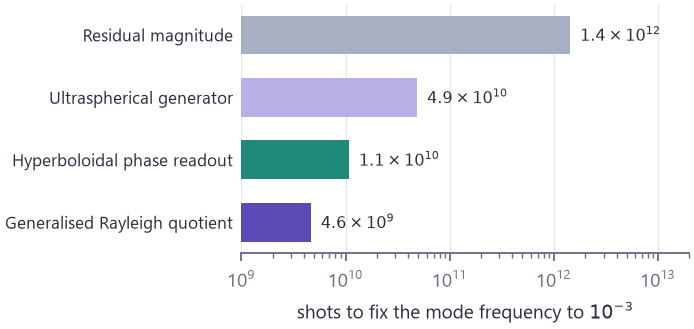
The obvious quantum encoding asks the processor where a matrix becomes singular — a quantity that is zero at the answer, which costs about 10¹⁹ shots for 10 % precision. The phase readout measures two averages of order one instead. On the same task — fixing a frequency to 10⁻³ with four qubits — it needs about 130 times fewer shots, and the banded generalised Rayleigh quotient is cheaper still.
The search finds the modes on its own
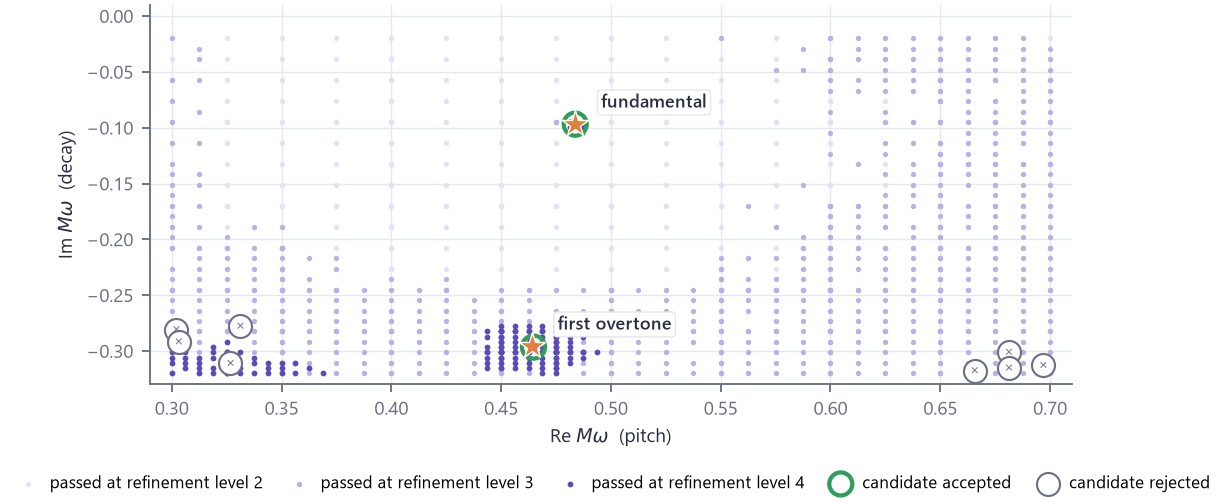
Starting from a region of the plane, the search narrows to ten candidates; verification accepts exactly the two true Schwarzschild modes — the fundamental to 10⁻⁶ and the first overtone to 3 × 10⁻⁵ — and rejects all eight false ones, with variational solvers in both stages.
On a real quantum processor
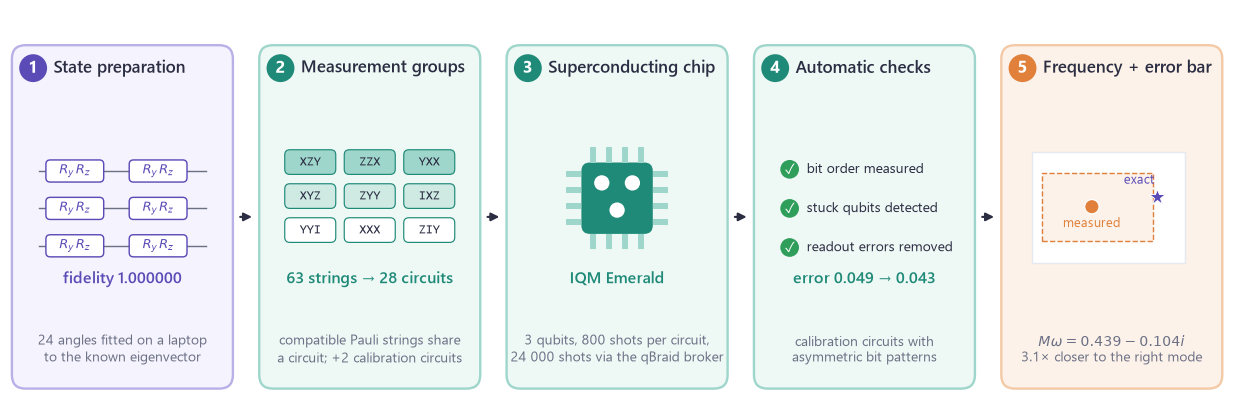
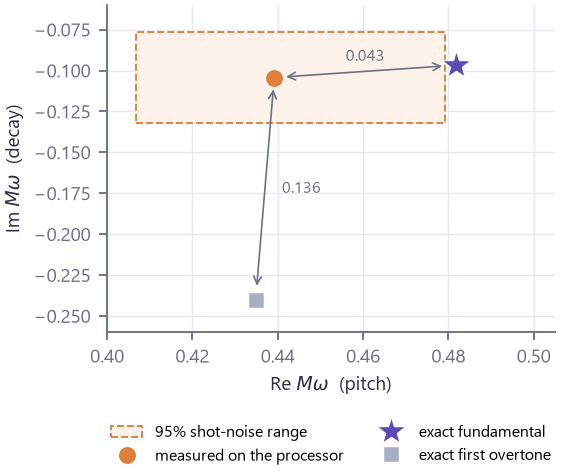
On IQM Emerald, a superconducting processor, the phase readout of a three-qubit state returned Mω = 0.439 − 0.104i against the exact 0.482 − 0.097i. It is 3.1 times closer to the right mode than to the next one, and its error (0.043) is what a noise model predicted before the run. The raw counts ship with the package:
import qnmlab as ql
ql.benchmarks.reanalyse_emerald_2026()   # (0.43919 - 0.10430i)
What more qubits buy — and cost
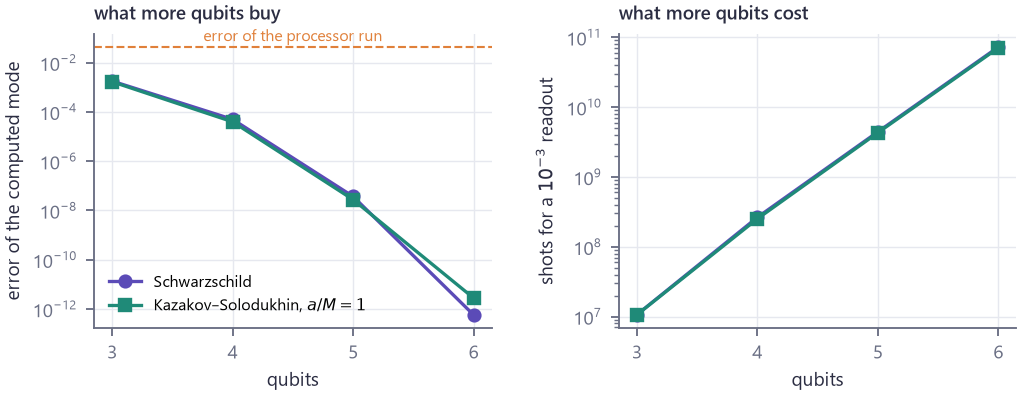
More qubits make the computed mode far more accurate, but each qubit multiplies the shots for a fixed-precision readout by about 16. At three qubits the method's own error is already 20 times smaller than today's hardware error.
Install
pip install qnmlab                                   # core: numpy, scipy, sympy
pip install "qnmlab[hardware]"                       # + Qiskit, to run circuits on real devices
pip install git+https://github.com/abir-tech/qnmlab.git   # latest development version
Quick start
import qnmlab as ql

bh = ql.KazakovSolodukhin(a=0.5)          # or ql.Schwarzschild(), ql.ReissnerNordstrom(Q), ql.Hayward(l)
ql.reference_modes(bh, ell=2, n_modes=2)  # classical ground truth

# read the fundamental on a simulated noisy 3-qubit device
r = ql.measure_mode(bh, qubits=3, noise=ql.NoiseModel.emerald_random(), shots=800)
print(r.omega, r.meta["error_vs_reference"])

# find modes with no starting guess (about 40 minutes with verification)
res = ql.find_modes(ql.Schwarzschild(), qubits=4)
print(res.modes)          # the fundamental and the first overtone
From the command line:
qnmlab modes   --model kazakov-solodukhin --parameter 0.5
qnmlab readout --model schwarzschild --qubits 3 --noise emerald-random --shots 800
qnmlab search  --model schwarzschild --qubits 4
A guided tour is in examples/01_quickstart.ipynb.
What you can choose
| choice | options |
|---|---|
| black hole | Schwarzschild(), KazakovSolodukhin(a) — validated against published frequencies; ReissnerNordstrom(Q), Hayward(l) — experimental (cross-checked against an independent method) |
| size | number of qubits; operator dimension 2**qubits |
| readout representation | "hyperboloidal" (any model), "ultraspherical" (banded generalised pencil, Schwarzschild) |
| search representation | "leaver" (tridiagonal, Schwarzschild), "frobenius" (any model) |
| search solver | "exact" (fast) or "variational" (a variational solver at every grid point) |
| noise | NoiseModel.ideal(), .emerald_random(), .emerald_coherent(), or NoiseModel(p2, eps, readout) |
Running on real hardware
op = ql.readout_operator(ql.Schwarzschild(), qubits=3)
state = ql.prepare_state(op, lead=0.48 - 0.097j)
job = ql.hardware.build_job(op, state)                  # 11 circuits
worst, ok = ql.hardware.verify(job)                     # Qiskit export matches the simulation
circuits = [ql.hardware.to_qiskit(c, 3) for c in job["circuits"]]
# ... run them with your provider and collect the raw counts by circuit name ...
result = ql.hardware.analyse_counts(job, raw_counts)    # measures bit order, mitigates readout
analyse_counts measures the provider's bit order from two calibration circuits and refuses
to continue if a qubit is stuck — both happened on real devices while this package was built.
Scope
- Classical methods compute these modes faster;
qnmlabis for studying, benchmarking and running the quantum formulation. - The end-to-end search ran in simulation; on hardware only the readout was run, from a classically prepared state. The search costs about 10¹³ shots at four qubits.
- For models other than Schwarzschild, the search threshold is calibrated on the classical reference mode (recorded in the result).
Citing
If you use qnmlab, please cite (see CITATION.cff):
A. Chekroun, H. Al-Yoorby, M. A. Assal, Z. Lourghi, A. Boussahi, Phase Readout and Seedless Search for Black-Hole Quasinormal Modes on Quantum Processors, 2026.
Development
pip install -e ".[dev]"
pytest -m "not slow"     # about 5 minutes
pytest                   # includes the 40-minute end-to-end search
MIT licence © 2026 the authors · AiQC — Ai and Quantum Community
1 maintainer

Metadata
1 maintainer
Release files for qnmlab 0.1.1
For a detailed explanation of source distributions (sdists) and built distributions (wheels), please see the package formats documentation.
Source distribution (sdist)
| File | Size | Uploaded | Provenance | |
|---|---|---|---|---|
| qnmlab-0.1.1.tar.gz | 87.5 kB | Without provenance | Details |
Built distribution (wheel)
| File | Interpreter | ABI | Platform | Reset |
|---|---|---|---|---|
| qnmlab-0.1.1-py3-none-any.whl | Python 3 | none | any | Details |
Total release size: 171.7 kB
Release files / qnmlab-0.1.1.tar.gz
| Download URL | qnmlab-0.1.1.tar.gz |
|---|---|
| Size | 87.5 kB |
| Tags | Source |
|
SHA-256 checksum How to use checksums |
d2435e7b15faff7b1a74f9a660f5ba0d0324afac86db6a1dc0688d7999b1300a
|
|
BLAKE2b-256 checksum How to use checksums |
12c1d6841161c847787f6712f2c88b4dc6b0fc529805744eac62c3b4ee0c0232
|
| Upload date | |
|
Uploaded using Trusted Publishing? What is trusted publishing? |
No |
| Uploaded via |
twine/7.0.0 CPython/3.12.0
|
Release files / qnmlab-0.1.1-py3-none-any.whl
| Download URL | qnmlab-0.1.1-py3-none-any.whl |
|---|---|
| Size | 84.2 kB |
| Tags | Python 3 |
|
SHA-256 checksum How to use checksums |
2eee495b58a3fb18c269f62e9e69e08a04237b04550689b75ee0d35ee16c4851
|
|
BLAKE2b-256 checksum How to use checksums |
9bc09383f191fa6e59ceab216784d275fe8a0dfbefb573593e6cb87844db524a
|
| Upload date | |
|
Uploaded using Trusted Publishing? What is trusted publishing? |
No |
| Uploaded via |
twine/7.0.0 CPython/3.12.0
|
Security for qnmlab 0.1.1
Provenance
Provenance describes where a file came from. On PyPI, provenance is shared via attestations, which provide a verifiable record of the build or publishing details. View details, limitations and caveats.
No provenance found
None of the files in this release were uploaded with provenance metadata.
A note on package security
PyPI is a repository for distributing packages, not a service for auditing them. While third-party security researchers and our staff do their best to detect and remove malicious packages, PyPI cannot guarantee the quality, security or suitability of any given package.
To learn more about protecting yourself from malicious actors, visit our package security documentation.














