
QoraGeom


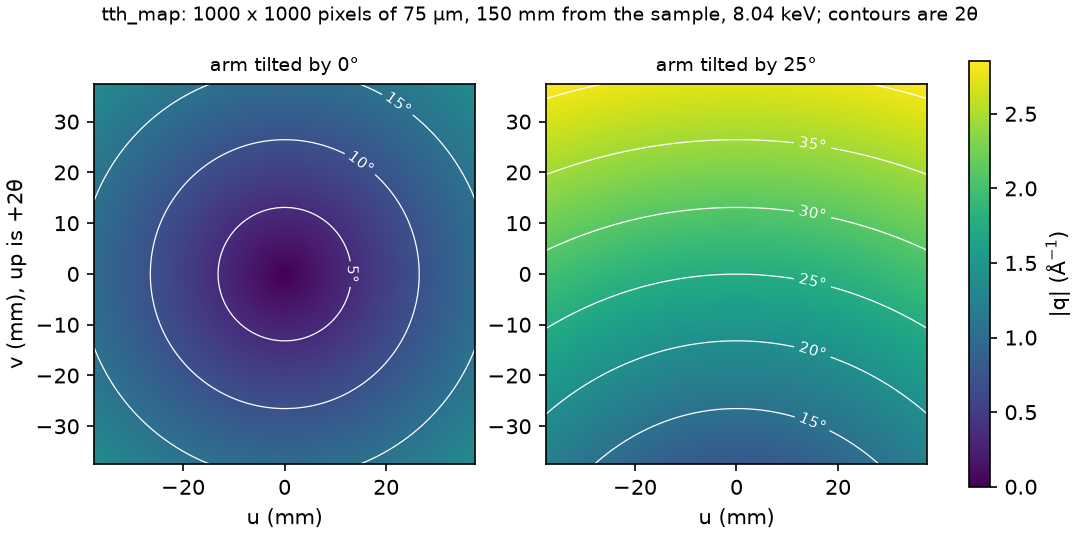
Per-pixel 2θ and |q| from tth_map for one detector at two arm tilts (script).
X-ray diffraction geometry, SPEC parsing and detector-frame loaders for Python.
QoraGeom handles the geometry and file-reading steps of analysing X-ray diffraction data from area detectors. It converts between photon energy, wavelength, 2θ, |q| and d-spacing, computes the true 2θ and lab-frame q of every pixel of a flat detector on a tilted arm, builds the BCDI reciprocal-space basis for a rocking scan, reads SPEC data files and loads detector frames from .mat, TIFF and HDF5.
Project boundary (current vs planned)
Current implementation: QoraGeom contains diffraction geometry, coordinates and reciprocal-space utilities and legacy SPEC parsing and optional MAT/TIFF/HDF5 frame loaders. The README examples below describe the code as it works today.
Intended long-term boundary: keep the reusable geometry/numerical core independent of experiment-file formats. SPEC and detector-frame readers can remain temporarily for compatibility while dedicated I/O and application layers take over. Do not remove or move existing import paths until downstream consumers (including CXD) are checked and migration/compatibility tests exist.
This boundary is an architectural direction, not a claim that the file readers have already been removed.
Install
Requires Python 3.13+ with numpy and scipy; h5py, tifffile and pandas are optional extras. Not on PyPI yet; install from git. The first release will add pip install qorageom.
1. Install into a uv project, then check the import
If you have no project yet, uv init makes one. The last command exits non-zero if the install is broken.
uv init --no-workspace --python 3.13 qorageom-demo
cd qorageom-demo
uv add "qorageom @ git+https://github.com/NaNIsaac/QoraGeom"
uv run python -c "from qorageom import wavelength; assert abs(wavelength(8.04) - 1.54209) < 1e-4"
With the optional loaders instead:
uv add "qorageom[h5,tiff,pandas] @ git+https://github.com/NaNIsaac/QoraGeom"
Usage
import numpy as np
from qorageom import wavelength, tth_to_q, tth_to_d, q_to_tth, shear_correction

lam = wavelength(8.04)  # 1.54209
tth_to_q(30.0, lam)  # 2.10909
tth_to_d(30.0, lam)  # 2.97909
q_to_tth(2.0, lam)  # 28.4147

B = shear_correction(
    wavelength(5.55) * 1e-10, np.radians(0.8 / 120), 0.511, 0.0, np.radians(69), 5.5e-5
)
# [[ 172662.33       0.     334222.41]
#  [      0.     481801.82       0.  ]
#  [-449800.75       0.     486236.02]]
from qorageom import reciprocal_basis

# phi rocking at theta = -71.35°, chi = 85.26° (chi motor offset 90°), 10 keV
B = reciprocal_basis(
    wavelength(10.0) * 1e-10,
    np.radians(0.01),
    1.0,
    np.radians(-1.0),
    np.radians(37.0),
    5.5e-5,
    theta=np.radians(-71.35),
    chi=np.radians(85.26),
    axis="phi",
)
# [[ 354278.6388    4659.2358  284512.2546]
#  [      0.      443537.3534   73814.7868]
#  [-266968.1031    6183.0148  843526.5203]]
from qorageom import energy_basis

# energy scan 9000 -> 9003 eV per step; the unit (keV or eV) is detected from the value
B_energy = energy_basis(
    9000.0, 3.0, 0.5, np.radians(-1.0), np.radians(37.0), 55e-6
)  # D, pixel in m; q in 1/m
# [[ 637701.5498    8386.6245 1455967.8687]
#  [      0.      798367.2361  -42228.9453]
#  [-480542.5856   11129.4266 -487528.5606]]
from qorageom import basis_diagnostics, direct_basis

A = direct_basis(B, shape=(64, 64, 32))  # voxel vectors [m] of the FFT grid, B: the phi scan above
# [[ 3.5177e-08 -1.8551e-09  2.2293e-08]
#  [-2.0437e-10  3.5282e-08 -6.4659e-10]
#  [-1.1847e-08 -2.4617e-09  2.9584e-08]]
d = basis_diagnostics(B)
d["angles_deg"]  # [ 90.     108.2963  84.311 ]
d["cond"]  # 2.2049
from qorageom import lab_voxel_size, resample_to_lab

lam, step = wavelength(10.0) * 1e-10, np.radians(0.01)
voxel = lab_voxel_size(lam, 1.0, 5.5e-5, (64, 64, 32), step)  # 2.4656e-08 m
B = reciprocal_basis(
    lam,
    step,
    1.0,
    np.radians(-1.0),
    np.radians(37.0),
    5.5e-5,
    theta=np.radians(-71.35),
    chi=np.radians(85.26),
    axis="phi",
)
lab = resample_to_lab(np.random.default_rng(0).random((64, 64, 32)), B, voxel)
lab.shape  # (64, 64, 32)
from qorageom import get_diffractometer

diff = get_diffractometer("34idc")
diff.sample_axes, diff.detector_motors  # (('y+', 'z-', 'y+'), ('delta', 'gamma'))
diff.detector_rotation([37.0, -1.0]) @ [0, 0, 1]  # [ 0.6017 -0.0175  0.7985]
from qorageom import strain

x = np.indices((12, 12, 12))[0] * 0.5  # nm
wrapped = np.angle(np.exp(1j * 10.0 * 0.02 * x))  # G = 10 rad/nm along x, strain 0.02
strain(wrapped, [10.0, 0, 0], voxel_size=0.5)[6, 6, 6]  # 0.020000000000000007
from qorageom.spec import Spec

with Spec("path/to/specfile") as sp:
    scan = sp.get_scan(1)
    scan.motors  # {'Theta': 10.0, 'Delta': 69.0, 'Gamma': 0.0}
    scan.sdd  # 511, from #UXML <sample_detector_distance>
    scan.to_dataframe()
# scan 1: "ascan Phi 0.5 -0.5 20 2", #UIMDET Timepix:, #UIMR5 100 120 64 64
scan.scan_axis  # ScanAxis(motor='Phi', start=0.5, stop=-0.5, intervals=20)
scan.scan_axis.step  # -0.05
scan.motor("del")  # 69.0, matches Delta ignoring case and the del/gam aliases
scan.detector, scan.roi  # ('Timepix', [100, 120, 64, 64])
main.py prints the detector pose and the q vector of pixel (1, 1) for an 8.04 keV beam, a 1 m detector distance and a 30° up angle:
$ uv run python main.py
center_pos:   [0.8660254 0.5       0.       ]
pixel_x_dir: [ 0.  0. -1.]
pixel_y_dir: [-0.5        0.8660254  0.       ]
q_lab:       [-5.45985588e-01  2.03742181e+00 -2.24095052e-04]
Modules
qorageom.geometry (also exported from qorageom):
HC_KEV_ANGSTROM,wavelength(energy_kev): λ [Å] from photon energy,tth_to_q,q_to_tth,tth_to_d: 2θ [deg] ↔ |q| [1/Å] ↔ d [Å] at a given λ,tth_map(shape, pixel_m, sdd_m, xc, yc, alpha_deg): true 2θ of every pixel of a flat detector on a tilted arm,detector_pose,pixel_to_q_lab: detector center/pixel directions from arm angles, and the lab-frame q of a pixel,rotate,rotation_matrix: Rodrigues rotation (vector and matrix form),shear_correction(wavelength, delta_theta, D, gamma, delta, pixel_size): BCDI reciprocal basisB_recip(34-ID-C convention),q = B_recip @ (i, j, k)for detector pixel (i, j) and rocking step k.reciprocal_basis(wavelength, delta_rock, D, gamma, delta, pixel_size, theta, chi, axis="theta"|"phi", chi_offset): the same basis for a theta or phi rocking scan with the theta/chi/phi sample circles; the k column is the exact rotation step, so it matchesshear_correctionto first order indelta_rock.energy_basis(energy, delta_energy, D, gamma, delta, pixel_size),energy_to_kev: the basis for an energy scan at a fixed sample angle (lengths in m, q in 1/m); energies of 1000 or more are taken as eV.direct_basis(B, shape=None): real-space basis conjugate to a reciprocal basis (B.T @ A == I, no 2π); withshapethe FFT voxel vectors. RaisesValueErrorfor a singular basis.lab_voxel_size(wavelength, D, pixel_size, shape, delta_rock, fov_min=0.7): isotropic lab-frame voxel edge for a detector-frame volume, shrinking the field of view by at mostfov_min.resample_to_lab(volume, B, voxel_size, order=1): resample a volume indexed (i, j, k) like the columns ofBonto an orthogonal lab grid of the same shape (scipy.ndimage.map_coordinates).basis_diagnostics(B): column lengths, pairwise angles [deg] and condition number of a basis.
qorageom.diffractometer: Diffractometer (circle axes in xrayutilities notation such as 'z-', outer to inner, with SPEC motor names; sample_rotation, detector_rotation take one angle [deg] per circle; rocking_basis gives the reciprocal basis of a scan rocking one sample circle or the energy), DIFFRACTOMETERS and get_diffractometer(name) for 34idc, P10sixc and id01.
qorageom.strain:
displacement_gradient(phase, voxel_size, axis): gradient of a wrapped phase [rad per length], robust against 2π jumps (smallest of three phase offsets per voxel, as in the legacy MATLAB strain script),strain(phase, q_vector, voxel_size, support=None): strain along the scattering vectorq_vector(rad per length, with the 2π),Ĝ . grad(phase) / |G|; nan outsidesupport.
qorageom.detector: Detector (pixel size [m], axis orientation, frame shape), DETECTORS and get_detector(name) for 34idcTIM1, 34idcTIM2, ASI, mpxgaas and e4m.
qorageom.scan_geometry: geometry_from_spec(scan, diffractometer="34idc", detector=None, shape=None, binning=(1, 1, 1), **overrides) and the ScanGeometry it returns.
qorageom.spec: Spec, SpecScan. Reads #O/#P motor positions, #D time, #L columns and data, and #UXML metadata (scan.sdd, scan.rois, scan.beam_center). scan.scan_axis (motor, start, stop, intervals, step of an ascan/dscan, else None), scan.motor(name), scan.detector (#UIMDET) and scan.roi (#UIMR5), scan.energy_kev and scan.detector_distance_m (camdist or sdd, mm to m). scan.to_dataframe() needs pandas.
qorageom.io: load_mat (.mat data (y, x, frame) → (frame, y, x)), load_tif_stack, load_h5, dump_h5 (print every group/dataset with shape, dtype and attributes).
From a SPEC scan to a lab-frame volume
geometry_from_spec reads the circle angles, energy, detector name and distance, and the rocking motor from a scan header, builds the basis from the diffractometer's axis strings (Diffractometer.rocking_basis, the same construction as xrayutilities' QConversion), and returns a ScanGeometry with the bases, the lab voxel size and the basis diagnostics. It covers every layout in the registry (34idc, P10sixc, id01) for rocking about any one sample circle or the energy. Keyword overrides (delta=, energy=, distance_m=, detector=, chi_offset=, ...) win over the file, and a missing value raises an error that names the keyword to pass. examples/spec_to_lab.py writes a one-scan SPEC file and resamples a volume:
uv run python examples/spec_to_lab.py
phi 34idcTIM2 9.0 keV 0.5 m
voxel 19.57 nm, cond 1.41
(64, 64, 32)
From diffraction pattern to strain
examples/bcdi_pipeline.py simulates a 16-voxel crystal (5 nm voxels, Au 111) with a localized Gaussian lattice displacement, computes its diffraction intensity, reconstructs it with QoraPhase (4 random starts), aligns it to the amplitude of the true object, removes the phase ramp with qoraphase.remove_ramp and recovers the strain with qorageom.strain on the support eroded by one voxel. The crystal is simulated directly in lab axes, so no resampling is needed; the QoraPhase dependency lives in the examples group.
uv run --group examples python examples/bcdi_pipeline.py
reconstruction: 13 s, Fourier error 1.8e-07
true strain:  rms 1.77e-03, range [-4.14e-03, 4.76e-03]
estimator floor on the true phase: rms 6.75e-05
strain error: rms 4.29e-04, max 6.41e-04
The "floor" line is the same estimator applied to the true phase, so it is the part of the error that comes from the 5 nm voxels and finite differences. The data are noiseless, and the global phase, translation and twin branch are fixed from the true amplitude.
Tests
uv run pytest
Citation
See CITATION.cff.
License
MIT, see LICENSE.
1 maintainer

Metadata
1 maintainer
Release files for qorageom 0.1.0
For a detailed explanation of source distributions (sdists) and built distributions (wheels), please see the package formats documentation.
Source distribution (sdist)
| File | Size | Uploaded | Provenance | Actions |
|---|---|---|---|---|
| qorageom-0.1.0.tar.gz | 21.6 kB | With provenance | Details for qorageom-0.1.0.tar.gz |
Built distribution (wheel)
| File | Interpreter | ABI | Platform | Actions Reset |
|---|---|---|---|---|
| qorageom-0.1.0-py3-none-any.whl | Python 3 | none | any | Details for qorageom-0.1.0-py3-none-any.whl |
Total release size: 45.7 kB
Release files / qorageom-0.1.0.tar.gz
| Download URL | qorageom-0.1.0.tar.gz |
|---|---|
| Size | 21.6 kB |
| Tags | Source |
|
SHA-256 checksum How to use checksums |
e2498973787f3913ad6b66938d91b0b67fc93ffabfdd5e6c3eac76da2c976763
|
|
BLAKE2b-256 checksum How to use checksums |
00e8f431fc6d54bce8a728eff69630ea0d5904f677e449a9679bd2e024adf328
|
| Upload date | |
|
Uploaded using Trusted Publishing? What is trusted publishing? |
Yes |
| Uploaded via |
twine/7.0.0 CPython/3.13.16
|
Provenance
Provenance describes where a file came from. On PyPI, provenance is shared via attestations, which provide a verifiable record of the build or publishing details. View details, limitations and caveats.


PyPI Publish Attestation
PyPI verified that this artifact, at this checksum, originated from the publisher listed below.
Signed by GitHub Actions, verified by PyPI on Oct 31, 2026.
Transparency logRelease files / qorageom-0.1.0-py3-none-any.whl
| Download URL | qorageom-0.1.0-py3-none-any.whl |
|---|---|
| Size | 24.1 kB |
| Tags | Python 3 |
|
SHA-256 checksum How to use checksums |
3fbeee6d10165168d922e0e39c25e0c6d2dae793483b4a5c824d2c47c5a6861f
|
|
BLAKE2b-256 checksum How to use checksums |
6392c89eb2099e5f579ca4a66f79ffbadc5e394250e925e5cb8ed26cbebe01b8
|
| Upload date | |
|
Uploaded using Trusted Publishing? What is trusted publishing? |
Yes |
| Uploaded via |
twine/7.0.0 CPython/3.13.16
|
Provenance
Provenance describes where a file came from. On PyPI, provenance is shared via attestations, which provide a verifiable record of the build or publishing details. View details, limitations and caveats.
PyPI Publish Attestation
PyPI verified that this artifact, at this checksum, originated from the publisher listed below.
Signed by GitHub Actions, verified by PyPI on Oct 31, 2026.
Transparency logSecurity for qorageom 0.1.0
Provenance
Provenance describes where a file came from. On PyPI, provenance is shared via attestations, which provide a verifiable record of the build or publishing details. View details, limitations and caveats.
Full provenance
All 2 files in this release have been uploaded with provenance metadata.
Attestation for qorageom-0.1.0.tar.gz
PyPI Publish Attestation
PyPI verified that this artifact, at this checksum, originated from the publisher listed below.
Signed by GitHub Actions, verified by PyPI on Oct 31, 2026.
Transparency logA note on package security
PyPI is a repository for distributing packages, not a service for auditing them. While third-party security researchers and our staff do their best to detect and remove malicious packages, PyPI cannot guarantee the quality, security or suitability of any given package.
To learn more about protecting yourself from malicious actors, visit our package security documentation.













