

Quak
An open-source remote for the GoPro HERO11 Black: a command-line tool and an app for desktop and Android.
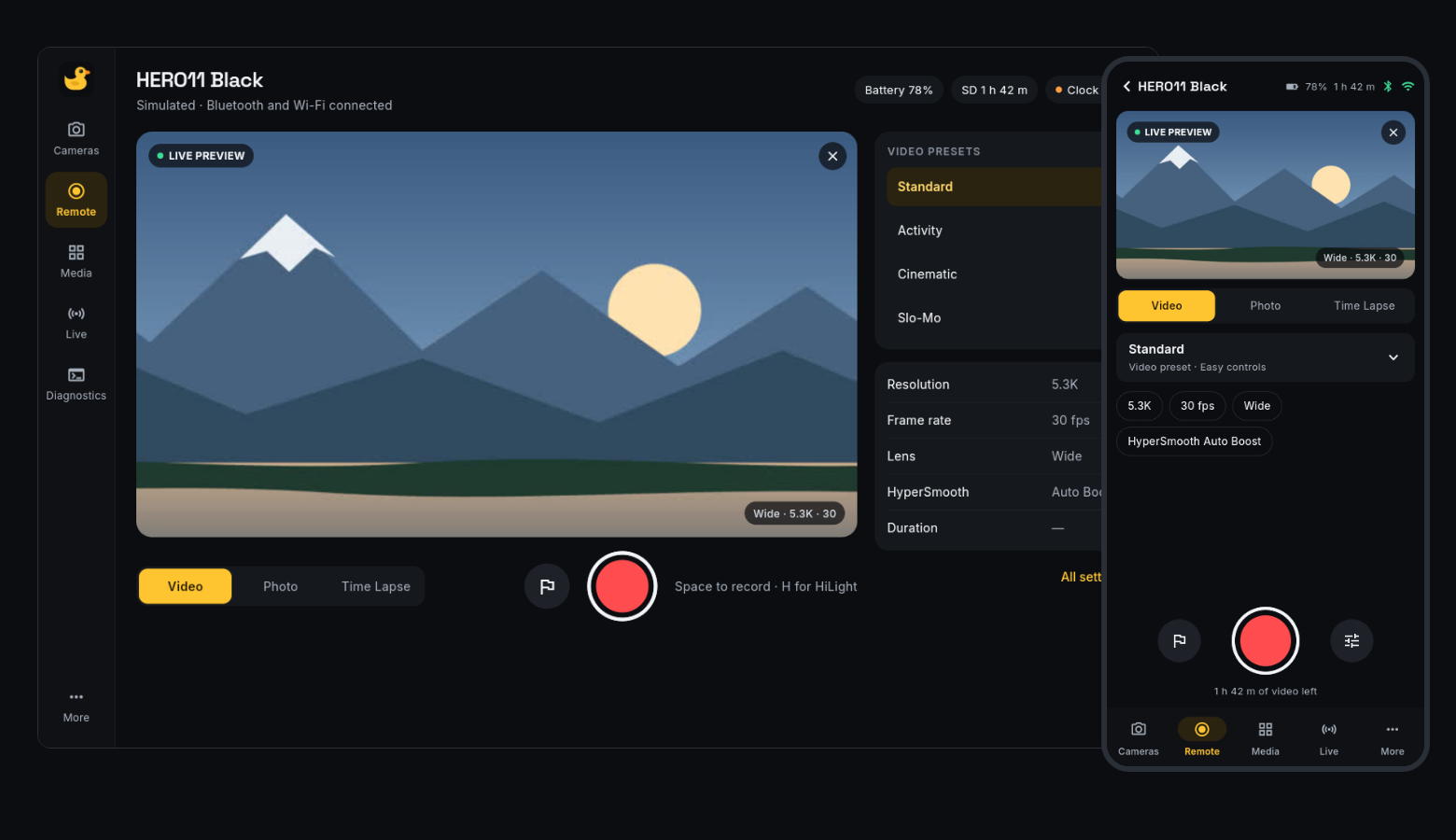
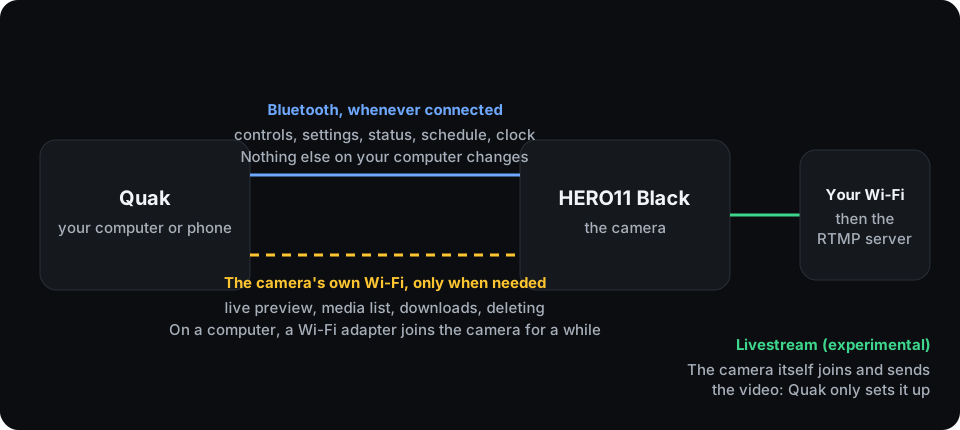
Quak talks to the camera over Bluetooth and the camera's own Wi-Fi, using GoPro's public Open GoPro API. No account and no cloud.
Status: early, and tested on one camera. It's built around one HERO11 Black (firmware 2.20). Other models get a warning and may not work. See what has been tested before you rely on it.
Try it without a camera
Quak includes a simulated camera that speaks the real protocol, so you can try everything first. You need Python 3.11 or newer.
pipx install 'quak-camera[gui]'               # or pip, in a virtual environment

quak --sim info                               # the command line
quak --sim schedule arm +2m --duration 15s
quak-gui --sim                                # the app (the first launch downloads about 45 MB)
Or download a ready-made app for Linux, Windows or Android from Releases. The install guide has the details for each system.

What it does
- Remote control: record, take photos, tag HiLights, change presets and every HERO11 setting.
- Scheduled capture: arm the camera for a time and a length, with its clock synced first. It starts and stops by itself, even if you switch it off after arming.
- Live preview over the camera's Wi-Fi. The camera can't stream while it records, so preview pauses until you stop.
- Media: browse the card, download clips, and delete them, with a confirmation that names the file.
- Livestream to an RTMP server such as YouTube or Twitch. This is experimental: see known issues.
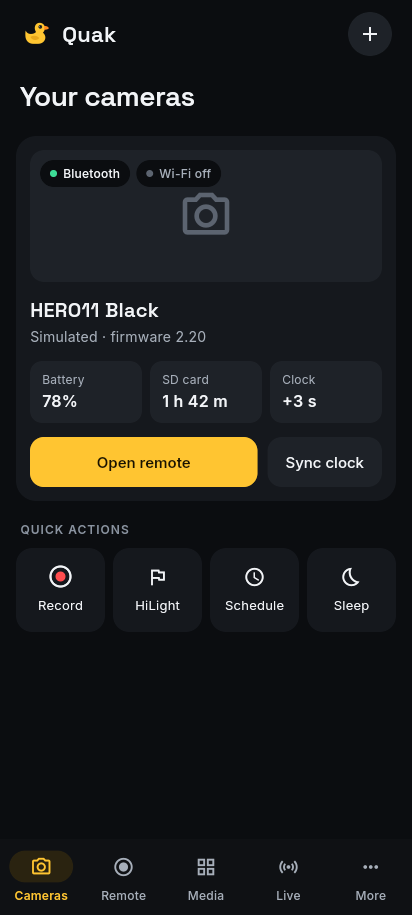
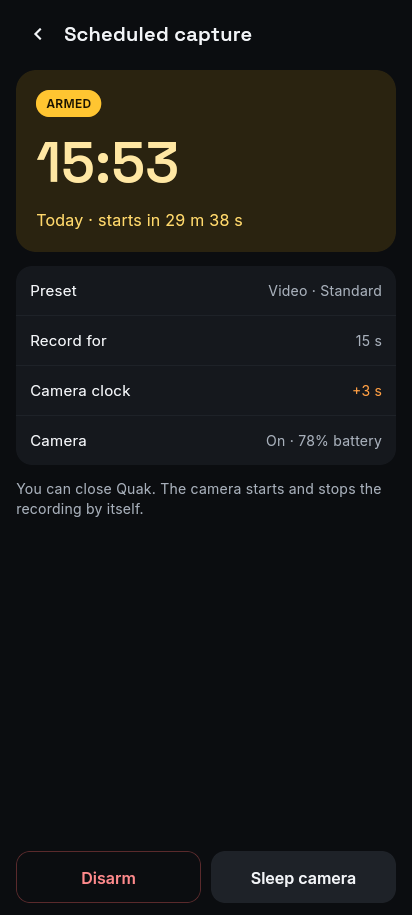
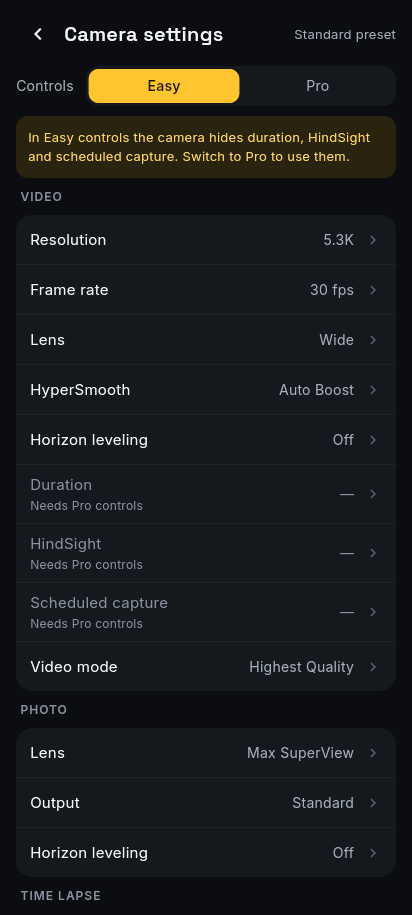
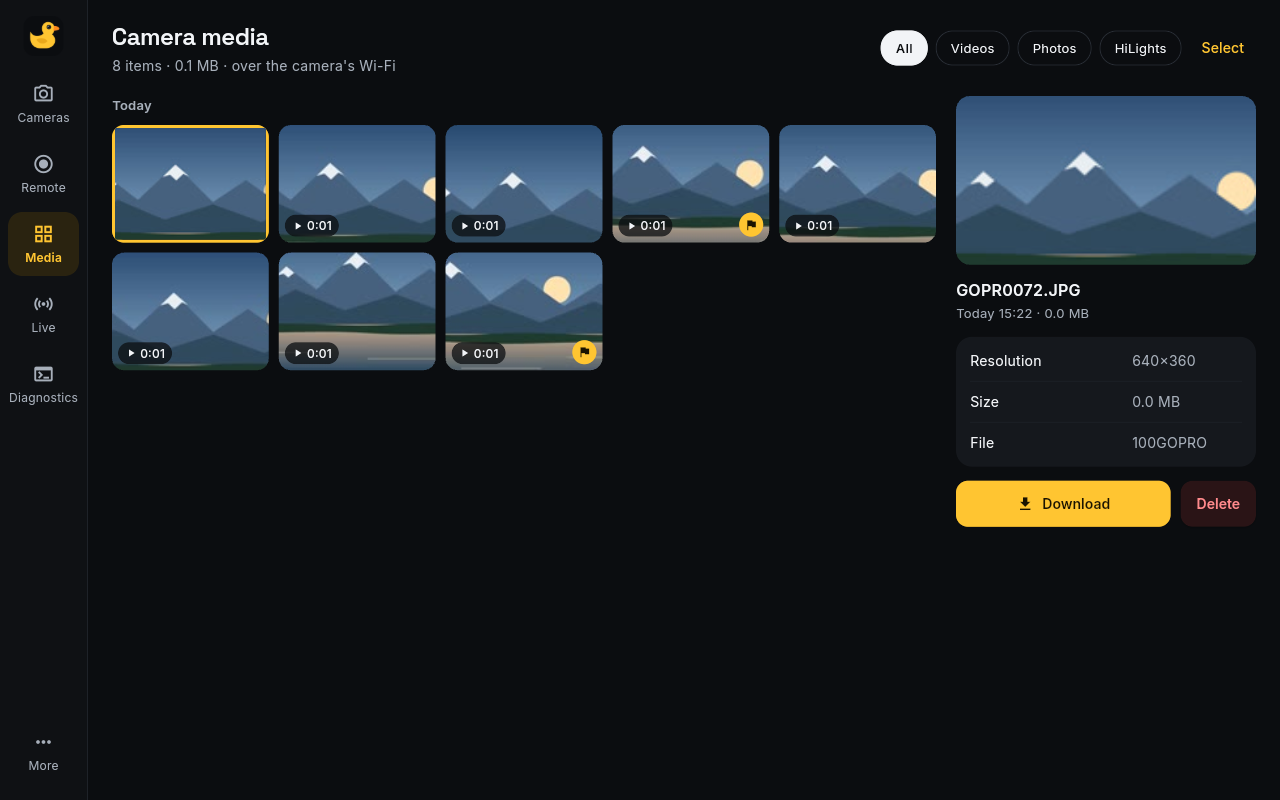
Screenshots come from the simulated camera, with a drawn scene instead of real footage.
Use it with your camera
Install it as above, plus what the install guide lists for your system. Then pair once. On the camera, open Preferences > Connections > Connect Device > GoPro Quik App, and leave that screen open while you run:
quak pair          # finds the camera on its pairing screen and remembers it
quak info
quak record --seconds 5
quak schedule arm +2m --duration 15s
quak media list
quak --help lists every command. In the app, use Add camera, which walks you through the same steps.
Android: download the APK from Releases. It needs Android 10 or newer.
Before you use it for real, read what Quak changes on your computer and camera. In short:
- On a computer, viewing media or the preview moves a Wi-Fi adapter onto the camera's network for a while. Quak avoids the adapter you're online through, and asks first if it's the only one.
- A scheduled capture changes the camera's Duration setting and leaves it changed, which also limits recordings you start by hand. Quak tells you when this happens.
What has been tested
Tested on one real HERO11 Black, with the end-to-end suites on Linux and by hand on one Android phone:
| Feature | Linux | Android | Windows |
|---|---|---|---|
| Pairing and reconnecting | Tested | Tested | Not tested |
| Status, clock sync | Tested | Tested | Not tested |
| Recording | Tested | Tested | Not tested |
| HiLights, presets, settings | Tested | Not tested | Not tested |
| Scheduled capture | Tested | Not tested | Not tested |
| Live preview | Tested | Tested | Not tested |
| Media: list, download, delete | Tested | Tested | Not tested |
| Livestream | Experimental | Not tested | Not tested |
Windows is experimental. The Windows build compiles and its unit tests pass, but it has never been launched or used with a
camera. Livestream worked end to end, then stopped working on the test camera for a reason that isn't known yet.
docs/testing.md has the details.
Documentation
- Install guide: Linux, Windows and Android, and building the packages
- Safety: what Quak changes and stores, what it can delete, and how to recover
- Troubleshooting: common problems and known issues
- Architecture: how the code is organised
- Testing: the test suites and hardware results
- Protocol notes: what we learned about the camera, beyond the official docs
- Contributing
How it was built
Quak was built with heavy AI assistance. Claude wrote most of the code, tests, documentation and the logo, and ran the test suites on a real camera, directed by a person who also tried it on the camera and phone. The hardware claims above come from those tests, and from nothing else.
Licence and disclaimer
MIT: see LICENSE. The packaged apps include other software under its own licences, including LGPL libraries: see THIRD_PARTY_NOTICES.md.
Quak is an independent project, not affiliated with, endorsed by or sponsored by GoPro, Inc. GoPro, HERO and Quik are trademarks of GoPro, Inc. See NOTICE.
1 maintainer

Metadata
1 maintainer
Release files for quak-camera 0.1.0
For a detailed explanation of source distributions (sdists) and built distributions (wheels), please see the package formats documentation.
Source distribution (sdist)
| File | Size | Uploaded | Provenance | Actions |
|---|---|---|---|---|
| quak_camera-0.1.0.tar.gz | 1.0 MB | With provenance | Details for quak_camera-0.1.0.tar.gz |
Built distribution (wheel)
| File | Interpreter | ABI | Platform | Actions Reset |
|---|---|---|---|---|
| quak_camera-0.1.0-py3-none-any.whl | Python 3 | none | any | Details for quak_camera-0.1.0-py3-none-any.whl |
Total release size: 2.1 MB
Release files / quak_camera-0.1.0.tar.gz
| Download URL | quak_camera-0.1.0.tar.gz |
|---|---|
| Size | 1.0 MB |
| Tags | Source |
|
SHA-256 checksum How to use checksums |
332dea09ec2a7e46442de4dee4445be7894ce6e42f0bf5b82a0f344671ed5b2b
|
|
BLAKE2b-256 checksum How to use checksums |
18e89dd083ef2aa28b2b4e4f7bfaf89b0b75b861627cce38441071954253f9e0
|
| Upload date | |
|
Uploaded using Trusted Publishing? What is trusted publishing? |
Yes |
| Uploaded via |
twine/7.0.0 CPython/3.13.16
|
Provenance
Provenance describes where a file came from. On PyPI, provenance is shared via attestations, which provide a verifiable record of the build or publishing details. View details, limitations and caveats.


PyPI Publish Attestation
PyPI verified that this artifact, at this checksum, originated from the publisher listed below.
Signed by GitHub Actions, verified by PyPI on Nov 7, 2026.
Transparency logRelease files / quak_camera-0.1.0-py3-none-any.whl
| Download URL | quak_camera-0.1.0-py3-none-any.whl |
|---|---|
| Size | 1.0 MB |
| Tags | Python 3 |
|
SHA-256 checksum How to use checksums |
df7686ac00deccc7b5939a64d3a02ea6e8fc04a335953074192a0a8afc7c2707
|
|
BLAKE2b-256 checksum How to use checksums |
76e17ad152fea2d1156e942f929e41b236a70f5a4967cedc6cb96325d96e2483
|
| Upload date | |
|
Uploaded using Trusted Publishing? What is trusted publishing? |
Yes |
| Uploaded via |
twine/7.0.0 CPython/3.13.16
|
Provenance
Provenance describes where a file came from. On PyPI, provenance is shared via attestations, which provide a verifiable record of the build or publishing details. View details, limitations and caveats.
PyPI Publish Attestation
PyPI verified that this artifact, at this checksum, originated from the publisher listed below.
Signed by GitHub Actions, verified by PyPI on Nov 7, 2026.
Transparency logSecurity for quak-camera 0.1.0
Provenance
Provenance describes where a file came from. On PyPI, provenance is shared via attestations, which provide a verifiable record of the build or publishing details. View details, limitations and caveats.
Full provenance
Both files in this release have been uploaded with provenance metadata.
Attestation for quak_camera-0.1.0.tar.gz
PyPI Publish Attestation
PyPI verified that this artifact, at this checksum, originated from the publisher listed below.
Signed by GitHub Actions, verified by PyPI on Nov 7, 2026.
Transparency logA note on package security
PyPI is a repository for distributing packages, not a service for auditing them. While third-party security researchers and our staff do their best to detect and remove malicious packages, PyPI cannot guarantee the quality, security or suitability of any given package.
To learn more about protecting yourself from malicious actors, visit our package security documentation.














