
Quake Analyzer



quake-analyzer is a command-line tool that fetches and analyzes earthquake data, including filtering based on magnitude and location, calculating recurrence intervals, and generating reports. This tool can help researchers and enthusiasts analyze earthquake data from the USGS database over various timeframes.
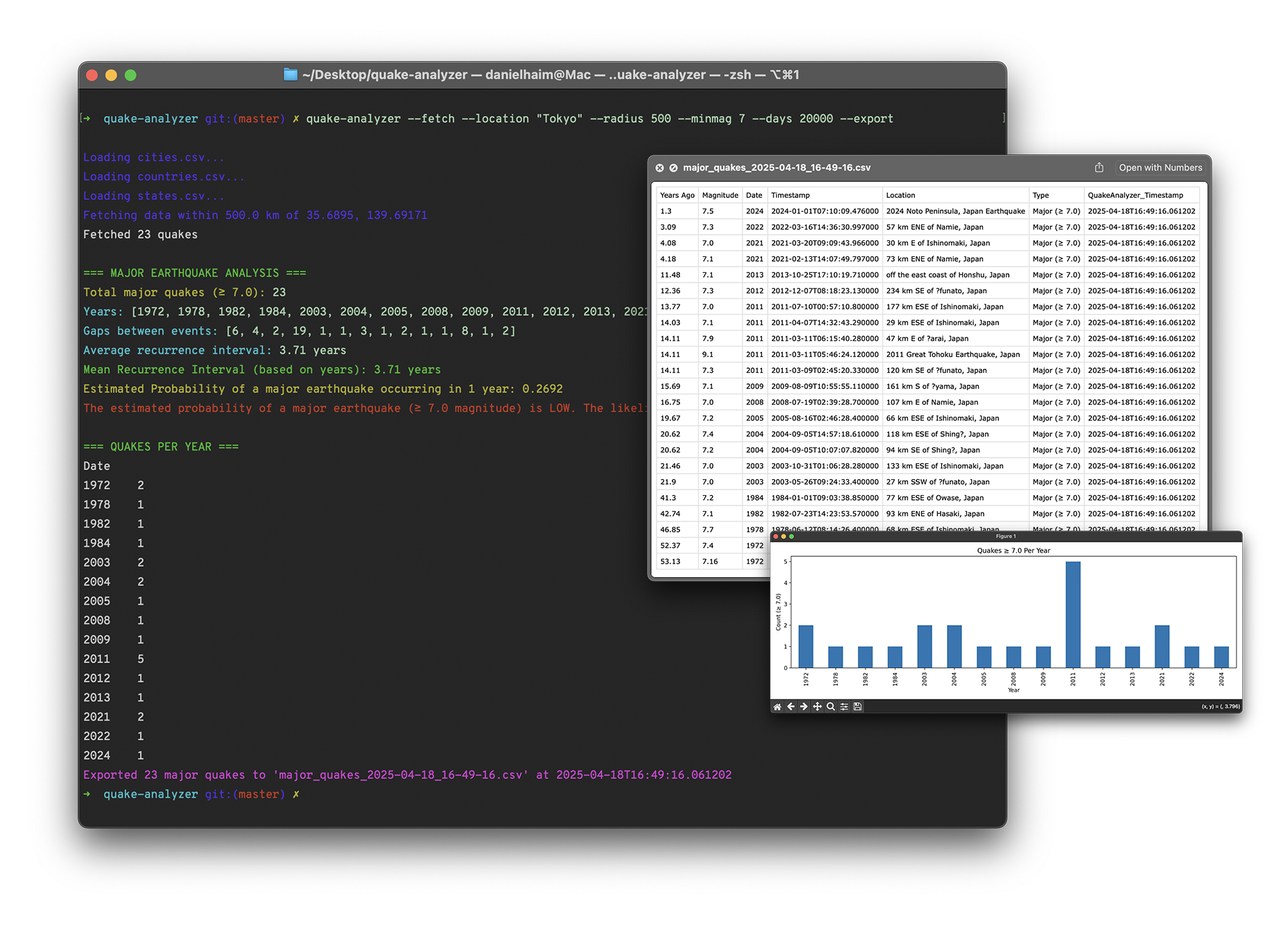
Features
- Fetch earthquake data from the USGS Earthquake API.
- Filter earthquakes based on magnitude and region.
- Analyze major earthquakes and their recurrence intervals.
- Export the list to CSV.
- Plot the count of major earthquakes per year.
- Estimate the recurrence interval and probability of future major earthquakes.
Installation
From source
git clone https://github.com/danielhaim1/quake-analyzer.git
cd quake-analyzer
python3 -m venv venv
source venv/bin/activate
pip install -e .
From PyPI
pip install quake-analyzer

# Run the CLI help command to verify:
quake-analyzer --help
# Loading cities.csv...
# Loading countries.csv...
# Loading states.csv...
Dependencies
This project relies on the following major Python libraries:
- pandas - for data manipulation and analysis.
- numpy - for numerical calculations and averaging intervals.
- requests - for fetching data from the USGS Earthquake API.
- colorama - for colorful terminal output.
- matplotlib - optional, used with the
--plotflag to visualize earthquake trends.
Options
| Option | Description | Default |
|---|---|---|
--data |
Manually pass quakes as [[timestamp, magnitude, location], ...] |
None |
--fetch |
Fetch recent earthquakes from USGS | None |
--minmag |
Minimum magnitude to filter | 6.0 |
--days |
Number of days to look back from today | 1825 (5 years) |
--start |
Start date for USGS query (format: YYYY-MM-DD) |
None |
--end |
End date for USGS query (format: YYYY-MM-DD or YYYY-MM-DDTHH:MM:SS) |
None |
--yesterday |
Automatically set --end to yesterday 23:59:59 UTC |
Off |
--location |
Location name to filter by (supports city, state, or country from CSVs) | None |
--lat |
Latitude for search center (used if --location is not set) |
None |
--lon |
Longitude for search center (used if --location is not set) |
None |
--radius |
Radius in kilometers around the specified location | None |
--estimate |
Estimate the recurrence interval and probability of major quakes (1, 2, 5, 10 years) | Off |
--export |
Export results to CSV | Off |
--plot |
Plot earthquakes per year | Off |
--verbose |
Print debug information | Off |
Examples
Global major quakes in past 20 years
quake-analyzer --fetch --minmag 6.0 --days 7300
Estimate Next Quake
quake-analyzer --fetch --minmag 6.0 --days 7300 --estimate
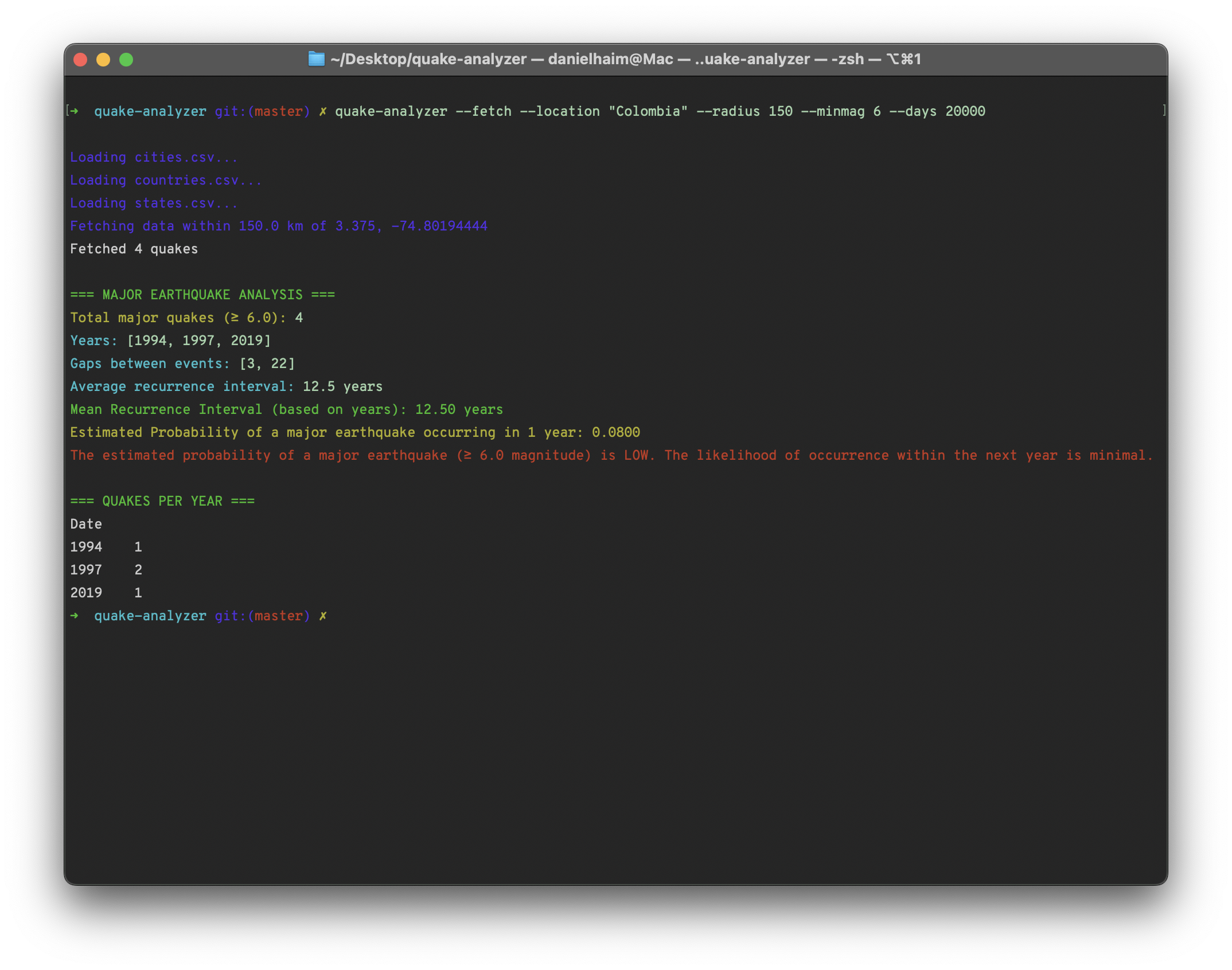
Estimate Analysis (Colombia)
quake-analyzer --fetch --minmag 9.5 --location "Colombia" --radius 1000 --days 10000
quake-analyzer --fetch --minmag 8.5 --location "Colombia" --radius 1000 --days 10000
quake-analyzer --fetch --minmag 7.5 --location "Colombia" --radius 1000 --days 10000
Location based filtering
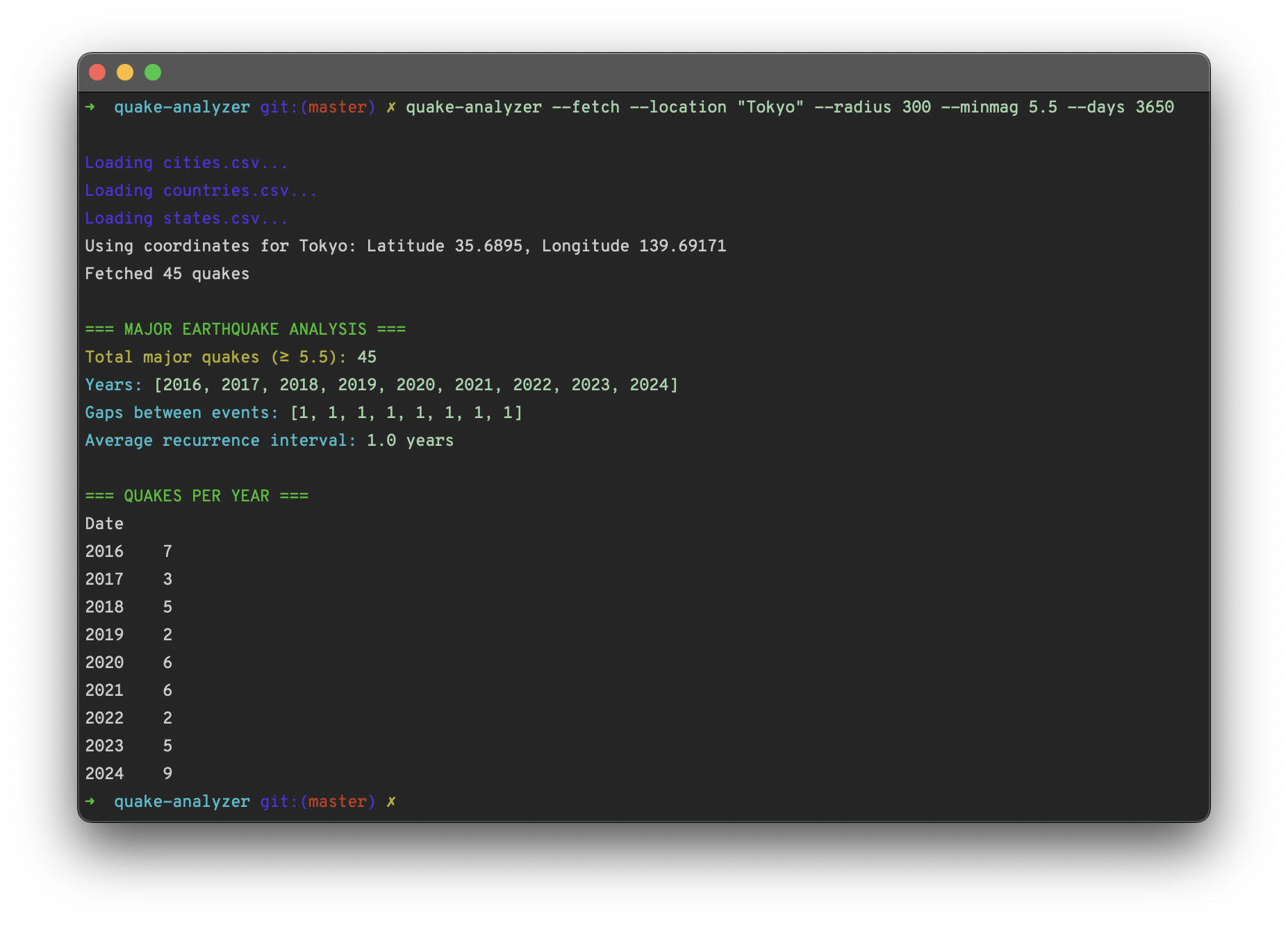
# Quakes near Tokyo (within 300 km)
quake-analyzer --fetch --location "Tokyo" --radius 300 --minmag 5.5 --days 3650

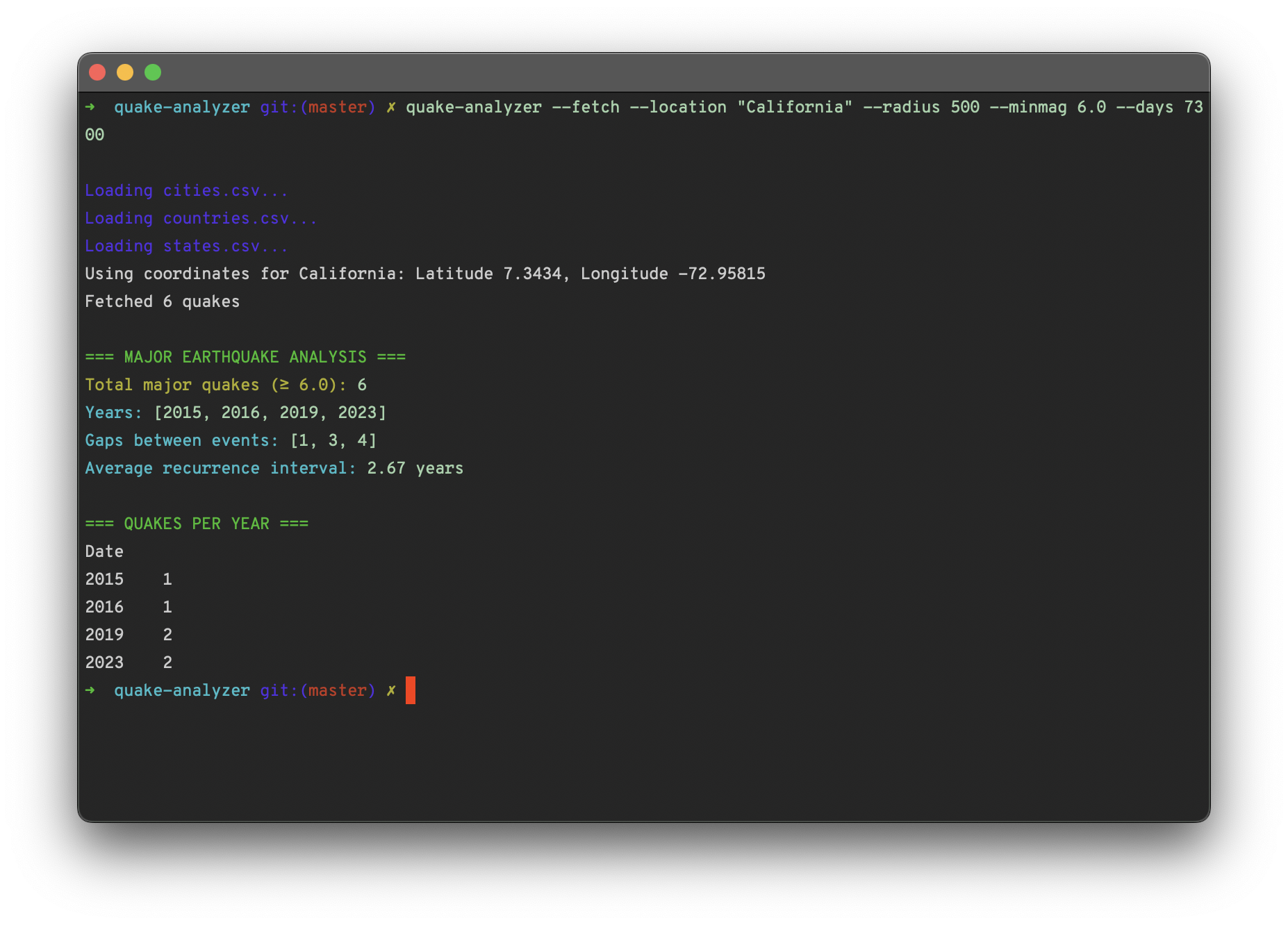
# California region, major quakes (last 20 years)
quake-analyzer --fetch --location "California" --radius 500 --minmag 6.0 --days 7300

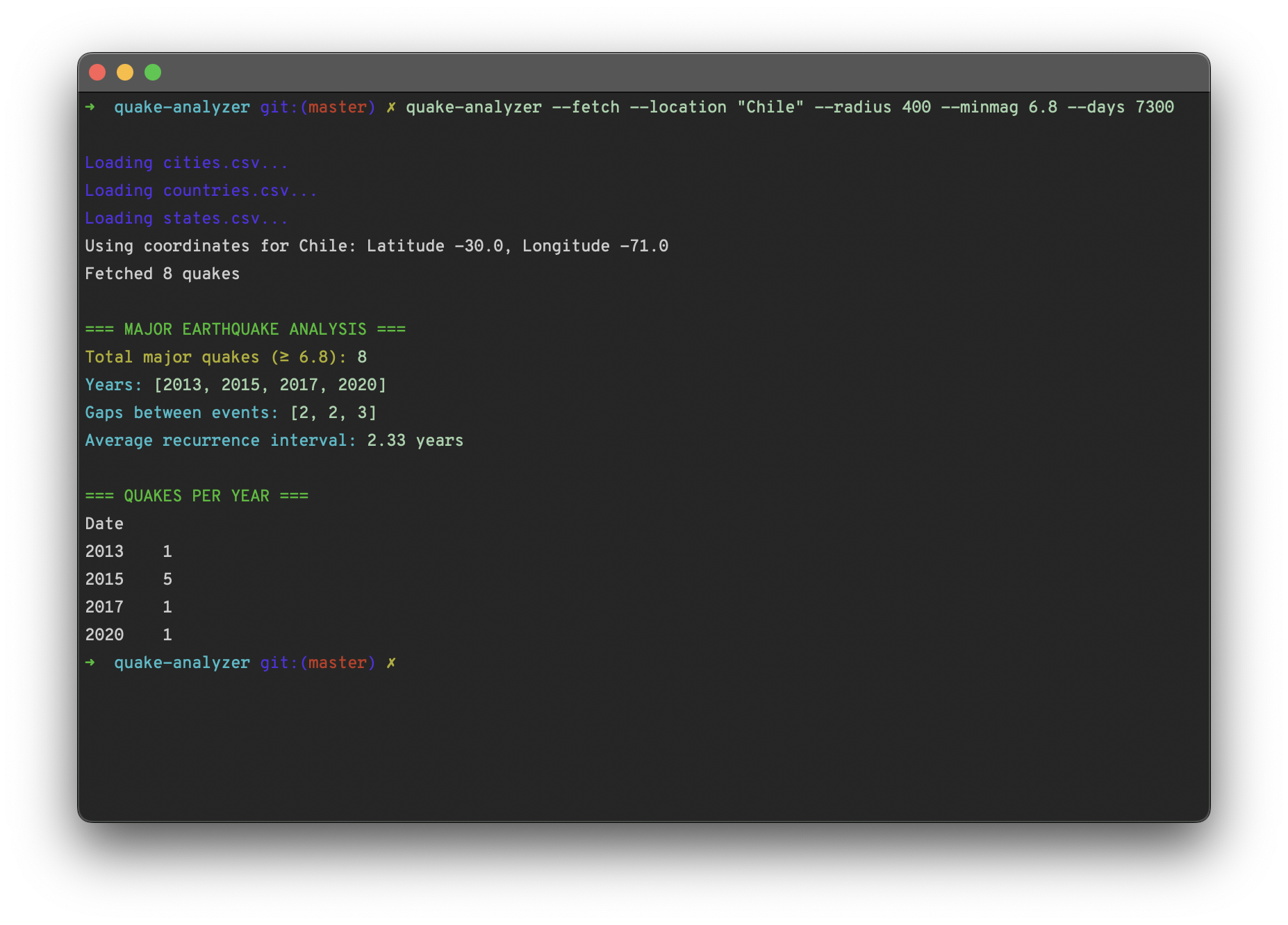
# Chile, strong events only
quake-analyzer --fetch --location "Chile" --radius 400 --minmag 6.8 --days 7300
Custom manual input
# Manually analyze a couple of events
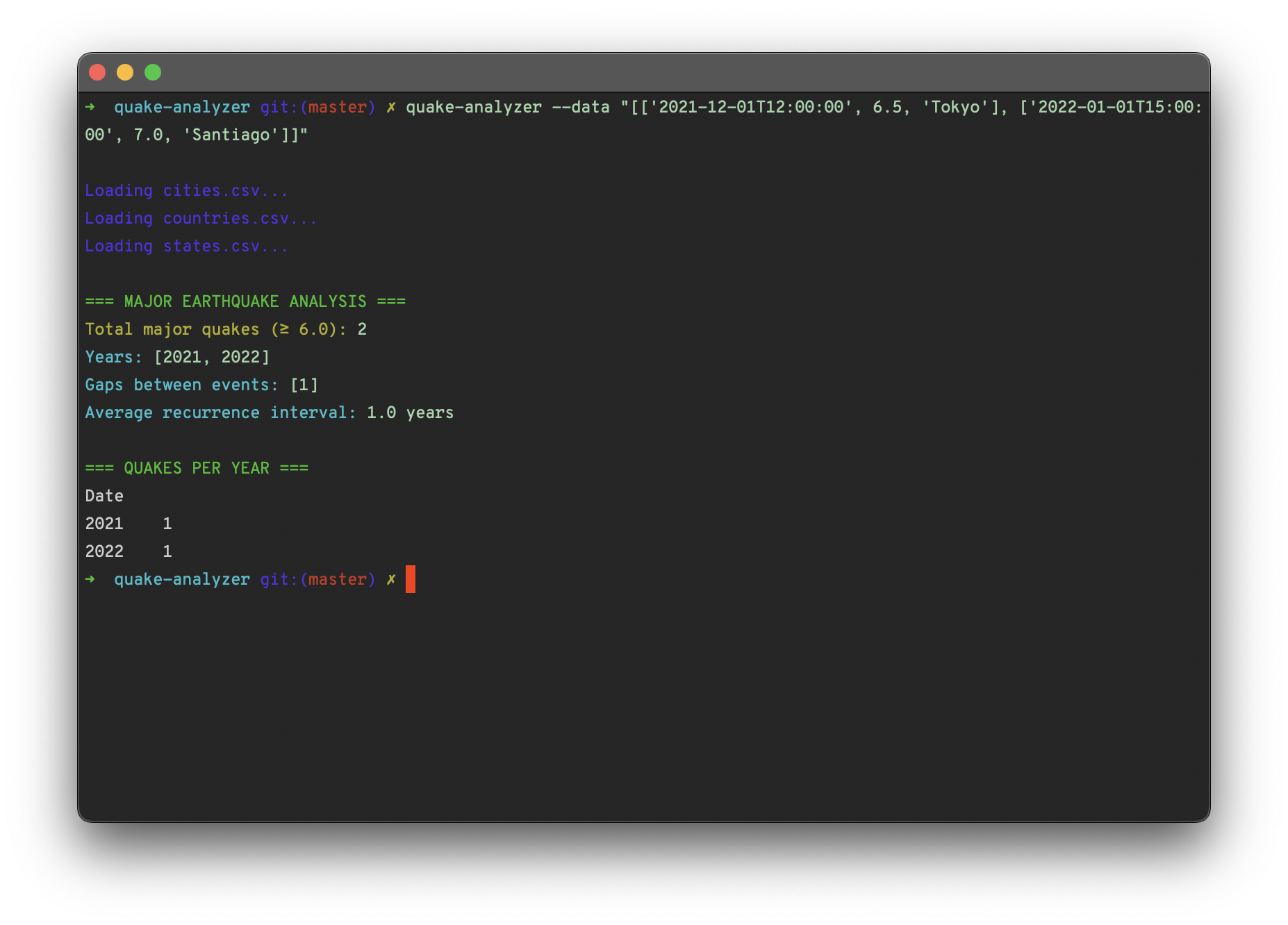
quake-analyzer --data "[['2021-12-01T12:00:00', 6.5, 'Tokyo'], ['2022-01-01T15:00:00', 7.0, 'Santiago']]"
Export and Plot
# Export filtered results to CSV
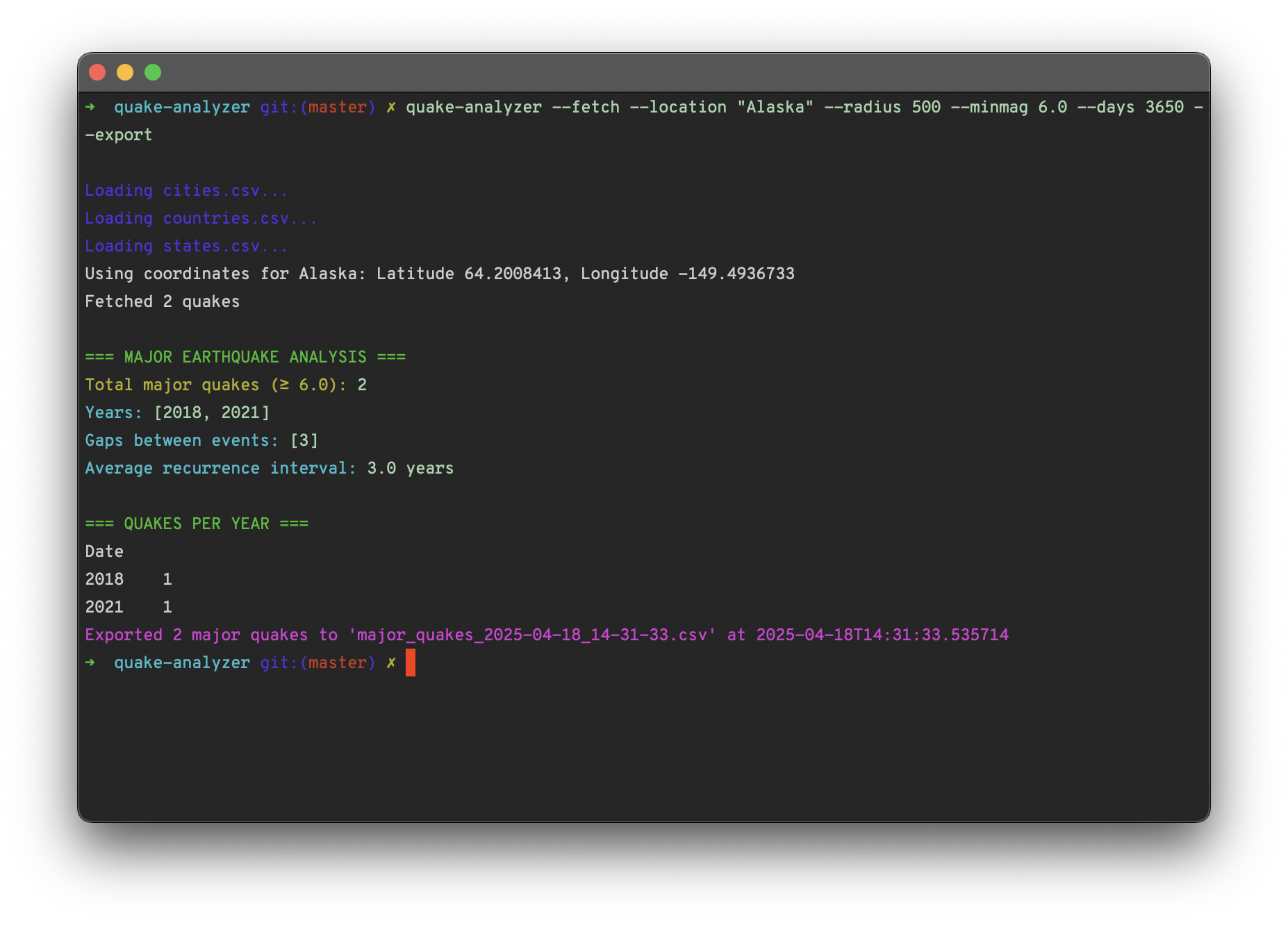
quake-analyzer --fetch --location "Alaska" --radius 500 --minmag 6.0 --days 3650 --export

# Plot quake frequency per year
quake-analyzer --fetch --location "Indonesia" --radius 500 --minmag 6.0 --days 7300 --plot

# Export and plot together
quake-analyzer --fetch --location "Mexico" --radius 300 --minmag 6.2 --days 5000 --export --plot
Location Resolution
You can pass --location using names of:
- Cities (e.g.,
Tokyo,San Francisco) - States (e.g.,
California,Bavaria) - Countries (e.g.,
Japan,Mexico)
Coordinates are looked up from:
src/data/
├── cities.csv
├── states.csv
├── countries.csv
Each file should include:
name,latitude,longitude
Estimate: How It Works
The estimation feature calculates two important metrics based on recent earthquake data:
- Recurrence Interval: The average time (in years) between major earthquakes (≥ 6.0 magnitude).
- Probability: The likelihood of a major earthquake occurring within the next year.
Calculation Process::
- Filter Major Quakes: Only earthquakes with a magnitude of 6.0 or higher are considered.
- Calculate Time Intervals: The tool calculates the time differences between each consecutive major earthquake.
- Compute Mean Recurrence Interval: The mean recurrence interval is the average of these time intervals.
- Estimate Probability: The probability of a major earthquake occurring within the next year is estimated as the inverse of the mean recurrence interval (1 / mean recurrence interval).
Example:
quake-analyzer --fetch --location "Tokyo" --radius 300 --minmag 9.5 --days 20000 --estimate
quake-analyzer --fetch --location "Tokyo" --radius 300 --minmag 8.5 --days 20000 --estimate
quake-analyzer --fetch --location "Tokyo" --radius 300 --minmag 7.5 --days 20000 --estimate
- Fetch earthquake data for Tokyo (within a 300 km radius).
- Filter by magnitude ≥ 6.0.
- Estimate the recurrence interval and probability based on the quakes in that region over the last 10 years (3650 days).
Outputs
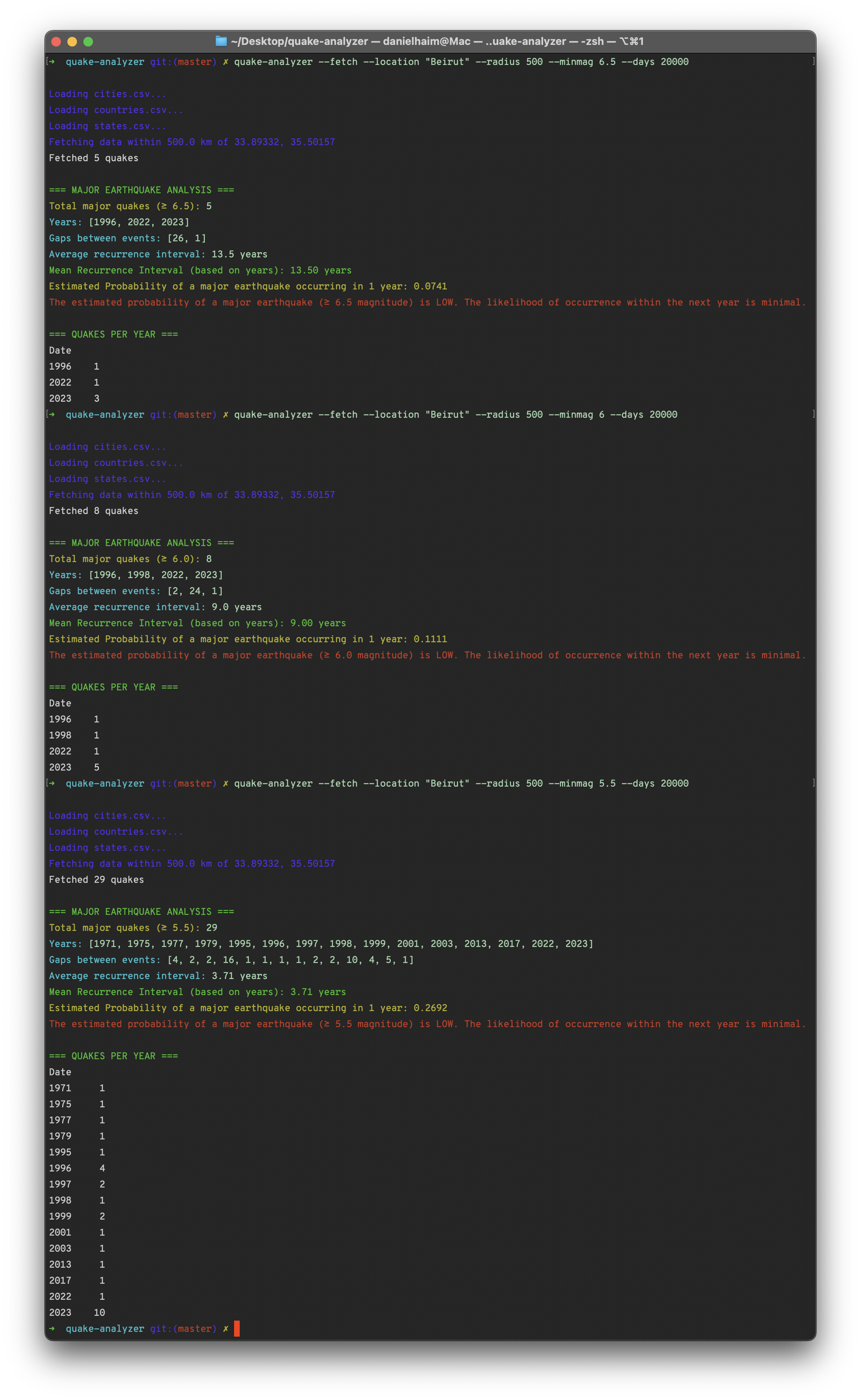
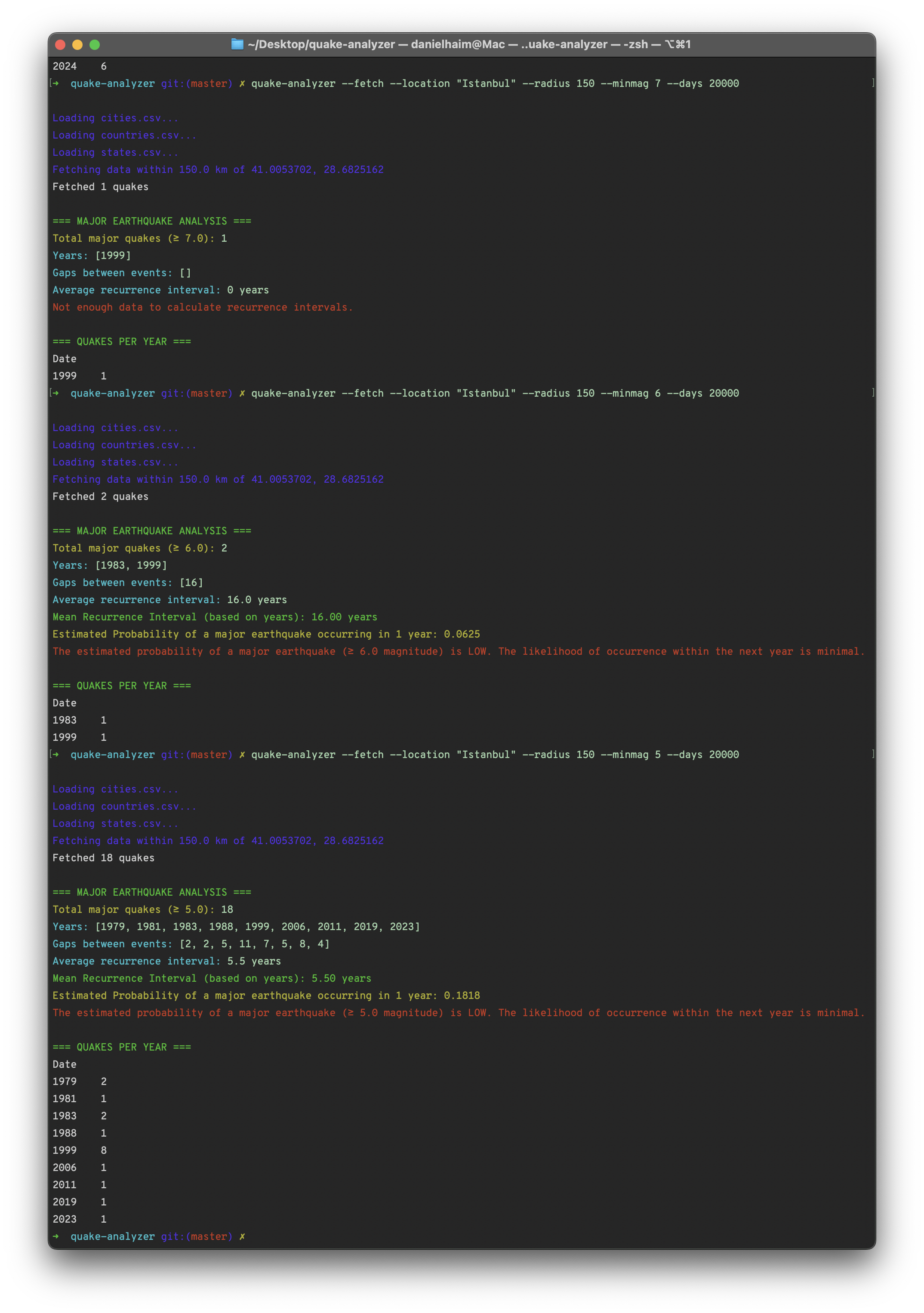
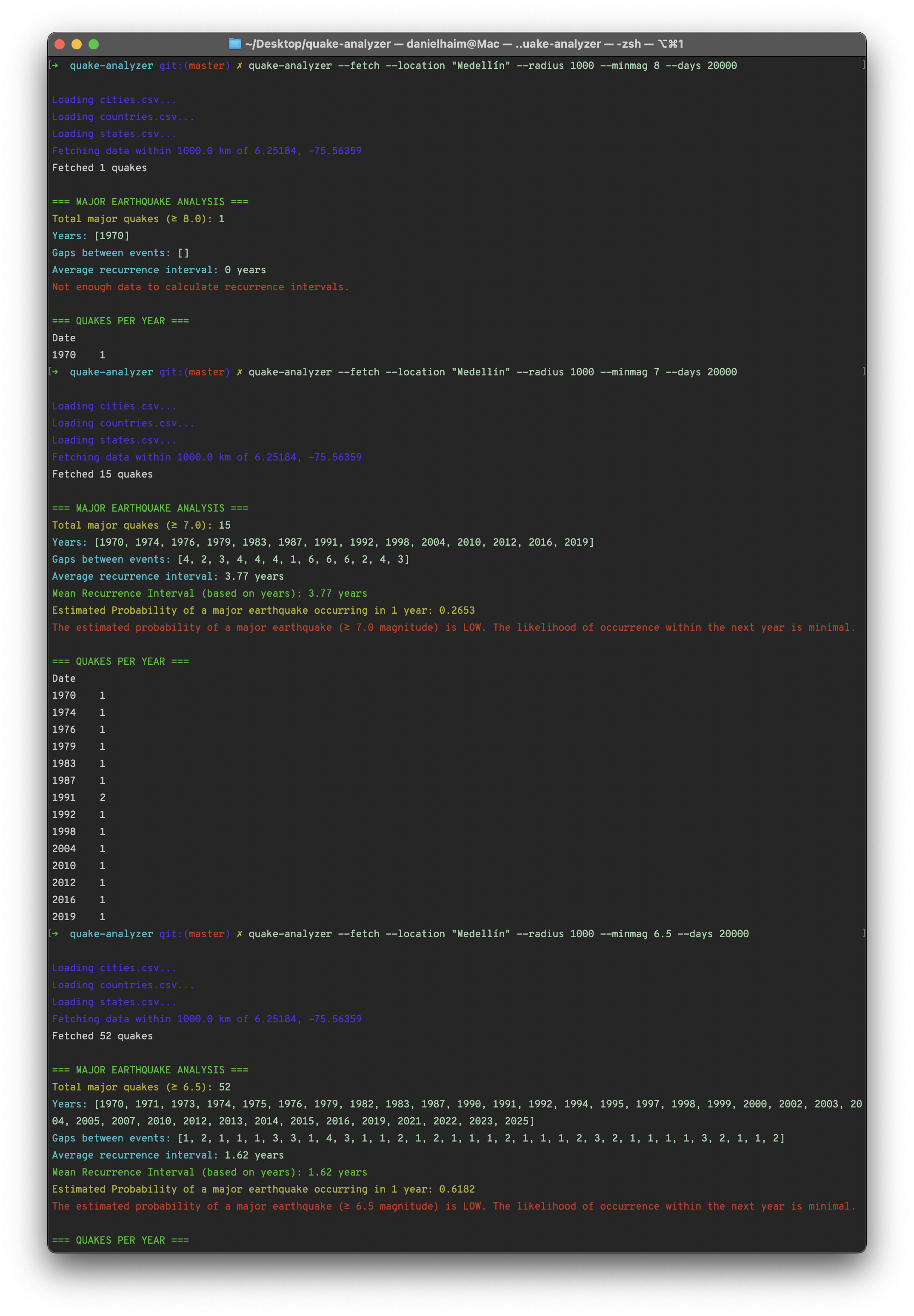
The tool will output earthquake data in the terminal, including:
-
The total number of major earthquakes.
-
The years in which earthquakes occurred.
-
Gaps between major earthquakes.
-
A summary of earthquakes per year.
-
Estimates of recurrence intervals and probabilities (if --estimate is used).
-
If
--exportis used, the results will be saved to a CSV file with the following columns: -
Years Ago
-
Magnitude
-
Date
-
Timestamp
-
Location
-
Type (Major or Moderate)
-
Mean Recurrence Interval (years)
-
Estimated Probability (per year)
Screenshots
Notes
- USGS limits results to 20 years and 2000 entries per request.
- For smaller magnitudes (e.g., 3.0+), results may be capped quickly, especially in active zones.
- Timestamp columns in exported CSVs include both quake time and export time.
- Plots require
matplotlib. Install via:
pip install matplotlib
License
This project is licensed under the MIT License. See the LICENSE file for details.
Contributing
Pull requests are welcome. For major changes, please open an issue first to discuss what you would like to change.
Reporting Bugs
If you encounter a bug or issue, please open an issue on the GitHub repository with as much detail as possible including:
- Command used
- Stack trace or error message
- Your OS and Python version
1 maintainer

Metadata
1 maintainer
Release files for quake-analyzer 0.1.4
For a detailed explanation of source distributions (sdists) and built distributions (wheels), please see the package formats documentation.
Source distribution (sdist)
| File | Size | Uploaded | |
|---|---|---|---|
| quake_analyzer-0.1.4.tar.gz | 11.6 MB | Details |
Built distribution (wheel)
| File | Interpreter | ABI | Platform | Reset |
|---|---|---|---|---|
| quake_analyzer-0.1.4-py3-none-any.whl | Python 3 | none | any | Details |
Total release size: 11.6 MB
Release files / quake_analyzer-0.1.4.tar.gz
| Download URL | quake_analyzer-0.1.4.tar.gz |
|---|---|
| Size | 11.6 MB |
| Tags | Source |
|
SHA-256 checksum How to use checksums |
a5e13bc6ae25f489349276147b71a1e7e357c949696611c33e75d1a33beede44
|
|
BLAKE2b-256 checksum How to use checksums |
0d2028ec40104dfc027e7423e711a70506f3e5cb67d14519fb5739ef157b7b5f
|
| Upload date | |
|
Uploaded using Trusted Publishing? What is trusted publishing? |
Yes |
| Uploaded via |
twine/6.1.0 CPython/3.12.9
|
Provenance
Provenance describes where a file came from. On PyPI, provenance is shared via attestations, which provide a verifiable record of the build or publishing details. View details, limitations and caveats.


PyPI Publish Attestation
PyPI verified that this artifact, at this checksum, originated from the publisher listed below.
Signed by GitHub Actions, verified by PyPI on Apr 24, 2025.
Transparency logRelease files / quake_analyzer-0.1.4-py3-none-any.whl
| Download URL | quake_analyzer-0.1.4-py3-none-any.whl |
|---|---|
| Size | 10.0 kB |
| Tags | Python 3 |
|
SHA-256 checksum How to use checksums |
a9a149811353cfe007408e7770f8bbad2e2853f790bc05e63a5873fca2a59ee0
|
|
BLAKE2b-256 checksum How to use checksums |
b60c1e38acbad5c82132ca2e690718821f190cfa9f03f98d28a8f0b38c439329
|
| Upload date | |
|
Uploaded using Trusted Publishing? What is trusted publishing? |
Yes |
| Uploaded via |
twine/6.1.0 CPython/3.12.9
|
Provenance
Provenance describes where a file came from. On PyPI, provenance is shared via attestations, which provide a verifiable record of the build or publishing details. View details, limitations and caveats.
PyPI Publish Attestation
PyPI verified that this artifact, at this checksum, originated from the publisher listed below.
Signed by GitHub Actions, verified by PyPI on Apr 24, 2025.
Transparency log













