
QuantaLogic ReAct Agents

Project description
QuantaLogic



QuantaLogic is a ReAct (Reasoning & Action) framework for building advanced AI agents.
It seamlessly integrates large language models (LLMs) with a robust tool system, enabling agents to understand, reason about, and execute complex tasks through natural language interaction.
The cli version include coding capabilities comparable to Aider.
Why QuantaLogic?
We created QuantaLogic because we saw a significant gap between the advanced AI models developed by companies like OpenAI, Anthropic, DeepSeek and their practical implementation in everyday business processes.
Our mission is to bridge this gap, making the power of generative AI accessible and actionable for businesses of all sizes.
🌟 Highlights
- ReAct Framework: Advanced implementation combining LLM reasoning with concrete actions
- Universal LLM Support: Integration with OpenAI, Anthropic, LM Studio, Bedrock, Ollama, DeepSeek V3, via LiteLLM
- Secure Tool System: Docker-based code execution and file manipulation tools
- Real-time Monitoring: Web interface with SSE-based event visualization
- Memory Management: Intelligent context handling and optimization
- Enterprise Ready: Comprehensive logging, error handling, and validation system
📋 Table of Contents
- Installation
- Quick Start
- Key Components
- Agent System
- Tool System
- Web Interface
- Examples
- Development
- Contributing
- License
📦 Installation
Prerequisites
- Python 3.12+
- Docker (optional for code execution tools)
Via pip
# Basic installation
pip install quantalogic
From Source
git clone https://github.com/quantalogic/quantalogic.git
cd quantalogic
python -m venv .venv
source ./venv/bin/activate
poetry install
Using pipx
pipx install quantalogic
🚀 Quickstart
Basic Usage
📖 CLI Reference
The QuantaLogic CLI provides powerful command-line capabilities:
Usage: quantalogic [OPTIONS] COMMAND [ARGS]...

  QuantaLogic AI Assistant - A powerful AI tool for various tasks.

Options:
  --version                       Show version information.
  --model-name TEXT               Specify the text model to use (litellm format,
                                  e.g. "openrouter/deepseek-chat").
  --vision-model-name TEXT        Specify the vision model to use (litellm format,
                                  e.g. "openrouter/A/gpt-4o-mini").
  --log [info|debug|warning]      Set logging level (info/debug/warning).
  --verbose                       Enable verbose output.
  --mode [code|basic|interpreter|full|code-basic]
                                  Agent mode (code/search/full).
  --help                          Show this message and exit.

Commands:
  task  Execute a task with the QuantaLogic AI Assistant.
Commands
task Execute a task with the QuantaLogic AI Assistant
Detailed Usage
Agent Modes
- code: Coding-focused agent with basic capabilities
- basic: General-purpose agent without coding tools
- interpreter: Interactive code execution agent
- full: Full-featured agent with all capabilities
- code-basic: Coding agent with basic reasoning
Task Execution
Tasks can be provided:
- Directly via
taskparameter - Through a file using --file parameter
- Interactively via standard input
Examples
Using a task file:
quantalogic task --file tasks/example.md --verbose
Selecting agent mode:
quantalogic --mode interpreter task "Explain quantum computing"
Interactive mode:
quantalogic
Using QuantaLogic With code
from quantalogic import Agent

# Initialize agent with default configuration
agent = Agent(model_name="deepseek/deepseek-chat")

# Execute a task
result = agent.solve_task(
    "Create a Python function that calculates the Fibonacci sequence"
)
print(result)
Environment Configuration Example
import os

from quantalogic import Agent

# Verify that DEEPSEEK_API_KEY is set
if not os.environ.get("DEEPSEEK_API_KEY"):
    raise ValueError("DEEPSEEK_API_KEY environment variable is not set")

# Initialize the AI agent with default configuration
agent = Agent(model_name="deepseek/deepseek-chat")

# Execute a sample task
result = agent.solve_task("Create a Python function that calculates the Fibonacci sequence")
print(result)
📖 Examples
Here are some practical examples to help you get started:
Here is the markdown table based on the provided directory listing:
| Example | Description | File |
|---|---|---|
| Simple Agent | A basic example of an agent implementation. | examples/01-simple-agent.py |
| Agent with Event Monitoring | An example of an agent with event monitoring capabilities. | examples/02-agent-with-event-monitoring.py |
| Agent with Interpreter | An example of an agent that includes an interpreter. | examples/03-agent-with-interpreter.py |
| Agent Summary Task | An example of an agent performing a summary task. | examples/04-agent-summary-task.py |
| Code Example | A general code example. | examples/05-code.py |
🔨 Key Components
Agent System
The core agent implements the ReActparadigm, combining:
- Language model reasoning
- Tool execution capabilities
- Memory management
- Event handling
- Task validation
from quantalogic import Agent
from quantalogic.tools import PythonTool, ReadFileTool

# Create agent with specific tools
agent = Agent(
    model_name="openrouter/deepseek-chat",
    tools=[
        PythonTool(),
        ReadFileTool()
    ]
)
How it works
The ReAct (Reasoning & Action) framework represents a significant advancement in the development of intelligent agents capable of autonomously reasoning through tasks and taking appropriate actions.
QuantaLogic implements this framework, allowing integration with large language models (LLMs) to construct sophisticated agents that can tackle complex problems through natural language interaction.
What is a ReAct Agent?
Basic Concept
A ReAct agent utilizes the synergy of reasoning and action. It not only processes natural language inputs but also executes actions in response to these inputs, utilizing various available tools. This functionality is particularly beneficial for environments where complex tasks can be decomposed into manageable subtasks.
The QuantaLogic Implementation
QuantaLogic provides an effective implementation of the ReAct framework with several core components:
- Generative Model: This serves as the agent's brain, enabling it to interpret tasks and generate human-like text responses.
- Memory Management: This capability allows the agent to maintain context, keeping track of previous inputs and interactions to provide coherent responses.
- Tool Management: The agent has access to a diverse range of tools, enabling it to perform actions such as code execution, file manipulation, and API communication.
How the ReAct Framework Works
Workflow of a ReAct Agent
The following state diagram shows the core workflow of a QuantaLogic agent:
stateDiagram-v2
    [*] --> InitializeAgent
    InitializeAgent --> Idle: Agent Initialized

    state Idle {
        [*] --> WaitForTask
        WaitForTask --> SolveTask: Task Received
    }

    state SolveTask {
        [*] --> ResetSession
        ResetSession --> AddSystemPrompt
        AddSystemPrompt --> PreparePrompt
        PreparePrompt --> EmitTaskStartEvent
        EmitTaskStartEvent --> UpdateTokens
        UpdateTokens --> CompactMemoryIfNeeded
        CompactMemoryIfNeeded --> GenerateResponse
        GenerateResponse --> ObserveResponse
        ObserveResponse --> CheckToolExecution
        CheckToolExecution --> TaskComplete: Tool Executed (task_complete)
        CheckToolExecution --> UpdatePrompt: Tool Not Executed
        UpdatePrompt --> UpdateTokens
        TaskComplete --> EmitTaskCompleteEvent
        EmitTaskCompleteEvent --> [*]
    }

    state CompactMemoryIfNeeded {
        [*] --> CheckMemoryOccupancy
        CheckMemoryOccupancy --> CompactMemory: Memory Occupancy > MAX_OCCUPANCY
        CheckMemoryOccupancy --> [*]: Memory Occupancy <= MAX_OCCUPANCY
        CompactMemory --> [*]
    }

    state ObserveResponse {
        [*] --> ProcessResponse
        ProcessResponse --> ExecuteTool: Tool Identified
        ProcessResponse --> UpdateAnswer: No Tool Identified
        ExecuteTool --> UpdateAnswer
        UpdateAnswer --> [*]
    }


    Idle --> [*]: Task Completed
    SolveTask --> Idle: Task Completed
The following sequence diagram illustrates the workflow of a ReAct agent as it processes and solves a task:
sequenceDiagram
    participant User
    participant Agent
    participant ToolManager
    participant Memory

    User->>Agent: Submit task
    Agent->>Memory: Store task details
    Agent->>ToolManager: Retrieve tools
    ToolManager-->>Agent: Provide available tools
    Agent->>Agent: Prepare prompt for task
    Agent->>Agent: Analyze input and generate response
    Agent->>ToolManager: Execute required tool
    ToolManager-->>Agent: Return tool execution result
    Agent->>User: Present final result
Key Components Explained
- User Input: The agent begins by receiving a task or question from the user, which initiates the interaction.
- Memory Management: Before tackling the task, the agent logs relevant task details into its memory, ensuring it has the necessary context for processing.
- Tool Retrieval: The agent communicates with the ToolManager to inquire about available tools that can facilitate the required actions.
- Prompt Generation: The agent constructs a prompt that outlines the task specifics, available tools, and any other pertinent context information.
- Analysis and Response Generation: The agent uses its generative model to analyze the task input and formulate a response.
- Tool Execution: If certain tools are needed for the task, the agent instructs the ToolManager to execute those tools, fetching the results for processing.
- Output to User: Finally, the agent compiles and presents the results back to the user.
Tool System
The QuantaLogic framework incorporates a well-defined tool system that enhances the functionality of AI agents by enabling them to perform a variety of tasks efficiently. Each tool is designed to address specific needs that arise in the context of complex problem-solving and task execution:
-
Core Functionality: Tools such as AgentTool and LLMTool are fundamental to the agent's operation, allowing it to manage tasks and interact with large language models. The integration of these tools enables the agent to process natural language inputs and execute corresponding actions effectively. AgentTool enables the agent to delegate tasks to specialized agents, and LLMTool provides the agent to explore a specific area of a latent space using role play.
-
Code Execution: Tools like PythonTool, NodeJsTool, and ElixirTool are vital for executing code in different programming languages. This capability allows the agent to handle programming tasks directly, facilitating real-time coding assistance and code evaluation.
-
File Operations: The framework includes tools for file management, such as ReadFileTool, WriteFileTool, and ReplaceInFileTool. These tools are essential for enabling the agent to read from and write to files, as well as update file content dynamically. This functionality supports scenarios where agents need to manipulate data or configuration files as part of the task execution process.
-
Search Capabilities: Tools like RipgrepTool and SearchDefinitionNames enhance the agent's ability to search through codebases and identify relevant definitions. This is crucial when dealing with large volumes of code, allowing the agent to quickly locate information necessary for problem-solving.
-
Utility Functions: Additional tools such as DownloadHttpFileTool, ListDirectoryTool, and ExecuteBashCommandTool provide broader functionality that supports various tasks, from fetching external resources to executing system commands. These utilities expand the operational scope of agents, allowing them to perform diverse actions beyond simple text processing.
-
Documentation and Representation: Tools like MarkitdownTool facilitate the generation of documentation, ensuring that output from the agent can be formatted and presented clearly. This is particularly beneficial for creating reports or guides based on the agent's findings and actions.
By integrating these tools into its architecture, QuantaLogic allows agents to perform a wide range of tasks autonomously while ensuring that they have the necessary resources and capabilities to do so effectively. This tool system is fundamental to the agent's ability to reason and act in sophisticated ways, thereby enhancing the overall utility of the framework in complex scenarios.
Tools Documentation
Overview of Tools
| Category | Tools |
|---|---|
| Task Automation | Agent Tool, Task Complete Tool, Input Question Tool, Execute Bash Command Tool |
| Script Execution | Python Tool, Node.js Tool, Elixir Tool |
| File Operations | Read File Tool, Write File Tool, Edit Whole Content Tool, Replace In File Tool |
| Code Analysis | Search Definition Names Tool, Ripgrep Tool |
| Content Generation | LLM Tool, LLMVisionTool |
| Utility and Management | Download HTTP File Tool, List Directory Tool, Markitdown Tool, Unified Diff Tool |
1. Agent Tool
The Agent Tool enables task delegation to another agent, providing specialized functionality for handling tasks.
Parameters
| Parameter | Type | Description | Example |
|---|---|---|---|
agent_role |
string | The role of the agent (e.g., expert, assistant) | expert |
agent |
Any | The agent to delegate tasks to | Agent object |
task |
string | The task to delegate to the specified agent. | Summarize the latest news. |
Example Usage
agent_tool = AgentTool(agent_role="expert", agent=some_agent)
result = agent_tool.execute(task="Summarize the latest news.")
print(result)
2. Task Complete Tool
The Task Complete Tool is used to respond to users after a task has been completed.
Parameters
| Parameter | Type | Description | Example |
|---|---|---|---|
answer |
string | The answer to the user. | "The answer to the meaning of life" |
Example Usage
task_tool = TaskCompleteTool()
response = task_tool.execute(answer="The answer is 42.")
print(response)
3. Input Question Tool
The Input Question Tool prompts the user with a question and captures their input.
Parameters
| Parameter | Type | Description | Example |
|---|---|---|---|
question |
string | The question to ask the user. | What is your favorite color? |
default |
string | Optional default value if no input is provided. | blue |
Example Usage
input_tool = InputQuestionTool()
user_response = input_tool.execute(question="What is your favorite color?", default="blue")
print("User Response:", user_response)
4. Execute Bash Command Tool
The Execute Bash Command Tool allows for the execution of bash commands and captures their output.
Parameters
| Parameter | Type | Description | Example |
|---|---|---|---|
command |
string | The bash command to execute. | ls -la |
working_dir |
string | The working directory where the command will be executed. | /path/to/directory |
timeout |
int | Maximum time in seconds to wait for the command to complete. | 60 |
Example Usage
bash_tool = ExecuteBashCommandTool()
output = bash_tool.execute(command="ls -la")
print(output)
5. Python Tool
The Python Tool executes Python scripts in an isolated Docker environment.
Parameters
| Parameter | Type | Description | Example |
|---|---|---|---|
install_commands |
string | Commands to install Python packages before running the script. | pip install rich requests |
script |
string | The Python script to execute. | print("Hello, World!") |
version |
string | The Python version to use in the Docker container. | 3.11 |
host_dir |
string | The absolute path on the host machine to mount for file access. | ./demo01/ |
memory_limit |
string | Optional memory limit for the Docker container. | 1g |
environment_vars |
string | Environment variables to set inside the Docker container. | ENV=production DEBUG=False |
Example Usage
python_tool = PythonTool()
output = python_tool.execute(
    install_commands="pip install rich requests",
    script='print("Hello, World!")',
    version="3.12",
    host_dir="./demo01/",
)
print("Script Output:", output)
6. Node.js Tool
The Node.js Tool executes Node.js scripts in an isolated Docker environment.
Parameters
| Parameter | Type | Description | Example |
|---|---|---|---|
install_commands |
string | Commands to install Node.js packages before running the script. | npm install chalk |
script |
string | The Node.js script to execute. | console.log('Hello, World!'); |
version |
string | The Node.js version to use in the Docker container. | 20 |
host_dir |
string | The absolute path on the host machine to mount for file access. | ./project/ |
memory_limit |
string | Optional memory limit for the Docker container. | 1g |
module_type |
string | The module system to use: 'esm' for ECMAScript Modules or 'commonjs' for CommonJS. | esm |
Example Usage
node_tool = NodeJsTool()
output = node_tool.execute(
    install_commands="npm install chalk",
    script='console.log("Hello, Node.js World!");',
    version="20",
    host_dir="./project/"
)
print("Node.js Output:", output)
7. Elixir Tool
The Elixir Tool executes Elixir code in an isolated Docker environment with Mix support.
Parameters
| Parameter | Type | Description | Example |
|---|---|---|---|
mix_commands |
string | Mix commands to run before executing the script. | mix deps.get && mix compile |
script |
string | Elixir code to execute. | IO.puts("Hello from Elixir!") |
version |
string | The Elixir version to use. | 1.15 |
host_dir |
string | Host directory to mount. | ./elixir_project/ |
memory_limit |
string | Container memory limit. | 512m |
environment_vars |
string | Environment variables to set. | MIX_ENV=prod |
Example Usage
elixir_tool = ElixirTool()
output = elixir_tool.execute(script='IO.puts("Hello from Elixir!")')
print("Elixir Output:", output)
8. Read File Tool
The Read File Tool reads content from a specified file.
Parameters
| Parameter | Type | Description | Example |
|---|---|---|---|
file_path |
string | The path of the file to read. | /path/to/file.txt |
Example Usage
read_tool = ReadFileTool()
content = read_tool.execute(file_path="/path/to/file.txt")
print("File Content:", content)
9. Write File Tool
The Write File Tool writes content to a specified file.
Parameters
| Parameter | Type | Description | Example |
|---|---|---|---|
file_path |
string | The path of the file to write to. | /path/to/file.txt |
content |
string | The content to write. | Hello, World! |
Example Usage
write_tool = WriteFileTool()
result = write_tool.execute(file_path="/path/to/file.txt", content="Hello, World!")
print(result)
10. Edit Whole Content Tool
The Edit Whole Content Tool replaces the entire content of a specified file.
Parameters
| Parameter | Type | Description | Example |
|---|---|---|---|
file_path |
string | The path to the file to edit. | /path/to/file.txt |
content |
string | The new content to write to the file. | New Content Here! |
Example Usage
edit_tool = EditWholeContentTool()
result = edit_tool.execute(file_path="/path/to/file.txt", content="New Content Here!")
print(result)
11. Replace In File Tool
The Replace In File Tool replaces specific content in a file with new content.
Parameters
| Parameter | Type | Description | Example |
|---|---|---|---|
file_path |
string | The path of the file to edit. | /path/to/file.txt |
search |
string | The string to search for in the file. | Old Content |
replace |
string | The string to replace the searched content. | New Content |
Example Usage
replace_tool = ReplaceInFileTool()
result = replace_tool.execute(file_path="/path/to/file.txt", search="Old Content", replace="New Content")
print(result)
12. Search Definition Names Tool
The Search Definition Names Tool searches for definition names in a directory using Tree-sitter.
Parameters
| Parameter | Type | Description | Example |
|---|---|---|---|
directory_path |
string | The path to the directory to search in. | ./path/to |
language_name |
string | The Tree-sitter language name (python, js, etc.). | python |
file_pattern |
string | Optional glob pattern to filter files (default: '*'). | **/*.py |
Example Usage
search_tool = SearchDefinitionNames()
results = search_tool.execute(directory_path="./my_project", language_name="python", file_pattern="**/*.py")
print("Found Definitions:", results)
13. Ripgrep Tool
The Ripgrep Tool searches for text blocks in files using ripgrep.
Parameters
| Parameter | Type | Description | Example |
|---|---|---|---|
cwd |
string | Base path for relative searches | . |
directory_path |
string | The directory path to search in. | ./src |
regex_rust_syntax |
string | The regex pattern to search for (in Rust syntax). | r"\bfunction\b" |
file_pattern |
string | Optional glob pattern to filter files. | **/*.js |
context_lines |
string | Number of context lines to include before and after matches. | 2 |
Example Usage
ripgrep_tool = RipgrepTool()
output = ripgrep_tool.execute(
    directory_path="./my_project",
    regex_rust_syntax=r"\bfunction\b",
    context_lines="2"
)
print("Ripgrep Results:", output)
14. LLMVisionTool
The LLMVisionTool enables processing of visual inputs using vision-language models.
Parameters
| Parameter | Type | Description | Example |
|---|---|---|---|
image_path |
string | Path to the image file to process | ./path/to/image.png |
prompt |
string | The question or instruction for the vision model | Describe the contents of this image |
temperature |
float | Sampling temperature between 0.0 and 1.0 | 0.7 |
Example Usage
vision_tool = LLMVisionTool()
response = vision_tool.execute(
    image_path="./path/to/image.png",
    prompt="Describe the contents of this image",
    temperature=0.7
)
print("Vision Model Response:", response)
15. LLM Tool
The LLM Tool generates answers using a specified language model.
Parameters
| Parameter | Type | Description | Example |
|---|---|---|---|
system_prompt |
string | The persona or system prompt to guide the language model's behavior. | You are a helpful assistant. |
prompt |
string | The question to ask the language model. | What is the meaning of life? |
temperature |
string | Sampling temperature between 0.0 and 1.0. | 0.5 |
Example Usage
llm_tool = LLMTool(model_name="gpt-4")
response = llm_tool.execute(
    system_prompt="You are a knowledgeable assistant.",
    prompt="What is the meaning of life?",
    temperature="0.7"
)
print("LLM Response:", response)
16. Download HTTP File Tool
The Download HTTP File Tool downloads a file from a specified HTTP URL.
Parameters
| Parameter | Type | Description | Example |
|---|---|---|---|
url |
string | The URL of the file to download. | http://example.com/file.txt |
destination |
string | The path where the file should be saved. | /path/to/save/file.txt |
Example Usage
download_tool = DownloadHttpFileTool()
result = download_tool.execute(url="http://example.com/file.txt", destination="/path/to/save/file.txt")
print(result)
17. List Directory Tool
The List Directory Tool lists files in a specified directory.
Parameters
| Parameter | Type | Description | Example |
|---|---|---|---|
directory_path |
string | The path of the directory to list files from. | ./path/to/directory |
Example Usage
list_tool = ListDirectoryTool()
result = list_tool.execute(directory_path="./path/to/directory")
print("Directory Files:", result)
18. Markitdown Tool
The Markitdown Tool processes markdown files, possibly for conversion or rendering.
Parameters
| Parameter | Type | Description | Example |
|---|---|---|---|
markdown_path |
string | The path of the markdown file to process. | ./path/to/file.md |
Example Usage
markitdown_tool = MarkitdownTool()
result = markitdown_tool.execute(markdown_path="./path/to/file.md")
print("Processed Markdown Output:", result)
Creating Custom Tools
from quantalogic.tools import Tool, ToolArgument

class DatabaseTool(Tool):
    name: str = "database_tool"
    description: str = "Execute database operations"
    need_validation: bool = True

    arguments: list[ToolArgument] = [
        ToolArgument(
            name="query",
            arg_type="string",
            description="SQL query to execute",
            required=True
        )
    ]

    def execute(self, query: str) -> str:
        # Tool implementation
        return "Query results"
🌐 Web Interface
Features:
- Real-time event visualization
- Task submission and monitoring
- Interactive validation dialogs
- Model selection
- Event filtering and search
API Endpoints
| Endpoint | Method | Description |
|---|---|---|
/tasks |
POST | Submit tasks |
/tasks/{task_id} |
GET | Task status |
/events |
GET | SSE endpoint |
/validate |
POST | Task validation |
📖 Examples
Python Tool Integration Example
import os

from quantalogic import Agent, console_print_events
from quantalogic.tools import (
    PythonTool,
)

# Verify API key is set - required for authentication with DeepSeek's API
# This check ensures the agent won't fail during runtime due to missing credentials
if not os.environ.get("DEEPSEEK_API_KEY"):
    raise ValueError("DEEPSEEK_API_KEY environment variable is not set")

# Initialize agent with DeepSeek model and Python tool
agent = Agent(model_name="deepseek/deepseek-chat", tools=[PythonTool()])

# Configure comprehensive event monitoring system
# Tracks all agent activities including:
# - Code execution steps
# - Tool interactions
# - Error conditions
# Essential for debugging and performance optimization
agent.event_emitter.on(
    "*",
    console_print_events,
)

# Execute a precision mathematics task demonstrating:
# - High-precision calculations
# - PythonTool integration
# - Real-time monitoring capabilities
result = agent.solve_task("1. Calculate PI with 10000 decimal places.")
print(result)
Agent with Event Monitoring
import os

from quantalogic import Agent, console_print_events
from quantalogic.tools import (
    LLMTool,
)

# Verify API key is set - required for authentication with DeepSeek's API
# This check ensures the agent won't fail during runtime due to missing credentials
if not os.environ.get("DEEPSEEK_API_KEY"):
    raise ValueError("DEEPSEEK_API_KEY environment variable is not set")

# Initialize agent with DeepSeek model and LLM tool
# The LLM tool serves dual purpose:
# 1. As a reasoning engine for the agent's cognitive processes
# 2. As a latent space explorer, enabling the agent to:
#    - Discover novel solution paths
#    - Generate creative combinations of concepts
#    - Explore alternative reasoning strategies
# Using the same model ensures consistent behavior across both roles
agent = Agent(model_name="deepseek/deepseek-chat", tools=[LLMTool(model_name="deepseek/deepseek-chat")])

# Set up event monitoring to track agent's lifecycle
# This helps in debugging and understanding the agent's behavior
agent.event_emitter.on(
    [
        "task_complete",
        "task_think_start",
        "task_think_end",
        "tool_execution_start",
        "tool_execution_end",
        "error_max_iterations_reached",
        "memory_full",
        "memory_compacted",
        "memory_summary",
    ],
    console_print_events,
)

# Execute a multi-step task showcasing agent's capabilities
# Demonstrates:
# 1. Creative content generation
# 2. Language translation
# 3. Style adaptation
# 4. Multi-step reasoning and execution
result = agent.solve_task(
    "1. Write a poem in English about a dog. "
    "2. Translate the poem into French. "
    "3. Choose 2 French authors"
    "4. Rewrite the translated poem with the style of the chosen authors. "
)
print(result)
Project Documentation
from quantalogic import Agent
from quantalogic.tools import MarkitdownTool, ReadFileTool

agent = Agent(
    model_name="openrouter/deepseek-chat",
    tools=[MarkitdownTool(), ReadFileTool()]
)

result = agent.solve_task("""
Generate a comprehensive documentation for:

1. Navigate and Read https://api.nasa.gov/ documentation
2. Write an API reference for https://api.nasa.gov/
2. Examples how to use the API using curl
3. Examples how to use the API from Python
""")
🔧 Development
Setup Development Environment
# Clone repository
git clone https://github.com/quantalogic/quantalogic.git
cd quantalogic

# Create virtual environment
python -m venv venv
source venv/bin/activate  # Windows: venv\Scripts\activate

# Install dependencies
poetry install
Run Tests
# Run all tests
pytest

# With coverage
pytest --cov=quantalogic

# Run specific tests
pytest tests/unit
Code Quality
# Format code
ruff format

# Type checking
mypy quantalogic

# Linting
ruff check quantalogic
🤝 Contributing
- Fork the repository
- Create a feature branch
- Write tests
- Implement changes
- Submit pull request
See CONTRIBUTING.md for detailed guidelines.
📄 License
Copyright 2024 QuantaLogic Contributors
Licensed under the Apache License, Version 2.0. See LICENSE for details.
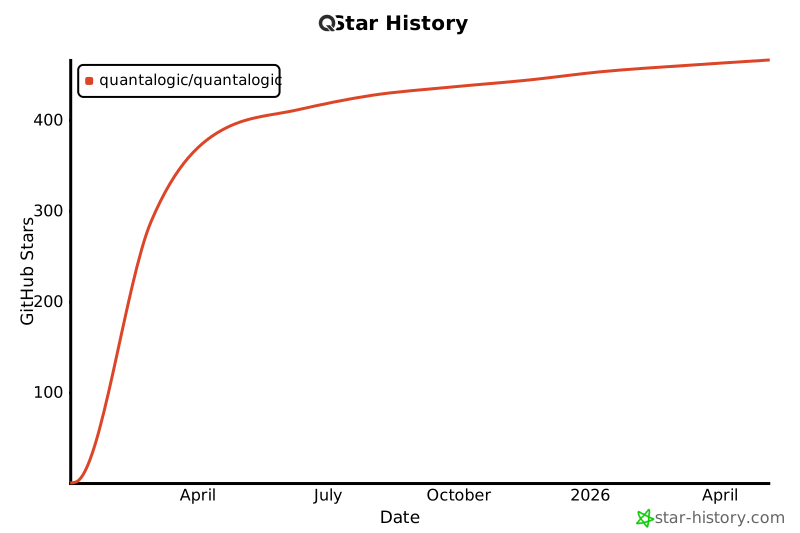
Project Growth
Initiated with ❤️ by Raphaël MANSUY. Founder of Quantalogic.
Release history Release notifications | RSS feed


Download files
Download the file for your platform. If you're not sure which to choose, learn more about installing packages.
Source Distribution
Built Distribution
Filter files by name, interpreter, ABI, and platform.
If you're not sure about the file name format, learn more about wheel file names.
Copy a direct link to the current filters
File details
Details for the file quantalogic-0.2.12.tar.gz.
File metadata
- Download URL: quantalogic-0.2.12.tar.gz
- Upload date:
- Size: 109.0 kB
- Tags: Source
- Uploaded using Trusted Publishing? No
- Uploaded via: poetry/1.8.4 CPython/3.12.7 Darwin/24.2.0
File hashes
| Algorithm | Hash digest | |
|---|---|---|
| SHA256 |
85a749473cfba505468cc69ad65c099622c3c63ccd4de240e97adc1ad8fa3a63
|
|
| MD5 |
d9cee05d0a3bbb8802443a8c2ffb4fac
|
|
| BLAKE2b-256 |
85bce4996027e0bc6168ec1bc2c3cd5b97661b39bdffaccf775bb0400c107e61
|
File details
Details for the file quantalogic-0.2.12-py3-none-any.whl.
File metadata
- Download URL: quantalogic-0.2.12-py3-none-any.whl
- Upload date:
- Size: 132.1 kB
- Tags: Python 3
- Uploaded using Trusted Publishing? No
- Uploaded via: poetry/1.8.4 CPython/3.12.7 Darwin/24.2.0
File hashes
| Algorithm | Hash digest | |
|---|---|---|
| SHA256 |
9a53829ce838799182a776407db1c1ce0ce68702d58fa0f43ac8f914c204f7a9
|
|
| MD5 |
ede58998af908527c200f5c6c2f33889
|
|
| BLAKE2b-256 |
8a4645829955408eb97e5ecc9db7e61a68ea8838010a71f249210afc9edd49fa
|






