
Quantified Self MCP









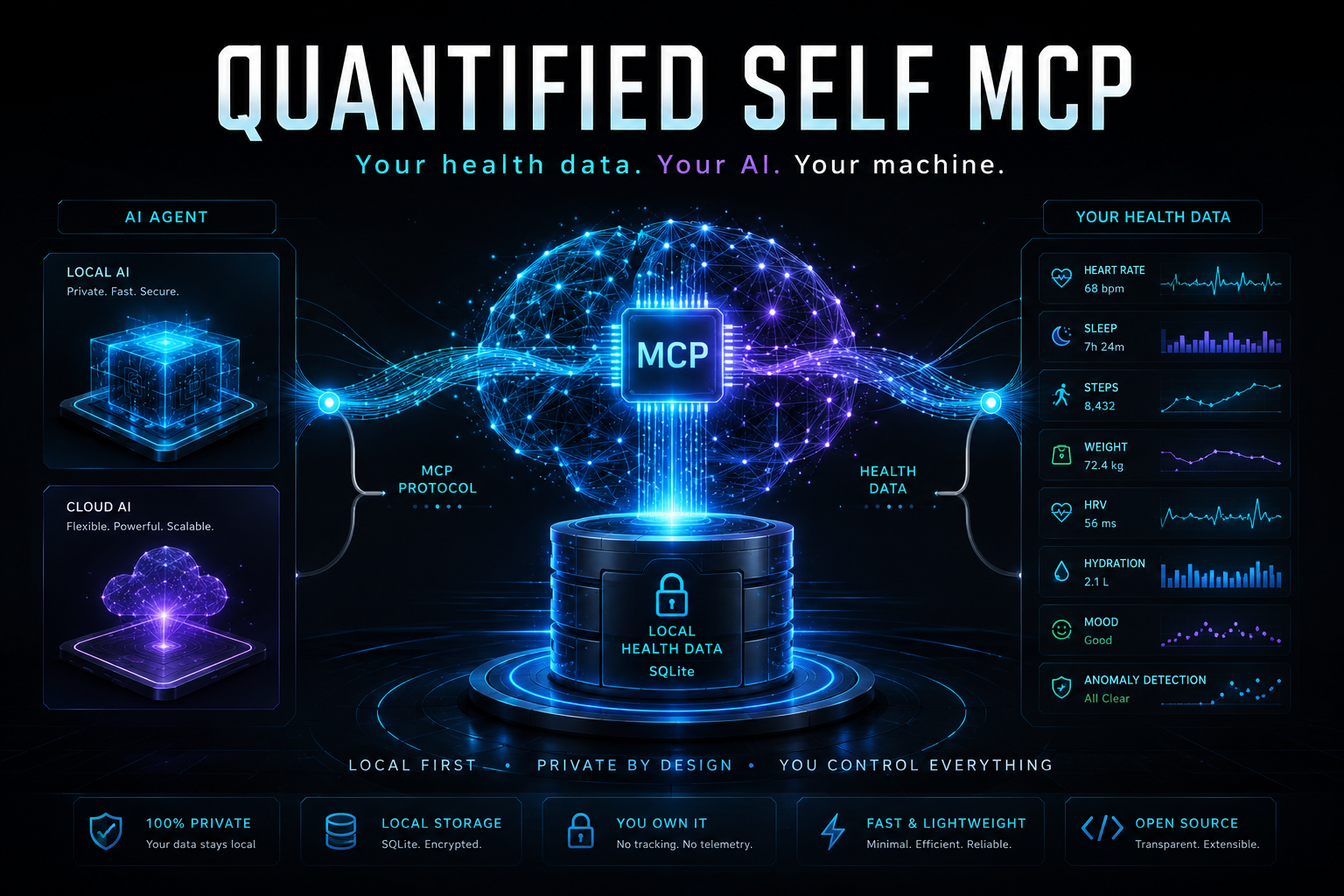
Your health data. Your AI. Your machine.
A local-first MCP server that gives AI agents access to your personal health data — with privacy, provenance, and evidence built in.
What is it?
Quantified Self MCP gives an AI agent a local, structured interface to your own health history.
Instead of another health dashboard, you can ask your AI questions like:
Why did my HRV change recently?

How has my sleep changed over the last 30 days?

What happened to my resting heart rate after my workouts increased?

What patterns do you see across my recent health data?

Which metrics changed the most this month?
The AI retrieves the relevant data through MCP and analyzes it.
The goal isn't another health dashboard.
It's a trustworthy interface between your health history and your AI.
Why is it different?
🔒 Local-first
Your health database runs locally in SQLite.
You control where your data goes.
You can use a completely local AI stack:
Health Data
     ↓
Local SQLite
     ↓
Quantified Self MCP
     ↓
MCP Agent
     ↓
Local LLM
Cloud models are also supported. In that configuration, the MCP database remains local, but data returned by MCP tools may be sent to the model provider.
🤖 AI-native
Built specifically for MCP-compatible AI agents, rather than another standalone health application.
🔎 Evidence & provenance
Analytics can be traced back to the underlying health data and its provenance.
The goal is not simply:
HRV ↓ 24%
but understanding:
What data produced this result?
Where did it come from?
What period was analyzed?
How strong is the evidence, and how strongly may it be claimed?
Concretely, every trend, baseline, anomaly, comparison, correlation, recent change, and explained metric carries a claim alongside its numbers — not just descriptive coverage, but an explicit, machine-checkable statement of how strongly the result may be reported:
Analysis result
    ↓
claim: ClaimEvidence
    ├── evidence   → what data was actually observed (coverage, gaps, freshness)
    ├── profile    → how much evaluative evidence exists, per dimension
    │                (sample, temporal, missingness, ...)
    └── decision   → what claim strength is justified: insufficient,
                     suggestive, detectable_not_meaningful, or supported —
                     plus the specific caveats that must be stated
evidence is descriptive: it reports the coverage a result rests on (how many days were logged, how large any gaps are, how fresh the data is). profile evaluates that coverage along several independent dimensions rather than collapsing it into one number. decision is the authoritative output: the only field that says how strongly the result may actually be claimed, and it is derived exclusively from the assessed dimensions in profile — never from a raw coverage number by itself. Composite results (like explaining a metric change, which combines a headline claim, a trend claim, and any correlations) roll their component decisions up into a single overall_decision, which is never stronger than the weakest component.
Without evidence:
Your HRV decreased 24% over the last 30 days.
With evidence:
Your HRV decreased 24% over the last 30 days — but HRV was only logged on 71% of those days, so treat this trend cautiously rather than as a settled pattern.
The second answer is what calculate_metric_trend (and every other analytics tool) is designed to make possible: the tool returns the 24% figure and a claim.decision alongside it (e.g. tier: "suggestive", with must_state naming the specific gaps and low-coverage days behind that tier), and each tool's own description tells the calling model to report that tier and those caveats rather than stating the number as if it came from a complete series.
📊 Longitudinal
Analyze health history across days, weeks, months, and years:
- trends
- baselines
- anomalies
- period comparisons
- correlations
- recent changes
- metric explanations
📥 Import existing data
Bring your existing health history into the local database.
Supported imports include:
- CSV
- Apple Health exports
See the import documentation.
What can your AI do?
Read
- Health metrics
- Metric history
- Raw measurements
- Workout sessions
- Data provenance
Analyze
- Baselines
- Trends
- Anomalies
- Period comparisons
- Correlations
Explain
- Recent changes
- Metric changes
- Supporting evidence
- Data provenance
The MCP currently exposes 20 tools across data access, measurements, workouts, analytics, personal intelligence, and data freshness (get_data_status, get_import_status).
See the tool reference for the complete list.
Supported data
Currently supported metrics include:
- 👟 Steps
- 😴 Sleep
- ❤️ Heart rate
- ❤️ Resting heart rate
- 📈 HRV
- ⚖️ Weight
- 🏋️ Workout minutes
- 🙂 Mood
- 💧 Water
The data model is extensible, so you can keep only the metrics you actually use.
Quick start
Install
pip install quantified-self-mcp
Import your data
CSV:
quantified-self-init-db your-health-data.csv
Apple Health:
quantified-self-init-db export.xml
Verify your setup (optional)
Run the built-in diagnostic tool to check Python, dependencies, and database readiness:
quantified-self-doctor
Connect an MCP client
Configure your preferred MCP-compatible client to run:
quantified-self-mcp
Client-specific setup guides are available in docs/clients/.
Ask your AI
How has my sleep changed over the last 30 days?
That's it.
Privacy
Health data is sensitive.
Quantified Self MCP is designed around local ownership:
- Your database stays on your machine.
- No proprietary health-data cloud is required.
- You choose the AI model.
- You can run the entire stack locally.
- Private metrics can be excluded from AI access.
For example:
HEALTH_PRIVATE_FIELDS=weight_kg,mood
Private fields remain stored locally but are excluded from MCP read and analytical operations.
See SECURITY.md for security considerations.
Architecture
                  AI Agent
                     │
                 MCP Protocol
                     │
                     ▼
          ┌─────────────────────┐
          │ Quantified Self MCP │
          │                     │
          │  Data · Analytics   │
          │  Evidence           │
          └──────────┬──────────┘
                     │
                     ▼
              Local SQLite
                     │
                     ▼
              Your Health Data
The MCP server is the bridge between your health history and your AI.
Documentation
Detailed documentation lives outside the README:
Open source
Quantified Self MCP is open source and built for the wider MCP ecosystem.
Contributions are welcome — especially around:
- health-data imports
- analytics
- evidence and data quality
- privacy
- MCP client integrations
- documentation
See CONTRIBUTING.md.
License
MIT
Your health data. Your AI. Your machine.
Local data. Open protocol. AI-powered insight.
1 maintainer

Metadata
1 maintainer
Release files for quantified-self-mcp 0.4.1
For a detailed explanation of source distributions (sdists) and built distributions (wheels), please see the package formats documentation.
Source distribution (sdist)
| File | Size | Uploaded | |
|---|---|---|---|
| quantified_self_mcp-0.4.1.tar.gz | 277.4 kB | Details |
Built distribution (wheel)
| File | Interpreter | ABI | Platform | Reset |
|---|---|---|---|---|
| quantified_self_mcp-0.4.1-py3-none-any.whl | Python 3 | none | any | Details |
Total release size: 413.8 kB
Release files / quantified_self_mcp-0.4.1.tar.gz
| Download URL | quantified_self_mcp-0.4.1.tar.gz |
|---|---|
| Size | 277.4 kB |
| Tags | Source |
|
SHA-256 checksum How to use checksums |
c34988a9f81594620ec9136561d276e1f06a002b444e9d9985cc1b853c5c903c
|
|
BLAKE2b-256 checksum How to use checksums |
271d561129f0bcecd7c5ec929f3817cba42b61bc64dfb76469af738ad997f53b
|
| Upload date | |
|
Uploaded using Trusted Publishing? What is trusted publishing? |
Yes |
| Uploaded via |
twine/7.0.0 CPython/3.13.14
|
Provenance
Provenance describes where a file came from. On PyPI, provenance is shared via attestations, which provide a verifiable record of the build or publishing details. View details, limitations and caveats.


PyPI Publish Attestation
PyPI verified that this artifact, at this checksum, originated from the publisher listed below.
Signed by GitHub Actions, verified by PyPI on Oct 8, 2026.
Transparency logRelease files / quantified_self_mcp-0.4.1-py3-none-any.whl
| Download URL | quantified_self_mcp-0.4.1-py3-none-any.whl |
|---|---|
| Size | 136.4 kB |
| Tags | Python 3 |
|
SHA-256 checksum How to use checksums |
0773456813edd91393f6a16aa3f1ee35b6a84871bc45863d88a78490d85d3846
|
|
BLAKE2b-256 checksum How to use checksums |
59131c5982d9ea910d1bf6e529e84fda60bcf60296ca1c216b77ec620bf2659e
|
| Upload date | |
|
Uploaded using Trusted Publishing? What is trusted publishing? |
Yes |
| Uploaded via |
twine/7.0.0 CPython/3.13.14
|
Provenance
Provenance describes where a file came from. On PyPI, provenance is shared via attestations, which provide a verifiable record of the build or publishing details. View details, limitations and caveats.
PyPI Publish Attestation
PyPI verified that this artifact, at this checksum, originated from the publisher listed below.
Signed by GitHub Actions, verified by PyPI on Oct 8, 2026.
Transparency log













