






English | 简体中文
quantlab is a Python backend for quantitative equity research. It takes you from raw market data to a backtested portfolio in one pipeline: load prices into a clean panel, compute factors and labels, train a model that predicts future returns, turn the predictions into target weights, and backtest them. Every stage is driven by a small configuration object, so any run can be saved, rebuilt and repeated exactly.
- Documentation: https://zhaorongdai.github.io/quantlab/
- Using your own DataFrames: Frame API guide
- Examples: examples/
- Source code: https://github.com/ZhaorongDai/quantlab
- Bug reports: https://github.com/ZhaorongDai/quantlab/issues
- Contributing: CONTRIBUTING.md
The research workflow
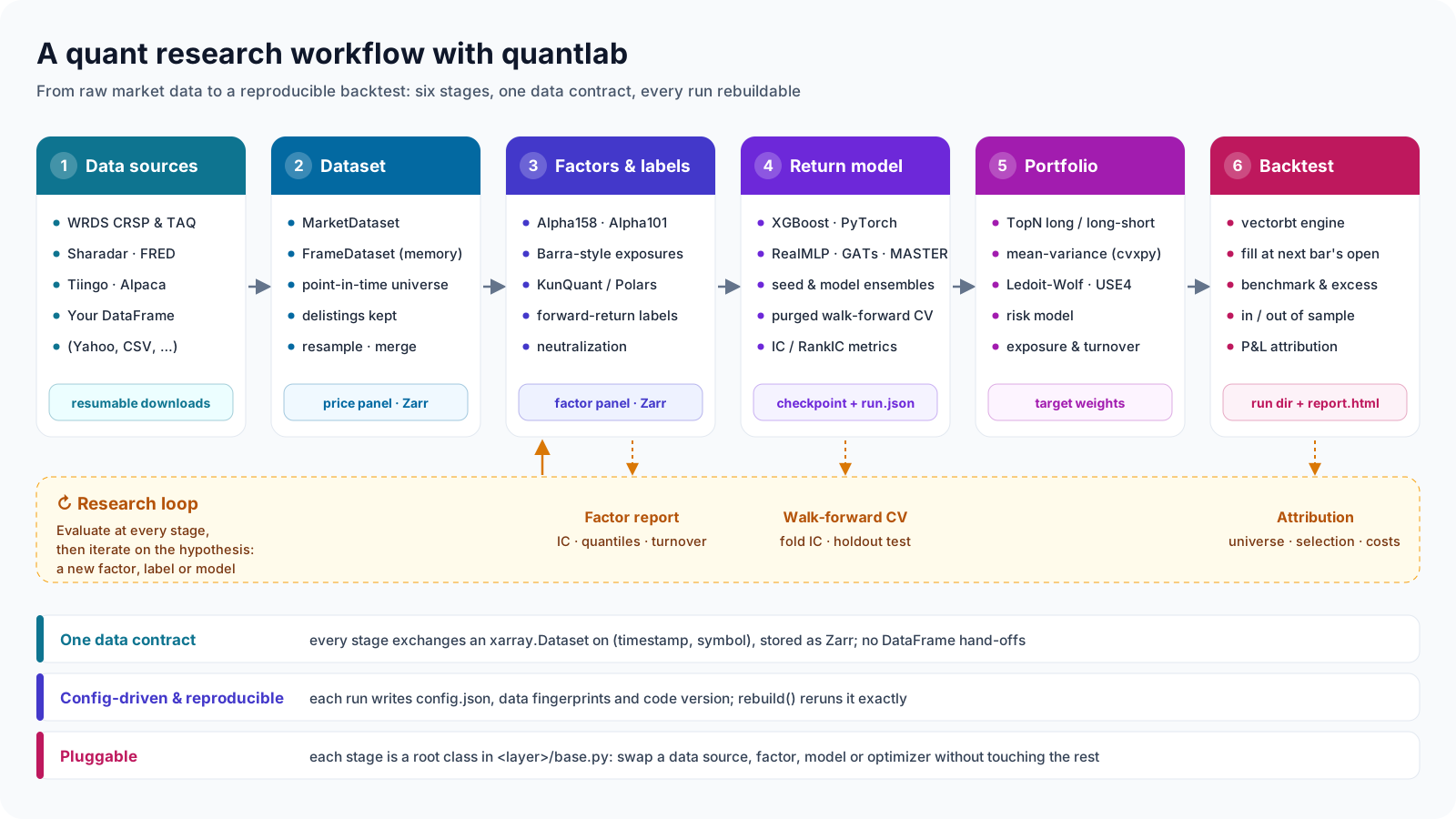
A study in quantlab runs through six stages. Each stage is a root class in its own layer
(quantlab/<layer>/base.py), takes the previous stage's output and hands on its own:
| Stage | What it does | Main classes | Output |
|---|---|---|---|
| 1. Data sources | Resumable downloads from WRDS (CRSP, TAQ), Sharadar, FRED, Tiingo and Alpaca, or your own DataFrame | DataSourceRegistry, scripts/wrds/, scripts/sharadar/ |
Raw files |
| 2. Dataset | Turns raw bars into a panel; point-in-time universes, delisted stocks kept, resampling and merging | MarketDataset, CrspStockDataset, FrameDataset |
Price panel |
| 3. Factors and labels | Compiled factor graphs (Alpha158, Alpha101, Barra-style exposures, neutralization) and forward-return labels | Alpha158Stock, BarraStyle, Return |
Factor panel |
| 4. Return model | Tree models and neural networks behind one interface, seed and model ensembles, purged walk-forward CV | XGBoostRegressor, RealMLPRegressor, GATsRegressor, SeedEnsemble |
Checkpoint, run.json |
| 5. Portfolio | Predictions to target weights: TopN, or mean-variance with a Ledoit-Wolf or USE4 factor risk model | TopNConstructor, MeanVarianceOptimizer |
Target weights |
| 6. Backtest | vectorbt simulation with next-bar fills, fees, delisting settlement and a benchmark | USEquityCrossectionSelectStockVectorBt |
Run directory, report.html |
Research is rarely a straight line, so evaluation is built into three of the stages:
Factor.analyze() writes an IC and quantile report for every factor, train_cv scores
each walk-forward fold and a holdout, and every backtest splits its return into universe,
selection and cost parts. What you learn there goes back into stage 3 as the next factor,
label or model.
Why quantlab
- One data contract. Every stage exchanges an
xarray.Dataseton the two dimensionstimestampandsymbol, a panel, stored on disk as Zarr. Models train on panels directly; there is no DataFrame conversion between stages, and any stage can be swapped without touching the others. - Free of look-ahead and survivorship bias by construction. Universes come from historical index membership or full-market listings that include delisted stocks; a signal formed at bar t fills at bar t+1's open; a delisted holding is settled at its last price; an order without a real fill price is rejected and the holding kept.
- Reproducible runs. Each training and backtest run writes its configuration, data
fingerprints and code version next to its results.
rebuild()turns a run directory back into the objects that produced it and reruns them to the same equity curve. - Fast factors. KunQuant compiles factor formulas to native code and runs them over a whole history or bar by bar, so a factor written for research can later run on live data. Polars is there for quick batch experiments.
- Bring your own data. A pandas or polars frame becomes a dataset through
FrameDataset, andquantlab.apioffers factors, labels, a factor report and a backtest as single function calls on frames. - Research-grade reports. An alphalens-style factor report, model metrics (IC, RankIC, ICIR) per split and per fold, and an HTML backtest report with in-sample and out-of-sample columns and a benchmark comparison.
quantlab is a research backend. It has no web front end and does not send orders to a broker.
Installation
quantlab needs Python 3.13 or newer, uv and a C++ compiler (KunQuant compiles factor code at run time).
pip install quantlab-py         # or: uv add quantlab-py
pip install 'quantlab-py[all]'  # with every optional extra except mosek
The distribution is named quantlab-py on PyPI (quantlab there is an unrelated project);
the package is imported as quantlab.
Some components need an optional extra; importing one without it raises an ImportError that
names the extra:
| Extra | Installs | Needed by |
|---|---|---|
optimize |
cvxpy | MeanVarianceOptimizer |
tabkit |
pytabkit | RealMLPRegressor, XGBTDRegressor |
wandb |
wandb | WandbTracker |
mlflow |
mlflow-skinny | MlflowTracker |
gbdt |
lightgbm, catboost | LGBMRegressor, CatBoostRegressor, DoubleEnsembleRegressor |
massive |
boto3 | Massive flat-file downloads |
mosek |
cvxpy, mosek | MeanVarianceOptimizer with max_names (needs a MOSEK licence) |
all |
every extra above except mosek |
From source, with every extra and the development tools:
git clone https://github.com/ZhaorongDai/quantlab.git
cd quantlab
uv sync --all-extras
On macOS, xgboost needs Homebrew's OpenMP runtime (brew install libomp).
All model heads, neural-network and tree models alike, use a CUDA GPU when one is available and the CPU otherwise. See the installation guide for GPU and macOS notes.
A pipeline on Yahoo Finance data
examples/yahoo_us_equity.py runs the whole pipeline on free
data, with no account and no credentials, in about twenty seconds on a laptop. It downloads
ten years of daily bars for the 30 Dow Jones stocks and SPY with
yfinance, which is not a quantlab dependency:
uv run --with yfinance python examples/yahoo_us_equity.py
1. Data. yfinance returns a pandas frame. FrameDataset holds it in memory as a
panel, renaming the columns to the split- and dividend-adjusted fields the stock factors and
the US-equity backtester read. Nothing is written to a Zarr store.
import yfinance as yf
from quantlab.dataset.memory import FrameDataset

wide = yf.download(DOW_30 + ["SPY"], start="2015-06-01", end="2025-01-01", auto_adjust=True)
bars = wide.stack(level="Ticker", future_stack=True).reset_index().dropna(subset=["Close"])
COLUMNS = {"Date": "timestamp", "Ticker": "symbol", "Open": "adjOpen", "High": "adjHigh",
           "Low": "adjLow", "Close": "adjClose", "Volume": "adjVolume"}
stocks, spy = bars[bars.Ticker != "SPY"], bars[bars.Ticker == "SPY"]
prices = FrameDataset(stocks, columns=COLUMNS)
2. Factors, label and model. The 169 Alpha158 factors and the 5-bar open-to-open forward return are computed with KunQuant, and an XGBoost model is trained on 2016 to 2021 and tested on 2022.
factor = Alpha158Stock(FactorConfig(dataset=prices, warmup_bars=60, mode="batch",
                                    data_columns=ADJUSTED, file_path=".../alpha158.zarr"))
label = Return(FactorConfig(dataset=prices, warmup_bars=0, mode="batch",
                            data_columns=("adjOpen",), kwargs={"n_forward_periods": 5},
                            file_path=".../ret_5.zarr"))
model = XGBoostRegressor(ModelConfig(
    factors=[factor], labels=[label], model_save_dir=".../models",
    factor_data_strategy="cal", label_data_strategy="cal",
    hyperparameters={"num_boost_round": 200, "max_depth": 3, "eta": 0.03},
    val_size=0.2, start_date="2016-01-01", end_date="2022-12-31",
    train_start="2016-01-01", train_end="2021-12-31",
    test_start="2022-01-01", test_end="2022-12-31",
))
model.collect()
checkpoint = model.train()
3. Portfolio and backtest. On 2023 and 2024, data the model never saw, every fifth bar the ten stocks with the highest predicted return are held in equal weights, against buy-and-hold SPY.
backtester = USEquityCrossectionSelectStockVectorBt(CrossSectionBacktestConfig(
    price_dataset=prices,
    benchmark_dataset=FrameDataset(spy, columns=COLUMNS),
    model=..., model_mode="load", checkpoint=str(checkpoint),
    start_date="2023-01-01", end_date="2024-12-31", output_dir=".../backtests",
    rebalance_periods=5,
    constructor=TopNConstructor(TopNConfig(direction="long_only", top_n=10)),
))
result = backtester.run()
The script prints:
72,420 rows for 30 stocks, 2,414 for SPY
Price panel: {'timestamp': 2414, 'symbol': 30}
169 factors; label ['ret_5']
2022 test: IC 0.0537, RankIC 0.0365
2023-2024             top-10       SPY
Total Return [%]       35.02     57.11
Sharpe Ratio            1.28      1.84
Max Drawdown [%]        9.54      9.97
Run directory, with the HTML report: output/yahoo_us_equity/backtests/USEquityCrossectionSelectStockVectorBt_<time>
Rebuilt from its run directory, same equity curve: True
and writes the backtest report, shown here in part:
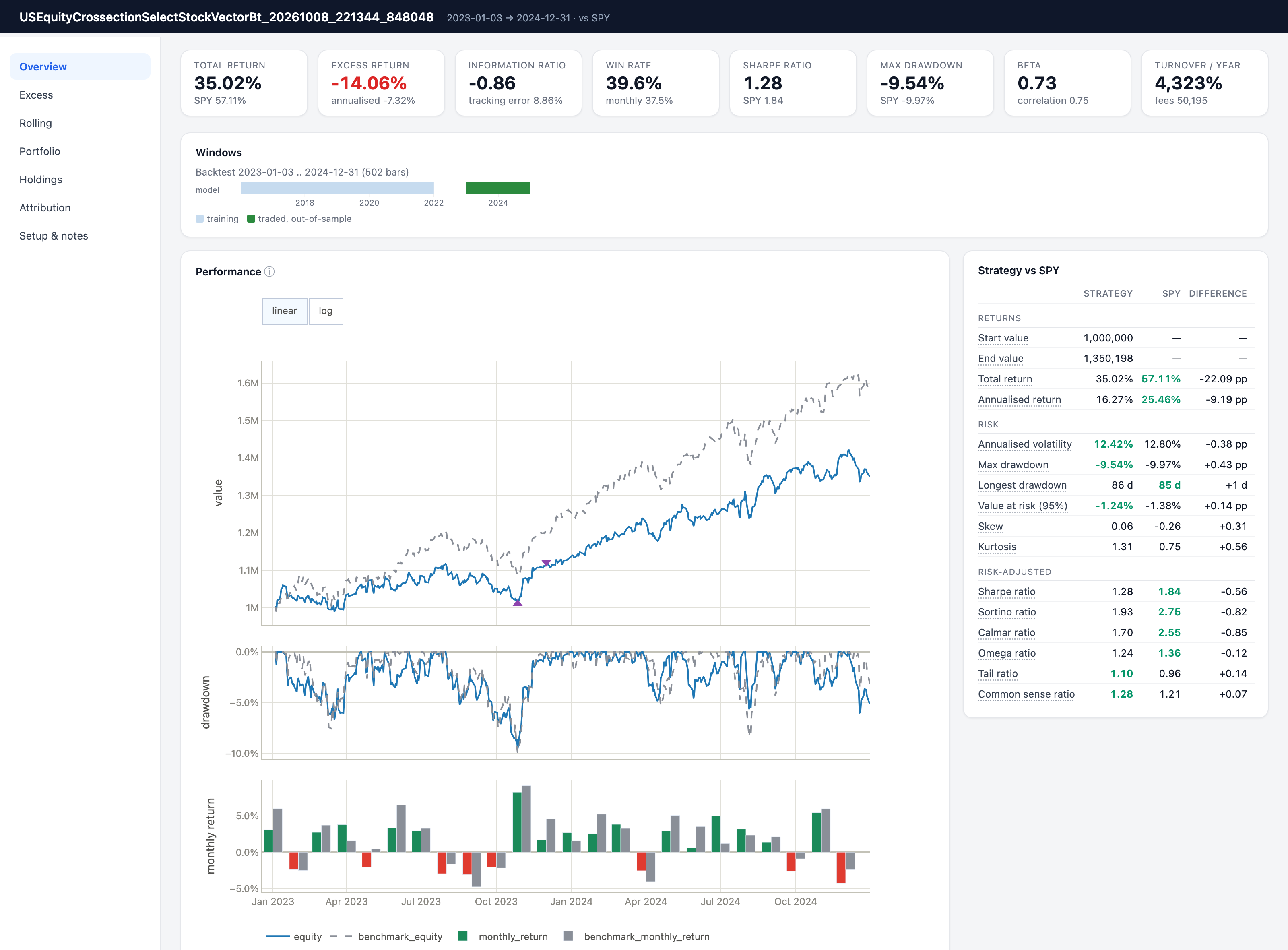
The strategy trails SPY over this window; the example is here to show the pipeline, not a
strategy to trade. Its universe is today's Dow 30, so every stock in it is one that
survived, and Yahoo's prices are not point-in-time. For research, use the CRSP or Sharadar
universes below. Yahoo's adjusted prices also change in their last digits from one request
to the next, so the script keeps the first download as output/yahoo_us_equity/bars.parquet
and reads it on later runs.
More examples
The offline quick start builds a synthetic price panel and runs the same pipeline with no network access, in about half a minute:
uv run python examples/quickstart.py
examples/ has one runnable script per topic (building panels, training
models, backtesting, data sources) and, for point-in-time research,
wrds_us_equity/ (CRSP via WRDS) and
sharadar_us_equity/ (Sharadar). The two figures
below come from the WRDS examples.
Factor report
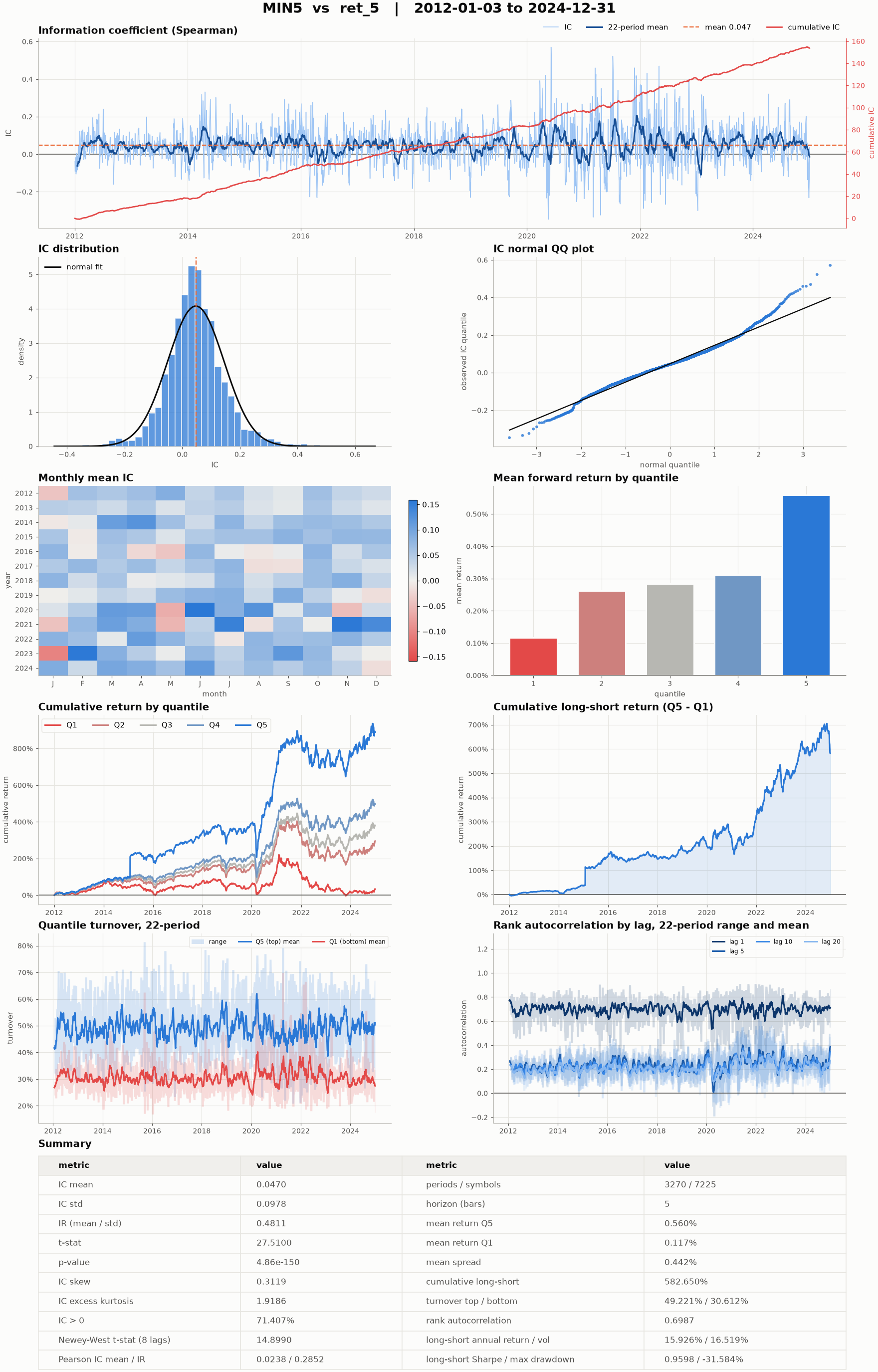
Factor.analyze() pairs every factor with every forward-return label and writes one
alphalens-style figure per pair: the information coefficient (IC) over time, its
distribution, monthly mean IC, returns by quantile, the long-short curve, turnover and rank
autocorrelation at several lags, plus a summary table (with the Newey-West t-statistic and
the long-short's return, volatility, Sharpe ratio and drawdown) and tidy CSVs. With two or more factors it also
clusters them by their mean rank correlation. This is MIN5 from the Alpha158 set, the
5-day low relative to the close, against the 5-day open-to-open forward return on every
common stock in CRSP, about 7,200 symbols including the delisted ones, 2012 to 2024.
Backtest report
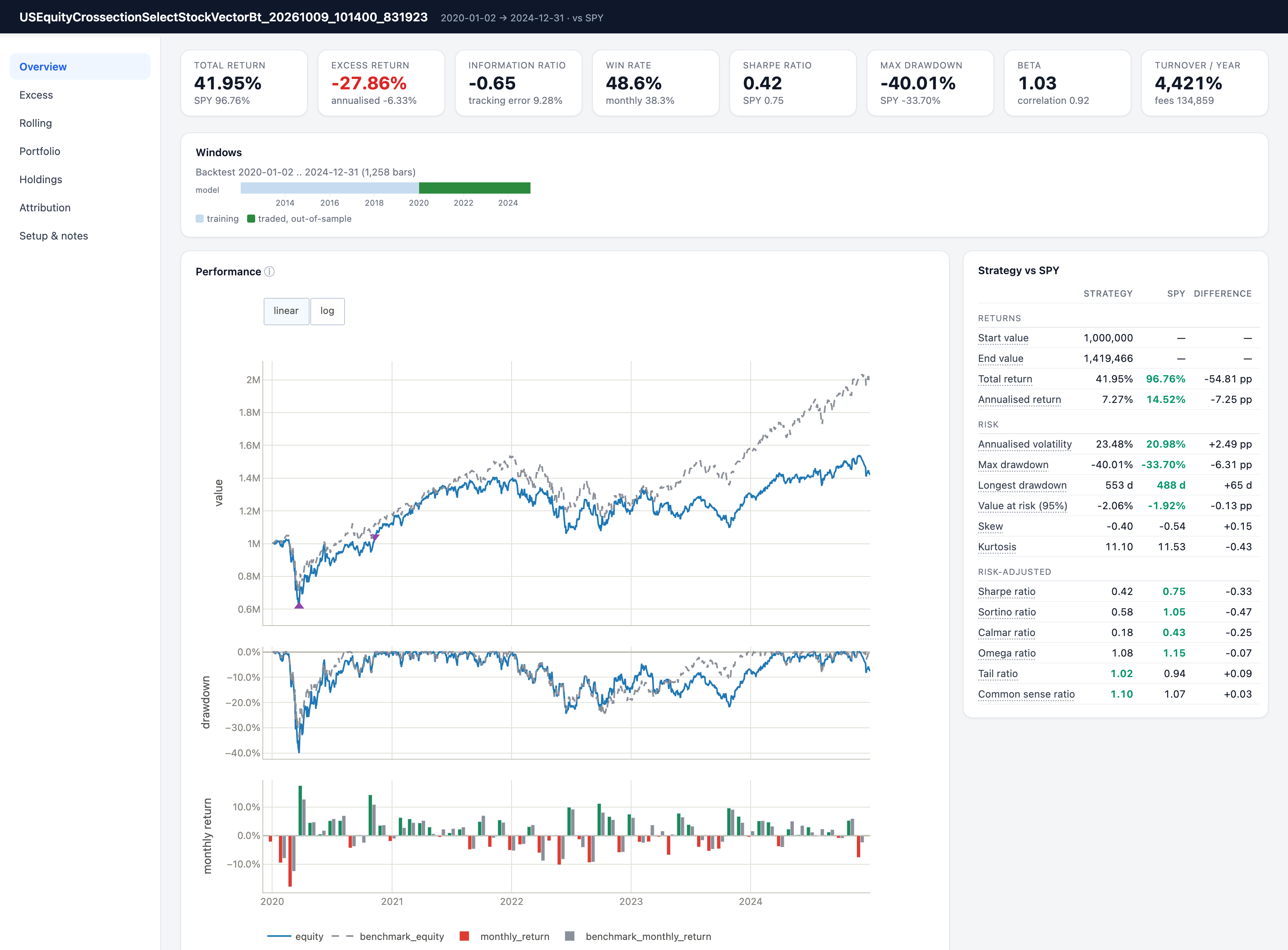
This is sp500_xgb_td.py: a long-only top-50 portfolio on the point-in-time S&P 500,
rebalanced every 5 bars from an XGBoost model trained on 2012 to 2019, backtested out of
sample on 2020 to 2024 against buy-and-hold SPY. Over this window the strategy trails SPY;
the figure is here to show the report, not a result to copy.
Credentials
quantlab reads credentials only from environment variables. They are never accepted on the command line and never written to a configuration file or a log.
| Variable | Used for |
|---|---|
WRDS_USERNAME |
WRDS (CRSP and TAQ); the password is read from ~/.pgpass |
SHARADAR_API_KEY |
Sharadar US equity prices, fundamentals and index membership |
TIINGO_API_KEY |
Tiingo end-of-day US stock prices |
APCA_API_KEY_ID, APCA_API_SECRET_KEY |
Alpaca bars, quotes and trades |
WANDB_API_KEY |
Optional Weights & Biases tracking, when a config names a WandbTracker |
MLFLOW_TRACKING_USERNAME, MLFLOW_TRACKING_PASSWORD or MLFLOW_TRACKING_TOKEN |
Optional MLflow tracking on a server that asks for credentials, when a config names an MlflowTracker (uv sync --extra mlflow) |
QUANTLAB_DATA_DIR |
Optional root directory the library's config factories derive data paths from; the download scripts take --download-dir and --data-dir instead |
The download scripts live in scripts/wrds/ and scripts/sharadar/, and each prints its
options with --help, for example uv run python scripts/wrds/index.py --help. Tiingo,
Alpaca and Binance have library interfaces only. The
data sources guide explains where files are written and
how to resume an interrupted download.
Documentation
The documentation is published at https://zhaorongdai.github.io/quantlab/. Getting started covers installation and the quick start. The user guide has one page per pipeline stage, from data sources and datasets through factors, models and portfolios to backtesting and daily operation. The API reference is generated from the docstrings. The developer guide shows how to extend each layer and explains the machinery underneath.
If you already hold your data in pandas or polars DataFrames and want one capability, such
as factors, forward returns, a factor report or a backtest, without the project's stores
and configurations, start with the frame API guide (quantlab.api).
Every public class and function has a docstring in the
numpydoc format; the
API reference renders them, and help() reads them in Python.
Testing
The test suite runs offline and needs no credentials:
uv run pytest
The KunQuant factor tests compile C++ and take a few minutes.
tests/test_crsp_rebuild_measurements.py measures a real CRSP store and fails with an
explanatory message unless QUANTLAB_DATA_ROOT points at one; a plain uv run pytest
never collects it, and it runs only when named on the command line.
Project status
quantlab is under active development, and its interfaces may still change. Event-driven backtesting with NautilusTrader, a service layer and a web front end are planned but not implemented.
Contributing
Bug reports, questions and pull requests are welcome. Please read CONTRIBUTING.md before opening a pull request.
License
quantlab is released under the MIT License.
1 maintainer

Metadata
1 maintainer
Release files for quantlab-py 0.2.0
For a detailed explanation of source distributions (sdists) and built distributions (wheels), please see the package formats documentation.
Source distribution (sdist)
| File | Size | Uploaded | Provenance | |
|---|---|---|---|---|
| quantlab_py-0.2.0.tar.gz | 2.6 MB | With provenance | Details |
Built distribution (wheel)
| File | Interpreter | ABI | Platform | Reset |
|---|---|---|---|---|
| quantlab_py-0.2.0-py3-none-any.whl | Python 3 | none | any | Details |
Total release size: 4.1 MB
Release files / quantlab_py-0.2.0.tar.gz
| Download URL | quantlab_py-0.2.0.tar.gz |
|---|---|
| Size | 2.6 MB |
| Tags | Source |
|
SHA-256 checksum How to use checksums |
c5d2581f533cbb83d9a6382d212a5226444708a6a152a8cc663dc8f3276a5467
|
|
BLAKE2b-256 checksum How to use checksums |
cf054bded2f8e633d27671bcf423e9862f739ce5c32468c85e94f6842b997c9a
|
| Upload date | |
|
Uploaded using Trusted Publishing? What is trusted publishing? |
Yes |
| Uploaded via |
twine/7.0.0 CPython/3.13.14
|
Provenance
Provenance describes where a file came from. On PyPI, provenance is shared via attestations, which provide a verifiable record of the build or publishing details. View details, limitations and caveats.


PyPI Publish Attestation
PyPI verified that this artifact, at this checksum, originated from the publisher listed below.
Signed by GitHub Actions, verified by PyPI on Oct 19, 2026.
Transparency logRelease files / quantlab_py-0.2.0-py3-none-any.whl
| Download URL | quantlab_py-0.2.0-py3-none-any.whl |
|---|---|
| Size | 1.5 MB |
| Tags | Python 3 |
|
SHA-256 checksum How to use checksums |
ea01a177f150f72812be0917a10162da1dcd883e72694a23dbc029c0af420198
|
|
BLAKE2b-256 checksum How to use checksums |
bf84203761cb34a87bde8b1ae4ccbec1115fc48be9f96dbd45ada698557f8a70
|
| Upload date | |
|
Uploaded using Trusted Publishing? What is trusted publishing? |
Yes |
| Uploaded via |
twine/7.0.0 CPython/3.13.14
|
Provenance
Provenance describes where a file came from. On PyPI, provenance is shared via attestations, which provide a verifiable record of the build or publishing details. View details, limitations and caveats.
PyPI Publish Attestation
PyPI verified that this artifact, at this checksum, originated from the publisher listed below.
Signed by GitHub Actions, verified by PyPI on Oct 19, 2026.
Transparency logSecurity for quantlab-py 0.2.0
Provenance
Provenance describes where a file came from. On PyPI, provenance is shared via attestations, which provide a verifiable record of the build or publishing details. View details, limitations and caveats.
Full provenance
All 2 files in this release have been uploaded with provenance metadata.
Attestation for quantlab_py-0.2.0.tar.gz
PyPI Publish Attestation
PyPI verified that this artifact, at this checksum, originated from the publisher listed below.
Signed by GitHub Actions, verified by PyPI on Oct 19, 2026.
Transparency logA note on package security
PyPI is a repository for distributing packages, not a service for auditing them. While third-party security researchers and our staff do their best to detect and remove malicious packages, PyPI cannot guarantee the quality, security or suitability of any given package.














