
QuantLite


A fat-tail-native quantitative finance toolkit for Python.
Most quantitative finance libraries bolt fat tails on as an afterthought, if they bother at all. They fit Gaussians, compute VaR with normal assumptions, and hope the tails never bite. The tails always bite.
QuantLite starts from the other end. Every distribution is fat-tailed by default. Every risk metric accounts for extremes. Every backtest ships with an honesty check. The result is a toolkit that models markets as they actually behave, not as textbooks wish they would.
import quantlite as ql

data = ql.fetch(["equity", "gold", "bonds", "crypto"], source="datasets", period="5y")
# Live data instead (needs quantlite[yahoo]): ql.fetch(["AAPL", "BTC-USD", "GLD", "TLT"], period="5y")
regimes = ql.detect_regimes(data, n_regimes=3)
weights = ql.construct_portfolio(data, regime_aware=True, regimes=regimes)
result = ql.backtest(data, weights)
ql.tearsheet(result, regimes=regimes, save="portfolio.html")
Five lines. Fetch data, detect market regimes, build a regime-aware portfolio, backtest it, and generate a full tearsheet. That is the Dream API.
Then four questions, one call each, every answer in plain English:
ql.honesty_check(returns, n_trials=20).explain()   # is this Sharpe ratio real, or the best of twenty tries?
ql.versus_gaussian(returns).explain()              # the tail your data shows, beside what a normal model says
ql.ruin_check(returns, leverage=3).explain()       # what leverage does to the path you actually live
ql.replay_all(prices, weights, prices=True).explain()  # every historical crisis your data covers, replayed
And one to check the library itself: ql.reference_check() reproduces 19 published results, from the deflated Sharpe ratio to the Kelly fraction, and shows any difference.
Why QuantLite
- Fat tails are the default, not an afterthought. Student-t, Lévy stable, GPD, and GEV distributions are first-class citizens. Gaussian is explicitly opt-in, never implicit.
- Operationalises Taleb, Peters, and Lopez de Prado. Ergodicity economics, antifragility scoring, the Fourth Quadrant map, Deflated Sharpe Ratios, and CSCV overfitting detection are built in, not bolted on.
- Every backtest comes with an honesty check. Bootstrap confidence intervals, multiple-testing corrections, and walk-forward validation ensure you know whether your Sharpe ratio is genuine or a statistical artefact.
- Results explain themselves. The headline tools return results whose
explain()says what the number means and what it does not, with the caveats the computation raised. Underneath they are still the dicts and dataclasses they were, so existing code is unaffected. - Every chart follows Stephen Few's principles. Maximum data-ink ratio, muted palette, direct labels, no chartjunk. Publication-ready by default.
The QuantLite Score
An open, versioned, verifiable rating for trading track records. Raw Sharpe ratios are trivially gamed: test fifty variants and publish the winner, start the chart at the bottom of a drawdown, sell tail risk and post a 92% win rate. The QuantLite Score rates a track record on the statistics that are hard to game (deflated Sharpe, bootstrap robustness, tail risk, consistency) and flags the classic manipulation patterns.
from quantlite.score import compute_score, verify_artifact

result = compute_score(returns, n_trials=20)
print(result.score, result.grade)          # e.g. 72.4 B

payload = result.artifact.to_json()        # publish or store this
assert verify_artifact(payload, returns)   # anyone can reproduce it bit for bit
Every score ships as a portable artifact with a SHA-256 content hash. Same returns, same parameters, same library version: same score, bit for bit. The methodology (QLS-1.0) is open and frozen per version; see the specification.
Visual Showcase
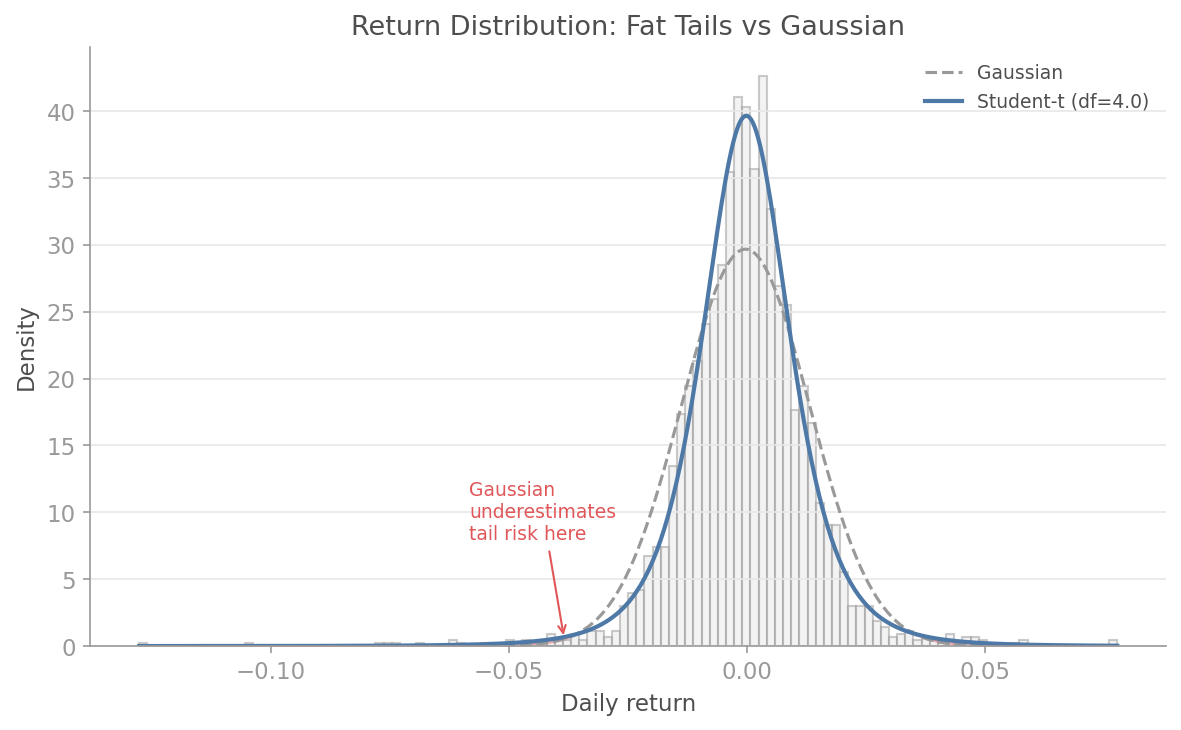
Fat Tails vs Gaussian
Where the Gaussian underestimates tail risk, EVT and Student-t fitting reveal the true shape of returns. The difference is where fortunes are lost.
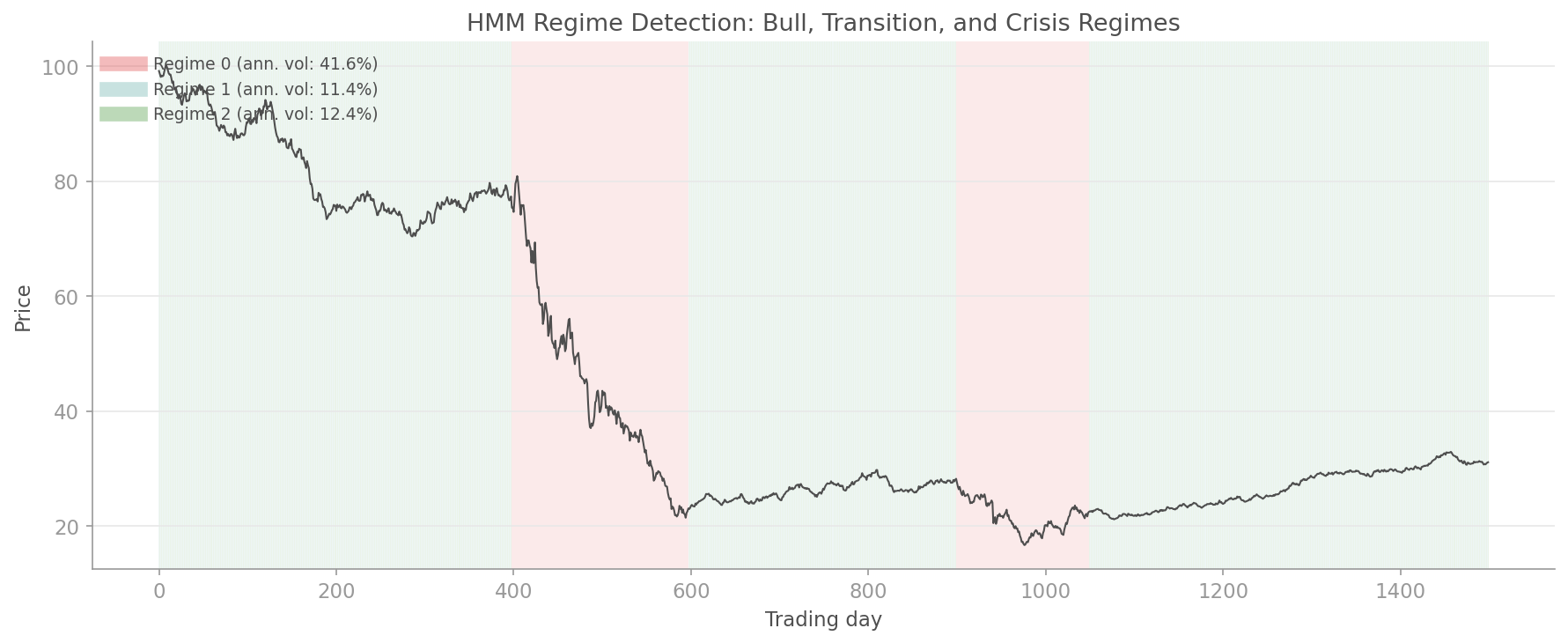
Regime Timeline
Hidden Markov Models automatically identify bull, bear, and crisis regimes. Your portfolio should know which world it is living in.
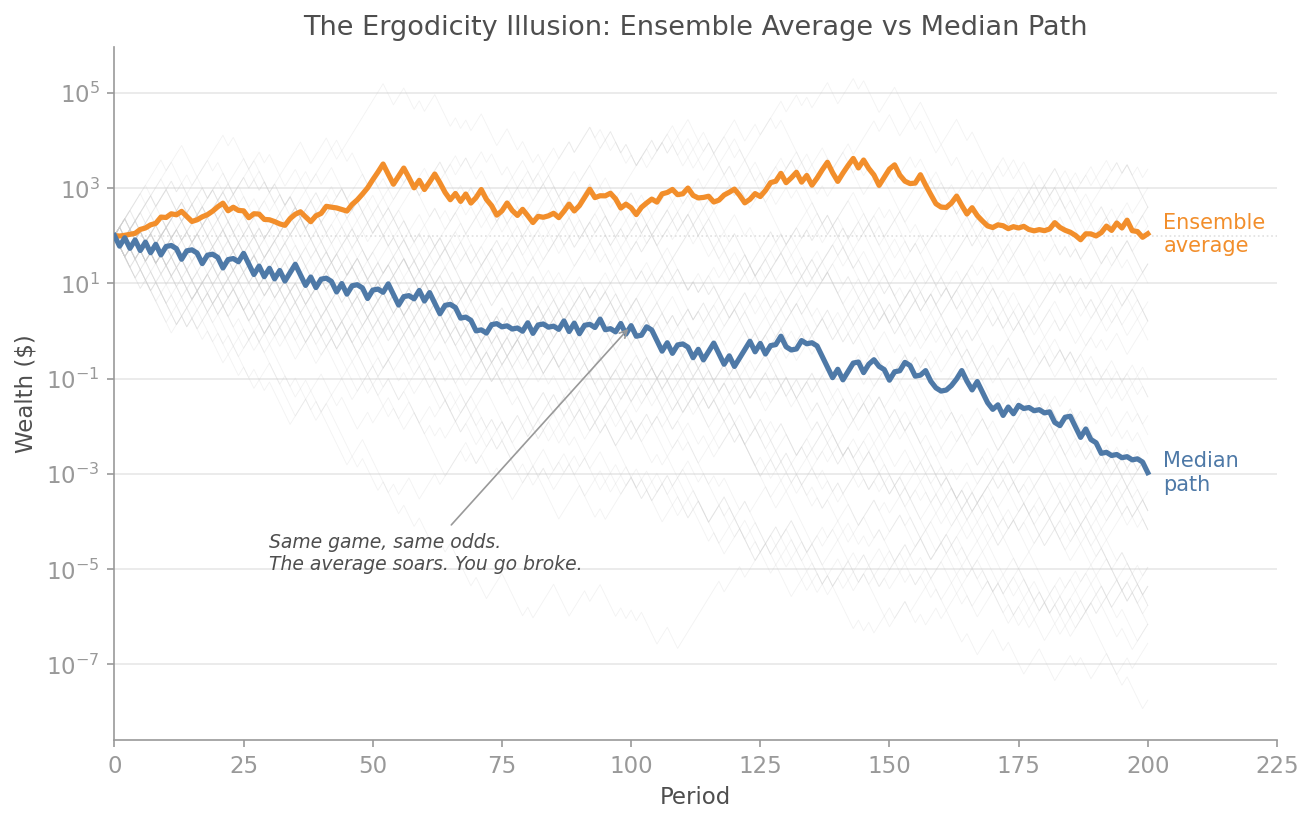
Ergodicity Gap
The ensemble average says you are making money. The time average says you are going broke. The gap between them is the most important number in finance that nobody computes.
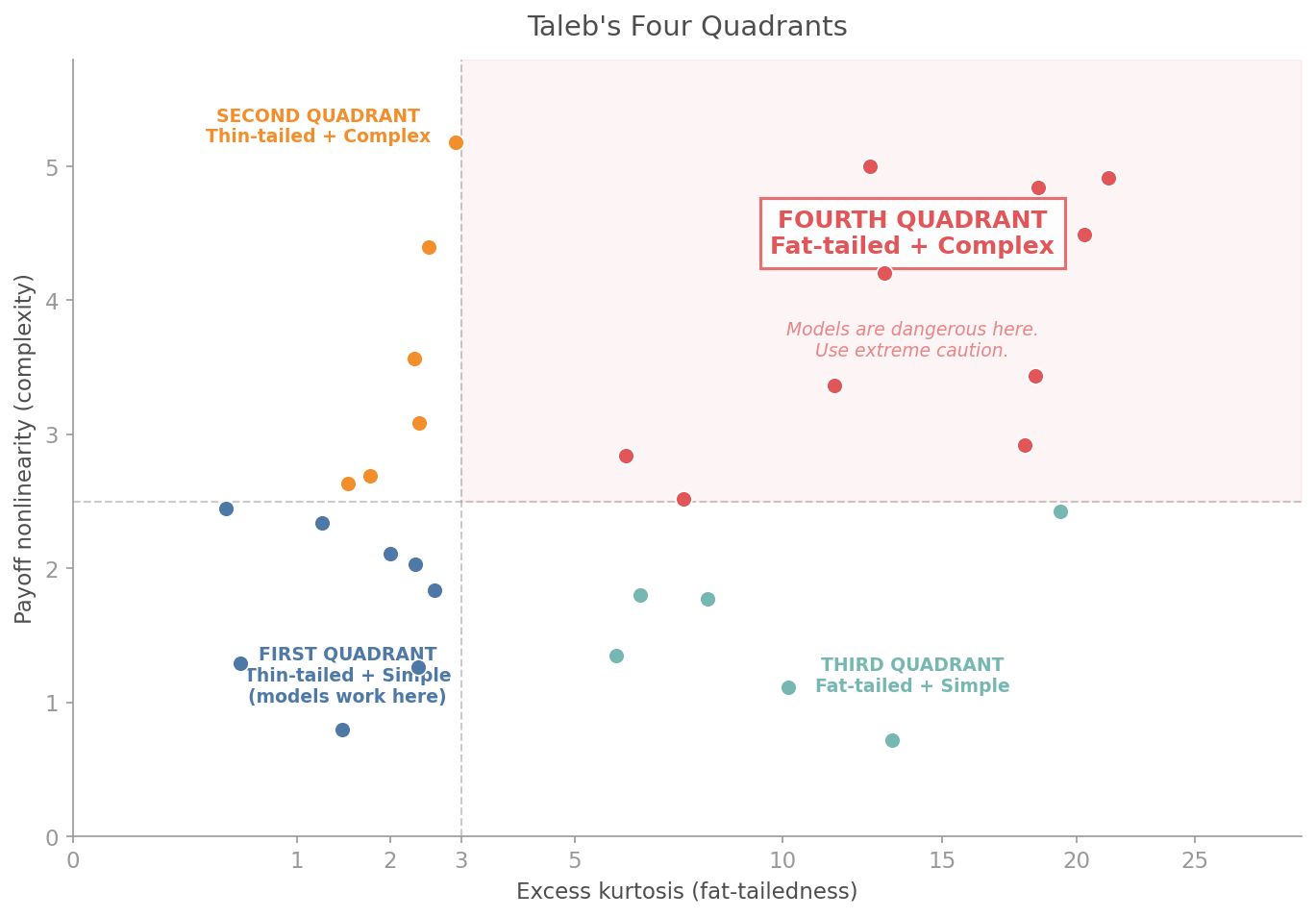
Fourth Quadrant Map
Taleb's Fourth Quadrant: where fat tails meet complex payoffs, and models fail. Returns can show the fat tails; the complexity of the payoff lives in the positions, options and leverage behind them.
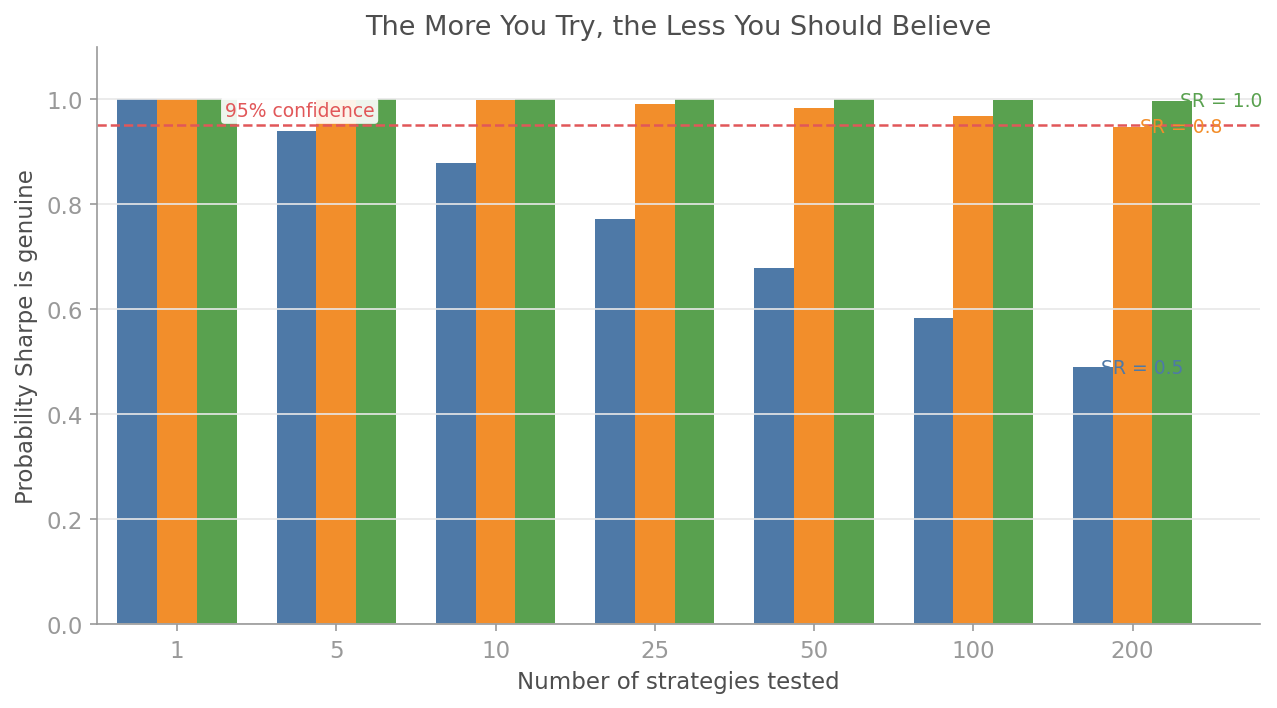
Deflated Sharpe Ratio
You tested 50 strategies and picked the best. The Deflated Sharpe Ratio tells you the probability that your winner is genuine, not a multiple-testing artefact.
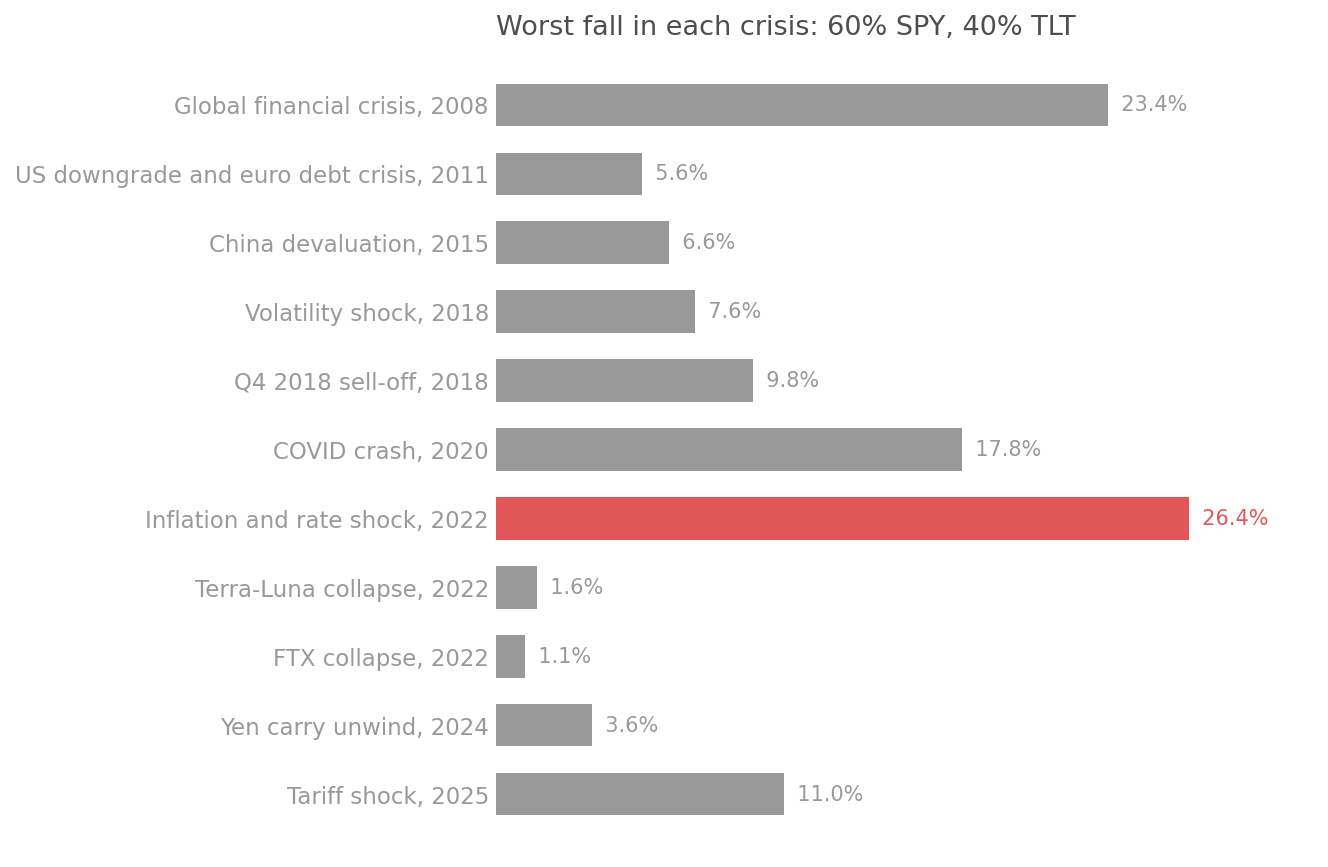
Historical Crises
A 60/40 portfolio of SPY and TLT, replayed on real prices through every crisis since 2007. Its worst was not 2008 but 2022, when stocks and bonds fell together and the hedge failed.
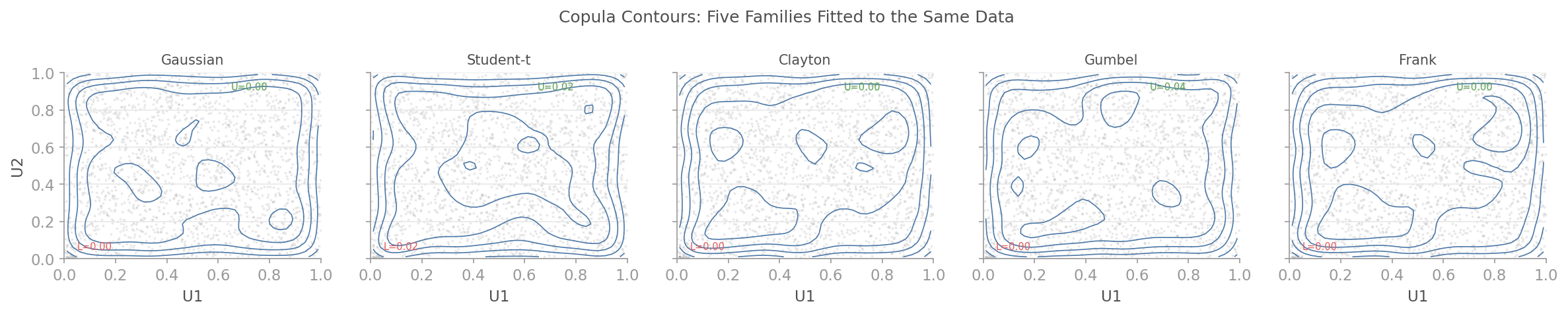
Copula Contours
Five copula families fitted to the same data. Gaussian copula says tail dependence is zero. Student-t and Clayton disagree. They are right.
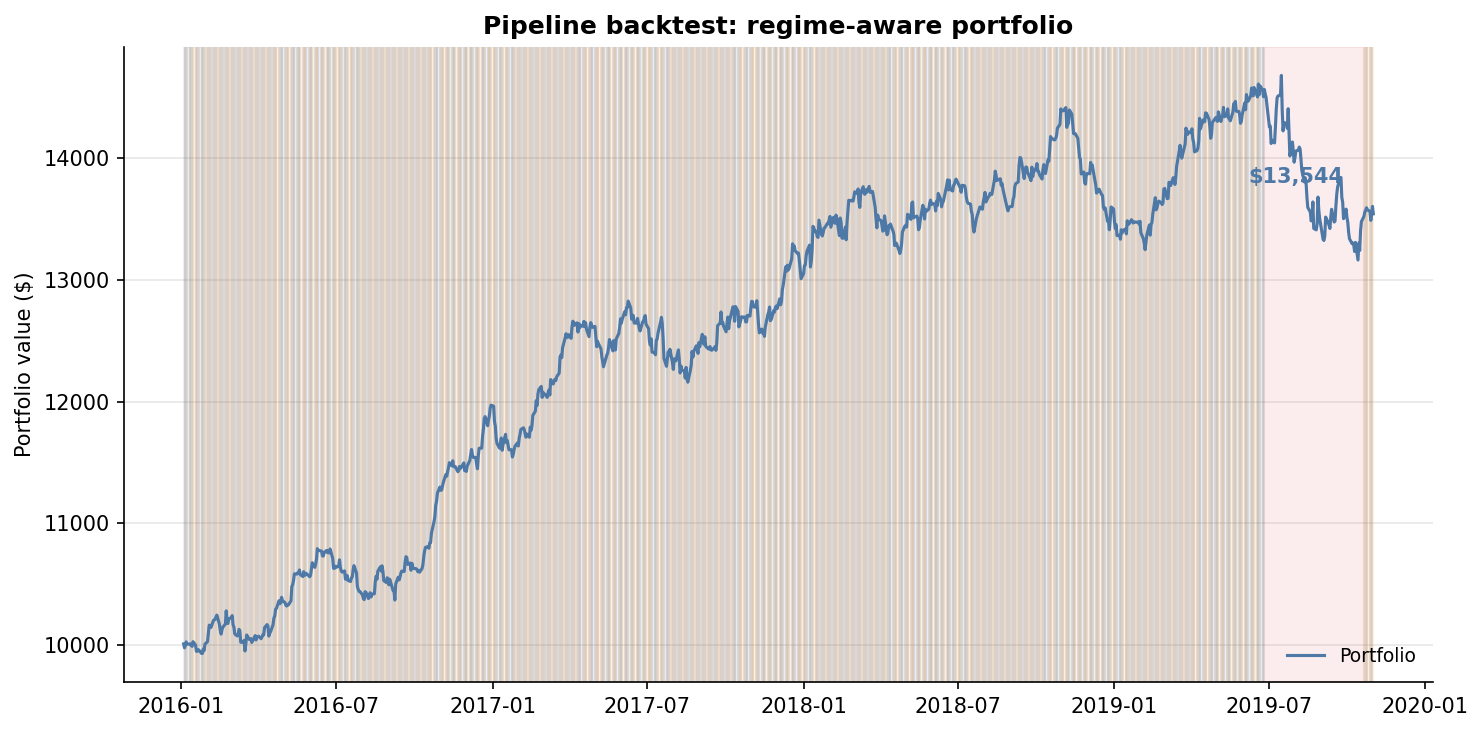
Pipeline Equity Curve
The Dream API in action: regime-aware portfolio construction with automatic defensive tilting during crisis periods.
Installation
pip install quantlite
Install only the data sources you need:
pip install quantlite[yahoo]    # Yahoo Finance
pip install quantlite[crypto]   # Cryptocurrency exchanges (CCXT)
pip install quantlite[fred]     # FRED macroeconomic data
pip install quantlite[all]      # Everything
Optional: hmmlearn for HMM regime detection.
Quickstart
The Dream API
import quantlite as ql

# Fetch → detect regimes → build portfolio → backtest → report
data = ql.fetch(["equity", "gold", "bonds", "crypto"], source="datasets", period="5y")
# Live data instead (needs quantlite[yahoo]): ql.fetch(["AAPL", "BTC-USD", "GLD", "TLT"], period="5y")
regimes = ql.detect_regimes(data, n_regimes=3)
weights = ql.construct_portfolio(data, regime_aware=True, regimes=regimes)
result = ql.backtest(data, weights)
ql.tearsheet(result, regimes=regimes, save="portfolio.html")
Fat-Tail Risk Analysis
from quantlite.distributions.fat_tails import student_t_process
from quantlite.risk.metrics import value_at_risk, cvar, return_moments
from quantlite.risk.evt import tail_risk_summary

# Generate fat-tailed returns (nu=4 gives realistic equity tail behaviour)
returns = student_t_process(nu=4.0, mu=0.0003, sigma=0.012, n_steps=2520, rng_seed=42)

# Cornish-Fisher VaR accounts for skewness and kurtosis
var_99 = value_at_risk(returns, alpha=0.01, method="cornish-fisher")
cvar_99 = cvar(returns, alpha=0.01)
moments = return_moments(returns)

print(f"VaR (99%):       {var_99:.4f}")
print(f"CVaR (99%):      {cvar_99:.4f}")
print(f"Excess kurtosis: {moments.kurtosis:.2f}")

# Full EVT tail analysis
summary = tail_risk_summary(returns)
print(f"Hill tail index: {summary.hill_estimate.tail_index:.2f}")
print(f"GPD shape (xi):  {summary.gpd_fit.shape:.4f}")
print(f"1-in-100 loss:   {summary.return_level_100:.4f}")
Backtest Forensics
from quantlite.forensics import deflated_sharpe_ratio
from quantlite.resample import bootstrap_sharpe_distribution

# You tried 50 strategies and the best had an annualised Sharpe of 1.8
# over a year of daily data. Is it real?
dsr = deflated_sharpe_ratio(observed_sharpe=1.8, n_trials=50, n_obs=252, periods_per_year=252)
print(f"Probability Sharpe is genuine: {dsr:.2%}")   # 31.62%: more likely luck than skill

# Bootstrap confidence interval on the Sharpe ratio
result = bootstrap_sharpe_distribution(returns, n_samples=2000, seed=42)
print(f"Sharpe: {result['point_estimate']:.2f}")
print(f"95% CI: [{result['ci_lower']:.2f}, {result['ci_upper']:.2f}]")
Module Reference
Core Risk
| Module | Description |
|---|---|
quantlite.risk.metrics |
VaR (historical, parametric, Cornish-Fisher), CVaR, Sortino, Calmar, Omega, tail ratio, drawdowns |
quantlite.risk.gaussian |
versus_gaussian: your tail number beside what a normal model would have said, with the ratio and a plain-English explain() |
quantlite.risk.evt |
GPD, GEV, Hill estimator, Peaks Over Threshold, return levels |
quantlite.volatility |
Realised volatility (Parkinson, Garman-Klass, Rogers-Satchell, Yang-Zhang), GARCH, GJR-GARCH, and EGARCH with Student-t innovations by default |
quantlite.volatility.fit_dcc |
Dynamic conditional correlation (Engle 2002) on Student-t GARCH marginals: correlation paths, crisis versus average correlation, portfolio volatility with today's correlations, and a test of whether correlations move at all |
quantlite.distributions.fat_tails |
Student-t, Lévy stable, regime-switching GBM, Kou jump-diffusion |
quantlite.metrics |
Annualised return, volatility, Sharpe, max drawdown |
Dependency and Portfolio
| Module | Description |
|---|---|
quantlite.dependency.copulas |
Gaussian, Student-t, Clayton, Gumbel, Frank copulas with tail dependence |
quantlite.dependency.correlation |
Rolling, EWMA, stress, rank correlation |
quantlite.dependency.clustering |
Hierarchical Risk Parity |
quantlite.portfolio.optimisation |
Mean-variance, CVaR, risk parity, HRP, Black-Litterman, Kelly |
quantlite.portfolio.rebalancing |
Calendar, threshold, and tactical rebalancing |
Backtesting
| Module | Description |
|---|---|
quantlite.backtesting.engine |
Multi-asset backtesting with circuit breakers and slippage |
quantlite.backtesting.signals |
Momentum, mean reversion, trend following, volatility targeting |
quantlite.backtesting.analysis |
Performance summaries, monthly tables, regime attribution |
Data
| Module | Description |
|---|---|
quantlite.data |
Unified connectors: Yahoo Finance, CCXT, FRED, funding history, local files, plugin registry |
quantlite.datasets |
Bundled data so every example runs offline: four public-domain Federal Reserve series and a seeded synthetic four-asset panel; also a source="datasets" connector |
quantlite.doctor |
Which optional extras are installed and what each unlocks |
quantlite.accessor |
The .ql accessor: returns.ql.cvar(), .versus_gaussian(), .honesty_check(), .garch(), frame.ql.hrp() |
quantlite.data_generation |
GBM, correlated GBM, Ornstein-Uhlenbeck, Merton jump-diffusion |
Taleb Stack
| Module | Description |
|---|---|
quantlite.ergodicity |
Time-average vs ensemble-average growth, Kelly fraction, leverage effect |
quantlite.ruin_check |
What leverage does to the path an investor lives: time-average growth, growth-optimal and zero-growth leverage, and the chance of ruin from a block bootstrap of your own returns, beside a normal model's answer |
quantlite.antifragile |
Antifragility score, convexity, Fourth Quadrant, barbell allocation, Lindy |
quantlite.scenarios |
Composable scenario engine, pre-built crisis library, shock propagation |
quantlite.scenarios.replay |
Twelve historical crises with verified dates, replayed on your own data: return, worst fall, worst day, recovery, correlation before and during, across markets and time zones |
Honest Backtesting
| Module | Description |
|---|---|
quantlite.forensics |
Deflated Sharpe Ratio, Probabilistic Sharpe, haircut adjustments, minimum track record |
quantlite.honesty_check |
One call, one verdict: PSR, deflated Sharpe with the luck benchmark, minimum track record, bootstrap interval, and PBO when the trials are supplied |
quantlite.reference_check |
Reproduces 19 published results (deflated and probabilistic Sharpe, minimum track record, normal tail constants, Kelly, Parkinson) and shows the differences; python -m quantlite.reference for CI |
quantlite.overfit |
CSCV/PBO, TrialTracker, multiple testing correction, walk-forward validation |
quantlite.resample |
Block and stationary bootstrap, confidence intervals for Sharpe and drawdown |
Systemic Risk
| Module | Description |
|---|---|
quantlite.contagion |
CoVaR, Delta CoVaR, Marginal Expected Shortfall, Granger causality |
quantlite.network |
Correlation networks, eigenvector centrality, cascade simulation, community detection |
quantlite.diversification |
Effective Number of Bets, entropy diversification, tail diversification |
Crypto
| Module | Description |
|---|---|
quantlite.crypto.stablecoin |
Depeg probability, peg deviation tracking, reserve risk scoring |
quantlite.crypto.exchange |
Exchange concentration (HHI), wallet risk, proof of reserves, slippage |
quantlite.crypto.onchain |
Wallet exposure, TVL tracking, DeFi dependency graphs, smart contract risk |
quantlite.crypto.funding |
Perp funding legs, venue differentials, hedge carry, all-in hedge cost |
Simulation
| Module | Description |
|---|---|
quantlite.simulation.evt_simulation |
EVT tail simulation, parametric tail simulation, scenario fan |
quantlite.simulation.copula_mc |
Gaussian copula MC, t-copula MC, stress correlation MC |
quantlite.simulation.regime_mc |
Regime-switching simulation, reverse stress test |
quantlite.monte_carlo |
Monte Carlo simulation harness |
Factor Models
| Module | Description |
|---|---|
quantlite.factors.classical |
Fama-French three/five-factor, Carhart four-factor, factor attribution |
quantlite.factors.custom |
Custom factor construction, significance testing, decay analysis |
quantlite.factors.tail_risk |
CVaR decomposition, regime factor exposure, crowding score |
Regime Integration and Pipeline
| Module | Description |
|---|---|
quantlite.regimes.hmm |
Hidden Markov Model regime detection |
quantlite.regimes.changepoint |
CUSUM and Bayesian changepoint detection |
quantlite.regimes.conditional |
Regime-conditional risk metrics and VaR |
quantlite.regime_integration |
Defensive tilting, filtered backtesting, regime tearsheets |
quantlite.pipeline |
Dream API: fetch, detect_regimes, construct_portfolio, backtest, tearsheet |
Other
| Module | Description |
|---|---|
quantlite.instruments |
Black-Scholes, bonds, barrier and Asian options |
quantlite.viz |
Stephen Few-themed charts: risk dashboards, copula contours, regime timelines |
quantlite.report |
HTML/PDF tearsheet generation |
Design Philosophy
- Fat tails are the default. Gaussian assumptions are explicitly opt-in, never implicit.
- Explicit return types. Every function documents its return type precisely:
float,dictwith named keys, or a frozen dataclass with clear attributes. - Composable modules. Risk metrics feed into portfolio optimisation which feeds into backtesting. Each layer works independently.
- Honest modelling. If a method has known limitations (e.g., Gaussian copula has zero tail dependence), the docstring says so.
- Reproducible. Every stochastic function accepts
rng_seedfor deterministic output.
Documentation
Full documentation lives in the docs/ directory:
| Document | Topic |
|---|---|
| risk.md | Risk metrics and EVT |
| copulas.md | Copula dependency structures |
| regimes.md | Regime detection |
| portfolio.md | Portfolio optimisation and rebalancing |
| data.md | Data connectors |
| visualisation.md | Stephen Few-themed charts |
| ergodicity.md | Ergodicity economics |
| antifragility.md | Antifragility measurement |
| scenarios.md | Scenario stress testing |
| historical_scenarios.md | Historical crises replayed on your data |
| forensics.md | Deflated Sharpe and strategy forensics |
| overfitting.md | Overfitting detection |
| resampling.md | Bootstrap resampling |
| contagion.md | Systemic risk and contagion |
| network.md | Financial network analysis |
| diversification.md | Diversification diagnostics |
| factors_classical.md | Classical factor models |
| factors_custom.md | Custom factor tools |
| factors_tail_risk.md | Tail risk factor analysis |
| simulation_evt.md | EVT simulation |
| simulation_copula.md | Copula Monte Carlo |
| simulation_regime.md | Regime-switching simulation |
| regime_integration.md | Regime-aware pipelines |
| pipeline.md | Dream API reference |
| reports.md | Tearsheet generation |
| stablecoin_risk.md | Stablecoin risk |
| exchange_risk.md | Exchange risk |
| onchain_risk.md | On-chain risk |
| architecture.md | Library architecture |
Contributing
Contributions are welcome. Please ensure:
- All new functions have type hints and docstrings
- Tests pass:
pytest - Code is formatted:
ruff checkandruff format - British spellings in all documentation
License
MIT License. See LICENSE for details.
Links
1 maintainer

Metadata
1 maintainer
Release files for quantlite 1.12.0
For a detailed explanation of source distributions (sdists) and built distributions (wheels), please see the package formats documentation.
Source distribution (sdist)
| File | Size | Uploaded | |
|---|---|---|---|
| quantlite-1.12.0.tar.gz | 556.9 kB | Details |
Built distribution (wheel)
| File | Interpreter | ABI | Platform | Reset |
|---|---|---|---|---|
| quantlite-1.12.0-py3-none-any.whl | Python 3 | none | any | Details |
Total release size: 1.1 MB
Release files / quantlite-1.12.0.tar.gz
| Download URL | quantlite-1.12.0.tar.gz |
|---|---|
| Size | 556.9 kB |
| Tags | Source |
|
SHA-256 checksum How to use checksums |
a0d69b29b601ad7d50556992a8e859b9d589cbe8e6ebd6efbc697c9283bcdaf4
|
|
BLAKE2b-256 checksum How to use checksums |
4fe9b73ad3c3aab7ca283956133cf5257e92fe2c2be82bd3c5d89456a7a56d85
|
| Upload date | |
|
Uploaded using Trusted Publishing? What is trusted publishing? |
Yes |
| Uploaded via |
twine/7.0.0 CPython/3.13.14
|
Provenance
Provenance describes where a file came from. On PyPI, provenance is shared via attestations, which provide a verifiable record of the build or publishing details. View details, limitations and caveats.


PyPI Publish Attestation
PyPI verified that this artifact, at this checksum, originated from the publisher listed below.
Signed by GitHub Actions, verified by PyPI on Sep 25, 2026.
Transparency logRelease files / quantlite-1.12.0-py3-none-any.whl
| Download URL | quantlite-1.12.0-py3-none-any.whl |
|---|---|
| Size | 509.5 kB |
| Tags | Python 3 |
|
SHA-256 checksum How to use checksums |
04175fb56122eaf0ff40262c494ec595033d2501a6200c919b96acb66d6c099f
|
|
BLAKE2b-256 checksum How to use checksums |
91d6e2b7b44d83f3906f42d2ad52ba44fe65c340f96855e450fbd77240e3fe76
|
| Upload date | |
|
Uploaded using Trusted Publishing? What is trusted publishing? |
Yes |
| Uploaded via |
twine/7.0.0 CPython/3.13.14
|
Provenance
Provenance describes where a file came from. On PyPI, provenance is shared via attestations, which provide a verifiable record of the build or publishing details. View details, limitations and caveats.
PyPI Publish Attestation
PyPI verified that this artifact, at this checksum, originated from the publisher listed below.
Signed by GitHub Actions, verified by PyPI on Sep 25, 2026.
Transparency log













