

Website · Documentation · Paper



quchip is an open-source Python toolkit for modelling superconducting quantum chips.
A predictive chip model needs more than a Hamiltonian: device physics, control-line transformations, frames and approximations, dissipation, and measured observables all belong to it. quchip represents each part explicitly. Line properties such as gain, delay, and crosstalk belong to the control chain, not to Hamiltonian terms written by hand.
Declare the chip once. The same declaration drives dressed-state analysis, model reduction, control sequencing, open-system simulation, parameter sweeps, and exact JAX gradients. The engine resolves each device's frame, applies the requested approximations, and records the bands it drops.
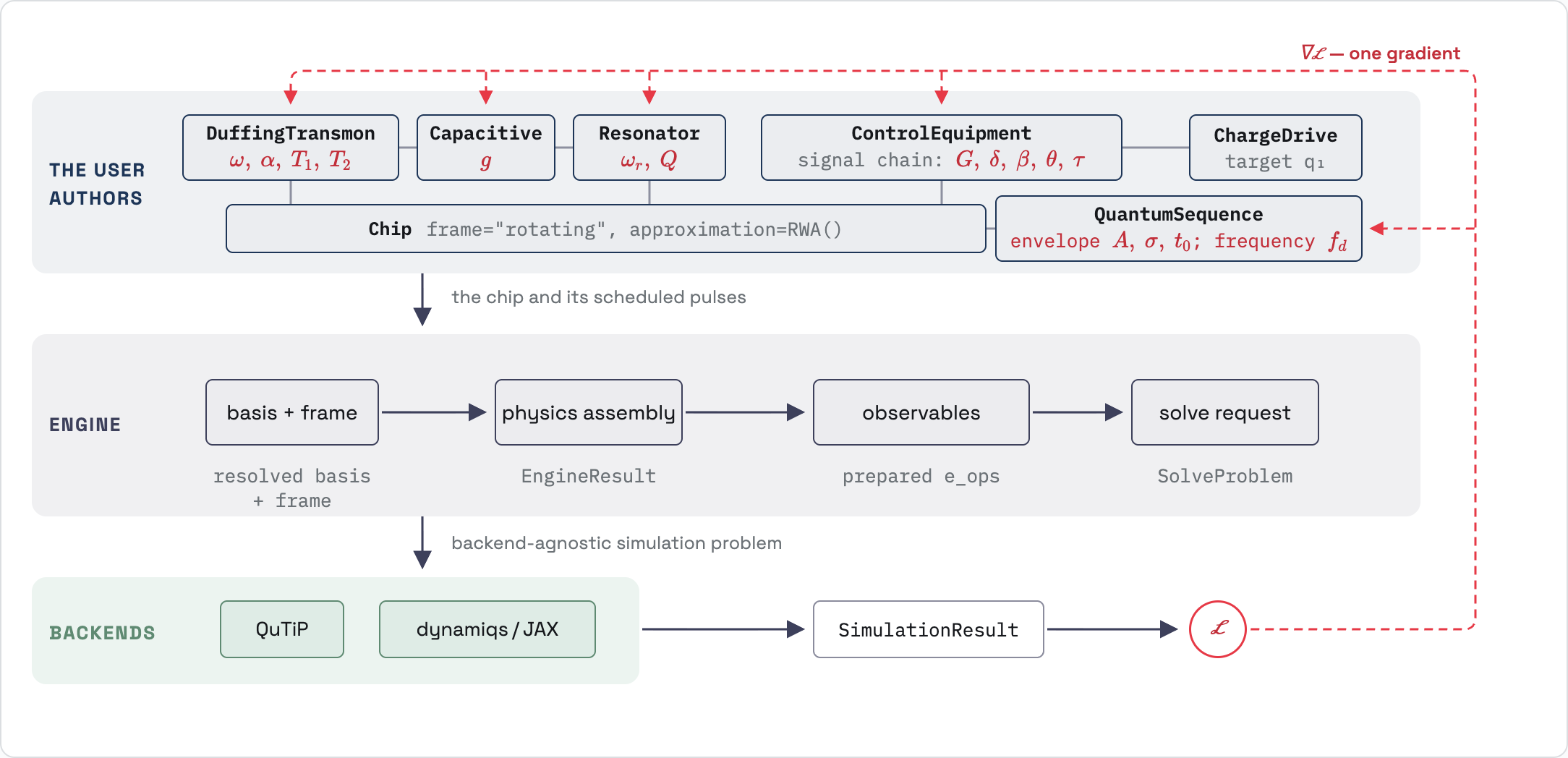
Chip + QuantumSequence → ResolvedFrame → EngineResult → SolveProblem → QuTiP or dynamiqs → SimulationResult
QuTiP is the default backend. The dynamiqs backend is JAX-native and keeps declared device and control parameters differentiable through the solve. The optional scqubits integration imports and exports selected device and composite models.
quchip uses GHz for ordinary frequencies, ns for time, and mK for temperature. The implemented conventions and approximations are documented in the physics guide.
Install
quchip requires Python 3.11 or newer.
python -m pip install quchip
Optional extras are available for the dynamiqs backend, graph visualization, and scqubits interoperability:
python -m pip install 'quchip[dynamiqs]'
python -m pip install 'quchip[viz]'
python -m pip install 'quchip[scqubits]'
Extras can be combined. To install the current source instead:
git clone https://github.com/quchip/quchip.git
cd quchip
python -m pip install .
Declare and inspect a chip
from quchip import RWA, Capacitive, ChargeDrive, Chip, DuffingTransmon, Resonator

qubit = DuffingTransmon(freq=5.0, anharmonicity=-0.30, levels=6, label="q")
readout = Resonator(freq=6.8, levels=10, quality_factor=6800, label="r")
coupling = Capacitive(qubit, readout, g=0.060, label="qr")
chip = Chip(
    [qubit, readout],
    couplings=[coupling],
    frame="rotating",
    approximation=RWA(),
)
qubit_line = ChargeDrive(qubit, label="qubit-charge")
readout_line = ChargeDrive(readout, label="readout-charge")
chip.wire(qubit_line, readout_line)

authored_hamiltonian = chip.unresolved_hamiltonian()
resolved_hamiltonian = chip.hamiltonian()

f01 = chip.freq(qubit)
f12 = chip.transition_frequency(qubit, 1, 2)
fr0 = chip.freq(readout, when={qubit: 0})
fr1 = chip.freq(readout, when={qubit: 1})
The authored Hamiltonian preserves the device and coupling expressions in their
declared local spaces. The resolved view applies the chip's basis, frame, and
approximation strategy through the same engine path used by simulation. Both remain
inspectable symbolic expressions; call .matrix() when a numerical array is
needed.
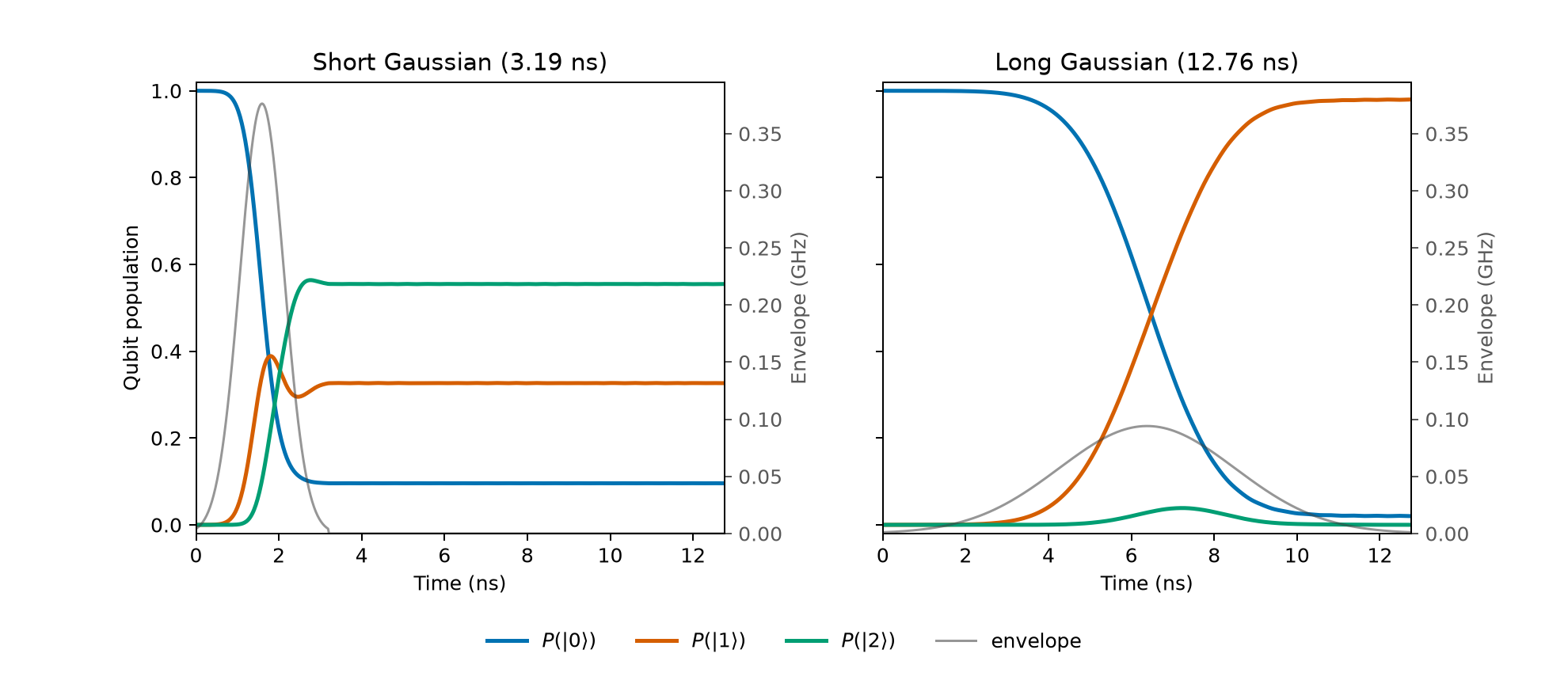
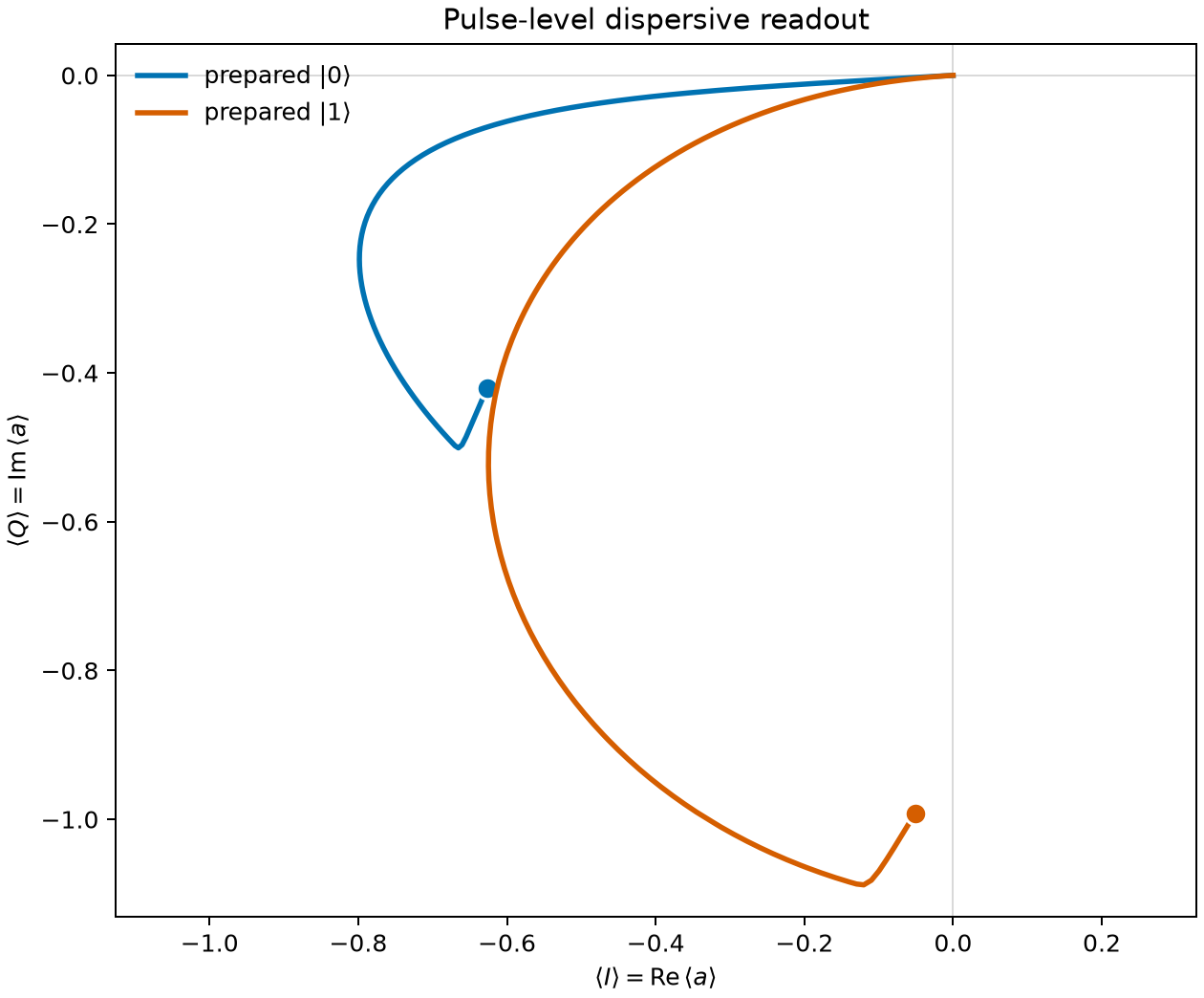
The complete example derives short and selective nominal-pi Gaussian drives from $|f_{12}-f_{01}|$, then derives a Gaussian-edge readout duration from the conditional pull and resonator linewidth. Both parts run the real multilevel, lossy chip with compact reproducibility receipts.
The complete walkthrough is available in the documentation.
Examples
- Hello, drive and readout: compare qubit-drive leakage, then resolve pulse-level dispersive readout on the same chip.
- Cookbook: practical conventions and task recipes.
- Extension guide: author devices, couplings, time-dependent terms, drives, envelopes, dissipation, local spaces, and interop mappings.
Project status and contributing
quchip is under active development. While it remains in 0.x, minor releases may refine public APIs; see the changelog.
Report bugs and model requests through GitHub Issues. Use Discussions for questions and open-ended proposals. See the contributing guide before making code or physics changes.
Paper and citation
The accompanying paper is quchip: A Differentiable Toolkit for Modeling Quantum Devices (arXiv:2607.17081).
The interactive walkthrough follows one five-device model through declaration, crosstalk identification and correction, adiabatic reduction from 576 to 16 dimensions, and gradient-based recovery of four directed crosstalk parameters.
If you use quchip in your work, please cite it:
@misc{alyousef2026quchip,
      title={quchip: A Differentiable Toolkit for Modeling Quantum Devices},
      author={Ibraheem AlYousef},
      year={2026},
      eprint={2607.17081},
      archivePrefix={arXiv},
      primaryClass={quant-ph},
      doi={10.48550/arXiv.2607.17081},
      url={https://arxiv.org/abs/2607.17081},
}
Citation metadata for the software itself is in CITATION.cff.
License
quchip is distributed under the Apache License 2.0. See LICENSE.
1 maintainer

Download files
Download the file for your platform. If you're not sure which to choose, learn more about installing packages.
Source Distribution
Built Distribution
Filter files by name, interpreter, ABI, and platform.
If you're not sure about the file name format, learn more about wheel file names.
Copy a direct link to the current filters
File details
Details for the file quchip-0.2.0.tar.gz.
File metadata
- Download URL: quchip-0.2.0.tar.gz
- Upload date:
- Size: 1.7 MB
- Tags: Source
- Uploaded using Trusted Publishing? Yes
- Uploaded via:
twine/7.0.0 CPython/3.13.14
File hashes
| Algorithm | Hash digest | |
|---|---|---|
| SHA256 |
94b3157ed175dec31fce38501f9e96fc4ebc64f70e3d50baf122ff6f7ac648da
|
|
| MD5 |
dcd8142b5685a9db52ef65e6528bfbd5
|
|
| BLAKE2b-256 |
f9a1767e9af91a3fe0a331bf0cdce2e9de6d8fa7acac0f014bb7cdf4a352229a
|
Provenance
The following attestation bundles were made for quchip-0.2.0.tar.gz:
Publisher:
release.yml on quchip/quchip
-
Statement:
-
Statement type:
https://in-toto.io/Statement/v1 -
Predicate type:
https://docs.pypi.org/attestations/publish/v1 -
Subject name:
quchip-0.2.0.tar.gz -
Subject digest:
94b3157ed175dec31fce38501f9e96fc4ebc64f70e3d50baf122ff6f7ac648da - Sigstore transparency entry: 2520003190
- Sigstore integration time:
-
Permalink:
quchip/quchip@6085f82e8a7ec2ad37b9553a805c30df473f1512 -
Branch / Tag:
refs/tags/v0.2.0 - Owner: https://github.com/quchip
-
Access:
public
-
Token Issuer:
https://token.actions.githubusercontent.com -
Runner Environment:
github-hosted -
Publication workflow:
release.yml@6085f82e8a7ec2ad37b9553a805c30df473f1512 -
Trigger Event:
push
-
Statement type:
File details
Details for the file quchip-0.2.0-py3-none-any.whl.
File metadata
- Download URL: quchip-0.2.0-py3-none-any.whl
- Upload date:
- Size: 453.9 kB
- Tags: Python 3
- Uploaded using Trusted Publishing? Yes
- Uploaded via:
twine/7.0.0 CPython/3.13.14
File hashes
| Algorithm | Hash digest | |
|---|---|---|
| SHA256 |
19c8583957f8e8835ea00598f1cf89dbb41f4a44281ef616df56ba0b90c82c4d
|
|
| MD5 |
c0696f59fc32ab9c2d3a76694c9778e6
|
|
| BLAKE2b-256 |
60fe5ca30c23e2f2d3327203aecb205b28e16de8e7db6e170b917c4b5cbfab08
|
Provenance
The following attestation bundles were made for quchip-0.2.0-py3-none-any.whl:
Publisher:
release.yml on quchip/quchip
-
Statement:
-
Statement type:
https://in-toto.io/Statement/v1 -
Predicate type:
https://docs.pypi.org/attestations/publish/v1 -
Subject name:
quchip-0.2.0-py3-none-any.whl -
Subject digest:
19c8583957f8e8835ea00598f1cf89dbb41f4a44281ef616df56ba0b90c82c4d - Sigstore transparency entry: 2520003251
- Sigstore integration time:
-
Permalink:
quchip/quchip@6085f82e8a7ec2ad37b9553a805c30df473f1512 -
Branch / Tag:
refs/tags/v0.2.0 - Owner: https://github.com/quchip
-
Access:
public
-
Token Issuer:
https://token.actions.githubusercontent.com -
Runner Environment:
github-hosted -
Publication workflow:
release.yml@6085f82e8a7ec2ad37b9553a805c30df473f1512 -
Trigger Event:
push
-
Statement type:














