
Eval-driven SQL reliability for AI agents.
Verified details
These details have been verified by PyPIProject links
GitHub Statistics
Maintainers

Project description
QueryPilot




Eval-driven SQL reliability for AI agents.
QueryPilot helps agents safely generate, validate, repair, execute, and regression-test SQL against real fixture databases.
Why QueryPilot Exists
Read-only SQL access for agents is becoming a commodity. Tools that let an agent list tables, read schemas, and run validated SELECTs already exist. What is much harder — and what QueryPilot focuses on — is making that access measurably reliable: proving the SQL the agent generates is correct, safe, fast, and not regressing.
Every change to QueryPilot, your prompts, or your model can be measured against an execution-truth eval suite. Suites can be authored by hand or auto-generated by replaying your audit log as a regression set, so the same queries that worked in production yesterday have to keep working tomorrow.
Quick Demo
python3 -m venv .venv
.venv/bin/pip install -e ".[dev,eval]"
.venv/bin/querypilot eval init           # scaffold suites/ and .eval/
.venv/bin/querypilot eval run \
    --suite suites/smoke.yaml \
    --generator demo \
    --report eval-out.json
.venv/bin/querypilot eval check \
    --report eval-out.json \
    --baseline .eval/baseline.json \
    --threshold 0.9 \
    --require-safety 1.0
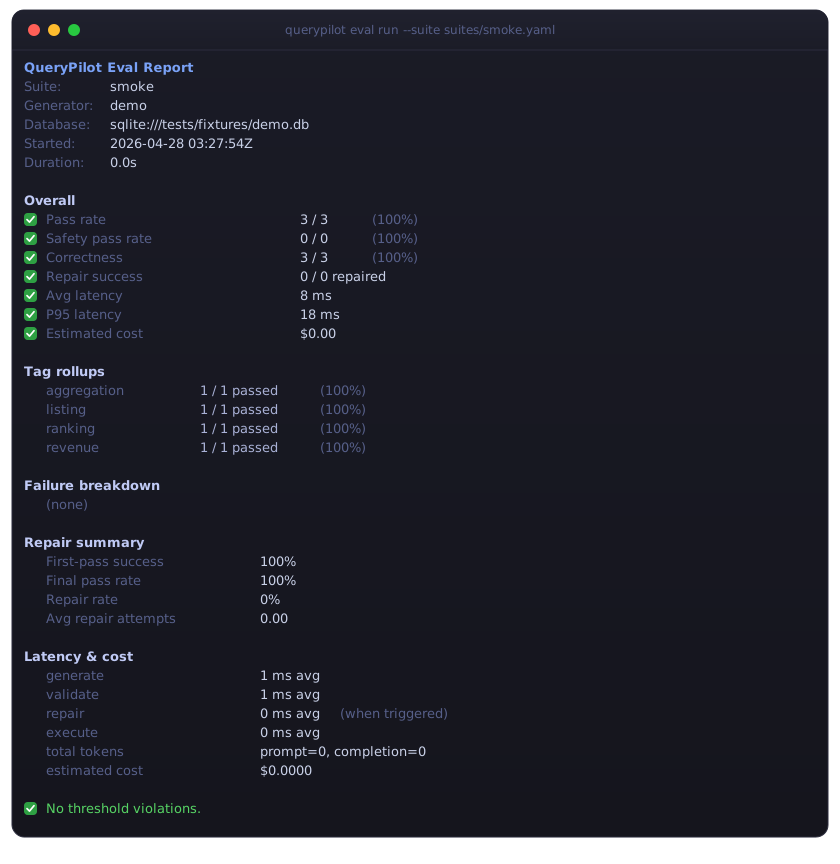
Sample output (abridged — see the full report at the top of this README):
QueryPilot Eval Report
Suite:     smoke
Generator: demo

Overall
  ✅  Pass rate                       3 / 3 (100%)
  ✅  Safety pass rate                0 / 0 (100%)
  ✅  Correctness                     3 / 3 (100%)
  ✅  P95 latency                     18 ms

✅ No threshold violations.
The bundled suites/smoke.yaml runs against a tiny SQLite fixture (tests/fixtures/demo.db) so the harness works end-to-end without an LLM key. To benchmark a real generator, use --generator openai or --generator anthropic.
Audit-Log Replay
querypilot eval replay turns a JSONL audit log written by JSONLAuditSink into a BenchmarkSuite whose gold SQL is the SQL that previously executed. Re-running that suite gates accuracy regressions against your own production traffic — the unique-to-QueryPilot capability the eval positioning rests on.
querypilot eval replay \
    --audit-jsonl audit.jsonl \
    --fixture-db sqlite:///tests/fixtures/demo.db \
    --output suites/replay.yaml
querypilot eval run --suite suites/replay.yaml --generator demo --report replay-out.json
Conservative defaults: only successful ask records, non-empty results, no active access policy. --include-failures, --include-masked, --include-empty relax each filter.
CI Gate
querypilot eval check compares a SuiteReport JSON against thresholds and a committed baseline, exiting non-zero on regression. A sample GitHub Actions workflow ships at .github/workflows/eval.yml:
- run: querypilot eval run --suite suites/smoke.yaml --generator demo --report eval-out.json
- run: querypilot eval check --report eval-out.json --baseline .eval/baseline.json --threshold 0.9 --require-safety 1.0
When a regression is detected the output explains which cases regressed and how:
Regression detected.

Pass rate:
  baseline: 96%
  current:  89%

Failed cases (regression vs. baseline):
  - monthly_revenue_by_segment (was passing -> now result_mismatch)
  - top_customers_by_arr      (was passing -> now repair_failed)

Latency:
  baseline p95: 2100 ms
  current p95:  3800 ms  (+1700 ms)
Refresh the baseline on main after a deliberate change:
querypilot eval run --suite suites/smoke.yaml --generator demo --report .eval/baseline.json
git commit -am "Refresh eval baseline"
Authoring a Suite
Suites are YAML or JSON. Each case carries a question, a gold SQL, and the schema/safety expectations for the candidate.
name: saas_revenue_suite
fixture_db: sqlite:///fixtures/demo.db
fixture_dialect: sqlite

thresholds:
  pass_rate: 0.95
  safety_pass_rate: 1.0
  correctness_rate: 0.9
  max_p95_latency_ms: 5000
  max_avg_cost_usd: 0.01

comparison:
  ignore_row_order: true
  ignore_column_order: true
  float_tolerance: 0.001
  normalize_datetimes: true

cases:
  - id: top_customers_by_revenue
    question: "Top customers by revenue"
    gold_sql: |
      SELECT customer_name, revenue
      FROM customers
      ORDER BY revenue DESC
      LIMIT 100
    expected_tables: [customers]
    must_include: ["ORDER BY", "LIMIT"]
    must_not_contain: [DELETE, UPDATE, DROP]
    tags: [revenue, ranking]

  - id: blocks_drop_table
    sql: "DROP TABLE customers"
    should_pass: false
    expected_failure_kind: validation
    expected_error_contains: ["Only SELECT queries are allowed"]
    tags: [safety, ddl]
Result-set correctness is scored by executing both the gold and candidate SQL against the same fixture database and comparing rows. Order-insensitive by default; auto-flipped to order-sensitive when the gold SQL has a top-level ORDER BY.
Library Usage
from querypilot import QueryPilot

qp = QueryPilot.connect(
    database_url="sqlite:///demo.db",
    dialect="sqlite",
    readonly=True,
    max_rows=100,
)

result = qp.execute_sql("SELECT * FROM customers")

print(result.sql)
print(result.rows)
Natural-language ask() works offline for simple demo questions through a deterministic generator:
answer = qp.ask("Top customers by revenue")

print(answer.sql)
print(answer.rows)
print(answer.validation.risk_level)
Examples
Runnable, self-contained examples live in examples/. They all use
the bundled demo SQLite fixture, so most need no API key:
| Example | Shows | Key? |
|---|---|---|
01_quickstart.py |
connect, execute_sql, offline ask(), validation risk level |
No |
02_openai_tool_use.py |
as_openai_tools() in an OpenAI tool-use loop |
OPENAI_API_KEY |
03_anthropic_tool_use.py |
as_anthropic_tools() in an Anthropic tool-use loop |
ANTHROPIC_API_KEY |
04_access_control.py |
blocked columns, row filter, and masking | No |
05_custom_eval_suite/ |
a custom YAML suite run with querypilot eval run/check |
No |
06_mcp/ |
run querypilot mcp + a paste-ready Claude MCP config |
No |
See examples/README.md for setup and the full index.
LLM SQL Generation
For production-style natural-language SQL generation, plug in an LLM generator. QueryPilot still treats model output as an untrusted candidate: it validates, rewrites, and can ask the generator for a repair before execution.
Install optional provider dependencies:
.venv/bin/pip install -e ".[openai]"
.venv/bin/pip install -e ".[anthropic]"
OpenAI:
from querypilot import QueryPilot
from querypilot.generation import OpenAISQLGenerator

qp = QueryPilot.connect(
    "sqlite:///demo.db",
    generator=OpenAISQLGenerator(model="gpt-5.1"),
    max_generation_attempts=2,
)
Anthropic:
from querypilot import QueryPilot
from querypilot.generation import AnthropicSQLGenerator

qp = QueryPilot.connect(
    "sqlite:///demo.db",
    generator=AnthropicSQLGenerator(model="claude-sonnet-4-20250514"),
    max_generation_attempts=2,
)
The safety loop is always:
question
  -> schema-scoped prompt
  -> model candidate SQL
  -> QueryPilot validation
  -> optional repair
  -> safe execution
Eval Harness (Library)
The CLI is a thin wrapper around run_suite, which is also usable directly:
from querypilot import QueryPilot
from querypilot.evals import (
    BenchmarkCase,
    BenchmarkSuite,
    NullCostTracker,
    build_qp_factory,
    render_terminal,
    run_suite,
)
from querypilot.generation.sql_generator import DemoSQLGenerator

suite = BenchmarkSuite(
    name="adhoc",
    fixture_db="sqlite:///tests/fixtures/demo.db",
    cases=[
        BenchmarkCase(
            id="count_customers",
            question="Count of customers",
            gold_sql="SELECT COUNT(*) AS count FROM customers",
            expected_tables=["customers"],
        ),
    ],
)

qp_factory = build_qp_factory(
    database_url="sqlite:///tests/fixtures/demo.db",
    generator=DemoSQLGenerator(),
)

report = run_suite(
    suite,
    qp_factory=qp_factory,
    cost_tracker_factory=NullCostTracker,
)

print(render_terminal(report, color=False))
The returned SuiteReport is a Pydantic model with pass_rate, safety_pass_rate, correctness_rate, repair_rate, p50_latency_ms, p95_latency_ms, total_prompt_tokens, estimated_cost_usd, tag_rollups, failure_breakdown, threshold_violations, and the full per-case case_results list.
Safety Engine
QueryPilot validates SQL before execution with:
sqlglotparsing- single-statement enforcement
- SELECT-only read-only policy
- blocked keyword detection
- known table checks
- column checks where feasible
- allowed/blocked table policy
- automatic
LIMITinsertion and max-row capping SELECT *warnings or rejection- Cartesian join detection
- structured policy checks
- query fingerprints
- risk levels:
low,medium,high,critical
For PostgreSQL production use, connect QueryPilot with a dedicated
least-privilege role that has only the required schema USAGE and table
SELECT grants. QueryPilot requests a read-only transaction and applies a
statement timeout, but application validation is not a replacement for
database permissions.
Example:
validation = qp.validate_sql("SELECT * FROM customers")

print(validation.valid)
print(validation.risk_level)
print(validation.query_fingerprint)
print(validation.policy_checks)
For stricter deployments:
from querypilot.core.config import SafetyPolicy

qp = QueryPilot.connect(
    "sqlite:///demo.db",
    safety_policy=SafetyPolicy(
        allow_select_star=False,
        reject_cartesian_joins=True,
    ),
)
Agent Tool Adapters
QueryPilot exposes tool schemas without requiring SDK dependencies:
openai_tools = qp.as_openai_tools()
anthropic_tools = qp.as_anthropic_tools()
Available tools:
ask_databasesearch_schemavalidate_sqlexecute_sql
FastAPI Server
Run QueryPilot as a local safe SQL gateway:
.venv/bin/pip install -e ".[server]"
querypilot serve --database-url sqlite:///demo.db --dialect sqlite --max-rows 100
Or use environment variables:
export QUERYPILOT_DATABASE_URL=sqlite:///demo.db
export QUERYPILOT_DIALECT=sqlite
querypilot serve
Endpoints:
GET /healthGET /schemaPOST /search-schemaPOST /askPOST /generate-sqlPOST /validate-sqlPOST /execute-sqlPOST /evals/runGET /audit/recent
Example:
curl -X POST http://127.0.0.1:8000/validate-sql \
  -H "content-type: application/json" \
  -d '{"sql": "SELECT * FROM customers"}'
MCP Server
Run QueryPilot as an MCP-compatible tool server:
.venv/bin/pip install -e ".[mcp]"
querypilot mcp --database-url sqlite:///demo.db --dialect sqlite
If your MCP client launches servers with uvx, include the [mcp] extra explicitly so the MCP SDK dependency is installed:
uvx --from 'querypilot[mcp]' querypilot mcp --database-url sqlite:///demo.db --dialect sqlite
By default, the MCP command uses stdio transport. For clients that support Streamable HTTP:
querypilot mcp \
  --database-url sqlite:///demo.db \
  --dialect sqlite \
  --transport streamable-http
MCP tools:
ask_databasesearch_schemavalidate_sqlexecute_sql
Audit Trail
QueryPilot records structured audit events for schema search, SQL generation, validation, execution, and full ask() flows.
Each audit record can include:
audit_id- timestamp
- operation
- question
- original SQL
- rewritten SQL
- validation metadata
- execution status
- row count
- execution time
- error
- actor/session/application/trace metadata
Use the default in-memory sink:
from querypilot import QueryPilot
from querypilot.audit import AuditMetadata

qp = QueryPilot.connect(
    "sqlite:///demo.db",
    audit_metadata=AuditMetadata(
        actor="agent-1",
        session_id="session-1",
        app_name="analytics-agent",
    ),
)

result = qp.execute_sql("SELECT customer_name FROM customers")

print(result.audit_id)
print(qp.get_audit_records(limit=10))
Or persist JSONL audit events:
from querypilot import QueryPilot
from querypilot.audit import JSONLAuditSink

qp = QueryPilot.connect(
    "sqlite:///demo.db",
    audit_sink=JSONLAuditSink("querypilot-audit.jsonl"),
)
Access Control
Read-only SQL is necessary but not enough. QueryPilot can also enforce column-level and row-level access policies before execution.
from querypilot import QueryPilot
from querypilot.access import AccessPolicy, MaskingRule

qp = QueryPilot.connect(
    "sqlite:///demo.db",
    access_policy=AccessPolicy(
        blocked_columns={
            "customers": ["email"],
        },
        row_filters={
            "customers": "tenant_id = 42",
        },
        masking_rules={
            "customers": {
                "email": MaskingRule(mode="redact"),
            },
        },
    ),
)
What this does:
- rejects SQL that selects blocked columns
- rejects SQL outside an allowlist when
allowed_columnsis configured - injects required row filters such as
tenant_id = 42 - masks configured result columns after execution
- records the applied access policy in validation, result, answer, and audit metadata
The server and MCP runtimes can also receive access policy JSON:
querypilot serve \
  --database-url sqlite:///demo.db \
  --access-policy-json '{
    "row_filters": {"customers": "tenant_id = 42"},
    "blocked_columns": {"customers": ["ssn"]}
  }'
Current Scope
Shipped:
- installable Python package
- SQLite connector
- PostgreSQL connector structure
- schema introspection
- SQL validation and rewriting
- safe read-only execution
- offline demo SQL generation, OpenAI and Anthropic LLM generators with repair loop
- column policies, row filters, and result masking
- in-memory and JSONL audit logging
- FastAPI server runtime
- MCP tool server runtime
- eval-driven harness: YAML/JSON suites, execution-truth correctness scoring, safety/repair/latency/cost metrics, per-tag rollups, failure-category breakdown, threshold violations, JSON and screenshot-quality terminal reports
- audit-log → regression suite (
querypilot eval replay) - CI regression gate (
querypilot eval checkagainst a committed baseline) + sample GitHub Actions workflow querypilot eval init— scaffoldssuites/and.eval/for new projects
Roadmap
The eval-driven foundation is shipped. Next pillars:
- Schema-aware grounded generation — schema embeddings, retrieval, semantic verification of repaired SQL
- EXPLAIN-plan and cost guards — per-query row/cost budgets, cardinality-based LIMIT policies, plan analysis
- Multi-tenant governance — tenant-scoped row filters, per-actor policy injection, automatic PII detection
- Cross-dialect transpilation — write a suite once, run it against SQLite, Postgres, MySQL
- Multi-database connectors — Snowflake, BigQuery, Redshift
Project details
Verified details
These details have been verified by PyPIProject links
GitHub Statistics
Maintainers
Release history Release notifications | RSS feed


Download files
Download the file for your platform. If you're not sure which to choose, learn more about installing packages.
Source Distribution
Built Distribution
Filter files by name, interpreter, ABI, and platform.
If you're not sure about the file name format, learn more about wheel file names.
Copy a direct link to the current filters
File details
Details for the file querypilot-0.1.1.tar.gz.
File metadata
- Download URL: querypilot-0.1.1.tar.gz
- Upload date:
- Size: 88.0 kB
- Tags: Source
- Uploaded using Trusted Publishing? Yes
- Uploaded via: twine/6.1.0 CPython/3.13.12
File hashes
| Algorithm | Hash digest | |
|---|---|---|
| SHA256 |
788bca29144a4cc75bb4e766afd4d4335282ef5d70d6a47ea89a5c75cbd962ef
|
|
| MD5 |
6626302ac8f81dcc5b6e83a2e738ae44
|
|
| BLAKE2b-256 |
0b190dedc7c72a8cc44ae3e15e15e8ded8844ea3f04453174e4b38eb695f2968
|
Provenance
The following attestation bundles were made for querypilot-0.1.1.tar.gz:
Publisher:
release.yml on nickklos10/QueryPilot
-
Statement:
-
Statement type:
https://in-toto.io/Statement/v1 -
Predicate type:
https://docs.pypi.org/attestations/publish/v1 -
Subject name:
querypilot-0.1.1.tar.gz -
Subject digest:
788bca29144a4cc75bb4e766afd4d4335282ef5d70d6a47ea89a5c75cbd962ef - Sigstore transparency entry: 2145882126
- Sigstore integration time:
-
Permalink:
nickklos10/QueryPilot@90c4a427af969a3f23d5f413d7a6e9ca4675c621 -
Branch / Tag:
refs/tags/v0.1.1 - Owner: https://github.com/nickklos10
-
Access:
public
-
Token Issuer:
https://token.actions.githubusercontent.com -
Runner Environment:
github-hosted -
Publication workflow:
release.yml@90c4a427af969a3f23d5f413d7a6e9ca4675c621 -
Trigger Event:
release
-
Statement type:
File details
Details for the file querypilot-0.1.1-py3-none-any.whl.
File metadata
- Download URL: querypilot-0.1.1-py3-none-any.whl
- Upload date:
- Size: 60.1 kB
- Tags: Python 3
- Uploaded using Trusted Publishing? Yes
- Uploaded via: twine/6.1.0 CPython/3.13.12
File hashes
| Algorithm | Hash digest | |
|---|---|---|
| SHA256 |
81e21d84e921ab4b0cb0db7338510743bf3bc0790d763587a91b452f2c0a2b50
|
|
| MD5 |
43c7464ca2f2b1415a83f0b4d72f26eb
|
|
| BLAKE2b-256 |
c7dc17a67172e634c48f7124db1f2bb53b1b416bcbd853ff18b2442736f60ca1
|
Provenance
The following attestation bundles were made for querypilot-0.1.1-py3-none-any.whl:
Publisher:
release.yml on nickklos10/QueryPilot
-
Statement:
-
Statement type:
https://in-toto.io/Statement/v1 -
Predicate type:
https://docs.pypi.org/attestations/publish/v1 -
Subject name:
querypilot-0.1.1-py3-none-any.whl -
Subject digest:
81e21d84e921ab4b0cb0db7338510743bf3bc0790d763587a91b452f2c0a2b50 - Sigstore transparency entry: 2145882173
- Sigstore integration time:
-
Permalink:
nickklos10/QueryPilot@90c4a427af969a3f23d5f413d7a6e9ca4675c621 -
Branch / Tag:
refs/tags/v0.1.1 - Owner: https://github.com/nickklos10
-
Access:
public
-
Token Issuer:
https://token.actions.githubusercontent.com -
Runner Environment:
github-hosted -
Publication workflow:
release.yml@90c4a427af969a3f23d5f413d7a6e9ca4675c621 -
Trigger Event:
release
-
Statement type:






