
quyuan
quyuan is a folk of tagore with several modifications to make it more suitable for my own use.
Installation
quyuan is a simple Python script with several dependencies.
$ pip install git+https://github.com/tcztzy/quyuan.git
$ quyuan --version
quyuan, version 1.1.2
Requirements
Quick start
The demo data consists of Catalogue of Somatic Mutations in Cancer (COSMIC) Cancer Gene Census genes and 100 randomly simulated mutations. Points represent single nucleotide variants (i.e. variant present in <3 samples); triangles represent single nucleotide polymorphisms (i.e. variants found in many samples); and short lines (single chromosome) represent known INDEL sites.
$ quyuan --input example_ideogram/test.bed --prefix example_ideogram/example -vf
Usage
Usage: quyuan [OPTIONS]

  quyuan: a utility for illustrating human chromosomes
  https://github.com/tcztzy/quyuan

Options:
  --version                       Show the version and exit.
  -i, --input <input.bed>         Input BED-like file  [required]
  -p, --prefix [output file prefix]
                                  Output prefix [Default: "out"]
  -b, --build [hg37|hg38|irgsp1]  Human genome build to use [Default: hg38]
  -f, --force                     Overwrite output files if they exist already
  -ofmt, --oformat [png|pdf|ps|svg]
                                  Output format for conversion
  -v, --verbose                   Display verbose output
  --help                          Show this message and exit.
The input file is a bed-like format, described below. If an output prefix is not specified, the scripts uses "out" as the default prefix.
Helper scripts for converting RFMix and ADMIXTURE outputs are included in the scripts/ folder.
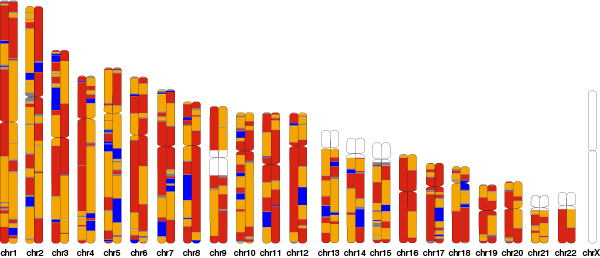
A more complete example of a full chromosome painting using an RFMix output can be seen by running:
rfmix2tagore --chr1 example_ideogram/1KGP-MXL104_chr1.bed \
	--chr2 example_ideogram/1KGP-MXL104_chr2.bed \
	--out example_ideogram/1KGP-MXL104_tagore.bed

quyuan --input example_ideogram/1KGP-MXL104_tagore.bed \
	--prefix example_ideogram/1KGP-MXL104 \
  --build hg37 \
  --verbose
Input file description
#chr	start	stop	feature	size	color	chrCopy
chr1	10000000	20000000	0	1	#FF0000	1
chr2	20000000	30000000	0	1	#FF0000	2
chr2	40000000	50000000	0	0.5	#FF0000	1
Each column is explained below:
- chr - The chromosome on which a feature has to be drawn
- start - Start position (in bp) for feature
- stop - Stop position (in bp) for feature
- feature - The shape of the feature to be drawn
- 0 will draw a rectangle
- 1 will draw a circle
- 2 will draw a triangle pointing to the genomic location
- 3 will draw a line at that genomic location
- size - The horizontal size of the feature. Should range between 0 and 1.
- color - Specify the color of the genomic feature with a hex value (#FF0000 for red, etc.)
- chrCopy - Specify the chromosome copy on which the feature should be drawn (1 or 2). To draw the same feature on both chromosomes, you must specify the feature twice
Etymology
Qu Yuan (屈原) was a Chinese patriot poet and politician living in c.340BC - 278BC.
1 maintainer

Metadata
1 maintainer
Release files for quyuan 1.1.3
For a detailed explanation of source distributions (sdists) and built distributions (wheels), please see the package formats documentation.
Built distribution (wheel)
| File | Interpreter | ABI | Platform | Reset |
|---|---|---|---|---|
| quyuan-1.1.3-py3-none-any.whl | Python 3 | none | any | Details |
Release files / quyuan-1.1.3-py3-none-any.whl
| Download URL | quyuan-1.1.3-py3-none-any.whl |
|---|---|
| Size | 26.3 kB |
| Tags | Python 3 |
|
SHA-256 checksum How to use checksums |
129d6085203b37a9a31cc5bea47041db1aeb4d42f8754751fb2cf807ad1a1720
|
|
BLAKE2b-256 checksum How to use checksums |
62c419845da28bbda6a2a78ac4de8adf99fcb2ba2f201e810ae33ba429fe9341
|
| Upload date | |
|
Uploaded using Trusted Publishing? What is trusted publishing? |
No |
| Uploaded via |
twine/4.0.2 CPython/3.11.3
|
Security for quyuan 1.1.3
Provenance
Provenance describes where a file came from. On PyPI, provenance is shared via attestations, which provide a verifiable record of the build or publishing details. View details, limitations and caveats.
No provenance found
None of the files in this release were uploaded with provenance metadata.
A note on package security
PyPI is a repository for distributing packages, not a service for auditing them. While third-party security researchers and our staff do their best to detect and remove malicious packages, PyPI cannot guarantee the quality, security or suitability of any given package.
To learn more about protecting yourself from malicious actors, visit our package security documentation.













