
The Deterministic Verification Protocol for AI - 8 verification engines for math, logic, code, SQL, facts, images, and more.
Verified details
These details have been verified by PyPIProject links
Owner
GitHub Statistics
Maintainers

Project description

QWED Protocol
The Deterministic Verification Layer for AI
QWED Verification - Production-grade deterministic verification layer for Large Language Models (LLMs). Detect and prevent AI hallucinations through 8 specialized verification engines. Open-source Python framework for AI safety, LLM accuracy testing, and model output validation.
Don't fix the liar. Verify the lie.
QWED does not reduce hallucinations. It makes them irrelevant.
If an AI output cannot be proven, QWED will not allow it into production.











Quick Start · The Problem · The 8 Engines · FAQ · 📄 Whitepaper · 📚 Docs
⚠️ What QWED Is (and Isn't)
QWED is: An open-source engineering tool that combines existing verification libraries (SymPy, Z3, SQLGlot, AST) into a unified API for LLM output validation.
QWED is NOT: Novel research. We don't claim algorithmic innovation. We claim practical integration for production use cases.
Works when: Developer provides ground truth (expected values, schemas, contracts) and LLM generates structured output.
Doesn't work when: Specs come from natural language, outputs are freeform text, or verification domain is unsupported.
🚀 Quick Start: Install & Verify in 30 Seconds
# Install from PyPI (Recommended)
pip install qwed

# Or install from source
git clone https://github.com/QWED-AI/qwed-verification.git
cd qwed-verification
pip install -e .
from qwed_sdk import QWEDClient

client = QWEDClient(api_key="your_key")

# The LLM says: "Derivative of x^2 is 3x" (Hallucination!)
response = client.verify_math(
    query="What is the derivative of x^2?",
    llm_output="3x"
)

print(response)
# -> ❌ CORRECTED: The derivative is 2x. (Verified by SymPy)
🚨 The LLM Hallucination Problem: Why AI Can't Be Trusted
Everyone is trying to fix AI hallucinations by Fine-Tuning (teaching it more data).
This is like forcing a student to memorize 1,000,000 math problems.
What happens when they see the 1,000,001st problem? They guess.
📊 The Proof: Why Enterprise AI Needs QWED Verification
We benchmarked Claude Opus 4.5 (one of the world's best LLMs) on 215 critical tasks.

| Finding | Implication |
|---|---|
| Finance: 73% accuracy | Banks can't use raw LLM for calculations |
| Adversarial: 85% accuracy | LLMs fall for authority bias tricks |
| QWED: 100% error detection | All 22 errors caught before production |
QWED doesn't compete with LLMs. We ENABLE them for production use.
🎯 Use Cases & Applications
QWED is designed for industries where AI errors have real consequences:
| Industry | Use Case | Risk Without QWED |
|---|---|---|
| 🏦 Financial Services | Transaction validation, fraud detection | $12,889 error per miscalculation |
| 🏥 Healthcare AI | Drug interaction checking, diagnosis verification | Patient safety risks |
| ⚖️ Legal Tech | Contract analysis, compliance checking | Regulatory violations |
| 📚 Educational AI | AI tutoring, assessment systems | Misinformation to students |
| 🏭 Manufacturing | Process control, quality assurance | Production defects |
✅ The Solution: Give the AI a Calculator
QWED doesn't try to make the LLM "smarter".
It treats the LLM as an untrusted translator and verifies its output using Deterministic Engines (SymPy, Z3, SQLGlot, AST).
"If an AI writes code, QWED runs the security audit.
If an AI does math, QWED runs the calculus."
┌──────────────┐
│  User Query  │
└──────┬───────┘
       │
       ▼
┌──────────────────┐
│ LLM (The Guesser)│
│ GPT-4 / Claude   │
└──────┬───────────┘
       │ Unverified Output
       ▼
┌────────────────────┐
│  QWED Protocol     │
│  (Verification)    │
└──────┬─────────────┘
       │
   ┌───┴────┐
   ▼        ▼
❌ Reject  ✅ Verified
            │
            ▼
   ┌────────────────┐
   │ Your Application│
   └────────────────┘
QWED 🆚 Traditional AI Safety Approaches
| Approach | Accuracy | Deterministic | Explainable | Best For |
|---|---|---|---|---|
| QWED Verification | ✅ 99%+ | ✅ Yes | ✅ Full trace | Production AI |
| Fine-tuning / RLHF | ⚠️ ~85% | ❌ No | ❌ Black box | General improvement |
| RAG (Retrieval) | ⚠️ ~80% | ❌ No | ⚠️ Limited | Knowledge grounding |
| Prompt Engineering | ⚠️ ~70% | ❌ No | ⚠️ Limited | Quick fixes |
| Guardrails | ⚠️ Variable | ❌ No | ⚠️ Reactive | Content filtering |
QWED doesn't replace these - it complements them with mathematical certainty.
🔧 The 8 Verification Engines: How QWED Validates LLM Outputs
We don't use another LLM to check your LLM. That's circular logic.
We use Hard Engineering:
| Engine | Tech Stack | What it Solves |
|---|---|---|
| 🧮 Math Verifier | SymPy + NumPy |
Calculus, Linear Algebra, Finance. No more $1 + $1 = $3. |
| ⚖️ Logic Verifier | Z3 Prover |
Formal Verification. Checks for logical contradictions. |
| 🛡️ Code Security | AST + Semgrep |
Catches eval(), secrets, vulnerabilities before code runs. |
| 📊 Stats Engine | Pandas + Wasm |
Sandboxed execution for trusted data analysis. |
| 🗄️ SQL Validator | SQLGlot |
Prevents Injection & validates schema. |
| 🔍 Fact Checker | TF-IDF + NLI |
Checks grounding against source docs. |
| 👁️ Image Verifier | OpenCV + Metadata |
Verifies image dimensions, format, pixel data. |
| 🤝 Consensus Engine | Multi-Provider |
Cross-checks GPT-4 vs Claude vs Gemini. |
🧠 The QWED Philosophy: Verification Over Correction
| ❌ Wrong Approach | ✅ QWED Approach |
|---|---|
| "Let's fine-tune the model to be more accurate" | "Let's verify the output with math" |
| "Trust the AI's confidence score" | "Trust the symbolic proof" |
| "Add more training data" | "Add a verification layer" |
| "Hope it doesn't hallucinate" | "Catch hallucinations deterministically" |
QWED = Query with Evidence and Determinism
Probabilistic systems should not be trusted with deterministic tasks. If it can't be verified, it doesn't ship.
🔌 LLM Framework Integrations
Already using an Agent framework? QWED drops right in.
🦜 LangChain
from qwed_sdk.langchain import QWEDTool

tools = [QWEDTool(verification_type="math"), QWEDTool(verification_type="sql")]
🤖 CrewAI
from qwed_sdk.crewai import QWEDVerifiedAgent

agent = QWEDVerifiedAgent(role="Analyst", allow_dangerous_code=False)
🌍 Multi-Language SDK Support
| Language | Package | Status |
|---|---|---|
| 🐍 Python | qwed |
✅ Available on PyPI |
| 🟦 TypeScript | @qwed-ai/sdk |
✅ Available on npm |
| 🐹 Go | qwed-go |
🟡 Coming Soon |
| 🦀 Rust | qwed |
🟡 Coming Soon |
git clone https://github.com/QWED-AI/qwed-verification.git cd qwed-verification pip install -r requirements.txt
---

## 🎯 Real Example: The $12,889 Bug

**User asks AI:** "Calculate compound interest: $100K at 5% for 10 years"

**GPT-4 responds:** "$150,000"
*(Used simple interest by mistake)*

**With QWED:**
```python
response = client.verify_math(
    query="Compound interest: $100K, 5%, 10 years",
    llm_output="$150,000"
)
# -> ❌ INCORRECT: Expected $162,889.46
#    Error: Used simple interest formula instead of compound
Cost of not verifying: $12,889 error per transaction 💸
❓ Frequently Asked Questions
Q: How does QWED differ from RAG (Retrieval Augmented Generation)?
A: RAG improves the input to the LLM by grounding it in documents. QWED verifies the output deterministically. RAG adds knowledge; QWED adds certainty.
Q: Can QWED work with any LLM?
A: Yes! QWED is model-agnostic and works with GPT-4, Claude, Gemini, Llama, Mistral, and any other LLM. We verify outputs, not models.
Q: Does QWED replace fine-tuning?
A: No. Fine-tuning makes models better at tasks. QWED verifies they got it right. Use both.
Q: Is QWED open source?
A: Yes! Apache 2.0 license. Enterprise features (audit logs, multi-tenancy) are in a separate repo.
Q: What's the latency overhead?
A: Typically <100ms for most verifications. Math and logic proofs are instant. Consensus checks take longer (multiple API calls).
📚 Documentation & Resources
| Resource | Description |
|---|---|
| 📖 Full Documentation | Complete API reference and guides |
| 🔧 API Reference | Endpoints and schemas |
| 📊 Benchmarks | LLM accuracy testing results |
| 🤝 Contributing Guide | How to contribute to QWED |
| 🏗️ Architecture | System design and engine internals |
| 🔒 Security Policy | Reporting vulnerabilities |
🏢 Enterprise Features
Need observability, multi-tenancy, audit logs, or compliance exports?
📧 Contact: rahul@qwedai.com
📄 License
Apache 2.0 - See LICENSE
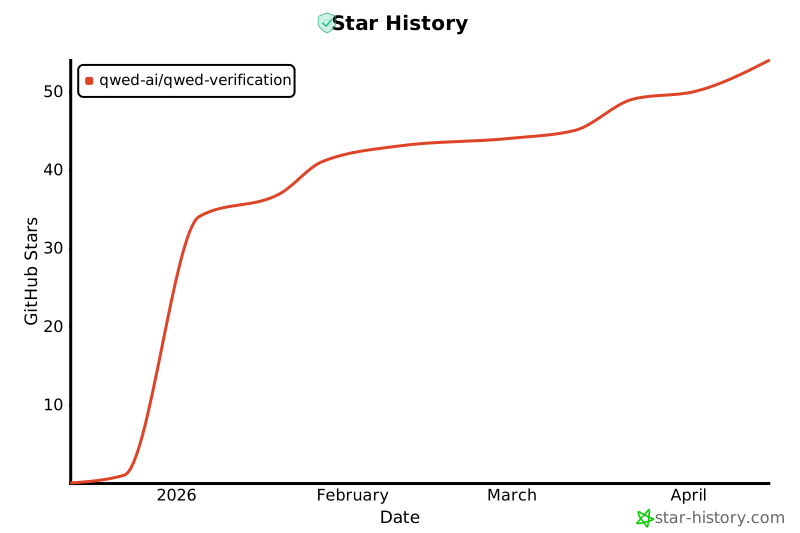
⭐ Star History
👥 Contributors

📄 Citation
If you use QWED in your research or project, please cite our archived paper:
@software{dass2025qwed,
  author = {Dass, Rahul},
  title = {QWED Protocol: Deterministic Verification for Large Language Models},
  year = {2025},
  publisher = {Zenodo},
  version = {v1.0.0},
  doi = {10.5281/zenodo.18110785},
  url = {https://doi.org/10.5281/zenodo.18110785}
}
Plain text:
Dass, R. (2025). QWED Protocol: Deterministic Verification for Large Language Models (Version v1.1.0). Zenodo. https://doi.org/10.5281/zenodo.18110785
✅ Using QWED in Your Project?
Add this badge to your README to show you're using verified AI:
[](https://github.com/QWED-AI/qwed-verification)
Preview:

This badge tells users that your LLM outputs are deterministically verified, not just "hallucination-prone guesses."
⭐ Star us if you believe AI needs verification
Ready to trust your AI?
"Safe AI is the only AI that scales."
Contribute · Architecture · Security · Documentation
Project details
Verified details
These details have been verified by PyPIProject links
Owner
GitHub Statistics
Maintainers
Release history Release notifications | RSS feed


Download files
Download the file for your platform. If you're not sure which to choose, learn more about installing packages.
Source Distribution
Built Distribution
Filter files by name, interpreter, ABI, and platform.
If you're not sure about the file name format, learn more about wheel file names.
Copy a direct link to the current filters
File details
Details for the file qwed-2.0.1.tar.gz.
File metadata
- Download URL: qwed-2.0.1.tar.gz
- Upload date:
- Size: 12.7 MB
- Tags: Source
- Uploaded using Trusted Publishing? Yes
- Uploaded via: twine/6.1.0 CPython/3.13.7
File hashes
| Algorithm | Hash digest | |
|---|---|---|
| SHA256 |
0836bd175fe28445d33b8a8837b45dc5d9a04e315aff1c8e8ff922acf086a8b4
|
|
| MD5 |
23627bc45804fed004d98ddd567f2822
|
|
| BLAKE2b-256 |
c13666b5d41f961c1239156aeed812b5926e0fb315df9c7df472a48160dfa1e0
|
Provenance
The following attestation bundles were made for qwed-2.0.1.tar.gz:
Publisher:
publish.yml on QWED-AI/qwed-verification
-
Statement:
-
Statement type:
https://in-toto.io/Statement/v1 -
Predicate type:
https://docs.pypi.org/attestations/publish/v1 -
Subject name:
qwed-2.0.1.tar.gz -
Subject digest:
0836bd175fe28445d33b8a8837b45dc5d9a04e315aff1c8e8ff922acf086a8b4 - Sigstore transparency entry: 786213761
- Sigstore integration time:
-
Permalink:
QWED-AI/qwed-verification@64f6441f102cb147e29fd3fc3afe6cb13fc2c28b -
Branch / Tag:
refs/tags/v2.0.1 - Owner: https://github.com/QWED-AI
-
Access:
public
-
Token Issuer:
https://token.actions.githubusercontent.com -
Runner Environment:
github-hosted -
Publication workflow:
publish.yml@64f6441f102cb147e29fd3fc3afe6cb13fc2c28b -
Trigger Event:
release
-
Statement type:
File details
Details for the file qwed-2.0.1-py3-none-any.whl.
File metadata
- Download URL: qwed-2.0.1-py3-none-any.whl
- Upload date:
- Size: 214.0 kB
- Tags: Python 3
- Uploaded using Trusted Publishing? Yes
- Uploaded via: twine/6.1.0 CPython/3.13.7
File hashes
| Algorithm | Hash digest | |
|---|---|---|
| SHA256 |
5484620e57ea0bb78b2f05311cf17391151cf090c70f05ef988456f322525d26
|
|
| MD5 |
87c107b9fe4f252d7adfbfa0d908db0f
|
|
| BLAKE2b-256 |
296ea81f7b561aa1d076907392646ac50484717b991a3cfe2e691f4b8c746926
|
Provenance
The following attestation bundles were made for qwed-2.0.1-py3-none-any.whl:
Publisher:
publish.yml on QWED-AI/qwed-verification
-
Statement:
-
Statement type:
https://in-toto.io/Statement/v1 -
Predicate type:
https://docs.pypi.org/attestations/publish/v1 -
Subject name:
qwed-2.0.1-py3-none-any.whl -
Subject digest:
5484620e57ea0bb78b2f05311cf17391151cf090c70f05ef988456f322525d26 - Sigstore transparency entry: 786213767
- Sigstore integration time:
-
Permalink:
QWED-AI/qwed-verification@64f6441f102cb147e29fd3fc3afe6cb13fc2c28b -
Branch / Tag:
refs/tags/v2.0.1 - Owner: https://github.com/QWED-AI
-
Access:
public
-
Token Issuer:
https://token.actions.githubusercontent.com -
Runner Environment:
github-hosted -
Publication workflow:
publish.yml@64f6441f102cb147e29fd3fc3afe6cb13fc2c28b -
Trigger Event:
release
-
Statement type:






