
Production-grade RabbitMQ toolkit — sync/async, decorator routing, retry, compression, full configurability
Verified details
These details have been verified by PyPIProject links
GitHub Statistics
Maintainers

Project description

rabbitkit
RabbitMQ made enjoyable — less broker plumbing, more business logic.






rabbitkit is a RabbitMQ-first toolkit for Python services. It gives you clean decorators, safe retries, dead-letter queues, publisher confirms, explicit acknowledgement policies, Kubernetes-ready lifecycle hooks, structured logging, OpenTelemetry tracing, and real in-memory testing — so your team can focus on what each message means, not how the broker behaves when things fail.
RabbitMQ is powerful. Production RabbitMQ is full of sharp edges. rabbitkit smooths those edges without hiding the broker from you.
from rabbitkit import AsyncBroker, RabbitConfig
from rabbitkit.serialization import JSONSerializer

broker = AsyncBroker(RabbitConfig(), serializer=JSONSerializer())

@broker.subscriber(queue="orders.created")
async def handle_order(order: dict) -> None:
    await fulfill_order(order)
That should feel like application code. The retry topology, acknowledgements, confirms, DLQs, shutdown behavior, and test harness should not be rewritten in every service. That is what rabbitkit is for.
Contents:
- Believes
- Why
- Install
- Quick start
- Safety model
- Failure table
- Ack policies
- Production profile
- Observability
- DI
- Middleware
- CLI
- Where it fits
- Performance
- Migrating
- Examples
- Architecture
- Docs
What rabbitkit believes
Most services need the same things:
- a clean way to register consumers
- safe retry behavior
- a place for poison messages to go
- publisher confirms that are checked
- explicit acknowledgement ownership
- graceful shutdown
- useful logs and traces
- health checks that behave correctly in Kubernetes
- tests that do not require a live broker
rabbitkit packages those concerns into one focused toolkit. The philosophy:
Make RabbitMQ pleasant for developers and predictable for operators.
Developers get a clean programming model. Operators get visible message outcomes. Production gets fewer silent failure paths.
Why rabbitkit exists
Starting with RabbitMQ is easy: basic_publish(...), basic_consume(...).
Then production asks better questions:
- What happens if a handler fails forever?
- Where does a malformed payload go?
- Can a rejected message disappear because the queue had no DLX?
- Did the retry publish confirm before the original was acknowledged?
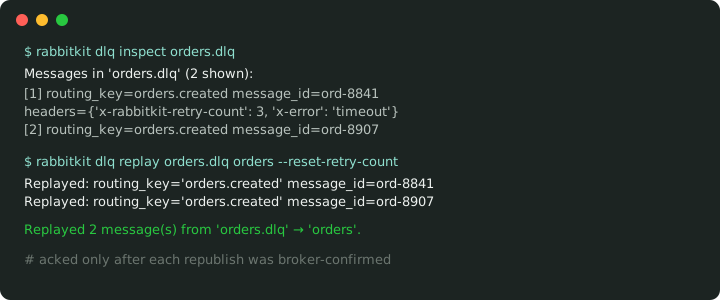
- Can a DLQ replay remove a message before the republish is confirmed?
- Can a pod shut down without interrupting in-flight work?
- Can CI test real consumer behavior without starting RabbitMQ?
rabbitkit exists for those questions. Its goal is not to turn RabbitMQ into something else — it is to make direct RabbitMQ usage feel like good application code: clear routing, safe defaults, explicit outcomes, real tests, production-ready lifecycle.
rabbitkit is:
- a RabbitMQ-first toolkit
- a clean consumer/publisher API
- a reliability layer over
pikaandaio-pika - a testing layer for handlers
- a production lifecycle layer
- safety defaults for retry, DLQ, confirms, and acks
rabbitkit is not:
- a task queue
- a scheduler
- a generic event-streaming abstraction
- a replacement for understanding RabbitMQ
- an exactly-once delivery system
Installation
Available on PyPI: pypi.org/project/rabbitkit
pip install rabbitkit[async]        # AsyncBroker (aio-pika)
pip install rabbitkit[sync]         # SyncBroker (pika)
pip install rabbitkit[all-brokers]  # both transports
pip install rabbitkit[all]          # everything optional
Requires Python ≥ 3.11.
The 10-minute path
A durable, retrying, DLQ-backed consumer — tested without a broker:
pip install rabbitkit[async]- Create an
AsyncBroker(RabbitConfig()) - Register a handler with
@broker.subscriber(queue=...) - Add
retry=RetryConfig(max_retries=3, delays=(5, 30, 120)) - Run it:
rabbitkit run myapp.main:broker - Test it in CI with
TestBroker— no RabbitMQ required
Each step is shown below.
Quick start
1. Create a consumer
from rabbitkit import RabbitConfig, AsyncBroker
from rabbitkit.serialization import JSONSerializer

# serializer= is what turns the raw bytes into your handler's annotation —
# without it, `body: dict` receives bytes.
broker = AsyncBroker(RabbitConfig(), serializer=JSONSerializer())

@broker.subscriber(queue="orders.created")
async def handle_order(body: dict) -> None:
    print(f"order id={body['id']}")

async def main() -> None:
    await broker.start()
That is enough to consume messages. But production usually needs more than "enough".
2. Publish — and check the outcome
async def publish_order() -> None:
    outcome = await broker.publish(
        exchange="orders",
        routing_key="orders.created",
        body={"id": 42, "item": "widget"},
    )
    outcome.raise_for_status()
A publish can be CONFIRMED, SENT, RETURNED, NACKED, TIMEOUT, or
ERROR. Application code can treat those as different states instead of
assuming "publish called" means "message safe".
3. Add retry and DLQ handling
from rabbitkit import RetryConfig

@broker.subscriber(
    queue="orders.created",
    exchange="orders",
    routing_key="orders.created",
    retry=RetryConfig(max_retries=3, delays=(5, 30, 120)),
)
async def handle_order_with_retry(body: dict) -> None:
    await fulfill_order(body)
This wires the reliability path — broker-side, carried in hardened headers, surviving crashes and reconnects:
orders.created
  → orders.created.retry.1   (5s)
  → orders.created.retry.2   (30s)
  → orders.created.retry.3   (120s)
  → orders.created.dlq
Transient failures retry with backoff. Permanent failures skip the ladder and go straight to the DLQ. By default, rejected messages do not disappear silently — every rejecting route gets a DLQ unless you explicitly opt into discard behavior.
4. Test it without RabbitMQ
from rabbitkit.testing import TestBroker
from rabbitkit.serialization import JSONSerializer

def test_order_handler():
    broker = TestBroker(serializer=JSONSerializer())

    @broker.subscriber(queue="orders.created")
    def handle(body: dict) -> None:
        assert body["id"] == 42

    broker.start()
    broker.publish("orders.created", b'{"id": 42}')
    broker.stop()
TestBroker is not a mock. It runs the real routing, middleware,
serialization, dependency resolution, settlement, and ack/nack pipeline in
memory. Your CI can test RabbitMQ behavior without running RabbitMQ.
5. Run with FastAPI
from contextlib import asynccontextmanager

from fastapi import FastAPI

from rabbitkit import RabbitConfig, AsyncBroker
from rabbitkit.fastapi import rabbitkit_lifespan

api_broker = AsyncBroker(RabbitConfig(), serializer=JSONSerializer())

@api_broker.subscriber(queue="orders.created")
async def handle_order_event(body: dict) -> None:
    ...

@asynccontextmanager
async def lifespan(app: FastAPI):
    async with rabbitkit_lifespan(broker=api_broker):
        yield

app = FastAPI(lifespan=lifespan)
Sync example
from rabbitkit import RabbitConfig
from rabbitkit.sync import SyncBroker

sync_broker = SyncBroker(RabbitConfig())

@sync_broker.subscriber(queue="orders.created")
def handle_order_sync(body: bytes) -> None:
    print(f"received order: {body!r}")

def main() -> None:
    # Blocks until SIGINT/SIGTERM or stop(); reconnects on connection drops
    # and drains in-flight work on pod termination.
    sync_broker.run()
The sync broker fits simple workers, scripts, legacy services, and teams
that do not want an asyncio runtime. Throughput note: sync confirmed
publishing waits one confirm per message (~0.9k msg/s measured);
worker_count does not raise it. For high-throughput confirmed publishing
use AsyncBroker + AsyncBatchPublisher (pipelined confirms, ~6.1k msg/s
measured) or SyncBatchPublisher (pipelined confirms for sync code on a
dedicated I/O thread), or scale out across processes.
Message safety model
rabbitkit is an at-least-once toolkit: a handler may run more than once (crash after work but before ack, connection death mid-handler, DLQ replay, producer retry after a confirm timeout…). rabbitkit removes dangerous ambiguity around those cases — it does not remove the need for idempotency.
For payments, emails, tickets, webhooks, external API calls: design the
handler so running it twice is safe (idempotency keys, unique constraints,
processed-event tables, outbox patterns — or rabbitkit's deduplication
middleware, whose store_results mode replays the original result to
duplicates). The rule is simple:
rabbitkit can help you retry safely. Your business logic must still be safe to retry.
What happens when things fail?
| Failure mode | rabbitkit behavior |
|---|---|
| Handler raises forever | Retry ladder, then DLQ |
| Malformed payload | Classified permanent, preserved in DLQ |
| Reject with no DLX | Safe default auto-provisions a DLQ — no silent discard |
| Retry publish times out | Original is not acked as if the retry succeeded |
| DLQ replay publish fails | DLQ message is not removed as if replay succeeded |
| Message unroutable | Mandatory publishing returns a distinct RETURNED outcome |
| Broker blips | Readiness changes; liveness does not kill the pod |
| Pod gets SIGTERM | Consumers stop first, in-flight work drains |
| CI has no RabbitMQ | TestBroker runs the real pipeline in memory |
Your own mistake (bad config, invalid topology, publish before start(), oversized body) |
A typed exception at the line that made it — ConfigValidationError, TopologyValidationError, BrokerNotStartedError, MessageTooLargeError, … — each subclassing the builtin (ValueError/RuntimeError) it replaces, so plain except ValueError still works |
Acknowledgement policies
Settlement is a decision, not a side effect hidden in a callback.
| Policy | Behavior | Use case |
|---|---|---|
AUTO |
Ack on success, retry/reject on failure | Most consumers |
MANUAL |
Handler owns ack/nack/reject | Custom settlement flows |
NACK_ON_ERROR |
Ack on success, nack on failure | Never silently accept failed work |
ACK_FIRST |
Ack before the handler runs | At-most-once workloads |
ACK_FIRST can lose messages if the handler fails after the ack — use it
only when loss is acceptable.
Production profile
The recommended baseline (see the
production checklist): quorum queues (+
delivery_limit), per-queue retry/DLQ topology, publisher confirms on,
mandatory publishing where routing matters, checked PublishOutcomes,
explicit ack policies, structured logs, split readiness/liveness probes,
management-API metrics for queue depth and consumer lag, idempotent
handlers. Migrating existing classic queues to quorum? There's a tool:
rabbitkit topology migrate (guide).
Observability
Structured logs carry message context (message_id, correlation_id,
routing, queue, handler, retry count, settlement, duration, error type) with
secret redaction on by default. Metrics cover consumed/acked/nacked/
retried/dead-lettered counts, publish outcomes, handler latency,
redeliveries, reconnects, and — via the management API poller — queue depth
and consumer lag. Tracing is standard OpenTelemetry
(pip install rabbitkit[otel]): W3C context propagation over AMQP headers,
one continuous trace from publish to consume.
Advanced & experimental
Advanced stable (enable deliberately): publish-side backpressure
(FlowController), batch publishing/acking, pipelined sync confirms
(SyncBatchPublisher), DLQ inspector + replay CLI, management API client,
topology validation/drift/migration CLI, health watcher, circuit-breaker
middleware (bring any CircuitBreakerProtocol implementation, e.g.
pybreaker).
Experimental (may change without a deprecation cycle — read the stability policy): RPC over direct reply-to, distributed locking, message signing, result backends, stream queues, the monitoring dashboard. Notable caveats: the default signing nonce cache is per-process (use a shared cache for real replay protection), and never expose the dashboard publicly without authentication.
Dependency injection
Handlers resolve request-like context declaratively — typed body, headers, routing-key segments, and shared dependencies:
from rabbitkit import AsyncBroker, Context, Depends, Header, Path, RabbitConfig
from rabbitkit.core.message import RabbitMessage
from rabbitkit.serialization import JSONSerializer

di_broker = AsyncBroker(RabbitConfig(), serializer=JSONSerializer())

def get_db() -> str:
    return "db-connection"

@di_broker.subscriber(queue="tenants.{tenant_id}.orders")
async def handle_tenant_order(
    body: dict,
    tenant_id: str = Path(),
    trace_id: str = Header("x-trace-id", default=""),
    db: str = Depends(get_db),
    message: RabbitMessage = Context(),
) -> None:
    ...
Serialization is pluggable per route: raw bytes, JSON (default), Pydantic models, msgspec structs, or a custom parser/decoder pipeline — annotate the body parameter with the type you want and pick the serializer that validates it.
Middleware, batteries included
| Middleware | Job |
|---|---|
RetryMiddleware |
Broker-side retry ladder (auto-wired with retry=) |
DeduplicationMiddleware |
Redis-backed duplicate suppression; claim policy is crash-safe; store_results replays the original answer to duplicates |
MetricsMiddleware |
Counters + latency histograms, cardinality-guarded labels |
OTelTracingMiddleware |
Standard OpenTelemetry spans + W3C propagation |
CompressionMiddleware |
gzip/zstd with streaming zip-bomb guards |
RateLimitMiddleware |
Token-bucket consume throttling (nack/drop/wait) |
TimeoutMiddleware |
Per-handler deadlines, retry-classified |
CircuitBreakerMiddleware |
Wraps any CircuitBreakerProtocol implementation |
SigningMiddleware |
HMAC signing + replay protection (experimental) |
Operate it from the terminal
rabbitkit run myapp.main:broker                   # run consumers
rabbitkit dlq inspect orders.dlq                  # peek at poison messages
rabbitkit dlq replay orders.dlq orders --reset-retry-count
rabbitkit topology validate myapp.main:broker     # declared vs live drift
rabbitkit topology migrate myapp.main:broker      # classic -> quorum, planned & resumable
rabbitkit health myapp.main:broker
The DLQ replay acks a message only after its republish is broker-confirmed — the recovery tool cannot itself lose messages.
Where rabbitkit fits
rabbitkit sits above pika and aio-pika — a reliability layer, not a
replacement; drop to the underlying client any time. It is for teams that
use RabbitMQ directly and want production-safe messaging without rebuilding
retries, DLQs, publisher confirms, acknowledgements, lifecycle handling, and
test infrastructure in every service.
A good fit when:
- RabbitMQ is your primary broker
- message loss would be an incident
- retry and DLQ behavior must be explicit
- CI should test handlers without a real broker
- Kubernetes shutdown and readiness matter
- operators need visibility into message outcomes
Do NOT use rabbitkit when:
- You need scheduled or delayed jobs as a first-class feature. There
is no
beat, no cron, noeta=. Use Celery/arq/APScheduler, or keep a scheduler alongside rabbitkit. - You need task canvases (chains, chords, groups, result-first workflows). That's a task framework's job; rabbitkit will not grow one.
- You might switch brokers. rabbitkit is RabbitMQ-only on purpose — Kafka/SQS/Redis Streams are not coming. Broker portability → FastStream.
- Your team must not see AMQP concepts. rabbitkit deliberately keeps exchanges, bindings, acks, and confirms visible; it smooths them, it does not hide them.
- At-most-once is fine and volume is trivial. A 30-line raw
aio-pikaconsumer withmessage.process()may be all you need — rabbitkit earns its keep when loss, retries, and operations matter. - You need exactly-once delivery. Nothing on RabbitMQ gives you that, including rabbitkit; the dedup middleware gives idempotent processing, which is a different (weaker, honest) guarantee.
A detailed framework-by-framework comparison lives in docs/comparison.md.
Performance
Measured against bare aio-pika doing identical work — interleaved A/B, 5 repetitions, median ± CV, GitHub-hosted runner (methodology: docs/benchmarking.md):
| Metric | raw aio-pika | rabbitkit | delta |
|---|---|---|---|
| Consume (drain, prefetch 200) | 6,899 ± 4.8% msg/s | 6,273 ± 0.9% msg/s | +9.1% overhead |
| Confirmed publish (sequential) | 2,544 ± 2.4% msg/s | 2,558 ± 3.5% msg/s | ≈ 0% |
| End-to-end latency @400 msg/s (open-loop) | — | p50 1.3 ms · p99 1.8 ms · p99.9 44 ms | — |
| Quorum vs classic queue (consume) | — | 4,659 vs 5,546 msg/s | quorum ≈ −16% |
That +9.1% buys the full pipeline: middleware chain, DI resolution, serialization dispatch, ack orchestration, retry/DLQ safety, and metrics. Absolute numbers vary by machine — the ratios are the stable part. In-memory pipeline overhead alone (no broker) runs 32–38k msg/s.
Migrating from aio-pika, pika, or Celery
rabbitkit consumers and your existing consumers can share the same broker and even the same queues, so migration is one consumer at a time — no big-bang cutover. The migration guide has before/after code for all three paths; the short version:
- From aio-pika/pika: your
on_messagecallback body becomes the handler; connection lifecycle, QoS, declaration, ack/reject logic, and all retry topology disappear. Sync consumers additionally gain reconnect-on-failure, whichBlockingConnectionnever had. - From Celery:
@app.task→@broker.subscriber(queue=...),task.delay()→broker.publish()— but read the guide's honest table first: if you depend on beat or canvases, stay on Celery.
Examples
examples/ — 25 self-contained, runnable projects covering every feature, each with its own README. They run against a real broker in CI on every nightly build, so they can't silently drift from the API.
Start here:
| Want to… | Example |
|---|---|
| See the smallest working consumer | quickstart/ |
| Wire retry ladders + DLQ | retry_dlx/ · poison_message_handling/ |
| Serve alongside FastAPI | fastapi_lifespan/ |
| Run in Kubernetes with probes | kubernetes_worker/ |
| Test handlers without a broker | testbroker_pytest/ |
| Do RPC over RabbitMQ | rpc/ |
| Push throughput (batching, pools, backpressure) | highload/ |
| See a full production service | order_service/ |
# every example expects RabbitMQ on localhost:5672 (some also Redis on 6379)
docker run -d -p 5672:5672 -p 15672:15672 rabbitmq:3.13-management
python examples/quickstart/02_async_broker.py
The full index (all 25, grouped by topic) is in examples/README.md.
Architecture
rabbitkit/
  core/                 # route registry, topology, pipeline, settlement, config
  sync/                 # pika adapter (+ SyncBatchPublisher)
  async_/               # aio-pika adapter (+ AsyncBatchPublisher)
  middleware/           # retry, dedup, metrics, otel, compression, rate limit…
  serialization/        # JSON, msgspec, Pydantic, parser/decoder pipeline
  di/                   # Depends, Header, Path, Context
  testing/              # TestBroker and friends
  highload/             # FlowController, BatchPublisher, BatchAcker
  cli/                  # dlq, topology, migrate, health, run, shell
  fastapi.py            # FastAPI lifespan integration
The shared core has zero imports from pika or aio-pika — both
transports are adapters over the same registry, pipeline, topology model,
and settlement rules.
Compatibility
Python ≥ 3.11 (tested: 3.11 / 3.12 / 3.13 / 3.14; 3.15 pre-release experimental) · RabbitMQ ≥ 3.12 recommended ·
pika >= 1.3, < 2.0 · aio-pika >= 9.1, < 10.0
Documentation
📚 Full rendered docs: talaatmagdyx.github.io/rabbitkit
- Getting Started
- Full Guide
- Message Safety
- Retry & DLQ
- Production Patterns — reference code
- Scale & Reliability Handbook — millions of messages
- Production Checklist
- Idempotency Contract
- Kubernetes
- Quorum Migration
- Security
- Stability Policy
- Troubleshooting
Contributing & security
See CONTRIBUTING.md for local development and quality
gates (ruff, mypy --strict, near-total test coverage — the bar is real).
Found a vulnerability? Follow SECURITY.md and report it
privately.
License
Project details
Verified details
These details have been verified by PyPIProject links
GitHub Statistics
Maintainers


Download files
Download the file for your platform. If you're not sure which to choose, learn more about installing packages.
Source Distribution
Built Distribution
Filter files by name, interpreter, ABI, and platform.
If you're not sure about the file name format, learn more about wheel file names.
Copy a direct link to the current filters
File details
Details for the file rabbitkit-0.10.0.tar.gz.
File metadata
- Download URL: rabbitkit-0.10.0.tar.gz
- Upload date:
- Size: 282.3 kB
- Tags: Source
- Uploaded using Trusted Publishing? Yes
- Uploaded via: twine/6.1.0 CPython/3.13.12
File hashes
| Algorithm | Hash digest | |
|---|---|---|
| SHA256 |
642fcb53b05ca621cf986e0022bc5f8a19411f00b9aa10e93f0e6b6845b10718
|
|
| MD5 |
7ce7aaf3ea9fa3e426cdb5b326d2c938
|
|
| BLAKE2b-256 |
d1a8104738f234b7e1f2228fbba2adb7b0565d4ce882eeb655c0f299823a302c
|
Provenance
The following attestation bundles were made for rabbitkit-0.10.0.tar.gz:
Publisher:
release.yml on talaatmagdyx/rabbitkit
-
Statement:
-
Statement type:
https://in-toto.io/Statement/v1 -
Predicate type:
https://docs.pypi.org/attestations/publish/v1 -
Subject name:
rabbitkit-0.10.0.tar.gz -
Subject digest:
642fcb53b05ca621cf986e0022bc5f8a19411f00b9aa10e93f0e6b6845b10718 - Sigstore transparency entry: 2107311831
- Sigstore integration time:
-
Permalink:
talaatmagdyx/rabbitkit@9a236a31d9682e9d21443d8e1097b53d50ceaec9 -
Branch / Tag:
refs/tags/v0.10.0 - Owner: https://github.com/talaatmagdyx
-
Access:
public
-
Token Issuer:
https://token.actions.githubusercontent.com -
Runner Environment:
github-hosted -
Publication workflow:
release.yml@9a236a31d9682e9d21443d8e1097b53d50ceaec9 -
Trigger Event:
push
-
Statement type:
File details
Details for the file rabbitkit-0.10.0-py3-none-any.whl.
File metadata
- Download URL: rabbitkit-0.10.0-py3-none-any.whl
- Upload date:
- Size: 313.7 kB
- Tags: Python 3
- Uploaded using Trusted Publishing? Yes
- Uploaded via: twine/6.1.0 CPython/3.13.12
File hashes
| Algorithm | Hash digest | |
|---|---|---|
| SHA256 |
5317f1c854374e105115fab9ec4039aff3d1dd966dc3ca4eed7a98bac9c301e9
|
|
| MD5 |
2dc2999ad93430065c5395b7aeb19204
|
|
| BLAKE2b-256 |
17dec37dfa114ada5c44d4e8c03cd6a98ced5fae6fc18de39199e8cffe19b0df
|
Provenance
The following attestation bundles were made for rabbitkit-0.10.0-py3-none-any.whl:
Publisher:
release.yml on talaatmagdyx/rabbitkit
-
Statement:
-
Statement type:
https://in-toto.io/Statement/v1 -
Predicate type:
https://docs.pypi.org/attestations/publish/v1 -
Subject name:
rabbitkit-0.10.0-py3-none-any.whl -
Subject digest:
5317f1c854374e105115fab9ec4039aff3d1dd966dc3ca4eed7a98bac9c301e9 - Sigstore transparency entry: 2107312161
- Sigstore integration time:
-
Permalink:
talaatmagdyx/rabbitkit@9a236a31d9682e9d21443d8e1097b53d50ceaec9 -
Branch / Tag:
refs/tags/v0.10.0 - Owner: https://github.com/talaatmagdyx
-
Access:
public
-
Token Issuer:
https://token.actions.githubusercontent.com -
Runner Environment:
github-hosted -
Publication workflow:
release.yml@9a236a31d9682e9d21443d8e1097b53d50ceaec9 -
Trigger Event:
push
-
Statement type:






