
🛠️ rag-agent-eval-ci
Stop shipping RAG systems you can't test.
A CI evaluation framework for RAG and AI agents — gate every deploy on groundedness, retrieval quality, hallucination, citations, latency, cost, and regression.



⚠️ The Problem
Teams are shipping RAG assistants and AI agents into production, but most have no automated way to answer the one question that matters before a deploy:
rag-agent-eval-ci turns RAG quality into a pull-request gate. Developers write test questions in YAML; the tool measures groundedness, retrieval accuracy, hallucination, citations, latency, and cost, compares against a baseline, and fails the build when quality drops.
📺 Demo
⚡ Quick Start (under 5 minutes, no API keys)
Installation
pip install rag-agent-eval-ci # or: git clone https://github.com/martian7777/rag-agent-eval-ci && pip install -e .
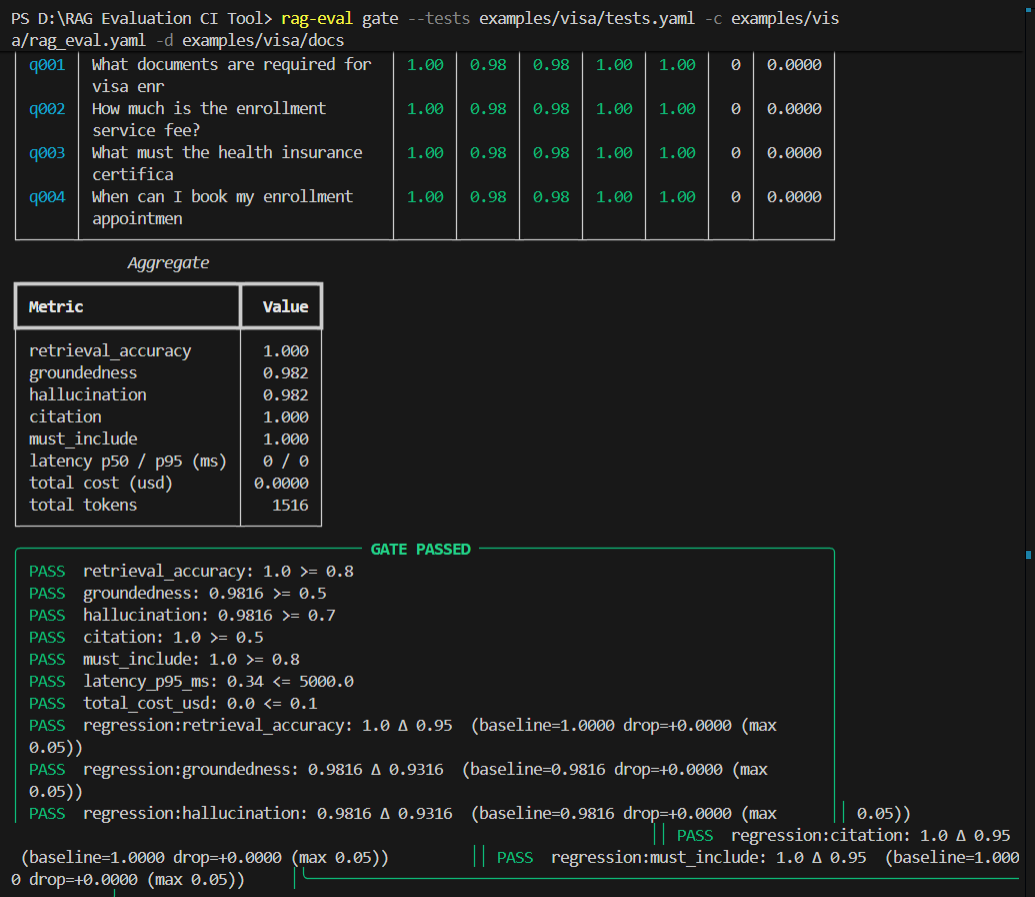
Run the bundled visa-enrollment example end-to-end:
rag-eval gate \
  --tests examples/visa/tests.yaml \
  -c examples/visa/rag_eval.yaml \
  -d examples/visa/docs
The exit code is 0 if the gate passes, and 1 if it fails — making it extremely straightforward to plug into your CI pipelines.
📄 Example Input
A developer just writes questions and expectations in tests.yaml:
suite: visa-docs
questions:
  - question: "What documents are required for visa enrollment?"
    expected_sources: ["visa_checklist.pdf"]   # retrieval must surface this
    must_include: ["passport", "admission letter", "insurance"]  # answer completeness
    must_not_include: ["bank statement is required"]             # hallucination trap
📊 Example Output
Every run produces clean console output and CI-friendly artifacts in .rag_eval/reports/:
| File | Use case / Description |
|---|---|
report.json |
Machine-readable full evaluation results. |
junit.xml |
Standard format that renders as native test results in GitHub/GitLab CI. |
summary.md |
Clean markdown summary intended to be auto-posted to PR comments or job summaries. |
report.html |
Self-contained, premium visual report (perfect as a CI build artifact). |
🎯 What it Measures
| Metric | Question it answers | Core Evaluation Method |
|---|---|---|
| Retrieval accuracy | Did we retrieve the documents we expected? | Substring checking on returned sources vs expected. |
| Groundedness | Is the answer actually supported by the retrieved context? | LLM-judge verification or fallback token overlap. |
| Hallucination | Did the model invent unsupported or forbidden claims? | LLM-judge analysis plus must_not_include penalty checks. |
| Citation | Are the cited sources real and the right ones? | Compares cited sources vs retrieved context. |
| Answer completeness | Does the answer contain the key facts? | Validates presence of must_include phrases. |
| Latency | How fast is the system? | Tracks wall-clock time (gates on suite-level p95). |
| Cost | What is the financial footprint? | Live calculations (gates on suite-level total USD). |
| Regression | Did quality drop since the last release? | Auto-compares metrics against a tagged baseline run. |
🏗️ Architecture
flowchart TD
    classDef main fill:#3b82f6,stroke:#1d4ed8,stroke-width:2px,color:#fff,font-weight:bold;
    classDef input fill:#f8fafc,stroke:#64748b,stroke-width:1.5px;
    classDef step fill:#fff,stroke:#cbd5e1,stroke-width:1px;
    classDef eval fill:#fef2f2,stroke:#f87171,stroke-width:1.5px;
    classDef storage fill:#ecfdf5,stroke:#34d399,stroke-width:1.5px;
    classDef report fill:#fff7ed,stroke:#fb923c,stroke-width:1.5px;
    classDef gate fill:#fef08a,stroke:#eab308,stroke-width:1.5px;

    tests["tests.yaml<br><i>(Questions & Expectations)</i>"]:::input --> runner["Runner Engine"]:::main

    runner --> target["Target System"]:::step
    runner --> evals["Evaluator Suite"]:::step
    runner --> reporting["Reporting System"]:::step

    target --> target_desc["• Local RAG Pipeline<br>• HTTP Endpoint"]:::step
    target_desc --> providers["Providers"]:::step
    providers --> providers_list["• Mock (Offline)<br>• Ollama / OpenAI<br>• Gemini / OpenRouter"]:::step
    providers_list --> vector["Vector Stores"]:::step
    vector --> vector_list["• Memory / Chroma / Qdrant"]:::step

    evals --> eval_list["• Retrieval Accuracy<br>• Groundedness <i>(LLM)</i><br>• Hallucination Penalty<br>• Citation & Source Precision<br>• Answer Completeness<br>• Latency & Cost"]:::eval
    eval_list --> storage["Storage DB<br><i>(SQLite / Postgres)</i>"]:::storage
    storage --> dashboard["Streamlit Dashboard<br>& FastAPI Backend"]:::storage

    reporting --> report_formats["• Rich Console Output<br>• report.json<br>• junit.xml<br>• summary.md<br>• report.html"]:::report
    report_formats --> gate_check["Gate Check"]:::gate
    gate_check --> threshold_desc["Thresholds & Regression Checks"]:::gate
    threshold_desc --> exit_code["CI Exit Code<br><i>(0 = Pass, 1 = Fail)</i>"]:::gate

    storage -.-> gate_check
- Providers:
mock,ollama,openai,gemini,openrouter(any model via OpenRouter with live cost tracking). See docs/providers.md. - Vector stores:
memory(zero dependencies),chroma,qdrant. - Targets: Evaluate the built-in pipeline or point it at your own RAG HTTP endpoint — making it a plug-and-play evaluation utility for existing architectures.
💼 Use Cases
- Pull-Request Gate — Automatically block merges that regress retrieval/groundedness metrics or exceed cost limits.
- Model & Prompt Optimization — Run side-by-side comparison matrices (e.g.
gpt-4o-minivs local LLM) on quality and cost. - Nightly Regression Gates — Schedule automated cron runs against a tagged production baseline to capture silent drift.
- Provider Migration Assurance — Benchmark a new model/provider to prove compatibility before going live.
🚀 How to Use It in Your Company
- Seed a Test Suite: Write 10–20 high-value user questions in a
tests.yaml. - Configure Your Target: Point the runner to your pipeline. If using your own server, set
target.type: http:target: type: http url: https://your-rag.internal/answer question_field: question answer_field: answer sources_field: sources
- Select Your Judge: Configure a judging provider. Use
ollamafor a free local judge, or keys foropenrouter/openai/gemini. - Define Quality Thresholds: Set performance/cost bounds in
rag_eval.yaml. - Drop into CI: Copy the prebuilt .github/workflows/rag-eval.yml to auto-run on every PR.
- Freeze a Baseline: Run
rag-eval baseline save <run_id>on your main branch to establish a comparison reference.
Run history is persisted to Postgres/SQLite and can be monitored visually using the Streamlit dashboard (
docker compose up).
🐍 Python SDK
from rag_eval import Evaluator

# Run evaluations directly from your custom pipeline or test script
report = Evaluator.from_config("rag_eval.yaml").run(
    "tests.yaml", ingest_dir="examples/visa/docs"
)

print(report.summary.quality)     # e.g., {'groundedness': 0.98, ...}
assert report.passed              # raise exceptions in standard test runners
🗺️ Roadmap
- Additional Evaluators: Context precision/recall, answer relevancy, and toxicity filters.
- Native Integrations: Direct connectors for LangChain / LlamaIndex pipelines.
- Agentic Evaluation: Support multi-turn agent conversations and tool usage tracking.
- Notification Exporters: Built-in Slack, Discord, and email alerts on gate failures.
- Visual Diffing: Comprehensive run-to-run comparisons on the dashboard.
- PyPI & Docker Images: Hosted pre-builds for zero setup.
🤝 Contributing
Contributions are very welcome! Please check out CONTRIBUTING.md to get started.
📄 License
This project is licensed under the terms of the Apache-2.0 License.
1 maintainer

Release files for rag-agent-eval-ci 0.1.0
For a detailed explanation of source distributions (sdists) and built distributions (wheels), please see the package formats documentation.
Source distribution (sdist)
| File | Size | Uploaded | |
|---|---|---|---|
| rag_agent_eval_ci-0.1.0.tar.gz | 46.3 kB | Details |
Built distribution (wheel)
| File | Interpreter | ABI | Platform | Reset |
|---|---|---|---|---|
| rag_agent_eval_ci-0.1.0-py3-none-any.whl | Python 3 | none | any | Details |
Total release size:102.0 kB
Release files / rag_agent_eval_ci-0.1.0.tar.gz
| Download URL | rag_agent_eval_ci-0.1.0.tar.gz |
|---|---|
| Size | 46.3 kB |
| Tags | Source |
|
SHA-256 checksum How to use checksums |
363627b31b29447dc752ec817a7bfe28b40a0f3dd4eec69f4a2f4b31cec517df
|
|
BLAKE2b-256 checksum How to use checksums |
929bbb976fbf69f2633dc3f13a048804ba47b3845b28e794f959d02fadc79c12
|
| Upload date | |
|
Uploaded using Trusted Publishing? What is trusted publishing? |
No |
| Uploaded via |
twine/6.2.0 CPython/3.11.5
|
Release files / rag_agent_eval_ci-0.1.0-py3-none-any.whl
| Download URL | rag_agent_eval_ci-0.1.0-py3-none-any.whl |
|---|---|
| Size | 55.7 kB |
| Tags | Python 3 |
|
SHA-256 checksum How to use checksums |
bac4d0863c2c386a7901403989664f14ba7ebf982d5d85bc4169e62e2dabb876
|
|
BLAKE2b-256 checksum How to use checksums |
f8d274bbbd9c8851d752a3a20da9956b8ea33c3c33a33a0c594e84dfe709ecea
|
| Upload date | |
|
Uploaded using Trusted Publishing? What is trusted publishing? |
No |
| Uploaded via |
twine/6.2.0 CPython/3.11.5
|













