
rag_intent_classifier
A production-ready, offline intent classifier that can sit right before any RAG system, domain-aware router, or any routing layer where fast intent decisions are needed. It runs before retrieval or downstream routing so your application can detect follow-up, escalation, urgent, human-handoff, negative-sentiment, and general-support requests early and route them intelligently.
Why this package exists
Most RAG pipelines, domain-aware routing systems, and other decision-heavy workflows focus on retrieval or downstream handling, but they often skip the most important first step: User intent classification.
This package helps you identify whether a user query is:
- a normal domain request,
- a follow-up question,
- a request to connect to a human,
- an escalation,
- an urgent issue,
- or negative sentiment that should not trigger normal search.
- 150 default labels (The full mapping is stored in the bundled model asset at rag_intent_classifier/models/label_map.joblib)
That makes retrieval more accurate and reduces unnecessary document search.
What it does
- Classifies intents using MiniLM embeddings and packaged classical ML models
- Returns human-readable labels for downstream routing
- Returns a confidence score for each prediction so you can decide when to route safely or fall back to an LLM or custom logic
- Works offline with no external API dependency
- Supports a simple Python API and CLI
Supported meta-intent labels
The current release surfaces these labels for routing-heavy RAG scenarios:
- follow_up
- connect_to_human
- escalate_issue
- negative_sentiment
- urgent_attention_required
- general_customer_support
- and additional 150 intents
These are especially useful for routing to a human, skipping standard retrieval, when to send chat history, narrowing search to the right support context, etc.
Quick comparison
| Without using intent classifier | With using intent classifier |
|---|---|
| Every query goes through the same retrieval flow | Urgent, follow-up, and escalation requests can be detected early |
| More irrelevant context may be searched | Routing becomes more precise and efficient |
| Human handoff needs are harder to identify | Support workflows can be triggered faster and more accurately |
This model is trained on a total of 17k+ labelled rows, with 3.8k+ validation rows and 5.7k+ test rows to support reliable intent routing.
Note: This classifier is built on general-purpose intent data and is intended as a strong starting point. For production use in a specific domain such as insurance, banking, sports, HR, consulting, or customer support, it is recommended to fine-tune or retrain the model on domain-specific examples for better accuracy and more relevant routing.
Architecture in a RAG pipeline
The package acts as the first decision layer in a RAG system.
Intent Classifier architecture
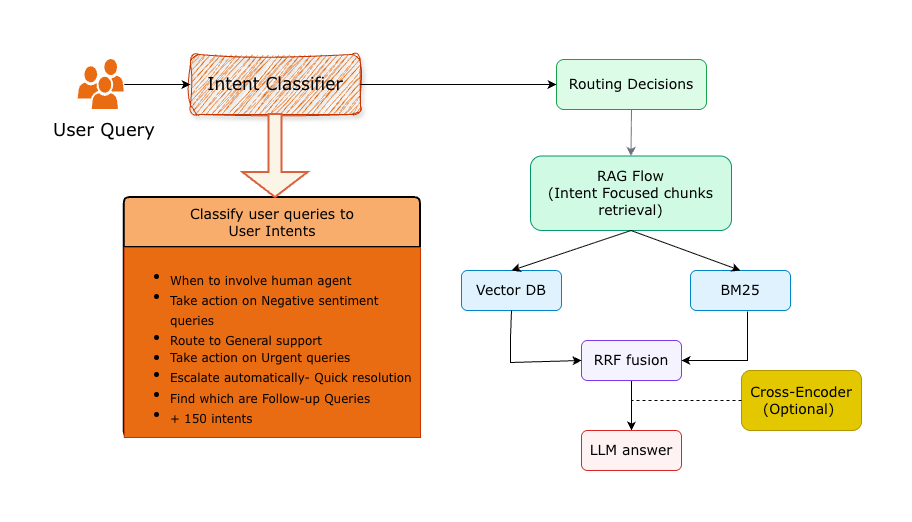
In practice, once the intent is classified, the retrieval step becomes smaller and more precise: the system can route to the right workflow, focus on the most relevant evidence and reduce the search area/scope dramatically.
Included capabilities
- 156 intents total (150 CLINC + 6 additional meta-intents)
- MiniLM embeddings
- Multiple packaged classifier models
- Offline inference
- Human-readable labels
- Simple Python API and CLI
Installation
Python 3.9 to 3.12 is the currently supported range for this package. This release uses a pinned dependency stack for reproducible installs and model compatibility. Python 3.13 is not currently targeted for this release.
If you try to install on Python 3.13 or newer, pip will now consider the package installable because the metadata declares requires-python = ">=3.9,<3.14".
That means the package is now advertised as installable for Python 3.13+, although runtime compatibility should still be validated in your target environment.
pip install rag_intent_classifier
Quick start
from rag_intent_classifier import infer_intent

result = infer_intent("How do I renew my policy?")
print(result)
Each result contains:
intent: the predicted labelconfidence: a score between 0 and 1 when availablereason: a short explanation of how the result was produced
For routing logic, a practical starting point is to use a confidence threshold such as 0.60 to 0.85.
If the score is below your threshold, you can safely fall back to an LLM, a human handoff, or a custom rule-based fallback.
A threshold around 0.60 is a reasonable default for many support or routing workflows, while more conservative systems may prefer 0.70 or higher.
The exact threshold depends on your domain risk tolerance and should be tuned on your own validation data.
CLI usage
rag_intent_classifier "How do I renew my policy?"
Sample inputs and outputs
Here are a few example predictions the model can return:
from rag_intent_classifier import infer_intent

print(infer_intent("Can you connect me to a human?"))
print(infer_intent("Can you follow up on my previous request?"))
print(infer_intent("I'm extremely unhappy with this service."))
Example output:
[{'intent': 'connect_to_human', 'confidence': 0.95, 'reason': 'predicted by classifier with probability-based score'}]
[{'intent': 'follow_up', 'confidence': 0.91, 'reason': 'predicted by classifier with probability-based score'}]
[{'intent': 'negative_sentiment', 'confidence': 0.97, 'reason': 'predicted by classifier with probability-based score'}]
Development install
git clone https://github.com/yuvarajd2588/rag_intent_classifier.git
cd rag_intent_classifier
pip install -e .
1 maintainer

Download files
Download the file for your platform. If you're not sure which to choose, learn more about installing packages.
Source Distribution
Built Distribution
Filter files by name, interpreter, ABI, and platform.
If you're not sure about the file name format, learn more about wheel file names.
Copy a direct link to the current filters
File details
Details for the file rag_intent_classifier-1.0.6.tar.gz.
File metadata
- Download URL: rag_intent_classifier-1.0.6.tar.gz
- Upload date:
- Size: 2.1 MB
- Tags: Source
- Uploaded using Trusted Publishing? No
- Uploaded via: twine/7.0.0 CPython/3.11.9
File hashes
| Algorithm | Hash digest | |
|---|---|---|
| SHA256 |
6e4d7065743689bc1999f2bdc36613fb13c9d7f57b3c3f098529c1f858a50a2d
|
|
| MD5 |
9aae176555632b9206d02768a35c3ed9
|
|
| BLAKE2b-256 |
542663f24aff8ef2b5f8f3c56529ad169bcb235be5f7b911d91df0b245aea60b
|
File details
Details for the file rag_intent_classifier-1.0.6-py3-none-any.whl.
File metadata
- Download URL: rag_intent_classifier-1.0.6-py3-none-any.whl
- Upload date:
- Size: 2.2 MB
- Tags: Python 3
- Uploaded using Trusted Publishing? No
- Uploaded via: twine/7.0.0 CPython/3.11.9
File hashes
| Algorithm | Hash digest | |
|---|---|---|
| SHA256 |
5dd4b228b12d7e2758a1868ce1c67d5eefc02dce285786699dbf33c5fc02bc7c
|
|
| MD5 |
bf37f3d3298c592a112f73c6d181d9b8
|
|
| BLAKE2b-256 |
c99f4d4cee187f1a18e6ff6ba63133a100cd416978c56fc8eb8798fbcb5cf62b
|







