





📖 Documentation · Getting started · Supported RAG types · API reference · PyPI
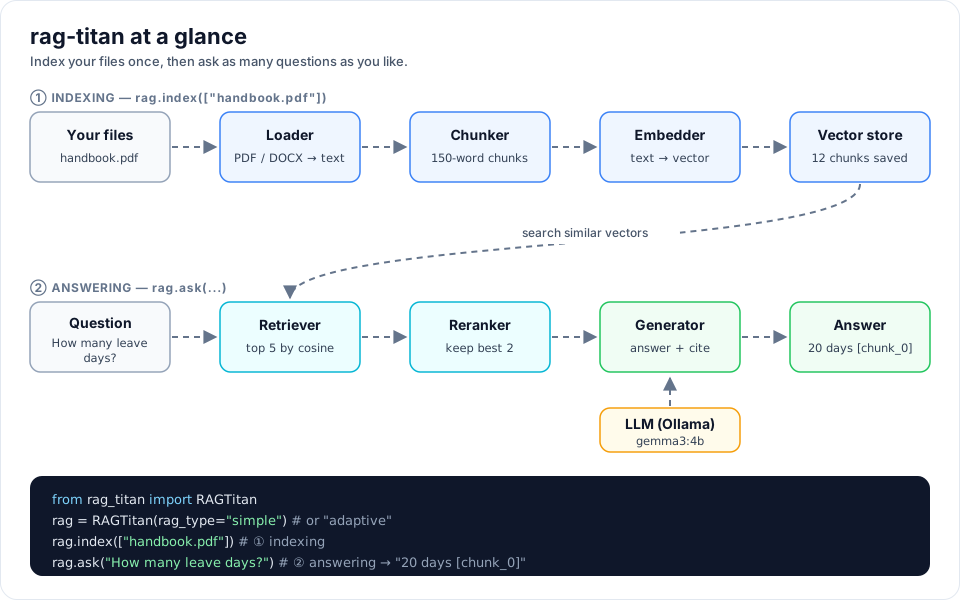
Why rag-titan?
- Many RAG types, one API. Two today (
simple,adaptive), with more on the way. Switch with one word:rag_type="adaptive". - Runs 100% locally with Ollama, so your documents never leave your machine.
- Grounded answers. The model answers only from your files and cites the chunks it used.
- Chunking your way. Eight chunkers: by words, characters or model tokens (tiktoken or your own tokenizer), recursive separators, and structure-aware chunkers that keep sentences, paragraphs, heading sections or pages whole. Try them live in the chunk playground →
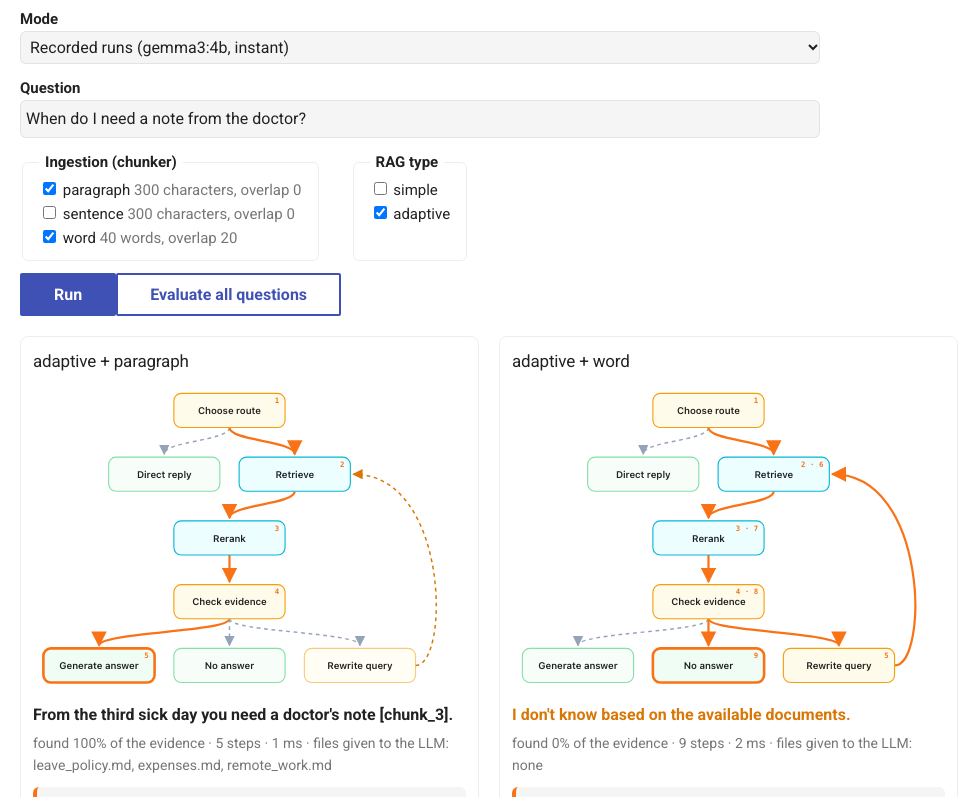
- Watch every step, in your browser. The RAG playground → runs the real package (Pyodide) side by side for any chunker and RAG type, and lights up each step on a live flow diagram: click a step to see the chunks it found. Recorded answers work instantly; a live mode with your own Ollama is work in progress.
- PDF, Word, Markdown and text files, with paragraphs, headings and pages kept for the chunkers.
- Measure, don't guess. Compare any chunker with any RAG type on your own questions in one command (
rag-titan evaluate): recall, MRR, nDCG, answered rate and p95 time, plus every step of a run with--trace. Evaluating RAG → - Find the stage that fails, in any RAG system. Pass the logged outputs of your pipeline (rag-titan or not) and get 70+ metrics for chunking, embedding, retrieval, reranking, context, answers and end to end, a 0 to 100 scorecard, root-cause hints and regression checks. No LLM judge. Evaluating every stage →
- Easy to read, easy to change. Short files, plain Python, and a docstring on every class. Swap any part by inheriting one base class.
Install
pip install rag-titan
ollama pull gemma3:4b && ollama pull nomic-embed-text
For token-based chunking, add the extra: pip install "rag-titan[tokens]".
Needs Python 3.10+ and Ollama. → Full setup guide
Quick start
from rag_titan import RAGTitan

rag = RAGTitan(rag_type="simple")            # or "adaptive"
rag.index(["handbook.pdf", "policy.docx"])

print(rag.ask("How many leave days do I get?"))
# You get 20 paid leave days every year [chunk_0].

print(rag.run("How many leave days do I get?")["log"])   # every step it took
rag.evaluate("questions.json")                           # score it on your own test questions
Or from the terminal:
rag-titan ask --files handbook.pdf --question "How many leave days do I get?"
rag-titan ask --files handbook.pdf --question "How many leave days do I get?" --trace
Evaluate on your own questions
Which chunker and which RAG type work best for your documents? Write a few test questions, each naming the file (or page) that holds the answer, and compare every combination in one command:
rag-titan evaluate --files docs/*.md --questions questions.json \
    --rag-type simple adaptive --chunker word paragraph
setup                   Recall       MRR      nDCG  Answered     Steps     p50 s     p95 s
simple + word            1.000     1.000     1.000      100%       3.0      0.92      1.26
adaptive + word          1.000     1.000     1.000      100%       5.0      1.67      2.02
simple + paragraph       0.917     1.000     0.936      100%       3.0      0.64      0.81
adaptive + paragraph     1.000     1.000     0.987      100%       6.3      0.96      2.91

Questions to look at:
  simple + paragraph: q_006  recall 0.50  found ['remote_work.md']
Then see why one question went wrong. Here search found the right file, so the problem is the answer step, not the chunker:
$ rag-titan ask --files docs/*.md --question "Can I work from Spain for a month?" --trace
1. retrieve     7.47 ms  -> 3 chunks: chunk_2 remote_work.md (0.615), chunk_0 expenses.md (0.540), ...
2. rerank       0.04 ms  -> 2 chunks: chunk_2 remote_work.md (rerank 0.815), chunk_0 expenses.md (rerank 0.690)
3. generate   567.39 ms  -> "I don't know based on the available documents."
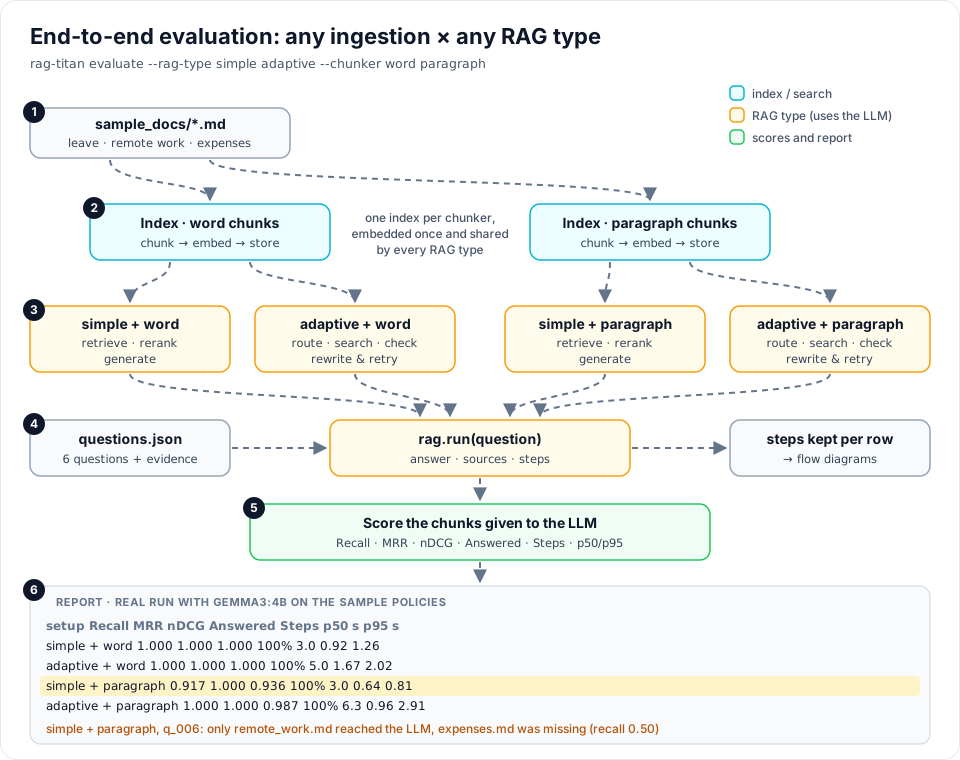
Real runs with gemma3:4b on the sample policies in examples/sample_docs/. Search-only scoring
(--retrieval-only, no LLM) and the Python API are in Evaluating RAG →
Evaluate every stage of any RAG system
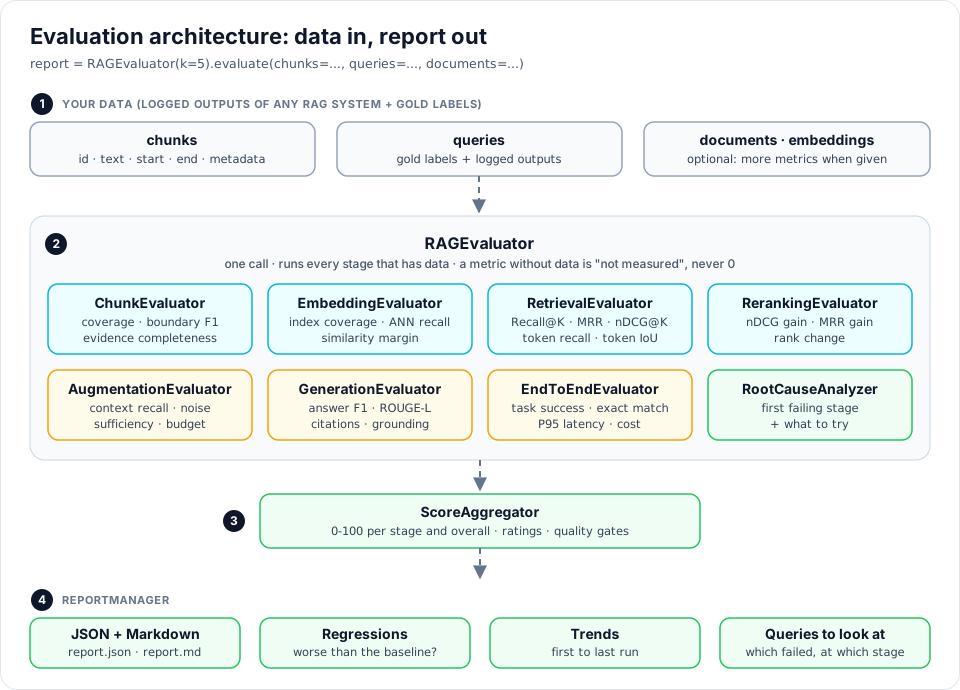
A wrong answer does not say which part failed. Pass what each stage of your pipeline produced, plus the right answers, and every stage is scored on its own. It works for any RAG system, uses no LLM judge and needs no extra dependencies:
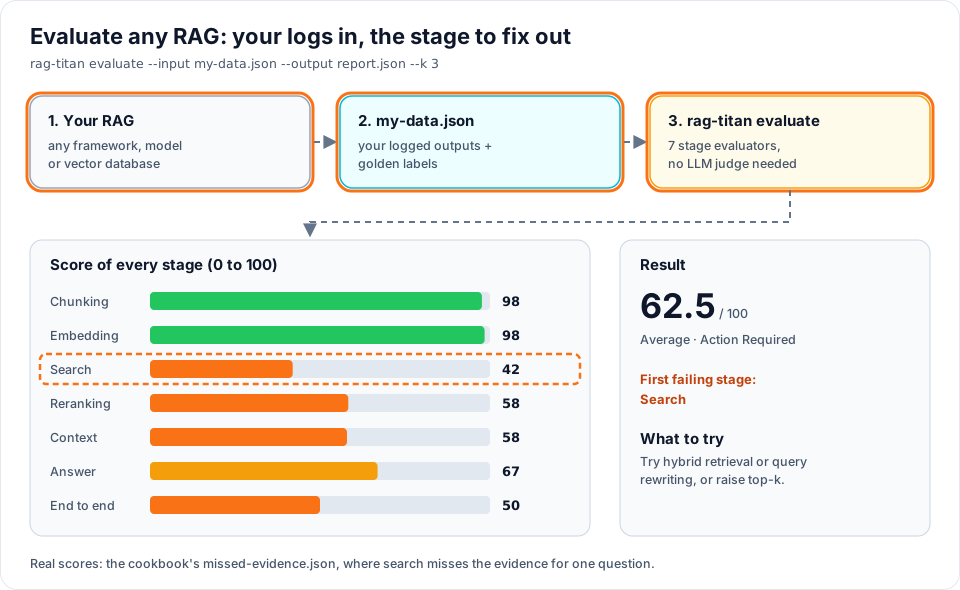
Already have a RAG and only want to evaluate it? Follow the 6 steps in the Evaluation cookbook →
from rag_titan.evaluation import RAGEvaluator

report = RAGEvaluator(k=5).evaluate(
    chunks=chunks,        # what your chunker produced
    queries=queries,      # per question: gold labels + retrieved ids, context, answer, latency
    document_text=text,   # optional: more metrics when given
)
print(report["scorecard"]["overall"]["score"])          # 0 to 100
print(report["root_causes"]["first_failing_stage"])     # e.g. "retrieval"
rag-titan evaluate --input data.json --baseline last_report.json --fail-on-regression
| Pipeline stage       | Score / 100 | Rating    | Measurement coverage |
|----------------------|------------:|-----------|---------------------:|
| Document preparation |        97.6 | Excellent |                  74% |
| Semantic indexing    |        98.4 | Excellent |                 100% |
| Information search   |        79.4 | Good      |                 100% |
| Search ordering      |        89.7 | Very Good |                 100% |
| Answer context       |        92.3 | Excellent |                 100% |
| Answer quality       |       100.0 | Excellent |                 100% |
| User experience      |       100.0 | Excellent |                 100% |
Using rag-titan itself? rag.evaluate_stages(files, "golden.json") collects the data for you.
Your own RAG? rag-titan golden drafts your golden questions and build_dataset() turns your
logs into the data file, see Evaluate your own RAG →.
Every formula is on the Evaluation metrics → page,
and the guide is Evaluating every stage →
Supported RAG types
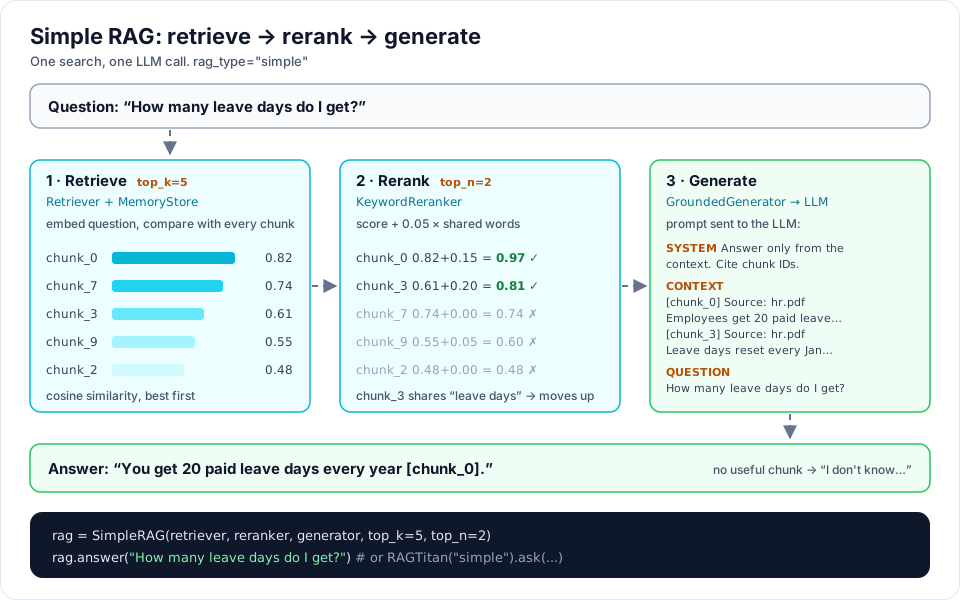
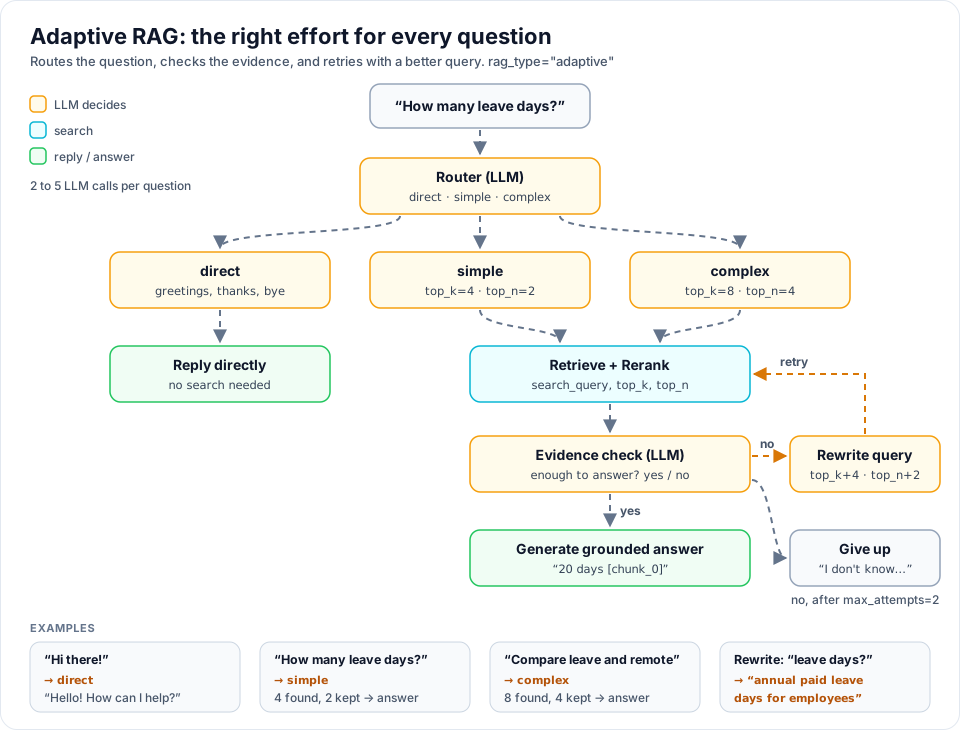
rag-titan supports 2 RAG types. Pick one with rag_type. Every type has answer(), and
run() that also returns every step it took (see the steps):
| Status | RAG type | How it works | Best for | LLM calls |
|---|---|---|---|---|
| ✅ Available | Simple RAGrag_type="simple" |
Retrieve → Rerank → Generate | Fast answers to clear questions | 1 |
| ✅ Available | Adaptive RAGrag_type="adaptive" |
Route → Retrieve → Check evidence → Rewrite & retry | Mixed questions, fewer wrong answers | 2–5 |
from rag_titan import RAG_TYPES
print(RAG_TYPES)        # ['simple', 'adaptive']
Coming next (not available yet): Corrective RAG · Multi-query RAG · HyDE · Hybrid RAG · Self-RAG · Parent-document RAG · Graph RAG · Agentic RAG. → Roadmap
Also included: a tool-calling agent loop. It's a separate feature, not a
rag_type.
Explore the docs
Click any picture to open its page.
RAG playground |
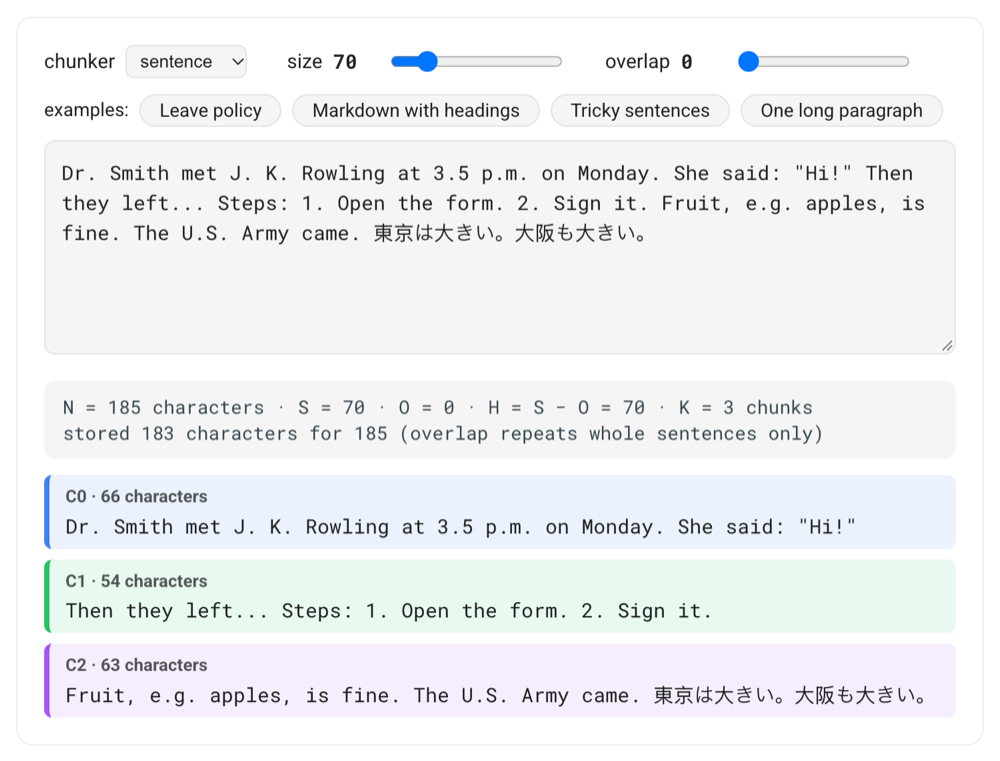
Chunk playground |
|
Evaluating RAG |
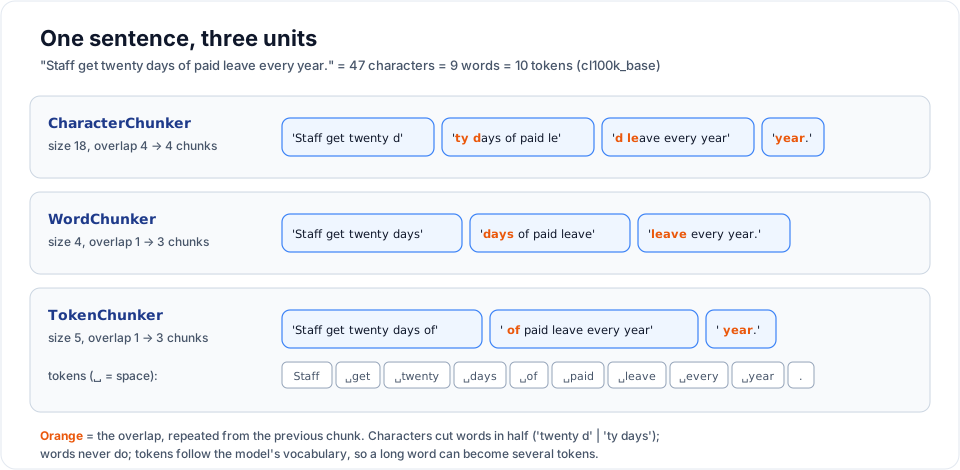
Chunking methods |
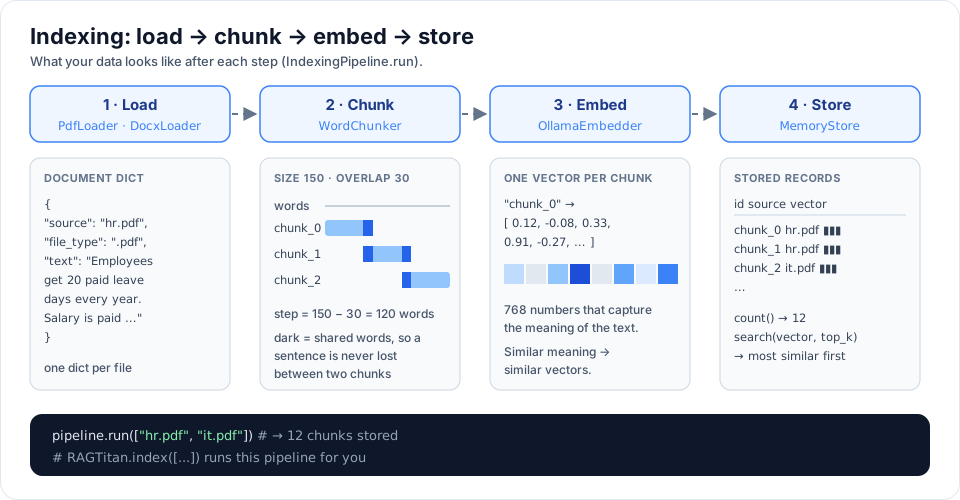
Building blocks |
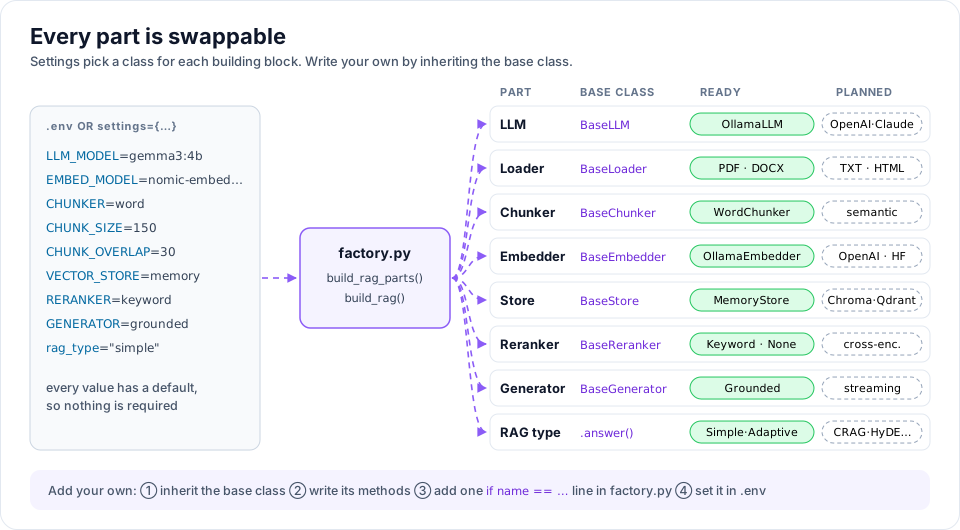
Extending rag-titan |
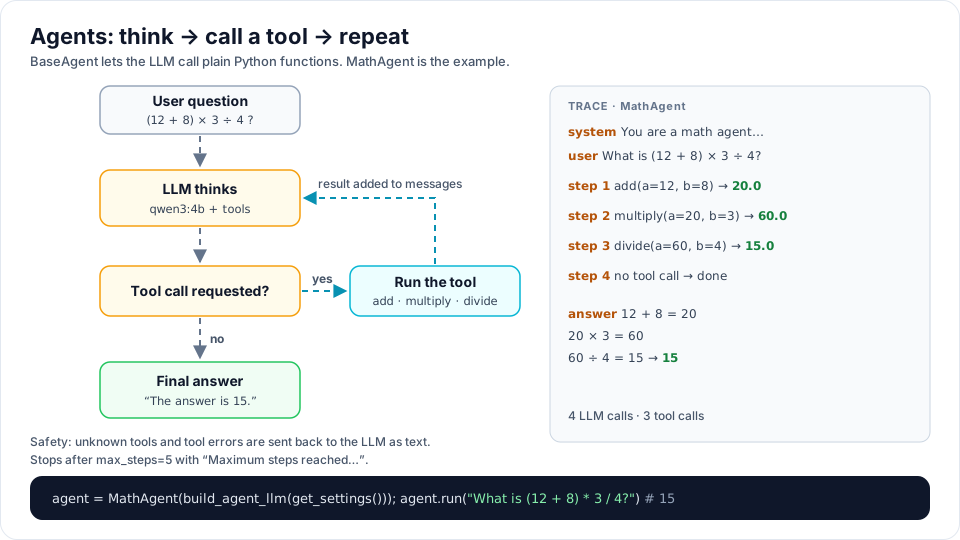
Agents |
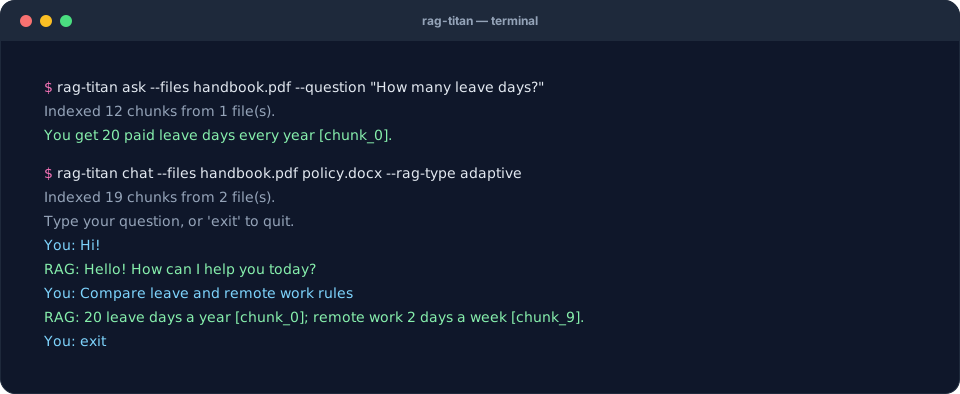
Command line |
| I want to... | Read |
|---|---|
| Install it and ask my first question | Getting started |
| Pick the right RAG type | RAG types |
| Pick the right chunker | Chunking methods |
| Run RAG types in my browser and watch each step | RAG playground |
| Try the chunkers on my own text | Chunk playground |
| Compare chunkers and RAG types on my questions | Evaluating RAG |
| Evaluate the RAG I already built, step by step | Evaluation cookbook |
| Score every stage of any RAG pipeline | Evaluating every stage |
| Look up a metric and its formula | Evaluation metrics |
| See why an answer went wrong | Seeing every step |
| Change models, chunk size or reranker | Configuration |
| See every class and method | API reference |
Contributing
Contributions are welcome! Read CONTRIBUTING.md to get set up. The tests run without Ollama.
License
MIT © Kumar Nishant
1 maintainer

Metadata
1 maintainer
Release files for rag-titan 0.8.2
For a detailed explanation of source distributions (sdists) and built distributions (wheels), please see the package formats documentation.
Source distribution (sdist)
| File | Size | Uploaded | Provenance | Actions |
|---|---|---|---|---|
| rag_titan-0.8.2.tar.gz | 147.4 kB | With provenance | Details for rag_titan-0.8.2.tar.gz |
Built distribution (wheel)
| File | Interpreter | ABI | Platform | Actions Reset |
|---|---|---|---|---|
| rag_titan-0.8.2-py3-none-any.whl | Python 3 | none | any | Details for rag_titan-0.8.2-py3-none-any.whl |
Total release size: 301.2 kB
Release files / rag_titan-0.8.2.tar.gz
| Download URL | rag_titan-0.8.2.tar.gz |
|---|---|
| Size | 147.4 kB |
| Tags | Source |
|
SHA-256 checksum How to use checksums |
c84ea7d24a660c9ba83ee39378d61e1aa925b20a03ebaca4fa705c1de82b27b0
|
|
BLAKE2b-256 checksum How to use checksums |
3a1507fe4f7bcb9ca8d43e829da6c1b4d530b11722599710f0f061eede387b95
|
| Upload date | |
|
Uploaded using Trusted Publishing? What is trusted publishing? |
Yes |
| Uploaded via |
twine/7.0.0 CPython/3.13.16
|
Provenance
Provenance describes where a file came from. On PyPI, provenance is shared via attestations, which provide a verifiable record of the build or publishing details. View details, limitations and caveats.


PyPI Publish Attestation
PyPI verified that this artifact, at this checksum, originated from the publisher listed below.
Signed by GitHub Actions, verified by PyPI on Nov 12, 2026.
Transparency logRelease files / rag_titan-0.8.2-py3-none-any.whl
| Download URL | rag_titan-0.8.2-py3-none-any.whl |
|---|---|
| Size | 153.8 kB |
| Tags | Python 3 |
|
SHA-256 checksum How to use checksums |
714d7bfc1aa7d41c25364afcfc572cb6b67d7637d9aab94ab49fcc68642666eb
|
|
BLAKE2b-256 checksum How to use checksums |
4d2af66b7b7c89991e773de4199676c3fbcbed8c962c4033bbf16104f18d61cc
|
| Upload date | |
|
Uploaded using Trusted Publishing? What is trusted publishing? |
Yes |
| Uploaded via |
twine/7.0.0 CPython/3.13.16
|
Provenance
Provenance describes where a file came from. On PyPI, provenance is shared via attestations, which provide a verifiable record of the build or publishing details. View details, limitations and caveats.
PyPI Publish Attestation
PyPI verified that this artifact, at this checksum, originated from the publisher listed below.
Signed by GitHub Actions, verified by PyPI on Nov 12, 2026.
Transparency logSecurity for rag-titan 0.8.2
Provenance
Provenance describes where a file came from. On PyPI, provenance is shared via attestations, which provide a verifiable record of the build or publishing details. View details, limitations and caveats.
Full provenance
Both files in this release have been uploaded with provenance metadata.
Attestation for rag_titan-0.8.2.tar.gz
PyPI Publish Attestation
PyPI verified that this artifact, at this checksum, originated from the publisher listed below.
Signed by GitHub Actions, verified by PyPI on Nov 12, 2026.
Transparency logA note on package security
PyPI is a repository for distributing packages, not a service for auditing them. While third-party security researchers and our staff do their best to detect and remove malicious packages, PyPI cannot guarantee the quality, security or suitability of any given package.
To learn more about protecting yourself from malicious actors, visit our package security documentation.














