
Ragbench
Benchmark chunking and retrieval strategies on your own data: compare accuracy, latency, and cost across every chunker × retriever combination, against real or LLM-generated questions.
CLI command:ragbench compare --config examples\scifact_all.json

⚠️ Before you install
Use a venv built from a standard Python (python.org, or your OS's python3) not one whose base interpreter is Anaconda or Miniconda.
ragbench depends on packages with native/compiled components (chromadb, torch via the optional huggingface/rerank extras, onnxruntime). On an Anaconda-based Python these can fail to import, or crash outright including hard segfaults during chromadb operations, because of how Anaconda bundles its own native libraries alongside them. Symptoms look like ImportError: DLL load failed or the process just dying with no traceback, no matter what package versions you install.
If you only have Anaconda installed: install Python from python.org first, then create your venv from that interpreter specifically (path\to\pythoncore\python.exe -m venv .venv, not the conda/Anaconda one).
Install
pip install ragbenchpy
The PyPI distribution is named
ragbenchpy(the plainragbenchname collides with an unrelated existing project) — but the Python package you import and the CLI command are both still justragbench, unaffected by this.
Optional extras:
| Extra | Adds | Why it's optional |
|---|---|---|
huggingface |
sentence-transformers, transformers |
Local/free embeddings heavy (torch), so opt-in |
rerank |
sentence-transformers |
Cross-encoder reranking same torch dependency |
yaml |
pyyaml |
Lets config files be .yaml/.yml, not just .json |
mlflow |
mlflow |
Optional tracing on LLM calls, no-ops cleanly if unset |
dev |
pytest, pytest-cov |
Only needed if you're developing ragbench itself |
all |
every extra above |
pip install "ragbenchpy[huggingface,rerank]"
openai, anthropic, google-genai, and chromadb are core dependencies (not extras), every retriever except bm25 needs a vector store, and the point of the tool is comparing providers, so gating them behind extras would defeat the purpose.
Quick start — CLI
ragbench run --config run.json
ragbench compare --config matrix.json --sort-by recall_at_k --save-json out.json --save-csv out.csv
ragbench detail --config run.json --chunker recursive --retriever hyde
ragbench list-chunkers
ragbench list-retrievers
A minimal run.json (single chunker × retriever):
{
  "corpus_path": "chunks.json",
  "benchmark_queries_path": "questions.json",
  "benchmark_qrels_path": "qrels.json",
  "chunker_name": "recursive",
  "retriever_name": "hyde",
  "llm_provider": "openai",
  "llm_model": "gpt-4.1-mini"
}
A matrix.json (sweeps every combination) uses chunker_names/retriever_names (plural, lists) instead of chunker_name/retriever_name:
{
  "corpus_path": "chunks.json",
  "benchmark_queries_path": "questions.json",
  "benchmark_qrels_path": "qrels.json",
  "chunker_names": ["recursive", "fixed_size"],
  "retriever_names": ["bm25", "dense", "hybrid", "hyde"]
}
⚠️ These two shapes are easy to mix up, pointing
ragbench compareat a singular-field config (orragbench runat a plural one) fails with a clear pydantic "Field required" error, not a silent misconfiguration. If you see that error, check you're using the right shape for the command.
Quick start — Python (no terminal required)
import ragbench  # auto-loads a .env file for API keys, if one exists next to your script

result = ragbench.run(
    corpus_path="chunks.json",
    benchmark_queries_path="questions.json",
    benchmark_qrels_path="qrels.json",
    chunker_name="recursive",
    retriever_name="hyde",
    llm_provider="openai",
    llm_model="gpt-4.1-mini",
)
print(result.accuracy, result.cost)

results = ragbench.compare(
    corpus_path="chunks.json",
    benchmark_queries_path="questions.json",
    benchmark_qrels_path="qrels.json",
    chunker_names=["recursive", "fixed_size"],
    retriever_names=["bm25", "dense", "hyde"],
)
for r in results:
    print(r.chunker_name, r.retriever_name, r.accuracy.get("recall_at_k"))
API keys
Put them in a .env file next to your script:
OPENAI_API_KEY=sk-...
ANTHROPIC_API_KEY=sk-ant-...
GOOGLE_API_KEY=...
import ragbench loads it automatically — no manual export/set needed, and it works identically whether you use the CLI or the Python API. Prefer to manage keys yourself instead (multiple accounts, a secrets manager)? Both ragbench.run() and ragbench.compare() accept an explicit override:
result = ragbench.run(..., api_key="sk-ant-...")               # applies to both LLM + embedding calls
result = ragbench.run(..., llm_api_key="sk-ant-...",            # or set them independently, if the
                            embedding_api_key="sk-...")          # LLM and embedder use different providers
What it measures
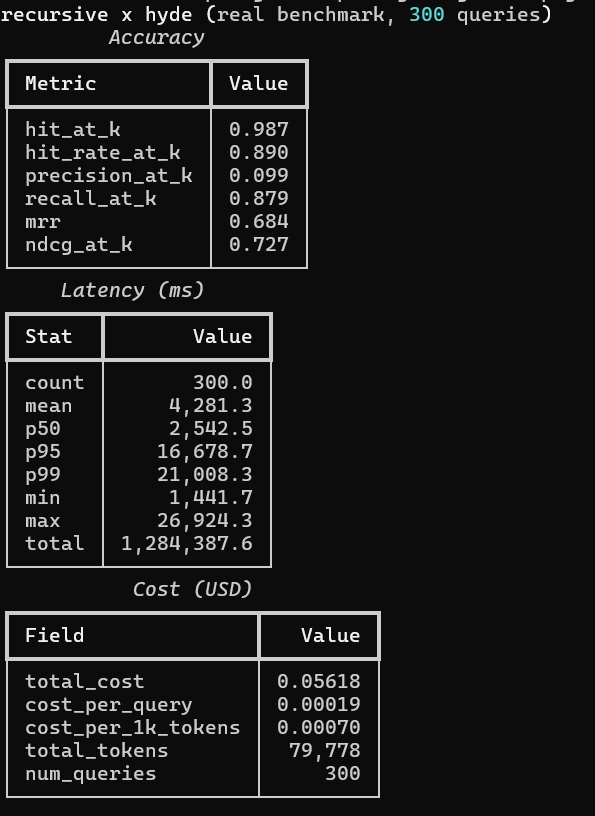
For every chunker × retriever combination, one RunResult with:
- accuracy —
recall_at_k,precision_at_k,hit_at_k,hit_rate_at_k,mrr,ndcg_at_k - latency —
mean,p50,p95,p99,min,max(milliseconds, per query) - cost —
total_cost,cost_per_query,cost_per_1k_tokens,total_tokens(USD;$0/untracked for free or unrecognized models — see Cost tracking below) - errors — per-query error messages that didn't fail the whole run
- failed / error_message — set if the whole combination couldn't run at all (bad config, index build failure, crash)
ragbench detail --config run.json --chunker recursive --retriever hydeoutput, showing the full per-combination metric breakdown.
System design
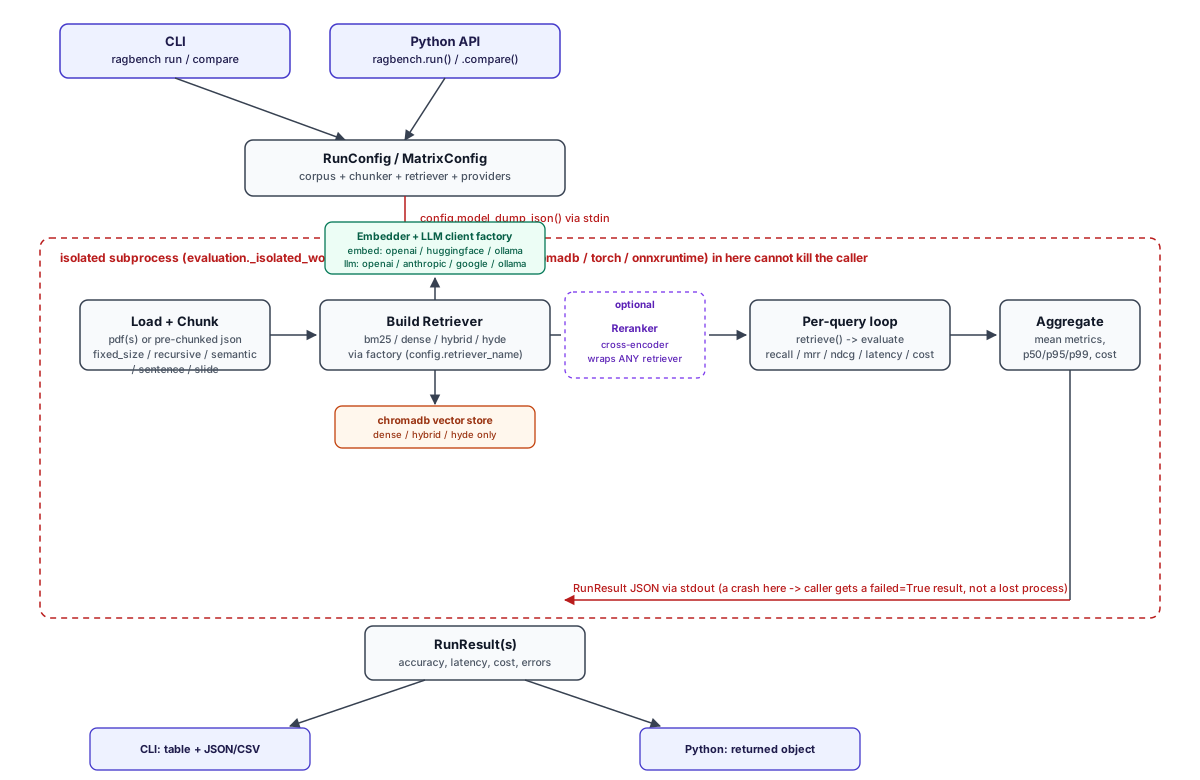
Both entry points (CLI and Python API) build the same RunConfig/MatrixConfig, which is handed to a subprocess (evaluation._isolated_worker) as JSON over stdin. That subprocess boundary exists specifically because a segfault in a native dependency (chromadb, torch, onnxruntime) cannot be caught by Python's try/except — the OS kills the process before any exception machinery runs. Isolating each chunker × retriever combination in its own subprocess means one bad combination becomes an ordinary failed=True result instead of losing an entire matrix sweep.
Inside the subprocess: the corpus is loaded and chunked, the embedder and LLM client are resolved through a provider factory (so retrievers never import a concrete provider directly), the retriever runs its per-query loop, and metrics are aggregated into a RunResult that's written back to the parent over stdout.
Chunkers
| Name | Strategy |
|---|---|
fixed_size |
Fixed word-count windows with overlap |
recursive |
Recursively splits on paragraph → line → sentence → word boundaries until each piece fits max_size |
semantic |
Groups sentences by embedding similarity (needs an embedder — defaults to OpenAI if none given) |
sentence |
One (or a few) sentences per chunk |
slide |
Sliding window over sentences/units |
chunker_params in your config passes strategy-specific kwargs straight to the chunker's constructor (e.g. {"max_size": 150} for recursive).
Corpus input can be:
- a pre-chunked
.json/.jsonlfile (each record needs at leasttext+chunk_id/doc_name— field aliases likecontent/body/id/documentare normalized automatically), which skips chunking entirely regardless of whatchunker_nameyou set, or - a single PDF (
corpus_pathpointing at one.pdffile), or - a directory of PDFs (
corpus_pathpointing at a folder) — every.pdfin it is chunked with the same strategy and the results combined, with chunk IDs re-sequenced globally.
⚠️ If you're testing
chunker_nameitself, make surecorpus_pathis a PDF (or PDF directory), not pre-chunked JSON — JSON input bypasses the chunker entirely, sochunker_namehas no effect on it.
Retrievers
| Name | Needs an embedder? | Needs an LLM? | Notes |
|---|---|---|---|
bm25 |
No | No | Classic sparse lexical retrieval, self-contained (no external index) |
dense |
Yes | No | Embedding similarity via chromadb |
hybrid |
Yes | No | Combines bm25 + dense |
hyde |
Yes | Yes | Generates a hypothetical answer with the LLM first, then embeds that for retrieval |
Providers
LLM (llm_provider) |
Embeddings (embedding_provider) |
|
|---|---|---|
| OpenAI | ✅ openai |
✅ openai |
| Anthropic | ✅ anthropic |
— (no embeddings API) |
✅ google |
— (not wired; Gemini's embedding API isn't implemented here) | |
| Ollama (local, free) | ✅ ollama |
✅ ollama |
| Hugging Face (local, free) | — | ✅ huggingface (needs the huggingface extra) |
| Cohere | 🚧 listed as valid, raises NotImplementedError |
🚧 same |
| Voyage | — | 🚧 listed as valid, raises NotImplementedError |
Any OpenAI-compatible endpoint (OpenRouter, Groq, LM Studio, vLLM, Ollama's own OpenAI-compat API) also works through llm_provider: "openai" by setting OPENAI_BASE_URL — e.g. OpenRouter for testing Claude/Gemini without a direct Anthropic/Google account:
export OPENAI_API_KEY=sk-or-v1-...
export OPENAI_BASE_URL=https://openrouter.ai/api/v1
{ "llm_provider": "openai", "llm_model": "anthropic/claude-3.5-sonnet" }
⚠️ Free-tier models are volatile. Model IDs get deprecated for new accounts, rate-limited, or renamed without much notice (this happened mid-development with a Gemini model). If a request 404s or connection-errors unexpectedly, check the provider's live model list before assuming it's a
ragbenchbug — for OpenRouter:GET https://openrouter.ai/api/v1/models; for Google:client.models.list().
Cost tracking caveats
metrics/cost.py has a static price table keyed by exact model-ID string. This means:
- Local/free providers (
ollama,huggingface) always report$0/untracked — correct, no API is billed. - Routed model IDs (OpenRouter's
vendor/modelstyle, e.g.anthropic/claude-3.5-sonnetused viaprovider: "openai") are not recognized by the price table, so cost shows as$0/untracked even though OpenRouter is actually billing you. Check OpenRouter's own dashboard for real spend when using it this way. - A model released after this package's price table was last updated will also show as untracked until the table is updated with its pricing.
Reranking
Any retriever can be wrapped with a cross-encoder reranker, it composes with all of bm25/dense/hybrid/hyde without any of them knowing reranking exists:
{
  "...": "...",
  "use_reranker": true,
  "reranker_model": "cross-encoder/ms-marco-MiniLM-L6-v2",
  "rerank_candidate_k": null
}
rerank_candidate_k defaults to top_k * 4 when null, the retriever over-fetches that many candidates, then reranks down to top_k. Needs the rerank extra (sentence-transformers).
Synthetic benchmarks (no labeled data required)
Omit benchmark_queries_path/benchmark_qrels_path entirely and ragbench generates questions itself using the configured LLM, sampling representative chunks from your corpus:
{
  "corpus_path": "my_documents/",
  "chunker_names": ["recursive"],
  "retriever_names": ["bm25", "dense"],
  "llm_provider": "openai"
}
⚠️ Synthetic question quality is entirely dependent on the generating LLM, there's no ground truth, so treat synthetic-benchmark accuracy numbers as directional (useful for A/B'ing chunkers/retrievers against each other), not as an absolute accuracy claim.
Development status
- No automated test suite yet (
pytest/pytest-covare in thedevextra, buttests/is currently just a placeholder package). Everything in this package has been exercised through real, manual benchmark runs against real provider APIs rather than unit tests — solid for correctness-in-practice, but there's no CI regression safety net yet. Worth adding before accepting outside contributions. - Crash isolation (subprocess-per-combination) has been verified against a real forced segfault, not just reasoned about.
License
MIT see LICENSE.
1 maintainer

Metadata
1 maintainer
Release files for ragbenchpy 0.1.1
For a detailed explanation of source distributions (sdists) and built distributions (wheels), please see the package formats documentation.
Source distribution (sdist)
| File | Size | Uploaded | |
|---|---|---|---|
| ragbenchpy-0.1.1.tar.gz | 56.2 kB | Details |
Built distribution (wheel)
| File | Interpreter | ABI | Platform | Reset |
|---|---|---|---|---|
| ragbenchpy-0.1.1-py3-none-any.whl | Python 3 | none | any | Details |
Total release size: 127.0 kB
Release files / ragbenchpy-0.1.1.tar.gz
| Download URL | ragbenchpy-0.1.1.tar.gz |
|---|---|
| Size | 56.2 kB |
| Tags | Source |
|
SHA-256 checksum How to use checksums |
80414adfae4387e52afbe95f30633f35fc3c82c448f6951fab25a5eba6a8c303
|
|
BLAKE2b-256 checksum How to use checksums |
19299525ce78b967674bbbc3ca65c97f3f131a663bfb5365982d815a30ff0cee
|
| Upload date | |
|
Uploaded using Trusted Publishing? What is trusted publishing? |
No |
| Uploaded via |
twine/7.0.0 CPython/3.14.7
|
Release files / ragbenchpy-0.1.1-py3-none-any.whl
| Download URL | ragbenchpy-0.1.1-py3-none-any.whl |
|---|---|
| Size | 70.7 kB |
| Tags | Python 3 |
|
SHA-256 checksum How to use checksums |
f909ae44b44521a636d15207a28af9694f8c1baacc64e6bc7cb0e8ce04839fae
|
|
BLAKE2b-256 checksum How to use checksums |
75b65288aa3521a4cb8baba07c3088bfa51dd38d33ee0532aa49c6da4f9702bd
|
| Upload date | |
|
Uploaded using Trusted Publishing? What is trusted publishing? |
No |
| Uploaded via |
twine/7.0.0 CPython/3.14.7
|














