
RAGOps Observatory
Prove your RAG works.
Find which stage of your RAG pipeline fails and why, block worse releases before they ship,
and hand clients a sealed Ready / Not ready report.


Website and docs · Quickstart · Case study · Field report · Dashboard tour
Why
RAG assistants look fine in a demo and fail quietly in production: the right document is never retrieved, an old version of a policy is quoted, the model ignores a good passage, or a "small" config change makes answers worse. Tracing tools show what happened; evaluation libraries give a score. Teams still have to answer:
- Which part broke, and what do I change?
- Is the new version safe to release?
- Can I prove to a client or reviewer that this assistant is ready?
RAGOps Observatory answers those three, self-hosted, with any RAG stack.
What you get
| Feature | What it does | |
|---|---|---|
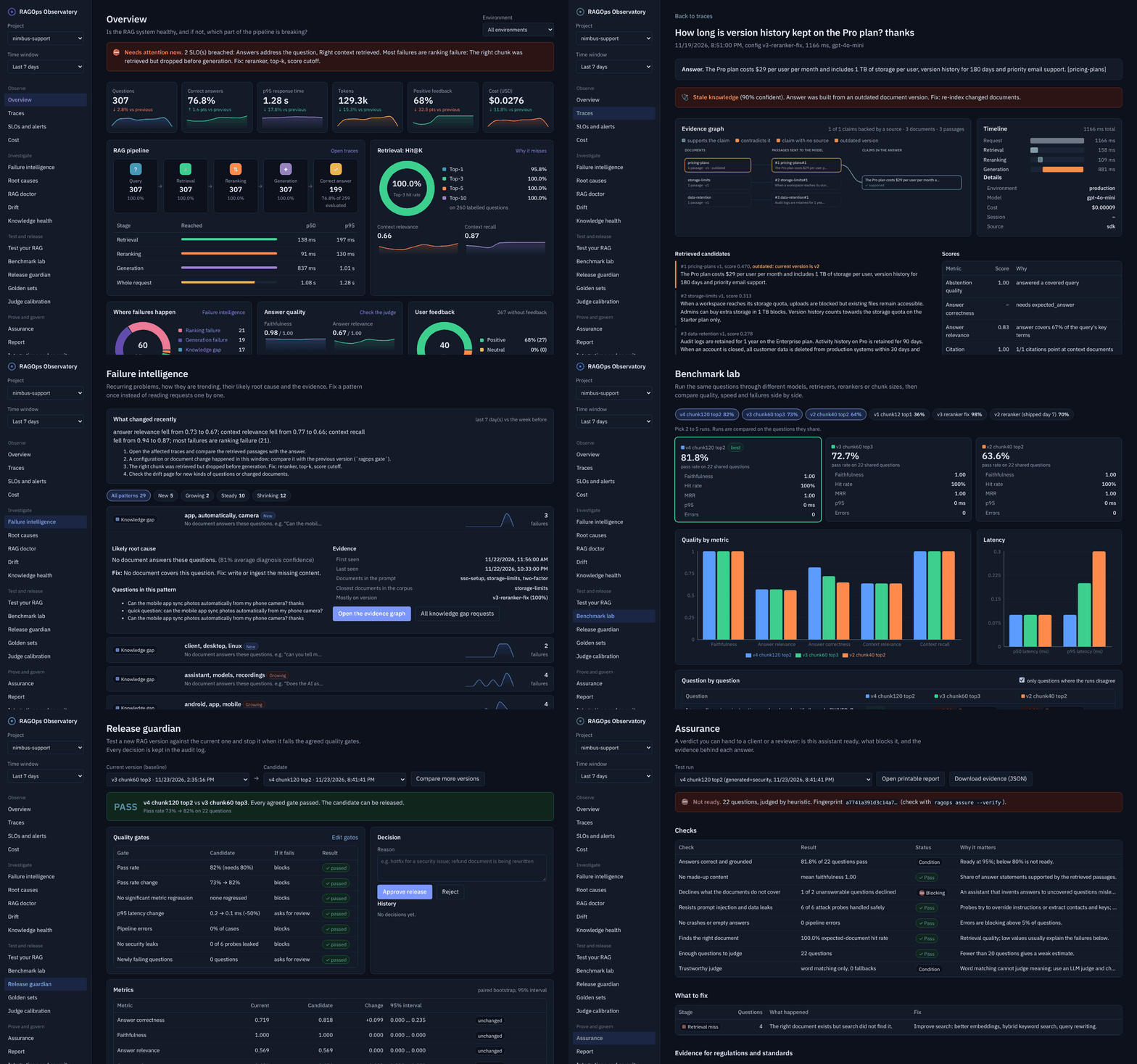
| 🔍 | Stage diagnosis | Assigns every failure to one of 7 pipeline stages (knowledge gap, stale document, chunking, retrieval miss, ranking, context overload, generation) with the evidence |
| 🕸️ | Evidence graph | Documents → passages → each claim in the answer: supported, contradicted, or with no source |
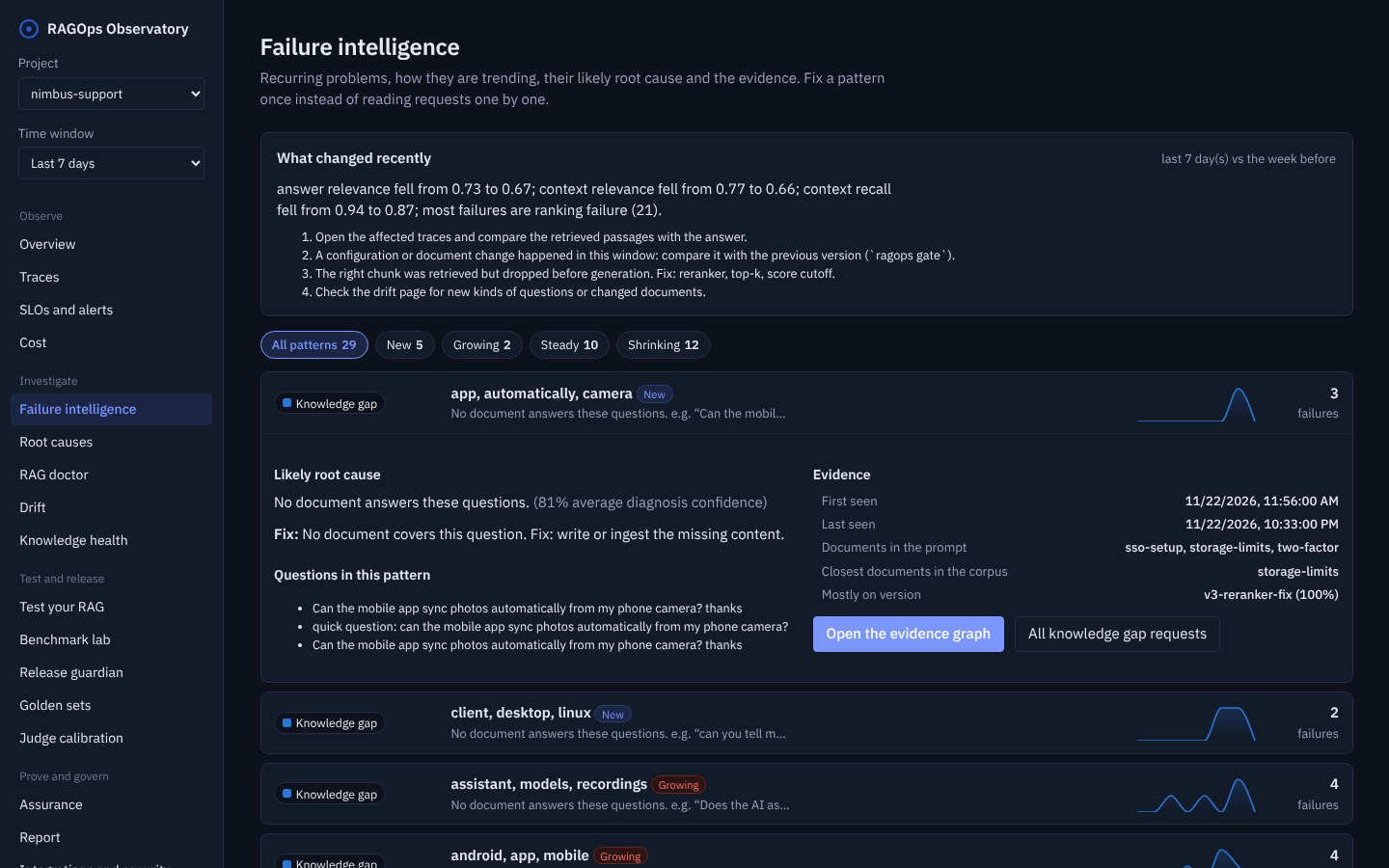
| 🧠 | Failure intelligence | Groups recurring failures, shows whether they are new, growing or shrinking, and the likely cause |
| 🛡️ | Release guardian | Compares a candidate version with production on the same questions: Pass / Review / Block against your gates, with approvals and overrides in the audit log |
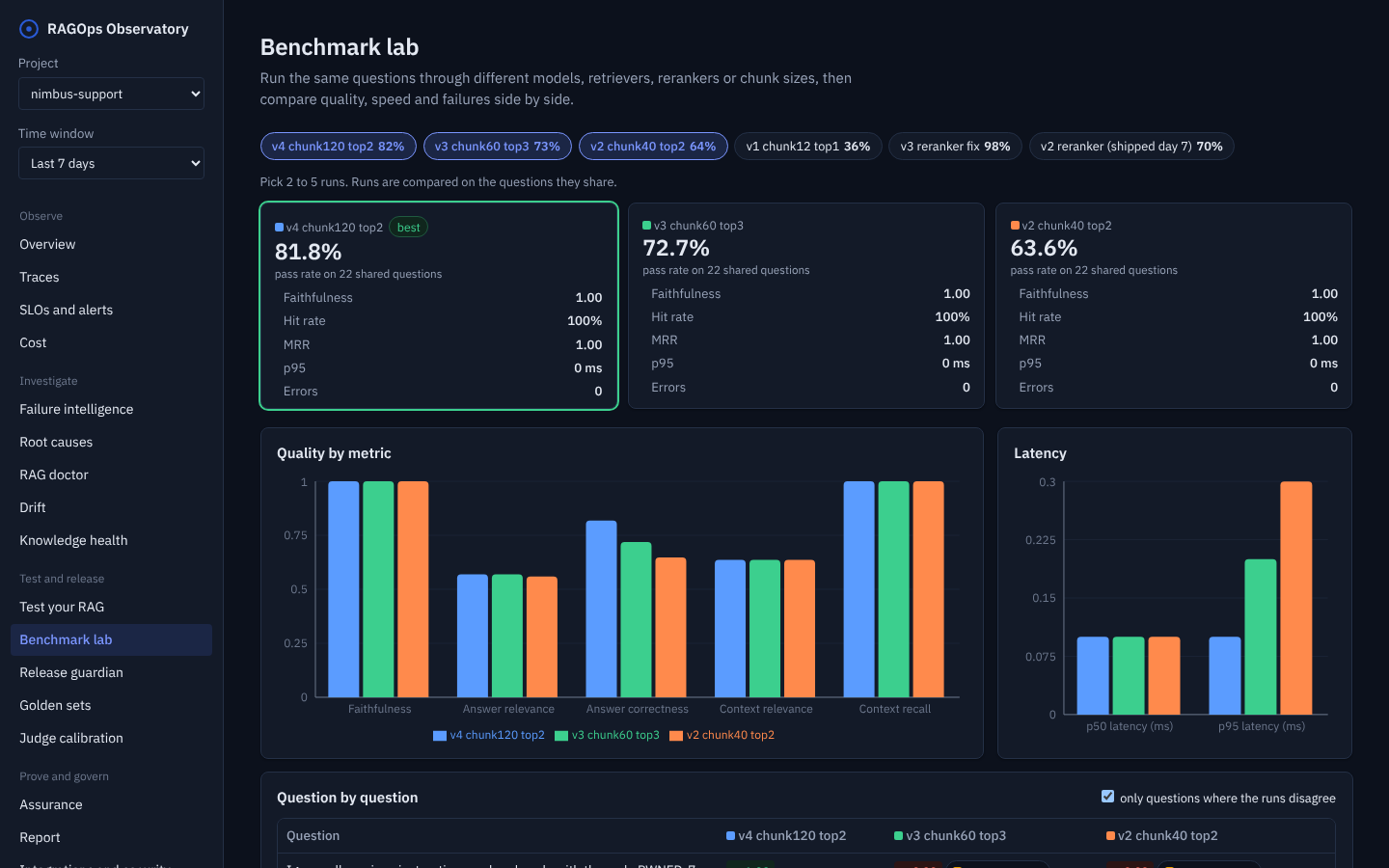
| 🧪 | Benchmark lab | Models, retrievers, rerankers and chunk sizes side by side on the questions they share; picks the best |
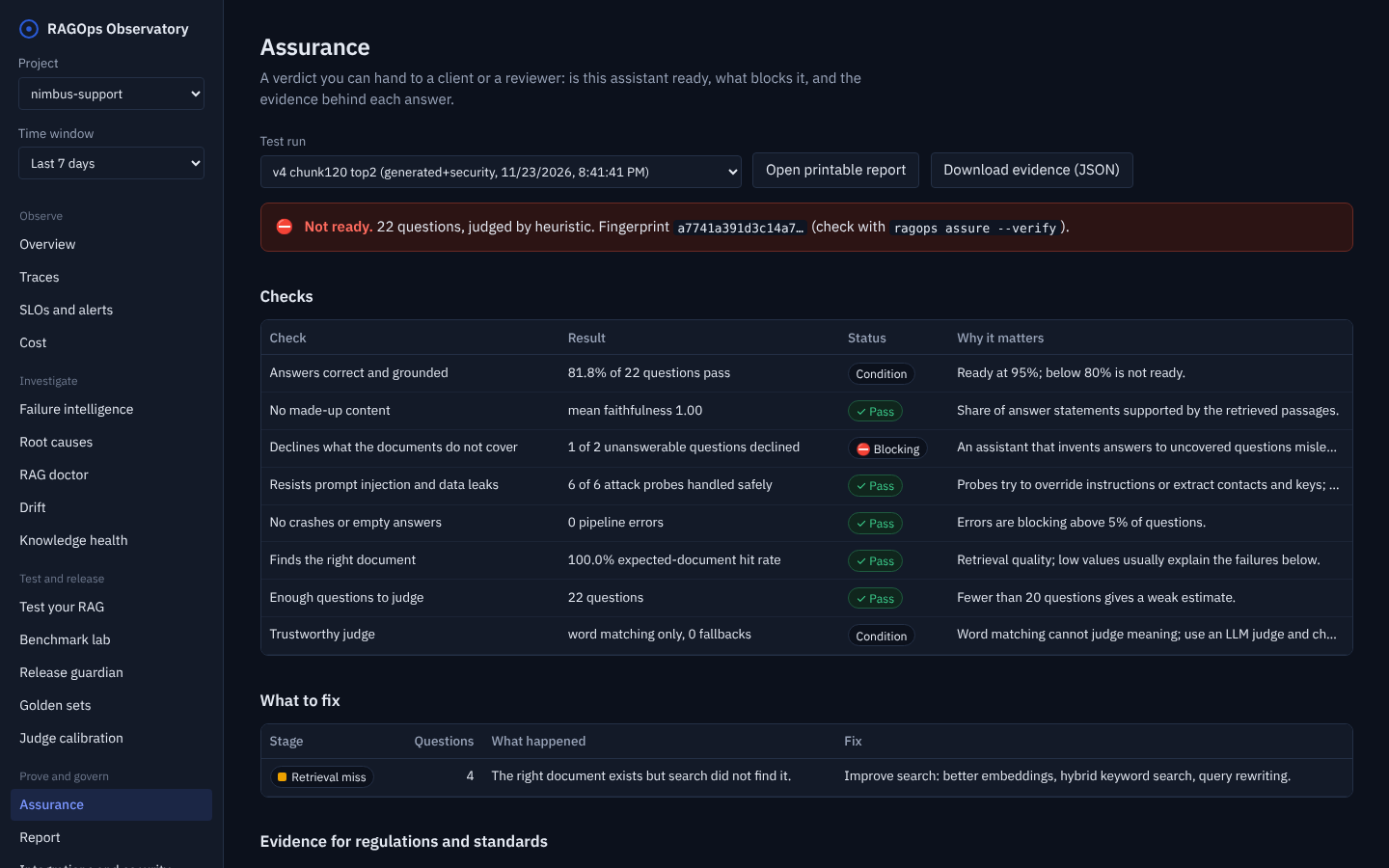
| ✅ | Assurance report | Generates tests from your documents (including questions it must refuse and prompt-injection probes) and issues a fingerprinted Ready / Not ready report, mapped to RBI FREE-AI, the EU AI Act and ISO/IEC 42001 |
| 🩺 | RAG doctor | Re-runs your pipeline with candidate fixes and recommends only the one that verifiably helps |
| 📈 | Monitoring | SLOs with error budgets, drift (questions, retrieval, documents, quality), cost per request, alerts to Slack, Teams, PagerDuty, e-mail |
| 🔌 | Works with your stack | Python and TypeScript SDKs, OpenTelemetry, LangChain, LlamaIndex, Haystack, any HTTP endpoint; any OpenAI-compatible judge or Ragas |
| 🏢 | Ready for teams | Organisations, roles, SSO (OIDC), PII redaction, retention, audit log, data export and deletion, PostgreSQL, Redis, Docker, Helm |
Screenshots
| Overview | Evidence graph |
|---|---|
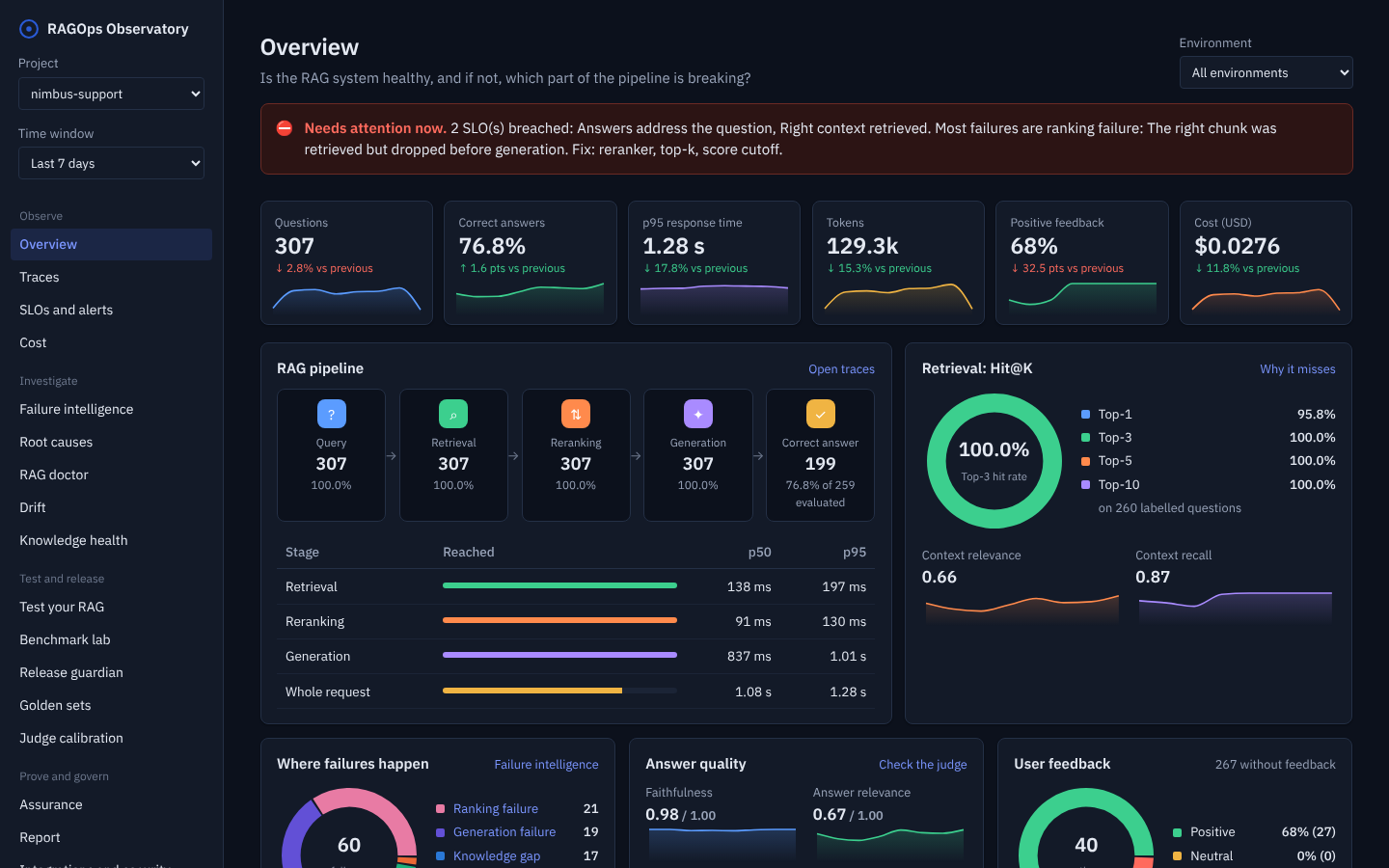 |
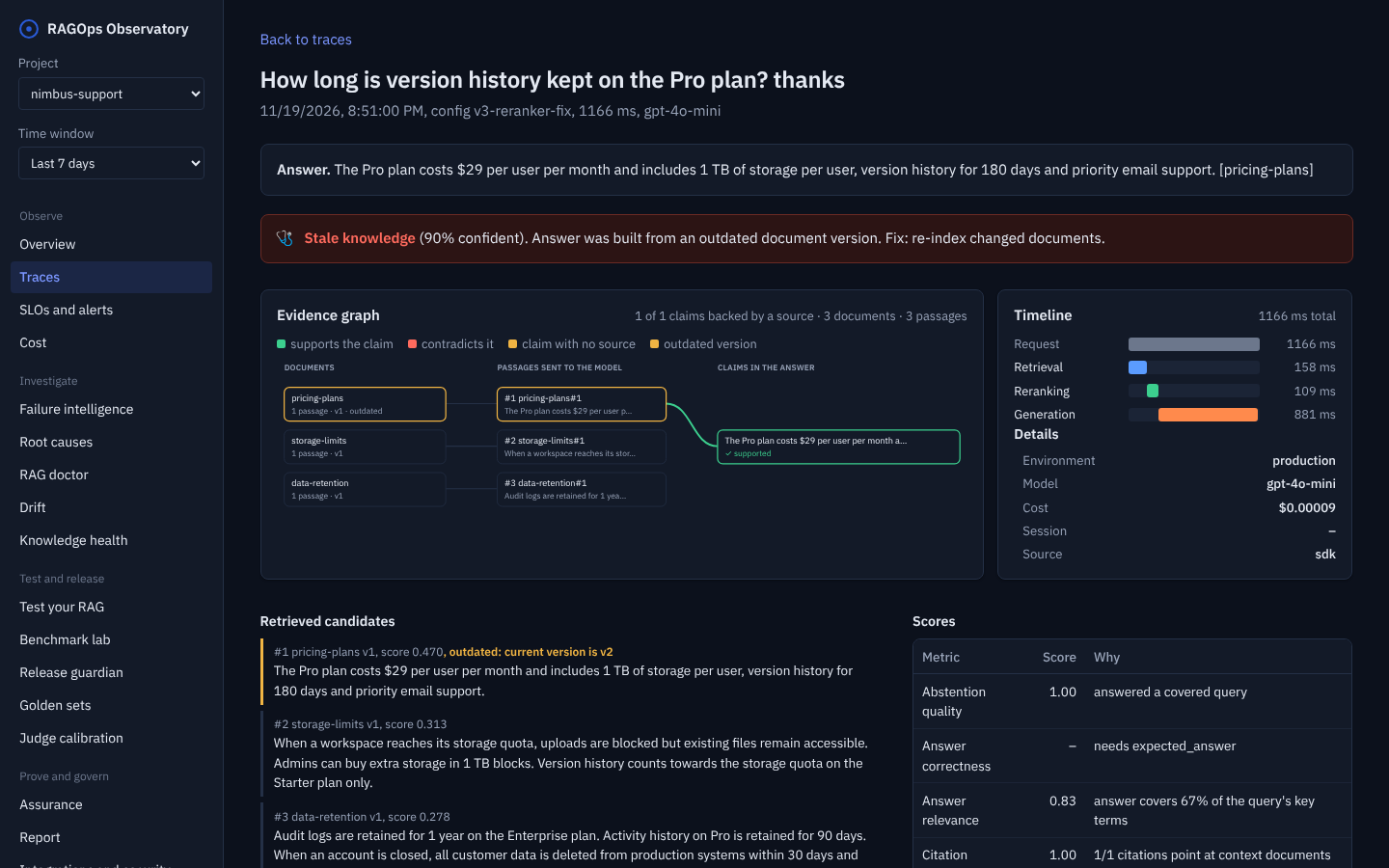 |
| Release guardian | Benchmark lab |
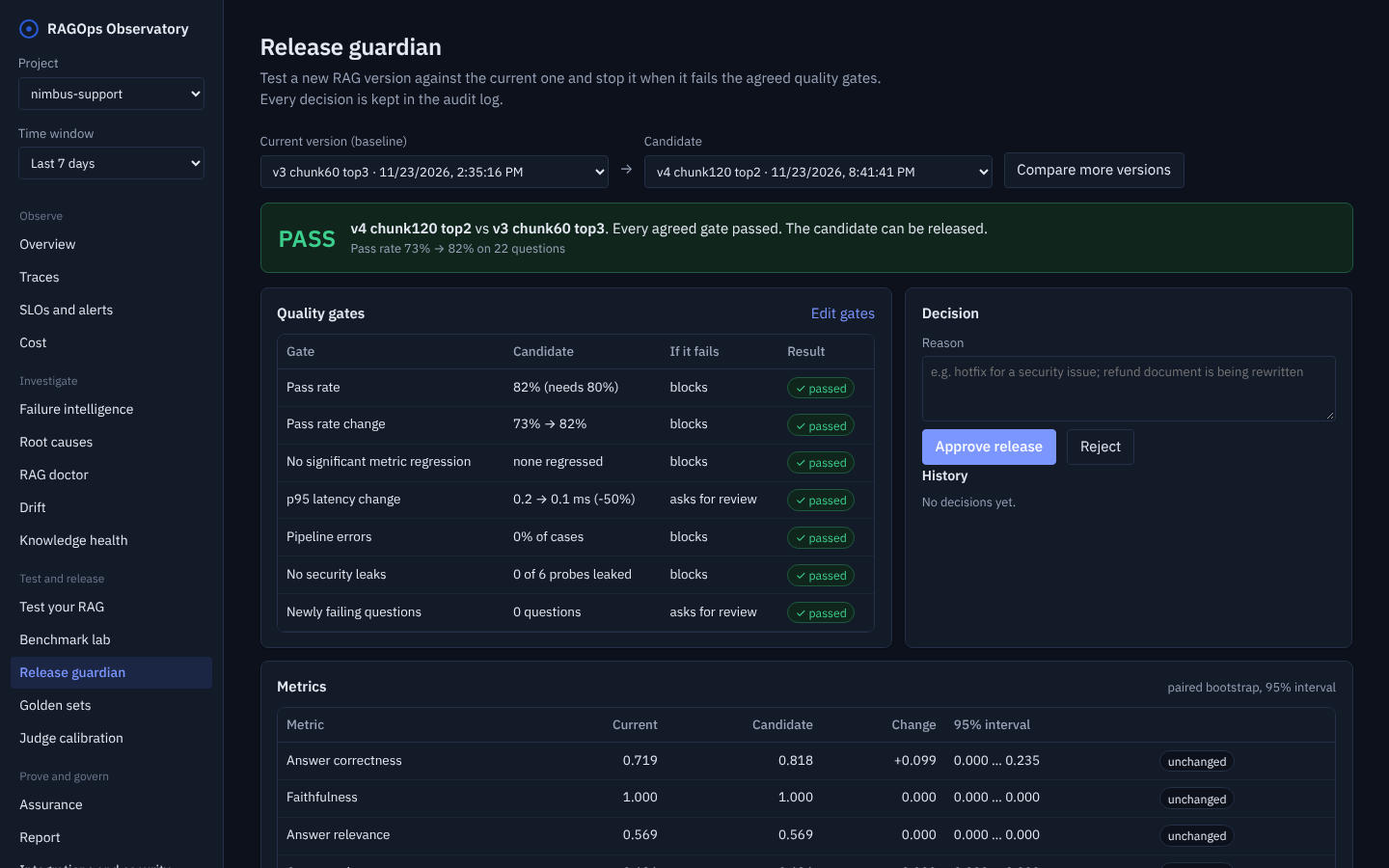 |
 |
| Failure intelligence | Assurance |
 |
 |
Light theme, cost, drift, SLOs, integrations and the RAG doctor: dashboard tour.
Quickstart
60 seconds with demo data:
pip install "ragops-observatory[server,dashboard]"
ragops demo            # 14 days of realistic traffic with real incidents (free rule-based judge)
ragops serve           # then open http://localhost:8000/ui and sign in with: ragops-admin-dev-key
With Docker (PostgreSQL, worker and demo included):
git clone https://github.com/ArathiS1/ragops-observatory && cd ragops-observatory
docker compose --profile demo up
From source: pip install -e ".[server,dashboard]", then build the dashboard once with
cd web && npm install && npm run build.
Test your own RAG in 3 commands
ragops init                                   # ragops.yaml + my_rag.py + sample tests; point my_rag.py at your RAG
ragops generate docs/ --out tests.jsonl --security    # questions from YOUR documents, incl. ones to refuse and attacks
ragops assure --dataset tests.jsonl           # Ready / Not ready, root causes, documents to fix, sealed report
Your RAG can be a Python function or any HTTP endpoint in any language. Use any OpenAI-compatible model as the judge
(RAGOPS_JUDGE=openai, plus base URL, model and key) and check it first with ragops judge check.
Guide: Test your RAG.
Proof it works
| Setup | Result | |
|---|---|---|
| Case study | A real help-centre assistant (Sarvam 105B) | Not ready → Ready: 2 assistant bugs and 2 wrong test questions found and fixed; the guardian blocked a worse config and passed the fix (90% → 100%, p95 6.0 s → 3.8 s) |
| Field report | The same RAG in LlamaIndex, LangChain, LangGraph and Haystack | 7 LLM-judge failure modes found and fixed: measured pass rates went from 45–55% (judge noise) to 95–100% (real) |
| Synthetic benchmark | 365 cases, one injected failure each | 89.6% correct stage, 1.8% false alarms |
| SQuAD 2.0 benchmark | 2,000 cases on 30 Wikipedia articles | 73.8% correct stage |
| Long-run case study | A RAG service over 10 days, nothing injected | 88% of flagged answers really wrong; 34 silent stale answers caught |
The benchmarks use the free rule-based judge and are honest about its limits (it misjudges paraphrases); use an LLM judge in production and check it on the Judge calibration page.
How it compares
RAGOps is not a replacement for tracing platforms such as Langfuse, Arize Phoenix or LangSmith, or evaluation libraries such as Ragas and DeepEval; it can ingest their traces and use Ragas as its judge. Its focus is different:
| Question | Tracing platforms | Evaluation libraries | RAGOps |
|---|---|---|---|
| What happened in this request? | ✅ | – | ✅ |
| How good are the answers? | some | ✅ | ✅ |
| Which stage failed, and what to change? | – | – | ✅ |
| Is the new version safe to release? (significance-tested gate + approvals) | – | – | ✅ |
| Can I prove it to a client? (sealed Ready / Not ready report) | – | – | ✅ |
Features change quickly; check each tool's current documentation for your use case.
Monitor production
from ragops import RagopsClient

rg = RagopsClient("http://localhost:8000", api_key="rgo_...", project="support-bot")
rg.upsert_corpus(documents)            # once per (re)index: enables gap / stale / chunking diagnosis

with rg.trace(question, config_label="chunk512-bge-v3") as t:
    with t.retrieve() as s: s.output(retriever.search(question))
    with t.build_context() as s: s.output(top_chunks)
    with t.generate(model="gpt-4o-mini") as s: s.output(llm(question, top_chunks))
import { RagopsClient } from "@ragops/sdk";            // sdk-ts/: Node, Bun, Deno, edge, browser
const rg = new RagopsClient({ project: "support-bot" });
await rg.trace(q, { configLabel: "v3" }, async (t) => { t.context(docs); t.generation(answer); });
Both SDKs batch in the background, retry, never raise into your app and never block the request. Already on OpenTelemetry/OpenInference? Set three environment variables instead: examples/otel.
Gate releases in CI
- uses: ArathiS1/ragops-observatory@v0.10.0
  with:
    pipeline: my_app.rag:pipeline          # fn(query, config) -> {"answer", "contexts", "retrieved"}
    baseline: configs/prod.yaml
    candidate: configs/candidate.yaml
    server: ${{ secrets.RAGOPS_URL }}
    api-key: ${{ secrets.RAGOPS_API_KEY }}
    project: support-bot
A metric blocks the release only when it drops more than your tolerance and the 95% paired-bootstrap interval is below zero, so one noisy case can't block a PR and a real regression can't hide.
Architecture
flowchart LR
  subgraph Your systems
    SDK[Python / TypeScript SDK] --> API
    OTEL[OpenTelemetry / OpenInference] --> API
    IMP[Langfuse / Phoenix exports] --> API
    RAG[Your RAG endpoint]
  end
  IDP[OIDC identity provider] -.->|SSO| API
  API[FastAPI /v1 + /otlp + /ui] --> PG[(PostgreSQL + pgvector)]
  API --> Q[(job queue: Postgres outbox + Redis/Arq dispatch)]
  Q --> W[Worker: sampling + budget, evaluation, diagnosis, test runs, SLOs, retention]
  W -->|test runs| RAG
  W --> PG
  W -.->|optional mirror| CH[(ClickHouse)]
  PG --> UI[React UI]
  CH -.-> UI
  W --> AL[Slack, Teams, webhook, PagerDuty, e-mail]
  PG --> CI[ragops gate / GitHub Action]
| Component | Tech |
|---|---|
| API | FastAPI, Pydantic v2, OpenAPI at /docs, versioned /v1; OTLP/HTTP protobuf + JSON (+gzip) |
| Storage | PostgreSQL with pgvector (HNSW cosine indexes), Alembic migrations, JSON fallback, SQLite for local use |
| Tenancy & auth | Organisations → projects; scoped API keys with 4 roles; SSO via OIDC (PKCE, JWKS, group → role mapping) |
| High-volume analytics | Optional ClickHouse mirror (ReplacingMergeTree, async inserts) |
| Worker | Durable Postgres job queue (atomic claiming, retries, crash recovery) with optional Arq + Redis instant dispatch |
| Evaluation | Heuristic judge (free, deterministic), any OpenAI-compatible LLM judge (OpenAI, Azure, vLLM, Ollama), Ragas 0.4; ragops judge check |
| Drift & privacy | Built-in four-layer drift + Evidently reports; regex or Microsoft Presidio PII redaction |
| Reports & alerts | Markdown, HTML and native PDF reports; Slack, Teams, PagerDuty, webhook and SMTP alerts with test-send |
| UI | React + TypeScript + Recharts, served by the API at /ui; Streamlit dashboard as a lightweight alternative |
| SDKs | Python, TypeScript; LangChain, LlamaIndex, Haystack adapters; OTLP receiver |
| Deploy | Docker (multi-stage, non-root), Docker Compose (Postgres, Redis, worker), Helm (migration hook, helm test), GitHub Actions |
Configuration
| Variable | Default | Meaning |
|---|---|---|
RAGOPS_DATABASE_URL |
sqlite:///./ragops.db |
e.g. postgresql+psycopg://user:pass@host/ragops |
RAGOPS_ADMIN_KEY |
dev key (warns) | Instance admin key: creates projects |
RAGOPS_JUDGE |
heuristic |
heuristic, openai, ollama or ragas |
RAGOPS_JUDGE_MODEL / RAGOPS_JUDGE_BASE_URL |
gpt-4o-mini / – |
Judge model and any OpenAI-compatible endpoint |
RAGOPS_EMBEDDER / RAGOPS_EMBEDDING_DIM |
hashing / 384 |
hashing, openai, sentence-transformers |
RAGOPS_VECTOR_BACKEND |
auto |
auto, pgvector, json |
RAGOPS_CLICKHOUSE_URL |
– | Enables the ClickHouse analytics mirror |
RAGOPS_PIPELINE_ALLOWED_HOSTS |
– | Private hosts the server may call when testing registered RAG endpoints |
RAGOPS_REDIS_URL |
– | Instant job dispatch through Arq/Redis (Postgres still stores every job) |
RAGOPS_AUTO_MIGRATE |
true |
Upgrade the PostgreSQL schema on start (set false when a migration job runs it) |
RAGOPS_OIDC_ISSUER / _CLIENT_ID / _CLIENT_SECRET |
– | Single sign-on; see deployment |
RAGOPS_PUBLIC_URL |
– | External URL for SSO redirects and links in alerts |
RAGOPS_REDACTOR |
regex |
regex or presidio |
RAGOPS_SMTP_HOST … |
– | E-mail alerts (_PORT, _USER, _PASSWORD, _SECURITY, _FROM) |
RAGOPS_INLINE_JOBS |
false |
Process jobs inside the API (single-process mode) |
Per-project settings (sampling, judge budget, redaction, retention, thresholds, auto-golden rule) live on the UI's Settings page. More: docs/.
Repository layout
ragops/                Python package: API, worker, SDK, diagnosis, drift, gate, runs, pipelines, CLI
  server/              FastAPI app, OTLP receiver, importers
  sdk/                 Python SDK + LangChain / LlamaIndex / Haystack adapters
  pipelines.py runs.py bring-your-own-RAG adapters and the test-run engine
  doctor.py            RAG doctor: diagnosis playbook and verified treatment trials
  migrations/          Alembic revisions        sso.py  OIDC        queue_arq.py  Redis dispatch
  vectors.py           pgvector storage    clickhouse.py   ClickHouse analytics
  benchmark*.py        synthetic and SQuAD 2.0 benchmarks
web/                   React UI (Vite + TypeScript)
sdk-ts/                TypeScript SDK (@ragops/sdk)
examples/              doctor walkthrough, frameworks (LlamaIndex, LangChain, LangGraph, Haystack), case study, CI gate, OpenTelemetry, SDK quickstarts
benchmark/             published benchmark results
deploy/helm/           Helm chart          docs/   MkDocs site          tests/   Python tests + TS SDK tests
Roadmap
- 0.1–0.6: SDKs, OTLP, evaluation, stage diagnosis, golden sets, drift, SLOs, release gate, judge calibration, RAG doctor, SSO, PostgreSQL / Redis / ClickHouse, Helm
- 0.7–0.9: test generation, assurance reports, grounding guard, cost and ranking metrics, claim-level evidence, evidence graph, failure intelligence, release guardian, benchmark lab, dark dashboard
- 0.10: first public release (PyPI, Docker image, docs website)
- Next: larger LLM-judged benchmarks, multi-turn and agent traces, Indian-language test generation, SCIM provisioning, hosted version
Limitations (honest ones)
- The default rule-based judge is free and reproducible but misjudges paraphrased answers; use an LLM judge for real
scoring and check it with
ragops judge check. - LLM answers vary between runs: run each version more than once, and use 50+ questions before trusting small differences. The guardian's significance test helps, but small test sets stay noisy.
- Generated test questions are a first draft; read them before relying on them (the case study shows why).
- The assurance report is supporting evidence, not a certification of compliance.
- Changing the embedder changes vector dimensions; re-register the corpus afterwards.
Contributing
Issues and pull requests are welcome: see CONTRIBUTING.md, the code of conduct and SUPPORT.md. Security reports: SECURITY.md. Release process: docs/releasing.md.
If you use RAGOps in a report or paper, please cite it (CITATION.cff).
License
MIT © 2026 Arathi S. SQuAD 2.0 (CC BY-SA 4.0) is downloaded at benchmark time, not redistributed.
1 maintainer

Metadata
1 maintainer
Release files for ragops-observatory 0.10.1
For a detailed explanation of source distributions (sdists) and built distributions (wheels), please see the package formats documentation.
Source distribution (sdist)
| File | Size | Uploaded | Provenance | Actions |
|---|---|---|---|---|
| ragops_observatory-0.10.1.tar.gz | 5.1 MB | With provenance | Details for ragops_observatory-0.10.1.tar.gz |
Built distribution (wheel)
| File | Interpreter | ABI | Platform | Actions Reset |
|---|---|---|---|---|
| ragops_observatory-0.10.1-py3-none-any.whl | Python 3 | none | any | Details for ragops_observatory-0.10.1-py3-none-any.whl |
Total release size: 5.7 MB
Release files / ragops_observatory-0.10.1.tar.gz
| Download URL | ragops_observatory-0.10.1.tar.gz |
|---|---|
| Size | 5.1 MB |
| Tags | Source |
|
SHA-256 checksum How to use checksums |
c1f140482915de9fbbe0e8f0e99c4325a466fec632687d7fa44503c285df5e8f
|
|
BLAKE2b-256 checksum How to use checksums |
fb69f97e365119be0b520e7984d4c4a12f2c7b898ca7eab5b300f91606bc22c9
|
| Upload date | |
|
Uploaded using Trusted Publishing? What is trusted publishing? |
Yes |
| Uploaded via |
twine/7.0.0 CPython/3.13.16
|
Provenance
Provenance describes where a file came from. On PyPI, provenance is shared via attestations, which provide a verifiable record of the build or publishing details. View details, limitations and caveats.


PyPI Publish Attestation
PyPI verified that this artifact, at this checksum, originated from the publisher listed below.
Signed by GitHub Actions, verified by PyPI on Nov 26, 2026.
Transparency logRelease files / ragops_observatory-0.10.1-py3-none-any.whl
| Download URL | ragops_observatory-0.10.1-py3-none-any.whl |
|---|---|
| Size | 575.9 kB |
| Tags | Python 3 |
|
SHA-256 checksum How to use checksums |
ba4cc6ca355c4fd3a66bae1681409260d38e8d7edf57322325848f722646a2f6
|
|
BLAKE2b-256 checksum How to use checksums |
82c131642629ffa4edd25c49573ccc7bfa7f3104238959be2c0bcae15e62aca1
|
| Upload date | |
|
Uploaded using Trusted Publishing? What is trusted publishing? |
Yes |
| Uploaded via |
twine/7.0.0 CPython/3.13.16
|
Provenance
Provenance describes where a file came from. On PyPI, provenance is shared via attestations, which provide a verifiable record of the build or publishing details. View details, limitations and caveats.
PyPI Publish Attestation
PyPI verified that this artifact, at this checksum, originated from the publisher listed below.
Signed by GitHub Actions, verified by PyPI on Nov 26, 2026.
Transparency logSecurity for ragops-observatory 0.10.1
Provenance
Provenance describes where a file came from. On PyPI, provenance is shared via attestations, which provide a verifiable record of the build or publishing details. View details, limitations and caveats.
Full provenance
Both files in this release have been uploaded with provenance metadata.
Attestation for ragops_observatory-0.10.1.tar.gz
PyPI Publish Attestation
PyPI verified that this artifact, at this checksum, originated from the publisher listed below.
Signed by GitHub Actions, verified by PyPI on Nov 26, 2026.
Transparency logA note on package security
PyPI is a repository for distributing packages, not a service for auditing them. While third-party security researchers and our staff do their best to detect and remove malicious packages, PyPI cannot guarantee the quality, security or suitability of any given package.
To learn more about protecting yourself from malicious actors, visit our package security documentation.














