
Project-scoped Railway MCP server — reads RAILWAY_TOKEN from .env.local, no login needed
Verified details
These details have been verified by PyPIProject links
GitHub Statistics
Maintainers

Project description
Project-scoped Railway MCP server.
Reads RAILWAY_TOKEN from each project's .env.local — no railway login needed.




railguey is for teams and businesses that need reliable Railway deployments. It is not the simplest way to deploy — Railway's built-in GitHub app is simpler. But railguey is more reliable, because it draws a cleaner engineering boundary.
Why not just use Railway's GitHub App?
Railway's GitHub App is fast to set up: connect your repo, push to main, and your service deploys. For prototyping, that speed is genuinely great. But speed of setup and quality of engineering are different things.
The GitHub App bundles five responsibilities into one opaque chain: watch for code changes, authenticate to GitHub, receive a webhook, clone the repo, build and deploy. When the chain works, it feels like magic. When it doesn't — and it has broken four times in four months — there is no observability, no retry, and no notification. Your push goes in. Nothing comes out. You find out when a customer does.
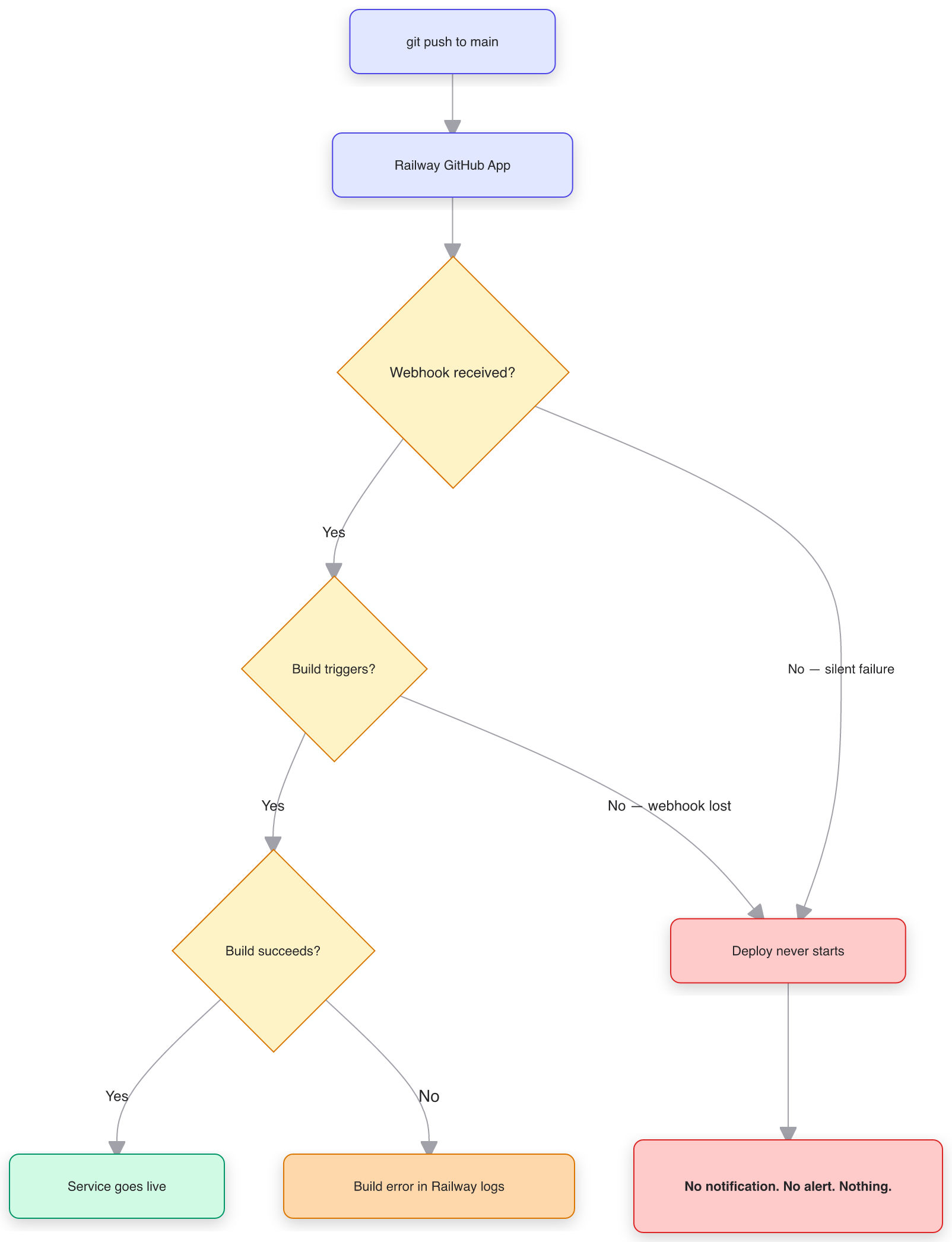
Every decision diamond in this diagram is a place where the chain can silently break. Missed webhooks, lost build triggers, GitHub App auth failures — all produce the same result: nothing happens, and nobody tells you.
This isn't a bug. It's an architectural choice. Railway chose to own the entire pipeline from push to deploy, which means every failure in GitHub's webhook delivery becomes Railway's problem — and yours.
How railguey fixes this
railguey separates concerns. GitHub Actions watches your repo (GitHub watching GitHub — the thing it was built for). railguey handles the deploy via Railway's API using project-scoped tokens. Railway builds and runs your service (the thing it was built for). Each system does one job.
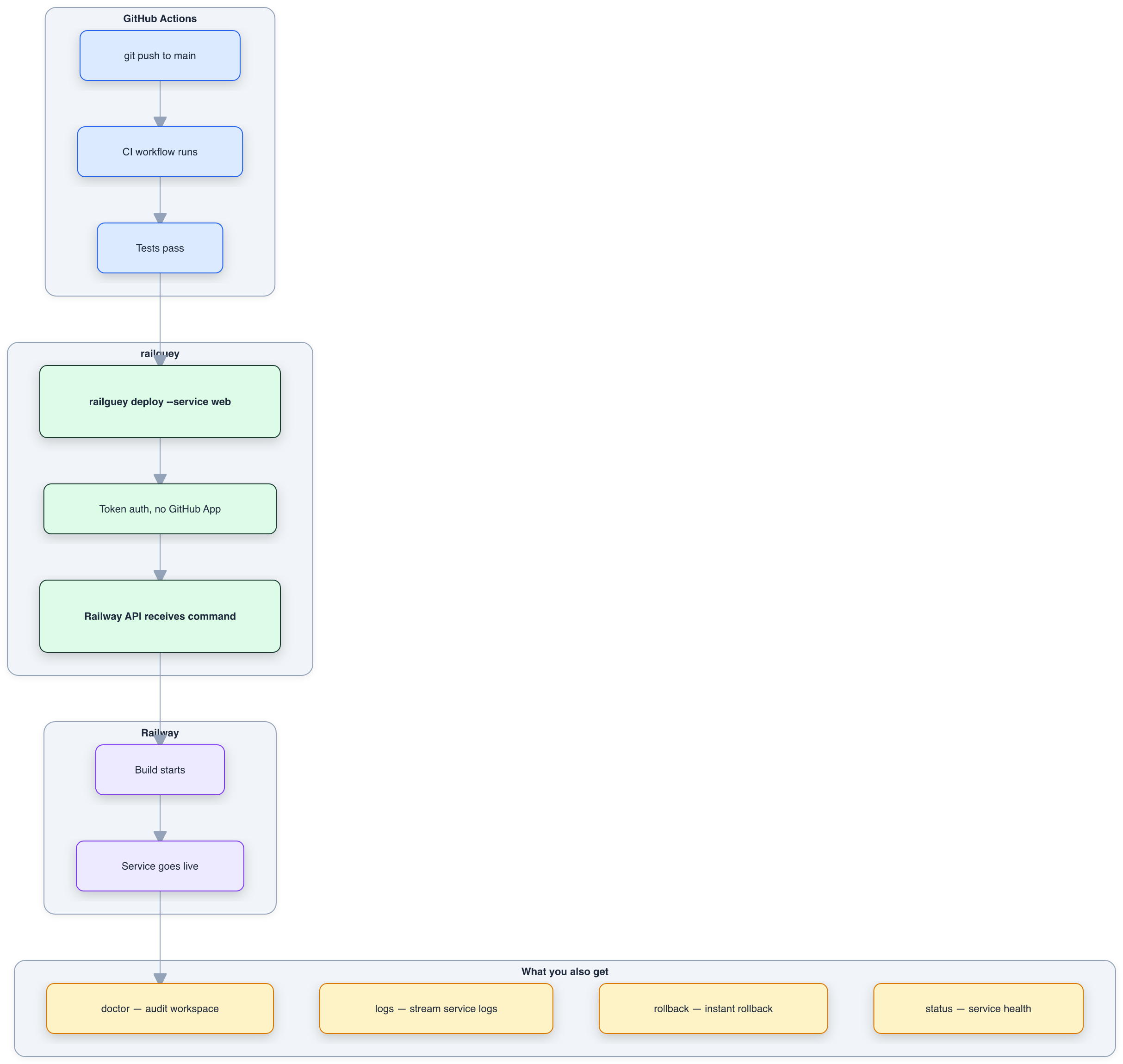
If CI fails, GitHub tells you. If the deploy fails, the CLI returns an error. If the service is unhealthy, railguey doctor catches it. Every step is observable, retryable, and owned by the system best suited to do it.
Fast delivery and good engineering aren't opposites — but Railway's GitHub App trades the second for the first. railguey gives you both.
| Doc | What it covers |
|---|---|
| WHY-NOT-RAILWAY-APP.md | The architectural argument — why coupling CI/CD triggering with deployment is a design flaw, not just a bug |
| WHY-RAILGUEY.md | The evidence — four incidents, community reports, and what the project-token pattern does differently |
| WHY-RAILGUEY.md#case-study | Real-world case study — ghost GitHub repo links silently blocked env var operations across 5 services |
When to use railguey
- You manage Railway services from AI agents (Claude Code, Cursor, etc.) and want them to deploy, rollback, and read logs without
railway login - You run multiple Railway projects and want one auth pattern across local dev, CI/CD, and AI tooling
- Deploy reliability matters — production services, client projects, anything where a silently missed deploy costs you
- You're already using GitHub Actions and want Railway deploys in the same pipeline as your tests
When NOT to use railguey
- Quick demos and hobby projects. Railway's GitHub app is genuinely convenient for push-and-forget deploys. If you're prototyping and don't care about deploy reliability, the built-in integration is fine.
- You don't use an MCP client or CLI. railguey includes both an MCP server and a CLI. But if you only deploy once in a while from the terminal, the Railway CLI with a project token is enough.
- You're happy with the dashboard. If you deploy once a week and check status manually, railguey adds complexity you don't need.
Known limitations
- All tools depend on Railway's Backboard GraphQL API, which isn't officially documented. The schema could change without notice.
- No Railway CLI required. All 21 tools use pure GraphQL with project-scoped tokens. The CLI backend module still exists for backward compatibility but is no longer used by any tool.
- One token per project. Project-scoped tokens can't query across projects. If you manage 10 projects, you need 10
.env.localfiles in 10 workspaces. This is by design (isolation), but it's more setup than a user-level login.
Install
Requires Python 3.10+. No Railway CLI needed.
pip install railguey
Or run without installing:
uvx railguey --help
Install from source
git clone https://github.com/eidos-agi/railguey.git
cd railguey
pip install -e .
CLI usage
pip install railguey gives you the railguey command with all 21 tools as subcommands:
railguey status ~/repos/my-app
railguey logs ~/repos/my-app cerebro --lines 50
railguey deploy ~/repos/my-app web
railguey deployments ~/repos/my-app cerebro --limit 5
railguey doctor ~/repos/my-app
railguey variables ~/repos/my-app web
railguey service-info ~/repos/my-app cerebro
Every command takes a workspace path — the directory containing .env.local with RAILWAY_TOKEN.
Configure Claude Code (MCP)
The recommended setup uses the Claude Code CLI to register railguey as a user-level MCP server:
pip install railguey
claude mcp add --scope user railguey -- railguey serve
This makes railguey available in every Claude Code session, across all projects. The --scope user flag writes to ~/.claude.json so it persists globally.
Manual config (alternative)
Add to ~/.claude.json under mcpServers:
{
  "mcpServers": {
    "railguey": {
      "command": "railguey",
      "args": ["serve"]
    }
  }
}
From source (development)
git clone https://github.com/eidos-agi/railguey.git
cd railguey
pip install -e .
claude mcp add --scope user railguey -- railguey serve
Or manually in ~/.claude.json:
{
  "mcpServers": {
    "railguey": {
      "command": "python3",
      "args": ["-m", "railguey.mcp"]
    }
  }
}
First deploy of a fresh service
A brand-new Railway service needs both a serviceCreate mutation (with environmentId so the per-env instance materializes) AND a source upload to be deployable. railguey collapses this to one verb:
railguey service-bootstrap /path/to/repo my-service
Under the hood: serviceCreate with the project-token's environmentId (Railway requires this), then a gzipped tarball of the workspace POSTed to https://backboard.railway.com/project/{p}/environment/{e}/up?serviceId={s} — both project-token-only, no GitHub-Railway link, no account-level auth.
The tarball respects .gitignore, .dockerignore, and .railwayignore (90% of .gitignore semantics — no negation, no nested **); .git, node_modules, .venv, and *.cache directories are always excluded. Hard-cap of 256MB; use .railwayignore to trim larger workspaces.
For subsequent deploys, use railguey upload-source (just upload — service already exists) or railguey deploy (redeploy from existing source).
Tools
21 tools, all pure GraphQL. No Railway CLI required — just a project-scoped token.
| Tool | What it does |
|---|---|
railguey_status |
Project overview — all services, deploy status, domains |
railguey_services |
List services with IDs |
railguey_logs |
Fetch recent deploy or build logs (with optional filter) |
railguey_deploy |
Trigger a deploy from linked source |
railguey_redeploy |
Redeploy latest deployment (rebuilds from source) |
railguey_restart |
Restart latest deployment (no rebuild, fast) |
railguey_variables |
List env vars for a service |
railguey_variable_set |
Set an env var (triggers redeploy) |
railguey_domain |
Generate a railway.app domain or add a custom domain |
railguey_environment_create |
Create a new environment (staging, preview, etc.) |
railguey_deployments |
Deployment history with IDs, statuses, timestamps, rollback eligibility |
railguey_rollback |
Roll back to a specific deployment |
railguey_service_info |
Full service config — build/start commands, healthcheck, region, replicas |
railguey_http_logs |
HTTP request logs — status codes, latency, paths |
railguey_deployment_logs |
Logs for a specific deployment by ID (deploy or build, with filter) |
railguey_unlink_repo |
Disconnect a service from GitHub repo linking |
railguey_service_create |
Create a service bound to the project token's environment |
railguey_upload_source |
Tarball workspace + POST to Railway /up — deploy via project token |
railguey_service_bootstrap |
One-call first deploy: service_create + upload_source |
railguey_service_delete |
Delete a service from the Railway project (irreversible) |
Coaching tools
| Tool | What it does |
|---|---|
railguey_doctor |
Audit a workspace for deployment best practices (4-point check) |
railguey_doctor checks:
RAILWAY_TOKENexists in.env.local.env.localis in.gitignore- GitHub Actions deploy workflow exists with token-based CI/CD
- No services linked to GitHub repos
Every tool requires a workspace parameter — the absolute path to a project directory that has a .env.local (or .env) containing RAILWAY_TOKEN.
Example
CLI:
railguey logs ~/repos/my-app web --lines 50
MCP (via AI agent):
railguey_logs(workspace="/Users/you/repos/my-app", service="web", lines=50)
Python library:
from railguey.lib import tools
result = await tools.logs("/Users/you/repos/my-app", "web", lines=50)
All three read /Users/you/repos/my-app/.env.local, extract the token, and run:
RAILWAY_TOKEN=<token> railway logs --service web --lines 50
The project-token pattern
Railway lets you create project-scoped tokens — API keys that authenticate to a single project without any user login. These tokens work the same way everywhere:
| Context | How the token is used |
|---|---|
| Local dev | .env.local — railway logs, railway up, etc. |
| AI agents (railguey) | Read from .env.local at the workspace path |
| GitHub Actions CI/CD | Repository secret → RAILWAY_TOKEN env var |
| Any CI system | Same — export the token, run railway up |
One mechanism. No OAuth. No repo linking. No webhook fragility.
GitHub Actions deploy workflow (copy-paste)
Add RAILWAY_TOKEN as a repository secret, then:
# .github/workflows/deploy.yml
name: Deploy to Railway

on:
  push:
    branches: [main]

jobs:
  deploy:
    runs-on: ubuntu-latest
    steps:
      - uses: actions/checkout@v4

      - name: Install Railway CLI
        run: curl -fsSL https://railway.com/install.sh | sh

      - name: Deploy
        env:
          RAILWAY_TOKEN: ${{ secrets.RAILWAY_TOKEN }}
        run: railway up --service ${{ vars.RAILWAY_SERVICE }} --detach
Set RAILWAY_SERVICE as a repository variable. More examples in examples/.
Token discovery
- Looks for
RAILWAY_TOKEN=in{workspace}/.env.local - Falls back to
{workspace}/.env - Raises a clear error if not found
Supports bare values, single-quoted, and double-quoted values.
License
MIT
Project details
Verified details
These details have been verified by PyPIProject links
GitHub Statistics
Maintainers
Release history Release notifications | RSS feed


Download files
Download the file for your platform. If you're not sure which to choose, learn more about installing packages.
Source Distribution
Built Distribution
Filter files by name, interpreter, ABI, and platform.
If you're not sure about the file name format, learn more about wheel file names.
Copy a direct link to the current filters
File details
Details for the file railguey-0.2.10.tar.gz.
File metadata
- Download URL: railguey-0.2.10.tar.gz
- Upload date:
- Size: 4.4 MB
- Tags: Source
- Uploaded using Trusted Publishing? Yes
- Uploaded via: twine/6.1.0 CPython/3.13.12
File hashes
| Algorithm | Hash digest | |
|---|---|---|
| SHA256 |
c467c21fbe01ea677b8aeea85c7bead5683e6b87baa332de1d242573d722b51f
|
|
| MD5 |
99f3f8f5d634a50ff92aed7157a789a9
|
|
| BLAKE2b-256 |
d12c8a6e44ba608444f43282a7fcac95d45f204fc37453ca5f2664bae24c0e40
|
Provenance
The following attestation bundles were made for railguey-0.2.10.tar.gz:
Publisher:
publish.yml on eidos-agi/railguey
-
Statement:
-
Statement type:
https://in-toto.io/Statement/v1 -
Predicate type:
https://docs.pypi.org/attestations/publish/v1 -
Subject name:
railguey-0.2.10.tar.gz -
Subject digest:
c467c21fbe01ea677b8aeea85c7bead5683e6b87baa332de1d242573d722b51f - Sigstore transparency entry: 1429594450
- Sigstore integration time:
-
Permalink:
eidos-agi/railguey@f716f3f34b27abfb13dc4304fa75827d86986d07 -
Branch / Tag:
refs/tags/v0.2.10 - Owner: https://github.com/eidos-agi
-
Access:
private
-
Token Issuer:
https://token.actions.githubusercontent.com -
Runner Environment:
github-hosted -
Publication workflow:
publish.yml@f716f3f34b27abfb13dc4304fa75827d86986d07 -
Trigger Event:
push
-
Statement type:
File details
Details for the file railguey-0.2.10-py3-none-any.whl.
File metadata
- Download URL: railguey-0.2.10-py3-none-any.whl
- Upload date:
- Size: 53.3 kB
- Tags: Python 3
- Uploaded using Trusted Publishing? Yes
- Uploaded via: twine/6.1.0 CPython/3.13.12
File hashes
| Algorithm | Hash digest | |
|---|---|---|
| SHA256 |
5f1281bf3a7e821f9478efd1e158767d9388eda391fb8a1b092112ffa5368e4e
|
|
| MD5 |
388e98728c07a0254c4f0ba26cf3daa9
|
|
| BLAKE2b-256 |
62a0e4125be9f07af3e2fc97f2da9e3fe0eb6e585b8e7947783dd03a40758958
|
Provenance
The following attestation bundles were made for railguey-0.2.10-py3-none-any.whl:
Publisher:
publish.yml on eidos-agi/railguey
-
Statement:
-
Statement type:
https://in-toto.io/Statement/v1 -
Predicate type:
https://docs.pypi.org/attestations/publish/v1 -
Subject name:
railguey-0.2.10-py3-none-any.whl -
Subject digest:
5f1281bf3a7e821f9478efd1e158767d9388eda391fb8a1b092112ffa5368e4e - Sigstore transparency entry: 1429594452
- Sigstore integration time:
-
Permalink:
eidos-agi/railguey@f716f3f34b27abfb13dc4304fa75827d86986d07 -
Branch / Tag:
refs/tags/v0.2.10 - Owner: https://github.com/eidos-agi
-
Access:
private
-
Token Issuer:
https://token.actions.githubusercontent.com -
Runner Environment:
github-hosted -
Publication workflow:
publish.yml@f716f3f34b27abfb13dc4304fa75827d86986d07 -
Trigger Event:
push
-
Statement type:






