
rashomon-py
Does your conclusion survive every equally-good model?
Many parameter vectors fit a training set about as well as the one your solver returned. If some of them reverse your conclusion (a coefficient's sign, a feature ranking, a decision for one row), the conclusion depends on which optimum the solver landed on, not on the data. rashomon-py checks this for a fitted scikit-learn logistic or linear regression.
from sklearn.linear_model import LogisticRegression
from rashomon import audit

model = LogisticRegression().fit(X, y)       # your existing model (Pipelines work too)
report = audit(model, X, y)                  # pandas in -> feature names out

print(report.summary())
report.plot()
report.flipped                               # bool mask: rows whose prediction can flip
report.coefficients                          # DataFrame: estimate, low, high, sign_stable
Output for the ten "mean" features of the Wisconsin breast-cancer data with the default LogisticRegression():
Stability audit: LogisticRegression (classification), n=569, 10 features
Equally-good models: training log-loss within 0.01704 of the optimum 0.1435
  (one standard error of the 5-fold cross-validated log-loss, whose mean is 0.1458; models closer than this cannot be told apart by CV)
Method: hit-and-run sampling of the exact set (with ellipsoid proposals); 2,000 models, min ESS = 218 -> reliable

Predictions (flip test exact; disagreement over the sampled models)
  Flip under some equally-good model:           17.4%  (99 of 569)
  Worst single-model disagreement with yours:    5.1%

Coefficients (exact range across all equally-good models)
  feature                  estimate        low       high  sign
  mean radius               -0.9976     -4.634      2.621  UNSTABLE
  mean texture               -1.399     -2.527    -0.4664  stable
  mean perimeter            -0.9124     -4.613      2.775  UNSTABLE
  mean area                  -1.298     -5.061      2.433  UNSTABLE
  ...
Sign stable: 1 of 10 features.
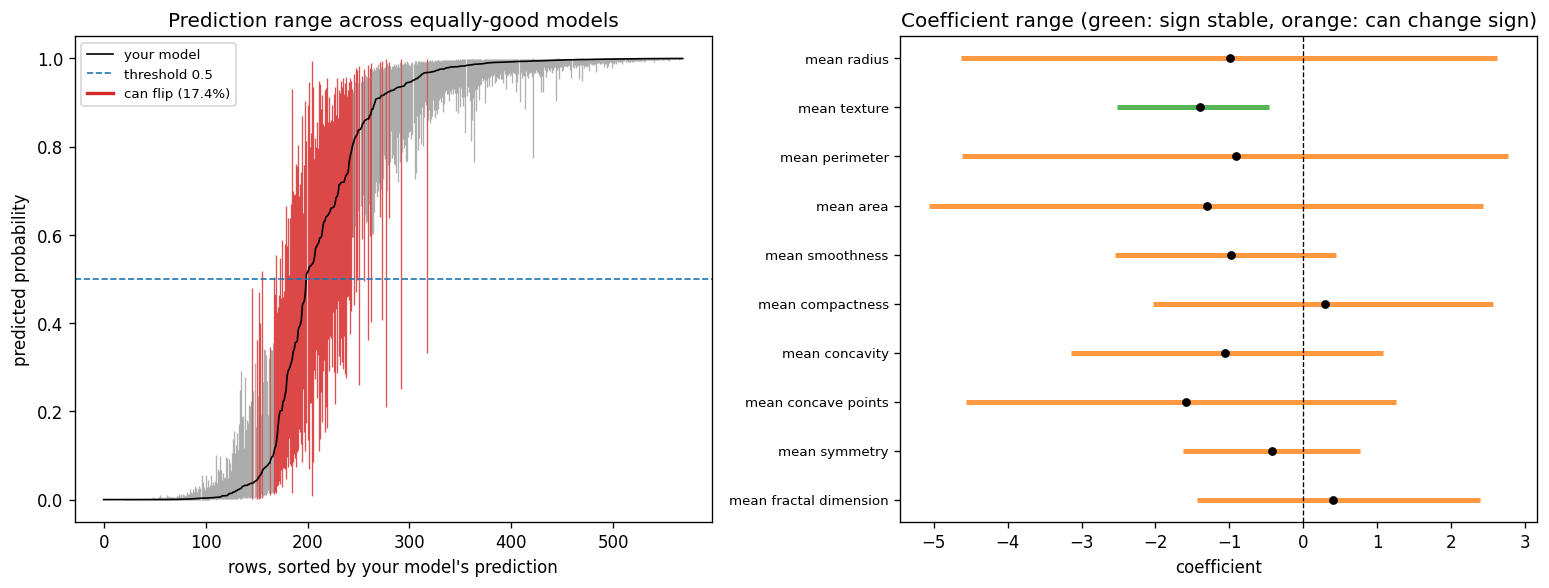
The model is 95% accurate. Still, one diagnosis in six is reversed by some model that cross-validation cannot distinguish from it, and only the coefficient on texture keeps its sign across all of them. Radius, perimeter and area are near-duplicates, so the data fixes their combined effect but not how to split it between them. A claim like "tumour radius lowers the odds" would not survive.
Install
pip install rashomon-py # Python 3.9+; depends on numpy, scipy, scikit-learn, pandas, matplotlib
How this differs from a confidence interval
A confidence interval or bootstrap asks how much the estimate would move under a new sample from the population. rashomon-py asks how many different models fit the data you have about equally well, and whether they agree with yours. The first is sampling uncertainty; the second is model multiplicity (Breiman's "Rashomon effect"). A coefficient can have a narrow confidence interval and still change sign across equally-good models when features are collinear, because the loss is nearly flat along the collinear directions. See Bootstrap, Rashomon, and Bayesian intervals for a worked comparison.
What "equally good" means
The tolerance sets how much worse than optimal a model may be and still count. audit() accepts four forms and prints the one in use:
tolerance= |
Meaning | When to use |
|---|---|---|
"cv" (default) |
one standard error of the cross-validated loss; models closer than this cannot be told apart by cross-validation (the one-standard-error rule from glmnet) | data-driven default |
0.01 (any float in (0,1)) |
models at most 1% worse than optimal on the training loss | a rule that is easy to state; 0.01 to 0.05 are common |
"lr" / ("lr", 0.05) |
the models not rejected by a likelihood-ratio test at level α | unpenalized fits |
("profile", 0.05) |
χ²₁(0.95)/(2n): for an unpenalized fit the coefficient ranges are the 95% profile-likelihood confidence intervals | statistical reporting; see Validation below |
("absolute", 0.002) |
a loss gap in training-loss units | reproducing a published setting |
The CV default is permissive, so expect larger sets than with a 1% rule. Results at two or three tolerances say more than any single one; see Choosing the tolerance.
What the report contains
report. |
Meaning | Term in the literature |
|---|---|---|
flip_rate, flipped |
share (and mask) of rows whose predicted label changes under some equally-good model | ambiguity (Marx, Calmon & Ustun 2020) |
max_disagreement |
the largest share of rows on which one equally-good model disagrees with yours | discrepancy (Marx et al. 2020) |
coefficients |
each coefficient's range across all equally-good models, and whether its sign is stable | variable importance cloud (Dong & Rudin 2020); hacking intervals (Coker, Rudin & King 2021) |
prediction_ranges |
per-row range of predicted probability or fitted value | prediction bands over the Rashomon set |
predict_ranges(X_new) |
the same for new rows, through your pipeline | |
tolerance |
the loss gap defining the set | ε in the ε-Rashomon set (Fisher, Rudin & Dominici 2019) |
rashomon_set, samples |
the underlying RashomonSet and the sampled parameter vectors |
Coefficient ranges and the flip test are exact: each coefficient range is the solution of a convex program over the true set, and each row not already flipped by a sampled model is settled by one more convex program (automatic when the problem is small enough: n · d² ≤ 5·10⁶ for ranges, n_undecided · n · d² ≤ 10⁹ for flips; force with exact_ranges=True / exact_flips=True). The disagreement figure and the prediction ranges come from models sampled from the exact set, so they are lower bounds that tighten as n_samples grows. The report states the effective sample size and whether it is reliable.
Validation
For an unpenalized logistic regression, the range of a coefficient over the Rashomon set with tolerance χ²₁(0.95)/(2n) is by definition its 95% profile-likelihood confidence interval, so the exact-range machinery can be checked against a standard statistical result. On the UCLA graduate-admissions data (admit ~ gre + gpa + rank, n = 400), coef_extremes() reproduces all twelve bounds of R's confint() output to within 1e-4 (R's own interpolation precision) and the MLE to 5e-7; the test also agrees with an independent profile root-finder to 2e-6. A second test grids a two-dimensional Rashomon set and checks the exact ranges, the exact flip test and the sampler's moments against brute force. See tests/test_validation.py.
Supported models
LogisticRegression / LogisticRegressionCV (binary; L2 or unpenalized; with or without class_weight), Ridge / RidgeCV, LinearRegression, and a Pipeline whose last step is one of these. If the model was fitted with sample_weight, pass the same weights to audit(..., sample_weight=w). The regularization strength, the unpenalized intercept and the row weights are converted exactly, and the audit checks that your fitted coefficients sit at the optimum of the reconstructed objective. A mismatch is reported.
Not supported: multiclass (planned), L1 and elastic-net penalties (the level set of a non-smooth objective is not a convex set of the same kind), trees, neural networks. The method needs a convex, twice-differentiable loss, so other L2-penalized GLMs (Poisson, multinomial) are possible extensions.
The method works in small to moderate dimension. Hit-and-run sampling mixes well up to a few dozen features. Above about 60 features the report will show a low effective sample size; reduce the dimension or sample longer. Exact coefficient ranges do not depend on sampling.
Expert API
RashomonSet gives direct access to ε calibration (percent_loss, LR_alpha, absolute), the membership oracle, hit-and-run sampling (with optional ellipsoid proposals), the Hessian-ellipsoid approximation, functional_range / coef_extremes, model class reliance, Shapley-VIC, and bootstrap and Bayesian comparisons. RashomonSet.from_sklearn(model, X, y, ...) builds one from a fitted model. RashomonSet(C=...) is not scikit-learn's C: it is 1/λ for the mean-loss objective, and scikit-learn's C equals C/n. audit and from_sklearn do the conversion.
from rashomon import RashomonSet
rs = RashomonSet.from_sklearn(model, X, y, epsilon=0.02, random_state=0)
rs.functional_range(x_row)          # exact prediction range for one row, on the logit scale
rs.sample_hitandrun(2000, ellipsoid_mix=0.5)
Documentation
- Quickstart
- When to use this
- Choosing the tolerance
- Interpreting instability
- Bootstrap, Rashomon, and Bayesian intervals
- Ellipsoid approximation vs sampling
- Tutorial: when equally-good models disagree
- Evaluation on real datasets
- API reference
References
- Breiman, L. (2001). Statistical modeling: The two cultures. Statistical Science, 16(3), 199-231.
- Fisher, A., Rudin, C., & Dominici, F. (2019). All models are wrong, but many are useful. JMLR, 20(177), 1-81.
- Marx, C., Calmon, F., & Ustun, B. (2020). Predictive multiplicity in classification. ICML.
- Dong, J., & Rudin, C. (2020). Exploring the cloud of variable importance for the set of all good models. Nature Machine Intelligence, 2, 810-824.
- Coker, B., Rudin, C., & King, G. (2021). A theory of statistical inference for ensuring the robustness of scientific results. Management Science, 67(10), 6174-6197.
- Rudin, C. (2019). Stop explaining black box machine learning models for high stakes decisions and use interpretable models instead. Nature Machine Intelligence, 1, 206-215.
- Semenova, L., Rudin, C., & Parr, R. (2022). On the existence of simpler machine learning models. FAccT.
License
MIT
1 maintainer

Metadata
1 maintainer
Release files for rashomon-py 0.3.1
For a detailed explanation of source distributions (sdists) and built distributions (wheels), please see the package formats documentation.
Source distribution (sdist)
| File | Size | Uploaded | |
|---|---|---|---|
| rashomon_py-0.3.1.tar.gz | 56.1 kB | Details |
Built distribution (wheel)
| File | Interpreter | ABI | Platform | Reset |
|---|---|---|---|---|
| rashomon_py-0.3.1-py3-none-any.whl | Python 3 | none | any | Details |
Total release size: 114.1 kB
Release files / rashomon_py-0.3.1.tar.gz
| Download URL | rashomon_py-0.3.1.tar.gz |
|---|---|
| Size | 56.1 kB |
| Tags | Source |
|
SHA-256 checksum How to use checksums |
0768a5a7890714722e293495c87caa6e3827c0778fe090d7704b09a17948394d
|
|
BLAKE2b-256 checksum How to use checksums |
364d4cdf641388f79de41ab20300d41786846b53ca33164df5a49b1aeba59571
|
| Upload date | |
|
Uploaded using Trusted Publishing? What is trusted publishing? |
Yes |
| Uploaded via |
twine/7.0.0 CPython/3.13.14
|
Provenance
Provenance describes where a file came from. On PyPI, provenance is shared via attestations, which provide a verifiable record of the build or publishing details. View details, limitations and caveats.


PyPI Publish Attestation
PyPI verified that this artifact, at this checksum, originated from the publisher listed below.
Signed by GitHub Actions, verified by PyPI on Oct 8, 2026.
Transparency logRelease files / rashomon_py-0.3.1-py3-none-any.whl
| Download URL | rashomon_py-0.3.1-py3-none-any.whl |
|---|---|
| Size | 58.0 kB |
| Tags | Python 3 |
|
SHA-256 checksum How to use checksums |
4dff043f2257ba381ad6a3a80a14ac0996cda44f79252cd30939b75cba1a653b
|
|
BLAKE2b-256 checksum How to use checksums |
e06f34583ad04524a1c96abc74ad7f0d6f3ee60ae7261a5ef31b430f6bf3ff79
|
| Upload date | |
|
Uploaded using Trusted Publishing? What is trusted publishing? |
Yes |
| Uploaded via |
twine/7.0.0 CPython/3.13.14
|
Provenance
Provenance describes where a file came from. On PyPI, provenance is shared via attestations, which provide a verifiable record of the build or publishing details. View details, limitations and caveats.
PyPI Publish Attestation
PyPI verified that this artifact, at this checksum, originated from the publisher listed below.
Signed by GitHub Actions, verified by PyPI on Oct 8, 2026.
Transparency log













