
RDF-Rust
Partial and total radial distribution functions (PRDF / RDF) for crystal structures, with native support for partially occupied sites.
⚙️ Rust backend, 🐍 Python frontend. The neighbour search, the histogramming and the CIF parsing run in compiled Rust, in parallel across cores. You call it from Python and get NumPy arrays back.
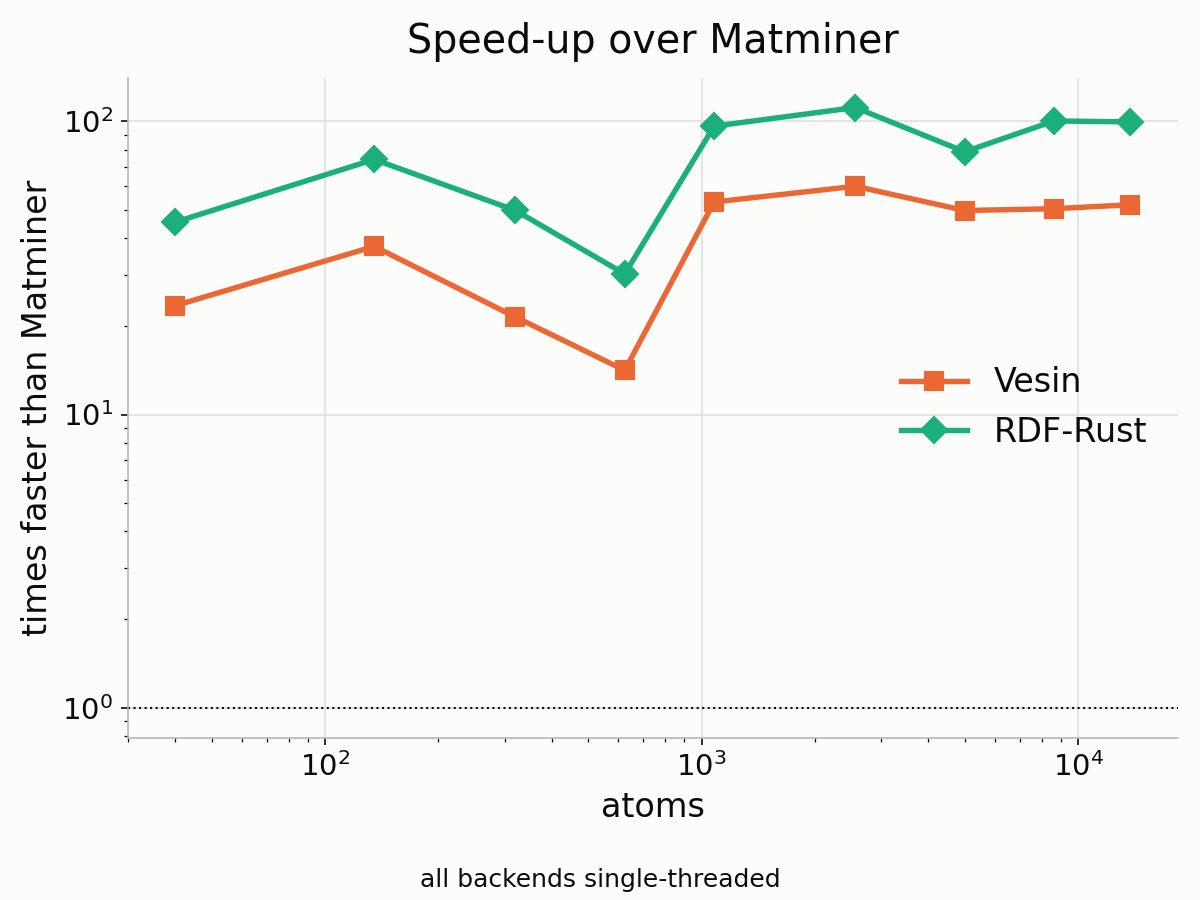
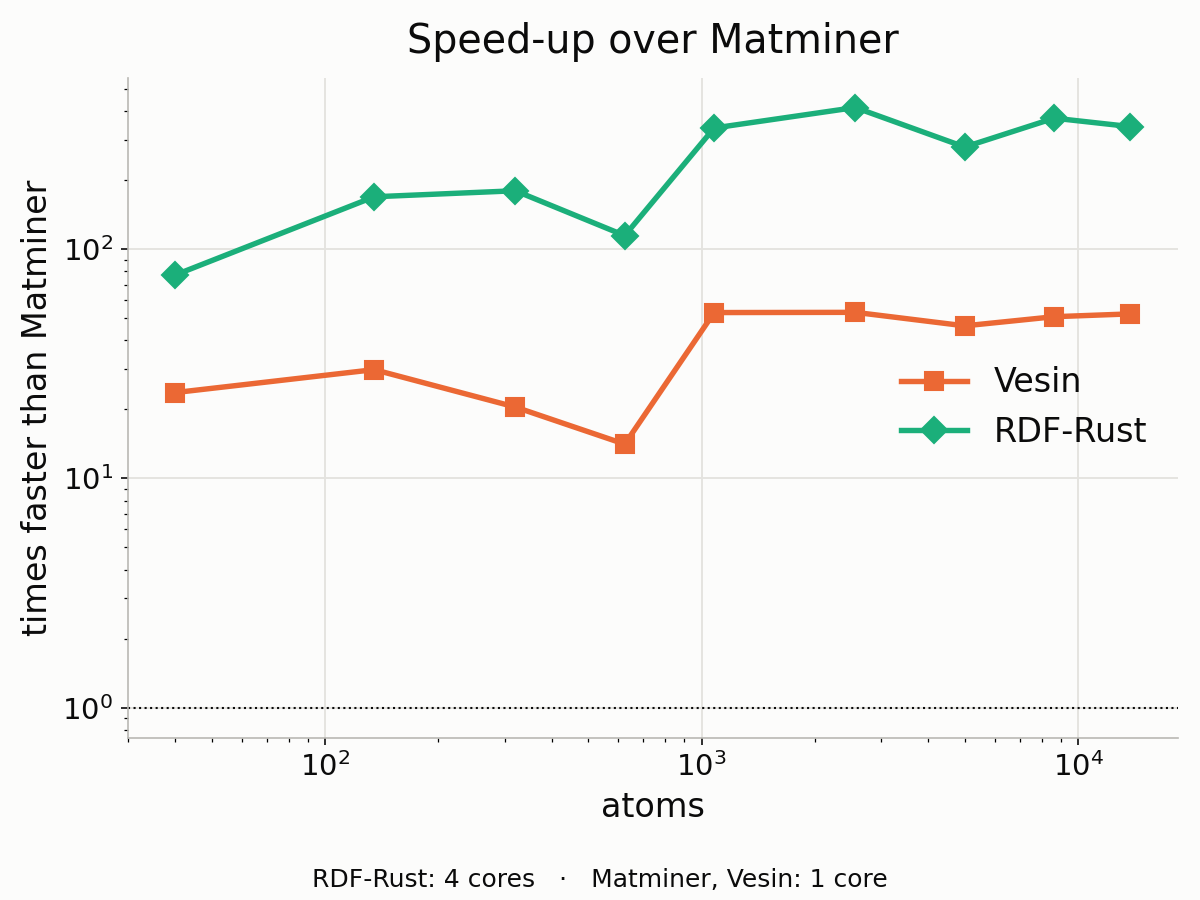
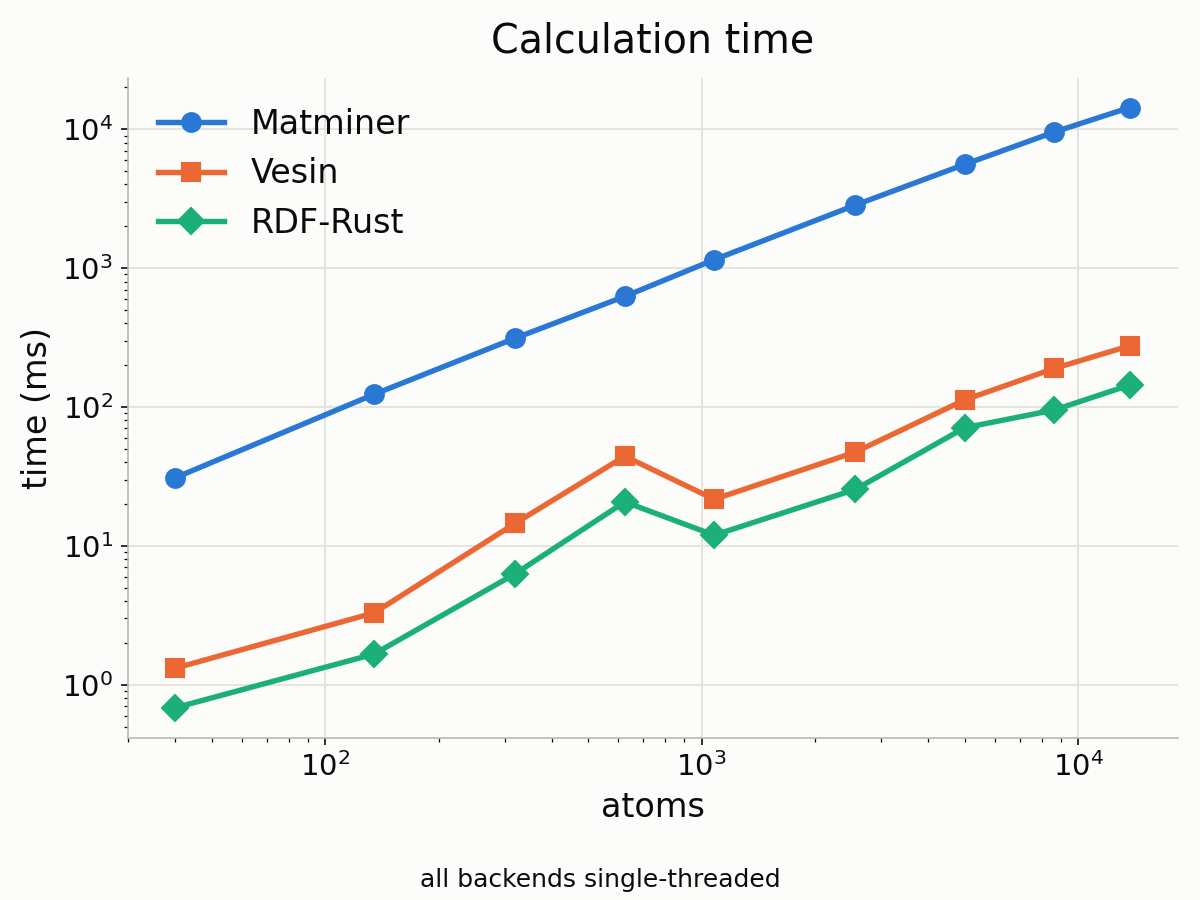
- 🚀 ~100× faster than Matminer on a single core, and ~340× faster on four cores: 13,720 atoms in 144 ms (42 ms on four cores) instead of 14.3 s.
- ⚡ ~2× faster than Vesin, core for core (1.5–2.2×).
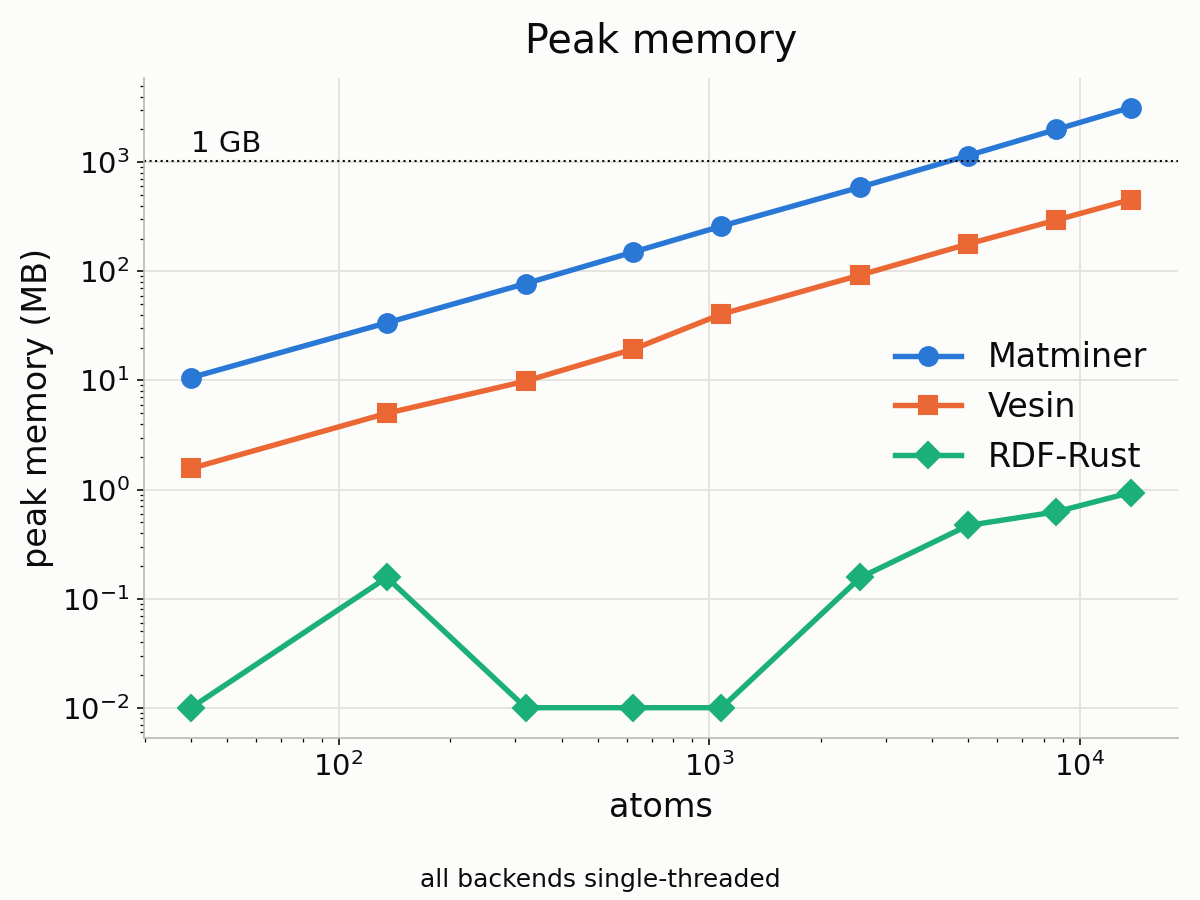
- 💾 Under 1 MB of memory at any size. Matminer needs 3.2 GB and Vesin 454 MB for the same 13,720 atoms.
- 🧩 Partial occupancies handled directly: no supercell, no random seed.
🌐 Online app
Use it in the browser, nothing to install: prdf-xrdlicious.streamlit.app
prdf_app.py in this repository is that app: the XRDlicious (P)RDF calculator,
with RDF-Rust, Vesin and Matminer as selectable methods. To run it locally:
pip install -r requirements.txt
streamlit run prdf_app.py
Install
pip install rdf-rust
Example
import rdfrust

s = rdfrust.read("BaSrTiO3.cif")                 # reports disorder on stderr
r, partials, total = s.prdf(cutoff=10.0, bin_size=0.1, n_threads=0)

partials[("Ba", "O")]     # numpy array, g_BaO(r)
total                     # number-weighted total RDF
r                         # left edge of each bin
cutoff is the maximum pair length r_max in Å, bin_size the histogram width,
and n_threads=0 uses every core. A complete runnable script is in
examples/run_prdf.py.
Every element pair is computed automatically: there is no element list to pass.
A five-element alloy gives all 25 partials, keyed as (A, B) tuples.
📈 Saving plots
Add save_plots and the curves are also written to a folder as clean figures,
with the numbers in a CSV. It is off by default.
s.prdf(cutoff=10.0, bin_size=0.1, save_plots="rdf_plots", title="BaSrTiO3")
This writes total_rdf.png, partial_rdfs.png (all pairs together),
one partial_A-B.png per pair, and rdf.csv. Needs matplotlib
(pip install "rdf-rust[plot]").
🎞️ MD trajectories
Multi-frame XYZ files, as written by MD codes, are read directly. Choose how
often a frame is analysed with every:
res = rdfrust.trajectory_prdf(
    "md_run.xyz",
    cutoff=10.0, bin_size=0.05,
    every=5,                  # every 5th frame
    save_plots="md_rdf",      # averages, animations and CSVs
)
res.total, res.partials       # averaged over the frames used
res.total_per_frame           # every frame, shape (n_frames, n_bins)
With save_plots it writes the trajectory-averaged total and partial RDFs
(with the frame-to-frame spread shaded), an animation of every analysed
frame (total_rdf_animation.gif, partial_rdfs_animation.gif), and the data
as CSV.
- Frames with their own
Lattice="..."keep their own box, so NPT runs work. - Plain XYZ has no cell: pass it with
cell=[a, b, c]or a 3×3 matrix. - Unwrapped coordinates (atoms outside the box) are handled.
startandstoplimit the frame range; skipped frames are not parsed, soevery=10on a long run stays fast.
A runnable demo that writes and analyses a small trajectory:
examples/md_trajectory.py.
🚀 Speed and 💾 memory
RDF-Rust on 1 thread (serial, like Matminer and Vesin) and on 4 threads:
| 1 thread | 4 threads |
|---|---|
 |
 |
 |
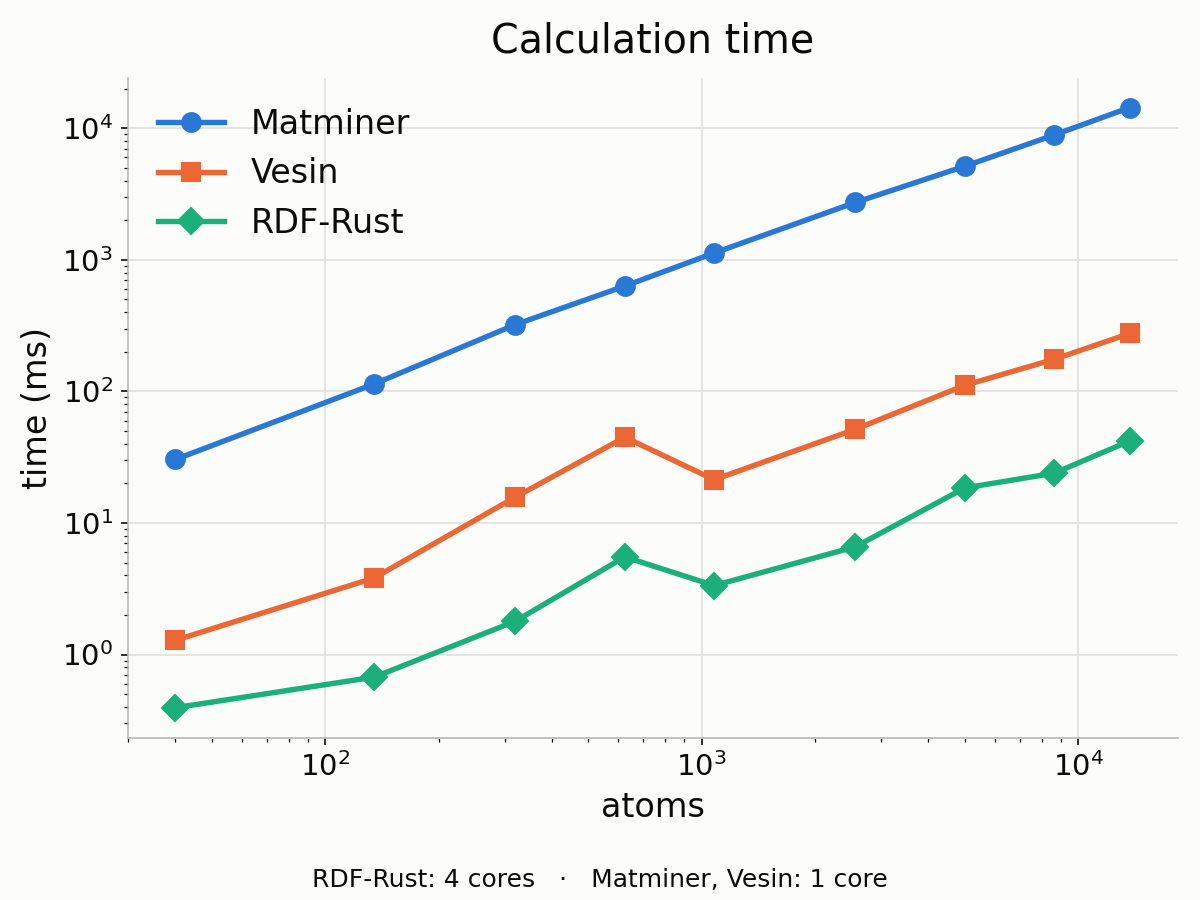 |
| atoms | Matminer | Vesin | ⚡ RDF-Rust, 1 thread | 🚀 RDF-Rust, 4 threads | 💾 RDF-Rust memory |
|---|---|---|---|---|---|
| 320 | 313 ms / 77 MB | 15 ms / 10 MB | 6.3 ms | 1.8 ms | < 1 MB |
| 2,560 | 2,840 ms / 592 MB | 47 ms / 93 MB | 25 ms | 6.6 ms | < 1 MB |
| 13,720 | 14,322 ms / 3,178 MB | 276 ms / 454 MB | 144 ms | 42 ms | < 1 MB |
Memory stays flat because pairs go straight from the neighbour search into the histogram and are never stored. Matminer and Vesin keep every pair distance, so their memory grows with the structure.
Results match Matminer to 3.6 × 10⁻¹⁵ (double-precision noise). Full numbers, structure types, thread scaling and the data behind every figure: BENCHMARKS.md.
🧩 Partial occupancies
How it works: each site i carries an occupancy $c_i^A$ for every species A on it. A pair of sites (i, j) within the cutoff adds $c_i^A c_j^B$ to the A–B histogram, instead of 1. Normalising by the number of A atoms, $N_A = \sum_i c_i^A$, gives
$$g_{AB}(r) = \frac{1}{N_A}\sum_{i \neq j} c_i^A c_j^B \frac{\delta(r - r_{ij})}{4\pi r^2 \Delta r}$$
This is the exact average over every random arrangement of the disordered sites, so no supercell, random seed or rounding of occupancies is needed. When all occupancies are 1 it is the ordinary RDF.
If you need an explicit ordered structure instead, for example to export it:
ordered, info = s.expand_occupancies(max_sites=4096, seed=42).
Formats
| format | partial occupancies |
|---|---|
| CIF | yes |
| VASP POSCAR / CONTCAR | no |
| extended XYZ, single frame or trajectory | no |
plain XYZ trajectory (with cell=) |
no |
| anything else | read through pymatgen or ASE, if installed |
📖 How to cite
RDF-Rust is part of the XRDlicious project. If you use it, please cite:
- XRDlicious: Lebeda, M. et al. XRDlicious: an interactive web-based platform for online calculation of diffraction patterns and radial distribution functions from crystal structures. Journal of Applied Crystallography 58(5) (2025). journals.iucr.org
- XRD-Rust: Lebeda, M. et al. Rust-accelerated powder X-ray diffraction simulation for high-throughput and machine-learning-driven materials science. Journal of Applied Crystallography 59(4), 1344–1350 (2026). journals.iucr.org
- RDF-Rust: this repository, github.com/bracerino/rdf-rust.
Tests
cargo test --lib     # Rust unit tests
pytest tests/ -q     # CIF, formats, neighbours, RDF, disorder physics
License
MIT
1 maintainer

Metadata
1 maintainer
Release files for rdf-rust 0.2.0
For a detailed explanation of source distributions (sdists) and built distributions (wheels), please see the package formats documentation.
Source distribution (sdist)
| File | Size | Uploaded | |
|---|---|---|---|
| rdf_rust-0.2.0.tar.gz | 78.7 kB | Details |
Built distributions (wheels)
| File | Reset | |||
|---|---|---|---|---|
| rdf_rust-0.2.0-cp38-abi3-win_amd64.whl | CPython 3.8 | abi3 | Windows x86-64 | Details |
| rdf_rust-0.2.0-cp38-abi3-manylinux_2_17_x86_64.manylinux2014_x86_64.whl | CPython 3.8 | abi3 | Linux glibc 2.17+ x86-64 | Details |
| rdf_rust-0.2.0-cp38-abi3-manylinux_2_17_aarch64.manylinux2014_aarch64.whl | CPython 3.8 | abi3 | Linux glibc 2.17+ ARM64 | Details |
| rdf_rust-0.2.0-cp38-abi3-macosx_11_0_arm64.whl | CPython 3.8 | abi3 | macOS 11.0+ ARM64 | Details |
| rdf_rust-0.2.0-cp38-abi3-macosx_10_12_x86_64.whl | CPython 3.8 | abi3 | macOS 10.12+ x86-64 | Details |
Total release size: 2.1 MB
Release files / rdf_rust-0.2.0.tar.gz
| Download URL | rdf_rust-0.2.0.tar.gz |
|---|---|
| Size | 78.7 kB |
| Tags | Source |
|
SHA-256 checksum How to use checksums |
383415a7126baf49ed843b5bb26ecd235949e049a2bee225e364765fe7173652
|
|
BLAKE2b-256 checksum How to use checksums |
e2aab26b059bde012eed149ac553c3fcdcea6466fd1324d554ca8eb1d68eb103
|
| Upload date | |
|
Uploaded using Trusted Publishing? What is trusted publishing? |
No |
| Uploaded via |
twine/7.0.0 CPython/3.13.14
|
Release files / rdf_rust-0.2.0-cp38-abi3-win_amd64.whl
| Download URL | rdf_rust-0.2.0-cp38-abi3-win_amd64.whl |
|---|---|
| Size | 339.1 kB |
| Tags | CPython 3.8 Windows x86-64 abi3 |
|
SHA-256 checksum How to use checksums |
a67fb7553c702e49ec3cccb209c60938307e44742afd33ac26ee9cebcd82bac7
|
|
BLAKE2b-256 checksum How to use checksums |
d45d725ccbfb4604d62a3e06cde7c65ed83fd50e651871f0cd26f64bbbde99e1
|
| Upload date | |
|
Uploaded using Trusted Publishing? What is trusted publishing? |
No |
| Uploaded via |
twine/7.0.0 CPython/3.13.14
|
Release files / rdf_rust-0.2.0-cp38-abi3-manylinux_2_17_x86_64.manylinux2014_x86_64.whl
| Download URL | rdf_rust-0.2.0-cp38-abi3-manylinux_2_17_x86_64.manylinux2014_x86_64.whl |
|---|---|
| Size | 457.5 kB |
| Tags | CPython 3.8 Linux glibc 2.17+ x86-64 abi3 |
|
SHA-256 checksum How to use checksums |
aaca41c86734b19830e6ef54cfa7ef80a65d55e0b60115281e2cc3fbf5fe6244
|
|
BLAKE2b-256 checksum How to use checksums |
bbd6e772b30715e292f5f69351be6bda8310bf027c917787061a4759faac7a4d
|
| Upload date | |
|
Uploaded using Trusted Publishing? What is trusted publishing? |
No |
| Uploaded via |
twine/7.0.0 CPython/3.13.14
|
Release files / rdf_rust-0.2.0-cp38-abi3-manylinux_2_17_aarch64.manylinux2014_aarch64.whl
| Download URL | rdf_rust-0.2.0-cp38-abi3-manylinux_2_17_aarch64.manylinux2014_aarch64.whl |
|---|---|
| Size | 438.4 kB |
| Tags | CPython 3.8 Linux glibc 2.17+ ARM64 abi3 |
|
SHA-256 checksum How to use checksums |
dcc23f22a5c5ac9d81f16390997bb3da7fb41e9f14104e7971e91af19fe0fa4a
|
|
BLAKE2b-256 checksum How to use checksums |
50bb215069a52f1c4fb25811ca7e4c78d0e89572456b356dd9993d5aac82a743
|
| Upload date | |
|
Uploaded using Trusted Publishing? What is trusted publishing? |
No |
| Uploaded via |
twine/7.0.0 CPython/3.13.14
|
Release files / rdf_rust-0.2.0-cp38-abi3-macosx_11_0_arm64.whl
| Download URL | rdf_rust-0.2.0-cp38-abi3-macosx_11_0_arm64.whl |
|---|---|
| Size | 403.2 kB |
| Tags | CPython 3.8 abi3 macOS 11.0+ ARM64 |
|
SHA-256 checksum How to use checksums |
e6adf82b459c35565a87b334b7697efd3b264edfbeafe9b53924876d1c07e4f9
|
|
BLAKE2b-256 checksum How to use checksums |
d7719970497915b8dcc8418684e456559112b5fb8b5fbac582b7a41006f438ee
|
| Upload date | |
|
Uploaded using Trusted Publishing? What is trusted publishing? |
No |
| Uploaded via |
twine/7.0.0 CPython/3.13.14
|
Release files / rdf_rust-0.2.0-cp38-abi3-macosx_10_12_x86_64.whl
| Download URL | rdf_rust-0.2.0-cp38-abi3-macosx_10_12_x86_64.whl |
|---|---|
| Size | 427.5 kB |
| Tags | CPython 3.8 abi3 macOS 10.12+ x86-64 |
|
SHA-256 checksum How to use checksums |
a08973400609c688502c5f8c6e7cd5eb2f218cecbfeb1de6dea07caae73fabc4
|
|
BLAKE2b-256 checksum How to use checksums |
c12067c0e8368b9edfc9f3f2f9e30d274260e24a84b3bef526ad70d49823df45
|
| Upload date | |
|
Uploaded using Trusted Publishing? What is trusted publishing? |
No |
| Uploaded via |
twine/7.0.0 CPython/3.13.14
|














