
Deterministic recursive hierarchies for stable partitioning and multiscale coverage.

Project description
RDT Adaptive Hierarchies





RDT Adaptive Hierarchies is a Python research package for deterministic recursive partitions with stable labels, depth metadata, and deterministic coverage schedules. The package is built around a smaller, testable version of the RDT idea: recursive structure is useful when it preserves something measurable during refinement or resize.
The two main applications in this repo are:
rdt-stable-partition: partition points into buckets, then resize the number of buckets while trading off movement, locality, and load.rdt-cover: generate deterministic numerical test cases at boundaries, midpoints, powers of ten, corners, and shell-like scale transitions.
The repo also includes bounded experimental modules for recursive-depth geometry validation, residual sampling, and shell diagnostics. Those modules are documented as limited research tools, not headline claims.
Origin
The Recursive Division Tree line of work began with Steven Reid's Zenodo preprint Recursive Division Tree: A Log-Log Algorithm for Integer Depth (DOI 10.5281/zenodo.18012166). That earlier work studied recursive depth on positive integers. This repository is a later narrowing of the idea into a computational hierarchy over finite numeric point sets.
The important change is scope. The preprint motivates depth and shell structure; this package asks which recursive metadata survives baseline comparison and ablation. The answer here is narrower: stable labels for resize partitioning and deterministic coverage schedules for numerical edge cases.
Why This Exists
Many systems need to assign points, keys, tasks, or regions to buckets. When the bucket count changes, the assignment should not move everything. Consistent hashing methods are good at minimizing movement, but they normally do not preserve spatial locality. Spatial orderings and grids can preserve locality, but they can move many points during resize or create load imbalance.
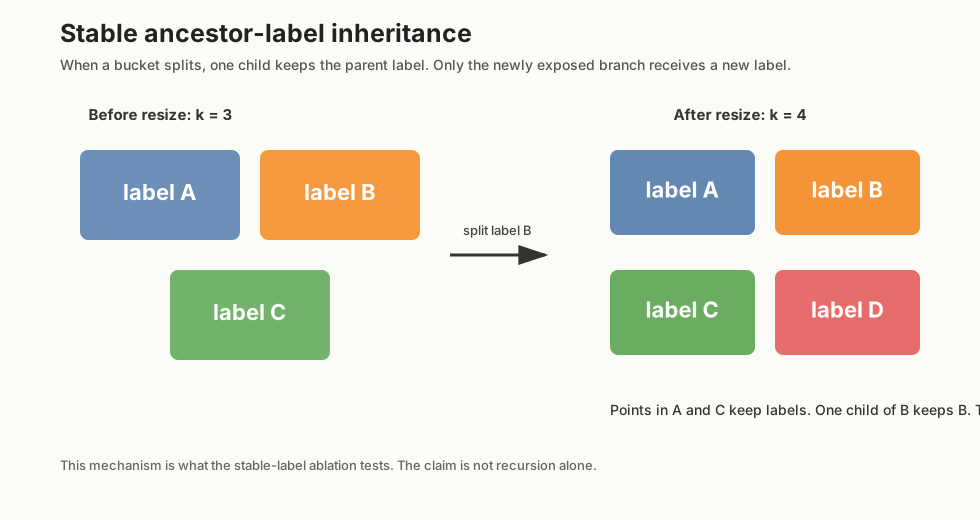
RDT stable partitioning tests a different compromise. It builds a deterministic recursive hierarchy, assigns labels to active cells, and preserves ancestor labels when a cell splits. That lets one child keep the parent label while the new branch receives a new label. The package measures whether this mechanism improves the movement/locality/load tradeoff.
Numerical testing has a related finite-budget problem. Random and low-discrepancy sampling fill a space well, but they can miss specific boundary or scale cases. RDT-cover adds deterministic edge anchors before optional Sobol fill, so it is best understood as a complement to standard sampling rather than a replacement.
What RDT Means Here
In this repository, RDT means a deterministic recursive hierarchy:
- The input is a finite numeric array
Xwith shape(n_points, n_dimensions). - The root cell contains all points.
- Cells are recursively split by a deterministic spread/median rule.
- Each cell has a depth, parent, descendants, and path from the root.
- Active cells receive stable labels.
- During resize, one child inherits the parent label and only the new branch receives a new label.
- Coverage routines can target boundaries, midpoints, powers, corners, and shell-like transitions.
The supported mechanism is stable ancestor-label inheritance plus deterministic coverage. Recursion by itself is not the claim.
What Is Supported By Current Evidence
The current evidence snapshot is from repeated local benchmark runs on 2026-05-18. It is strong enough for technical review and further development, but not yet enough for a broad theory paper.
| Area | Current evidence | Interpretation |
|---|---|---|
| Stable partitioning | In the submission-validation run, RDT stable labels had the best combined movement/locality/load score in 60/60 dataset/resize tasks across 10 seeds, including public US cities, California Housing coordinates, sklearn digits, and breast-cancer feature workloads. |
Strongest current direction. The claim is a tradeoff claim, not raw speed superiority. |
| RDT-cover | On the expanded 14-class seeded corpus at budget 2048, Hypothesis-targeted found 13/14 classes, powers-only found 11/14, RDT-cover found 10/14, and blind random/Sobol/Halton/Latin found 4/14. A separate property benchmark found RDT-cover useful on several floating-point traps but not on the tangent-periodicity case. |
Useful deterministic edge-case generator, but narrower than before. Power/scale anchors explain much of the gain, and Hypothesis is stronger when predicates are known. |
| Geometry validation | Recursive-depth schedule still passes selected known-form checks, but Sobol/QMC dominates several simple integration tests. | Bounded numerical validation result, not a new geometry theory. |
| Residual sampling | RDT variants win on selected synthetic fields, but lose to greedy or stratified baselines on oscillatory, multi-front, and real California residual fields. | Research-only. No PDE/PINN training claim is supported. |
| Shell drift | Some synthetic shifts are detected, but simple histogram and mean/std baselines are competitive or better. | Diagnostic-only. Not an anomaly detector claim. |
| Recursive delta codec | Helps ramp-like synthetic bytes but loses to standard compressors on text and CSV corpora. | Narrow transform observation. Not a general compressor. |
Headline Results
Stable Partitioning
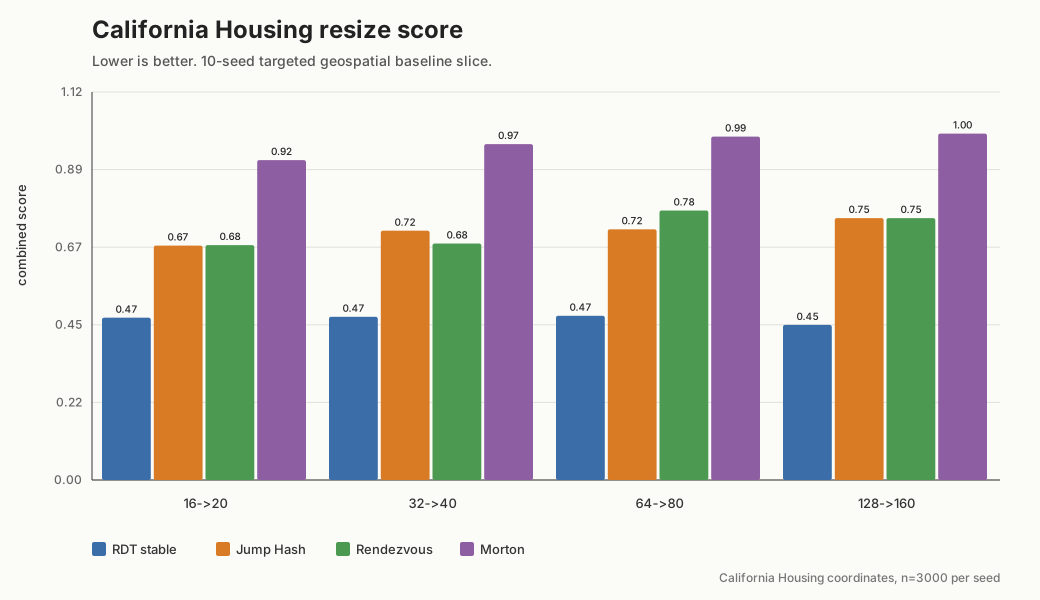
The stable partition benchmark resizes from k1 buckets to k2 buckets. Lower combined score is better:
movement + 0.45 * locality + 0.20 * max(0, imbalance - 1).
On California Housing coordinates in the 10-seed submission-validation run:
| Resize | RDT stable | Jump Hash | Rendezvous Hash | Virtual-node hash | H3 | S2 | Morton sort |
|---|---|---|---|---|---|---|---|
| 16 -> 20 | 0.4673 | 0.6748 | 0.6761 | 0.7568 | 0.9068 | 0.9376 | 0.9210 |
| 32 -> 40 | 0.4698 | 0.7177 | 0.6807 | 0.7391 | 0.9632 | 0.9762 | 0.9670 |
| 64 -> 80 | 0.4728 | 0.7218 | 0.7757 | 0.7413 | 0.9892 | 0.9916 | 0.9887 |
| 128 -> 160 | 0.4464 | 0.7540 | 0.7540 | 0.8048 | 0.9989 | 0.9988 | 0.9973 |
The mechanism ablation matters. Remapping labels from centroids loses badly against stable ancestor-label inheritance:
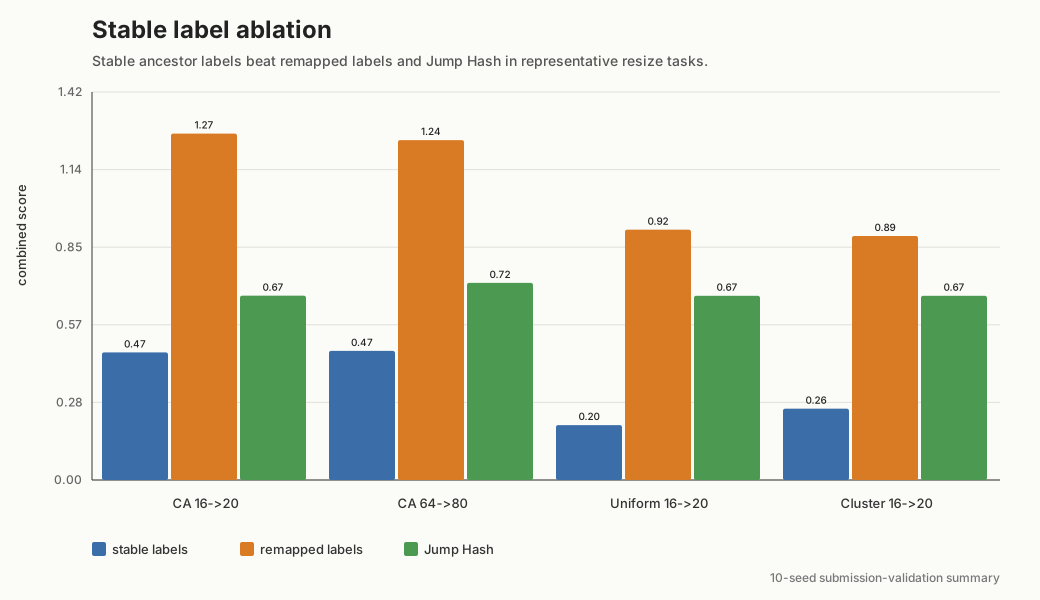
This does not mean RDT is the fastest partitioner. In timing checks, grid and Morton ordering were faster. The current value is the measured tradeoff: lower movement than spatial orderings, much better locality than hash-only baselines, and acceptable load balance in the tested tasks.
The broader submission-validation benchmark covers 12 workloads and five resize pairs over 10 seeds. It runs expensive rendezvous hashing on the geospatial workload slice and keeps the full broad matrix reproducible by using the faster strong-baseline set elsewhere.
| Method | Mean combined score across broad matrix |
|---|---|
| RDT stable | 0.3263 |
| Jump Hash | 0.7085 |
| Virtual-node hash | 0.7606 |
| Hilbert sort | 0.9801 |
| Morton sort | 0.9896 |
| Principal sort | 1.0347 |
| RDT remapped-label ablation | 1.0402 |
| Random labels | 1.4747 |
| Same-count shuffled labels | 1.5224 |
Peak resident-set-size snapshots in the broad run were about 133 MiB; the scaling run also records tracemalloc and RSS snapshots. This is still process-level profiling, not isolated per-method memory accounting.
RDT-Cover
The RDT-cover benchmark generates numeric test inputs and counts predeclared edge-case classes. The expanded corpus now includes zero boundary, near-zero division, overflow-adjacent values, underflow-adjacent values, cancellation, powers of ten, powers of two, square-root and log-domain boundaries, trigonometric periodic boundaries, outer corners, thin annuli, near-singular matrices, and ill-conditioned vectors.
At budget 2048 on the submission-validation run:
| Method | Mean classes found | Mean total hits |
|---|---|---|
| Hypothesis-targeted | 13.00 | 2562.00 |
| Powers-only ablation | 11.00 | 920.50 |
| RDT full | 10.00 | 274.60 |
| Boundary-only ablation | 9.00 | 561.30 |
| RDT+Sobol | 9.00 | 418.10 |
| Random uniform | 4.00 | 532.70 |
| Sobol | 4.00 | 539.20 |
| Halton | 4.00 | 539.00 |
| Latin hypercube | 4.00 | 539.40 |
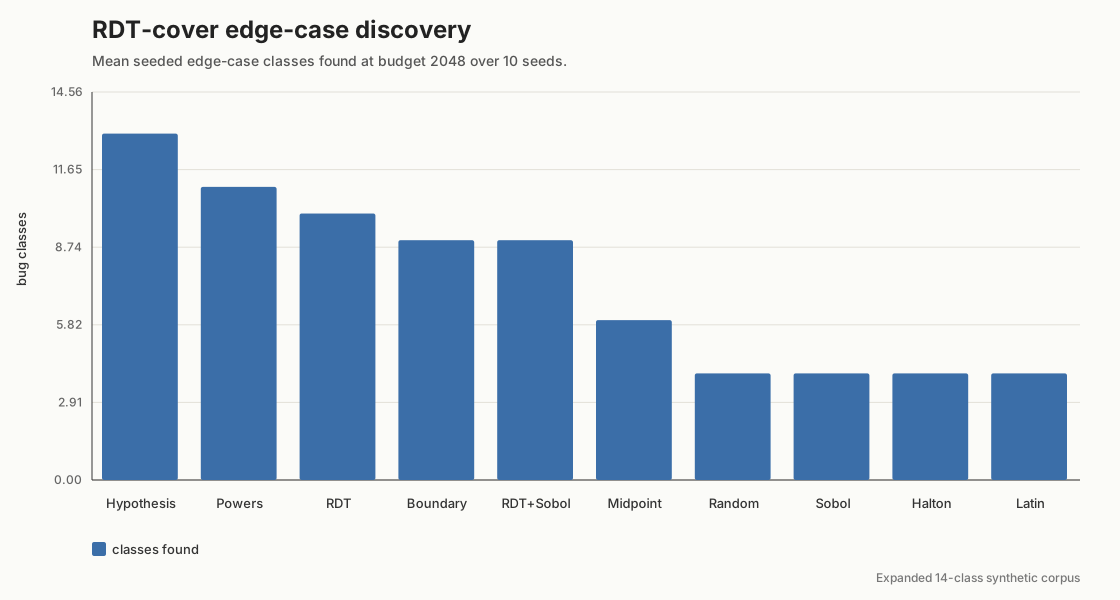
This result supports RDT-cover as an edge-case complement to random and low-discrepancy sampling. It also narrows the claim. The powers-only ablation found more classes than full RDT-cover on this corpus, so power and scale anchors explain much of the useful behavior. Hypothesis-targeted coverage found the most classes because it uses predicate-aware strategies.
The property benchmark tells the same story in a different way. RDT-cover found failures in the division, overflow, log/exp, and near-singular-matrix checks, but it did not find the tangent-periodicity failure at budget 512. That keeps the correct claim narrow: RDT-cover is a deterministic multiscale schedule that can improve blind coverage, not a replacement for property-based testing, fuzzing, or tuned edge-case strategies.
Residual Sampling Failure Case
The residual sampler is included because failures are useful. On the real California Housing residual field, greedy top-residual selection beats RDT-tuned selection:
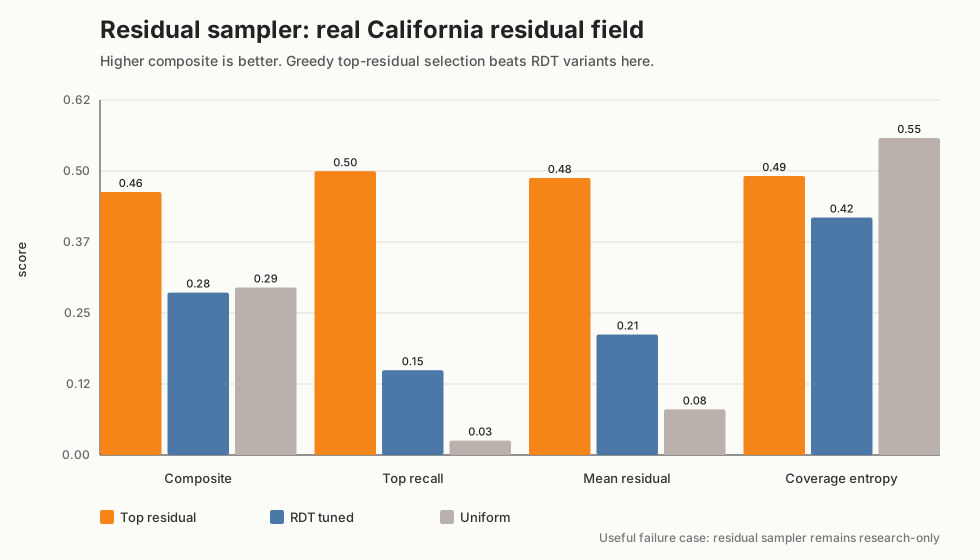
That is why the residual sampler remains a research module. It needs full PDE/PINN training loops and RAR/RAD-style baselines before it can support any training claim.
Installation
From PyPI:
python -m pip install rdt-adaptive-hierarchy
For local development from a checkout:
python -m venv .venv
. .venv/bin/activate
python -m pip install -e ".[test]"
Public-data reruns use scikit-learn:
python -m pip install -e ".[test,data]"
Full release-check dependencies include optional geospatial baselines, Hypothesis integration, memory profiling, package build tooling, and public-data support:
python -m pip install -e ".[dev]"
Quick Start
import numpy as np
from rdt_adaptive_hierarchy import RDTStablePartition, movement_fraction

points = np.random.default_rng(0).random((1000, 2))
partitioner = RDTStablePartition(max_buckets=32).fit(points)

labels_16 = partitioner.assign_training(16)
labels_20 = partitioner.assign_training(20)

print(movement_fraction(labels_16, labels_20))
Expected output is a movement fraction near 0.125 for this small random example.
Run examples:
python examples/stable_partition_basic.py
python examples/cover_basic.py
python examples/geometry_validation_basic.py
python examples/residual_sampler_research_demo.py
python examples/cover_hypothesis_basic.py
Benchmark Commands
Fast smoke runs:
python -m rdt_adaptive_hierarchy.benchmarks.stable_partition_bench --seeds 2 --n 2000 --output-dir results/tmp/stable_partition
python -m rdt_adaptive_hierarchy.benchmarks.cover_bench --seeds 2 --budgets 256 --output-dir results/tmp/cover
python -m rdt_adaptive_hierarchy.benchmarks.residual_sampler_bench --seeds 2 --n-side 48 --output-dir results/tmp/residual
python -m rdt_adaptive_hierarchy.benchmarks.geometry_bench --output-dir results/tmp/geometry
Tests:
pytest -q
Current local validation: 23 passed.
GitHub Actions runs tests on Python 3.11 and 3.12, executes public examples, runs benchmark smoke checks, builds source/wheel distributions, and checks package metadata with Twine.
Repository Map
| Path | Purpose |
|---|---|
src/rdt_adaptive_hierarchy/core/ |
Core cells, hierarchy, labels, metrics, coverage, refinement, validation. |
src/rdt_adaptive_hierarchy/applications/ |
Stable partitioning, RDT-cover, residual sampler, geometry validation, shell diagnostics. |
src/rdt_adaptive_hierarchy/baselines/ |
Jump Hash, virtual-node hashing, rendezvous hashing, Morton, Hilbert, H3, S2, geohash, grid, random, Sobol, Latin hypercube, Hypothesis-targeted coverage. |
src/rdt_adaptive_hierarchy/benchmarks/ |
Runnable benchmark entry points. |
examples/ |
Short scripts that show the public API. |
docs/ |
Definitions, framework specification, claims, limitations, prior work, reproducibility. |
results/ |
Interpreted summaries and raw benchmark artifacts. |
paper/ |
Complete Markdown draft, references, and methods-paper notes. |
What Is Not Claimed
This project does not claim that RDT is:
- a universal algorithm,
- a universal entropy theory,
- a cryptographic primitive,
- a turbulence or magnetohydrodynamics closure theory,
- a general compressor,
- a general anomaly detector,
- a replacement for all standard spatial indexes or testing tools.
Raw RDT spatial indexes are not the headline claim in this release. They live in the companion RDT Spatial Index repository, which is the correct home for range-query and kNN-oriented indexing code. This repo uses that line of work as provenance and comparison context, while keeping the public claim here focused on stable partitioning under resize.
Known Failure Cases
These are part of the release boundary, not footnotes:
- RDT is not the fastest raw partitioner. Grid, Morton, and other simple orderings can be faster in machine-local timing checks.
- RDT-cover is not better than targeted property-based testing when the failure predicates are known. In the deep-validation run, Hypothesis-targeted coverage found
13/14seeded classes, while full RDT-cover found10/14. - The RDT-cover ablation matters in both directions: power-only anchors found
11/14classes, so the full schedule is not yet the best combination for the expanded synthetic corpus. - RDT residual sampling is mixed. It helps selected synthetic hotspot fields but loses to greedy top-residual selection on a real California Housing residual field.
- Shell drift is diagnostic-only. Simple histogram and mean/std baselines remain competitive.
- Recursive delta preprocessing is not a general compressor. It helps ramp-like synthetic bytes and loses on real text/CSV corpora.
- Raw RDT spatial-index results are handled as companion-repo evidence, not as a claim that this package replaces mature spatial indexes.
Relation To Known Methods
The closest neighbors are consistent hashing, Jump Consistent Hash, rendezvous hashing, Morton/Z-order layouts, tree-based spatial indexes, geospatial hierarchies such as H3 and S2, property-based testing, quasi-Monte Carlo sampling, adaptive random testing, and residual adaptive refinement. The closest internal companion project is RDT Spatial Index, which focuses on practical spatial indexing rather than stable resize partitioning.
RDT should be compared against those methods before stronger public claims. Hilbert, H3, S2, geohash, virtual-node consistent hashing, and Hypothesis-targeted coverage are now implemented. Remaining missing work includes larger real workloads, production-style tuning, full memory profiling, and real numerical bug corpora.
Project Status
This is a pre-release research package. It is ready for technical review, reproduction, and focused development. It is not ready for broad claims of general superiority.
The best next development target is rdt-stable-partition, followed by rdt-cover. Residual sampling, shell drift, and codec-related ideas should stay experimental until they beat stronger baselines on real tasks.
Citation
Use the metadata in CITATION.cff. Until the method is published, cite this repository and the exact commit used.
License
MIT. See LICENSE.
Release history Release notifications | RSS feed

Download files
Download the file for your platform. If you're not sure which to choose, learn more about installing packages.
Source Distribution
Built Distribution
Filter files by name, interpreter, ABI, and platform.
If you're not sure about the file name format, learn more about wheel file names.
Copy a direct link to the current filters
File details
Details for the file rdt_adaptive_hierarchy-0.1.0.tar.gz.
File metadata
- Download URL: rdt_adaptive_hierarchy-0.1.0.tar.gz
- Upload date:
- Size: 102.9 kB
- Tags: Source
- Uploaded using Trusted Publishing? No
- Uploaded via: twine/6.2.0 CPython/3.12.12
File hashes
| Algorithm | Hash digest | |
|---|---|---|
| SHA256 |
64e95a6814d4bbdb20908918cbcd3514ce6b2ca00639edd8b6de1e3e4c6035c3
|
|
| MD5 |
029faeaabf0993ba0e85c34d35a5965b
|
|
| BLAKE2b-256 |
8661aa2f044bda6c93999beb032d4fec0a9ee8d94c334fd8d3a03bff46b86284
|
File details
Details for the file rdt_adaptive_hierarchy-0.1.0-py3-none-any.whl.
File metadata
- Download URL: rdt_adaptive_hierarchy-0.1.0-py3-none-any.whl
- Upload date:
- Size: 60.8 kB
- Tags: Python 3
- Uploaded using Trusted Publishing? No
- Uploaded via: twine/6.2.0 CPython/3.12.12
File hashes
| Algorithm | Hash digest | |
|---|---|---|
| SHA256 |
3d84e2752460c49495655816fa8126b3e2e280e62c800f5af2f7a042d8b5223f
|
|
| MD5 |
ebe0c223d0e7c8ab39daeba0c01d65d0
|
|
| BLAKE2b-256 |
724753ded7ebfeb53cd03124e0265827e878e31c083dfb6b5a8de7fa83a34c26
|






