
Trustworthy retrieval for an AI agent's own memory — verdict, confidence and provenance per hit, or an explicit abstention
Verified details
These details have been verified by PyPIProject links
GitHub Statistics
Maintainers

Project description

Trustworthy retrieval for an AI agent's own memory.
Every hit comes back with confidence, provenance, and validity — or the honest answer is "I don't know."




See it · What's verified · Production posture · Quickstart · Limits
Most RAG hands back the closest vector match. That's the wrong answer more often than you'd think.
A long-running agent piles up memory — decisions, closed experiments, incident notes — and then it re-litigates settled decisions, hallucinates over gaps the memory can't fill, and builds on facts that are no longer true. The catch: when you've reversed a decision, the stale memory of it is often the highest-cosine hit in the whole result. Similarity search serves it, confidently.
RE-call is a retrieval engine for that memory that is honest about what it doesn't know. It returns verdict + confidence + provenance with every hit — not just similarity — demotes memories that were superseded or expired, and prefers an explicit abstention over confident noise.
See it in one screen
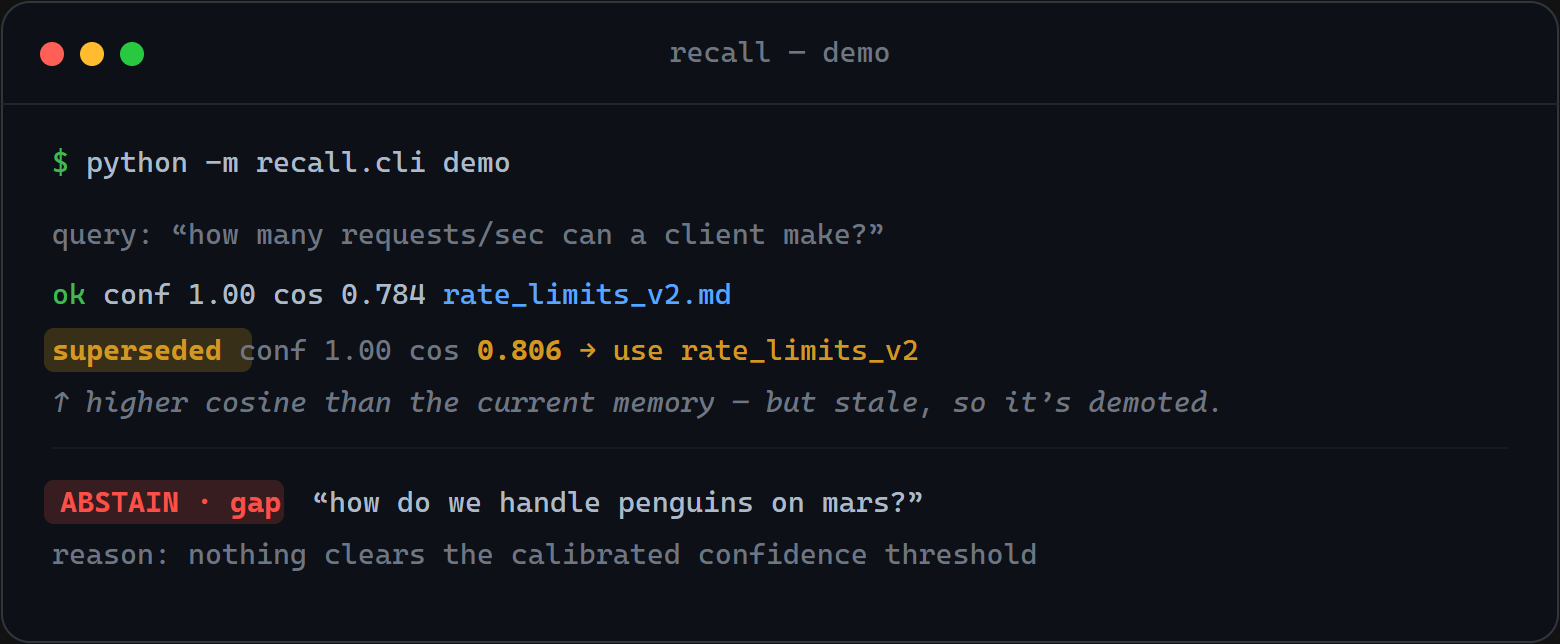
same run, as text
$ python -m recall.cli demo

[ok] query='how many requests per second can a client make?'
  ok           conf=1.00  cos=0.784  rate_limits_v2.md                       '# API rate limits (revised)'
  superseded   conf=1.00  cos=0.806  rate_limits_v1.md → use rate_limits_v2  '# API rate limits … limited to 100'

[ABSTAIN · gap] query='how do we handle penguins on mars?'
  reason: no hit above the calibrated confidence threshold (probable corpus gap)
Look at the cosines. The stale memory scores higher (0.806) than the current one — plain vector
search returns it, and the agent builds on a limit that no longer exists. RE-call flags it
superseded, points at its successor, and puts the current memory on top. When the memory genuinely
has no answer, it says so. That ordering decision is the whole thesis.
What is actually verified
Every headline number below was measured, and every one carries its limit. Where a claim could not be supported, it was withdrawn rather than softened — the withdrawals are listed too, because a claims table without them is marketing.
| Claim | Measurement | Limit |
|---|---|---|
| Supersession beats similarity — where the edge was authored | Superseded-trust rate 0.00, 95% Wilson [0.00, 0.02], n=250, against a baseline of 1.00 — plain search returns the stale memory every time on adversarially-worded queries | Generated corpus; the successor/abstain columns on it are not meaningful (below). And the mechanism is only as good as its coverage: 2 of 792 real memos declared supersedes: while 60 closed a decision in prose — the enforcement is exact, the corpus is sparse, and both halves are load-bearing (below) |
| Abstention is calibrated, not guessed | On the real corpus: threshold 0.728 ± 0.042 over 4 index rebuilds, false-abstain 0.015, gap false-confidence 0.000 | Needs ≥ ~20 labelled samples; below that the rule loses its outlier robustness |
| Timestamps cannot replace declared supersession | "Trust the newest relevant hit", steelmanned, still trusts the stale memory 83–100% of the time | — |
| Reranking rescues a weak embedder | Hybrid + cross-encoder lifts MRR 0.63 → 1.00 offline | Situational: a strong embedder already saturates this corpus |
| Fine-tuning pays only for a vocabulary gap | +0.00 on a rich corpus; 0.31 → 0.55 held-out MRR on opaque jargon → study | Measure your gap first |
| Near-misses need a judge, not a threshold | QNLI stage cuts near-miss false-confidence 1.00 → 0.60, 0.80 → 0.50, same judge across embedders → study | Judge-alone degrades far-gap detection — the two stack, neither replaces the other |
| Retrieval, on a second public benchmark | knowledge-update 1.000 (36/36) — the category this library exists for, and the most robust one under haystack pressure (retains 74% of hit@5 across a 20× larger corpus where the overall figure retains 51%). Overall hit@5 0.970 [0.94, 0.99] on LongMemEval's own per-question haystacks with the free local embedder → FINDINGS §10 | A retrieval figure — evidence session in the top 5 — not the benchmark's LLM-judged answer accuracy. It does not belong in a column with one. And 0.970 is the benchmark's ~49-session haystack, not a memory store: on one merged 19,195-session index the same questions score 0.366. Both arms are published because the second is the one that looks like production |
| Abstention has a bounded domain | Far gaps: accuracy 1.00 (PEPs), 0.89 (real corpus). Near-misses: it fails — false-abstain 0.481 on LongMemEval, and six candidate signals all score AUC ≤ 0.753 — the best one's 95% interval tops out at 0.826, below the ~0.90 a usable gate needs, so the bar is excluded rather than merely unproven. Independently corroborated on LOCOMO, where no judge configuration crosses into usable territory either → FINDINGS §9–§10 | Nothing was retuned, because every alternative measured worse. recall calibrate reports separability with its interval, certifies on the interval's lower bound, and exits non-zero rather than certify a threshold the data cannot support |
Full methodology, per-embedder tables and the negative results → results/FINDINGS.md. Design rationale and the reasoning behind each guard → docs/WRITEUP.md.
Claims that were withdrawn
A previous version of this file published each of these. They did not survive re-measurement:
- "FCR @calibrated 0.00" — the threshold was fitted and scored on the same samples. On separable data that is 0.00 by arithmetic. Now cross-validated, and the fitting rule was replaced outright after it proved to let 20.5% of unanswerable queries through.
- Coverage and abstention accuracy on generated corpora — the "unanswerable" queries were an answerable query plus a nonsense suffix, so nothing could separate them. Rebuilt as genuinely off-topic questions; the document-level degeneracy remains and is stated as unmeasured.
- "6× faster incremental re-index" — understated. Measured on a Linux server it is 33×.
- Real-corpus recall@5 of 0.945 — that used document headings as queries, which is known-item retrieval. Against 110 hand-labelled questions phrased the way a person actually asks, hit@5 is 0.33 on that corpus. → FINDINGS §7
- "Retrieval is the weakest part of this system" — the sentence this file carried after that measurement. A replication on a public corpus scored 0.705 with the same local embedder, so 0.33 was a property of that corpus, not of this software. Corrected rather than quietly deleted, because the claim was published. → FINDINGS §8
- "ANN recall is tuned on the filtered path" — the heading this file gave the HNSW fix, which reads as a recall improvement. Two measurements were taken and only the flattering one reached the docs: the 0.38 → ~0.90 lift comes from a fixture corpus the test retries until it reproduces the pathology, while an independent A/B on a normally-built corpus moved recall the other way (0.523 → 0.483). What was actually fixed is truncation — filtered search returning fewer results than requested — and the PR that shipped it said so at the time. Reworded above, and corrected in FINDINGS §5b and the changelog, rather than deleted. → #57
Production posture
"Enterprise-grade" is not a single property, so here is the itemised version — verified on a real host (PostgreSQL 17, pgvector 0.8.2, Python 3.12, connecting as an unprivileged role), not only on a laptop.
| Property | Status | Evidence |
|---|---|---|
| Multi-tenancy | ✅ tenant_id on every row and every query, plus a row-level-security policy (ENABLE + FORCE) |
Verified as a NOSUPERUSER NOBYPASSRLS role — a superuser bypasses RLS, so testing it as one would have passed vacuously |
| Concurrency | ✅ async MCP tools + psycopg_pool; the server previously served exactly one request at a time |
FastMCP awaits async tools and calls sync ones inline — there is no thread offload |
| Timeouts / resilience | ✅ statement_timeout, connect_timeout, narrow reconnect-and-retry |
The retry refuses to re-run a QueryCanceled, which would escape the very timeout that fired |
| Security posture | ✅ fail-closed on published default credentials; index-root confinement that survives symlinks on 3.11/3.12 | pathlib only gained recurse_symlinks in 3.13 |
| Observability | ✅ logging (text/JSON), counters and latency percentiles for abstention, verdicts, reconnects; surfaced through the MCP recall_stats tool |
The library never attaches handlers — that is the host's job |
| Incremental indexing | ✅ content-hash skip, bounded-memory batched writes, prunes files deleted from disk | 5,100 chunks / 1,120 files: full 7.4 s, unchanged re-index 0.22 s |
| Scale characteristics | ✅ measured at 50,600 chunks: recall@5 1.00 filtered and unfiltered, search p50/p95/p99 | Templated text; absolute retrieval quality is optimistic |
| Real-corpus operation | ✅ 794 hand-written memos → 6,491 chunks, p50 78 ms | Works at this size; see the retrieval row for how well |
| Retrieval quality, real questions | ✅ hit@5 0.705 [0.56, 0.82] on a public 746-doc corpus with the free local embedder · ⚠️ 0.348 on an idiosyncratic private one — see the tables below | Measured on 110 hand-labelled questions per corpus, not on headings. Corpus vocabulary dominates: a cloud embedder is worth +0.28 on the hard corpus and +0.02 on the ordinary one |
| Data erasure | ✅ recall forget / recall_forget permanently delete a source's chunks; previews by default, --yes to act |
The right-to-erasure path — irreversible, so it refuses to act unattended without the flag |
| Abuse bounds | ✅ recall_index refuses before embedding anything if a request exceeds RECALL_INDEX_MAX_FILES / RECALL_INDEX_MAX_BYTES |
A client-callable indexer with no cap is an unbounded spend on a cloud embedder |
| Authentication | ✅ bearer tokens on the HTTP transports, three scopes, one tenant per principal — see docs/AUTH.md | Starting an HTTP transport without tokens refuses to boot rather than warning. stdio stays unauthenticated by design: it is a private pipe, not a listener |
| Schema migrations | ❌ runtime CREATE TABLE IF NOT EXISTS, no versioned upgrade path |
Pre-tenancy tables are migrated in place, with a test |
| HA / replication | ❌ out of scope — this is a library over your Postgres | — |
Retrieval on a real corpus: what actually moved it
110 hand-labelled questions against 794 real memos (6,491 chunks), phrased the way a person asks rather than as document headings. Four hypotheses, tested one at a time on the same 46 held-out questions — three eliminated, one confirmed:
⚠️ Measured before #81 was fixed (2026-07-25). Every "hybrid" row below ran with a sparse leg that only fired when a single chunk contained every term of the query, so on longer questions it contributed nothing and the arm was effectively dense-only. Read them as a lower bound on the hybrid configuration.
Re-measured 2026-07-25, same 46 held-out questions, same runner:
dense0.326,sparse0.348,hybrid0.457,hybrid+rerank0.435. The corpus has grown since (824 files against 794), so this is not a clean before/after and the two sets are not differenced — but on this corpus a working lexical leg is worth roughly +0.13 over dense alone.The
candidate pool 20 → 100null is worse than suspect — it is retracted. The original reading here, that widening the pool only widened the dense pool, was too generous: it did not widen the dense pool either.hnsw.ef_searchdefaults to 40 and an HNSW scan cannot return more rows than it examined, socandidate_k=100delivered 40 dense candidates (fixed). And even uncapped, RRF scoresdense[r]andsparse[r]identically, so a fused top-5 reads only ~3 ranks into each leg whatever the pool is — the null was arithmetic, not evidence. Full correction in FINDINGS §7.
| change | hit@5 | Δ | cost |
|---|---|---|---|
| baseline — bge-small, hybrid dense+sparse | 0.348 [0.23, 0.49] | — | 45 ms |
| + cross-encoder rerank | 0.391 [0.26, 0.54] | +0.043 (within noise) | 57× latency |
| candidate pool 20 → 100 | retracted — see the note above | fused −0.065, +reranker +0.022 (both n.s., n=46) | — |
| chunk size 400 / 800 / 1600 | 0.326 / 0.348 / 0.348 | +0.000 | a re-index each |
| embedder → voyage-3 | 0.630 [0.49, 0.76] | +0.282 | 246 ms, API dependency, data egress |
hit@50 plateaus at ~0.50 in every local configuration — though with the dense leg capped at 40,
no run here ever offered a true top fifty, so read that as "top ~40–50". A recall ceiling is
real and the embedder is what moved it. The claim that bigger pools therefore could not help
does not follow and has been withdrawn: on a corpus where the comparison has power (FinanceBench,
n=150), dense-only + reranker went 0.393 → 0.527 when the pool grew 40 → 100 with ef_search
corrected. The ceiling was the representation — but the pipeline was never actually ruled out.
The three eliminations are what make the fourth result a diagnosis rather than a lucky guess. The abstention layer was never the bottleneck: 89% of unanswerable questions correctly refused, 4–7% of answerable ones wrongly refused, on every arm.
Replicated on a public corpus — and it narrows the conclusion
The above is one corpus, and a private one. Repeated on the public Python PEP corpus — 746
files matched by **/*.rst, the figure the runner reports and the one used in the table — with 110
hand-labelled questions that ship in this repo — a corpus anyone can fetch and check:
| hit@5 | bge-small (local) | voyage-3 (cloud) | Δ |
|---|---|---|---|
| private memory corpus, 794 docs | 0.348 [0.23, 0.49] | 0.630 [0.49, 0.76] | +0.282 |
| PEPs, 746 docs (public) | 0.705 [0.56, 0.82] | 0.727 [0.58, 0.84] | +0.022 |
The pipeline was never the cap — on ordinary technical prose the free local embedder reaches 0.705. And the cloud embedder's win is corpus-specific: +0.28 where the vocabulary is idiosyncratic, +0.02 on the PEPs, the latter inside the noise for ~5× latency, an API dependency and data egress. So the rule is conditional, not "buy the better embedder".
Abstention accuracy is 1.00 on the PEPs for both embedders — the trust layer was never the bottleneck on either corpus.
Against a baseline — because 0.705 means nothing on its own
A hit@5 is only a result next to what a boring baseline scores on the same corpus, chunks and questions. So the runner now reports four arms, not one. On the PEPs, bge-small, 44 held-out answerable questions:
| arm | hit@5 | MRR | p50 | reading |
|---|---|---|---|---|
| BM25 (Okapi, untuned) | 0.455 [0.32, 0.60] | 0.313 | 150 ms | the thirty-year-old anchor |
| sparse only (Postgres FTS) | 0.023 [0.00, 0.12] | 0.023 | 24 ms | near-useless alone on this corpus |
| dense only (pgvector) | 0.682 [0.53, 0.80] | 0.483 | 31 ms | carries almost all of the result |
| hybrid (dense + sparse + RRF) | 0.705 [0.56, 0.82] | 0.494 | 26 ms | the published number |
Two things this makes honest that the single number could not. The pipeline beats BM25 by
+0.25 (0.705 vs 0.455) — a real margin, not a rounding artifact, so the embedding stack is
earning its keep. And dense is doing the work: hybrid's +0.023 over dense-alone is inside the
interval, and the sparse leg scores 0.023 by itself, so on ordinary prose like the PEPs the
fusion is barely moving the top-5 — its value is on the rare identifiers and error codes that a
memory corpus has and this one does not. Stated as a margin over a baseline, "hybrid reaches
0.705" becomes a measurement instead of an assertion. (The BM25 tokeniser has no stemming while
the FTS leg does, so BM25 is mildly handicapped on morphology — noted in recall/eval/bm25.py;
it does not move the +0.25 conclusion.)
git clone --depth 1 https://github.com/python/peps
python -m recall.eval.labelled --corpus peps/peps     --questions recall/eval/peps_questions.json --glob '**/*.rst'
→ FINDINGS §7–§8 for the misses, the labelling errors found by inspecting them, and the one experiment still untested.
How it works
flowchart LR
    Q([query]) --> E[embed]
    E --> D[dense · pgvector cosine]
    Q --> S[sparse · Postgres full-text]
    D --> F[Reciprocal Rank Fusion]
    S --> F
    F --> R[cross-encoder rerank]
    R --> G{trust layer}
    G --> O([verdict + confidence + provenance per hit, or ABSTAIN])
Dense semantic search and sparse keyword search each retrieve candidates; Reciprocal Rank Fusion
merges them, a cross-encoder reranks, and the trust layer judges every hit — supersession,
validity window, calibrated confidence — before it reaches the agent. Validity is plain frontmatter
in the memory itself (supersedes: old_doc.md, valid_until: 2026-06-30) — authored, not inferred,
because a claim honoured as written is safe and a claim guessed at is not.
Prior art — and where this genuinely differs
Agent memory is a crowded field. Everything below is Apache-2.0 and further along than this project; a claim to novelty has to survive them, so here is the comparison rather than an implication that the corner is empty.
| what it is | how it handles a fact that stopped being true | what it needs | |
|---|---|---|---|
| Graphiti (powers Zep) | temporal knowledge-graph engine | bi-temporal validity windows; contradicted facts are invalidated, not deleted — inferred by an LLM at ingestion | a graph DB (Neo4j / FalkorDB / Neptune) + an LLM call per episode |
| Mem0 | memory layer (lib · self-host · cloud) | as of its 2026 redesign, ADD-only — no update or delete; memories accumulate and temporal reasoning happens at retrieval | an LLM for extraction; hybrid semantic + BM25 + entity linking |
| Letta (ex-MemGPT) | stateful-agent runtime | memory blocks + context management, at the agent layer | an agent runtime — a different layer entirely, not a retrieval library |
| LangMem | memory-management toolkit | not addressed in its docs | pairs with LangGraph, though not required |
| RE-call | retrieval library over Postgres | validity declared by the author in frontmatter (supersedes:, valid_until:), enforced as a post-processing layer |
PostgreSQL + pgvector. No LLM in the retrieval path, no graph DB |
The one real difference is who decides that a memory is stale. Graphiti infers it; RE-call
requires the author to have written it down. That is not obviously the better choice, and this
repo has the measurement that shows the cost: on the reference corpus, 2 of 792 memos declared
supersedes: while 60 closed a decision only in prose. Authored edges are trustworthy and
have terrible coverage.
It also has the measurement that argues for it. recall lint --fix was built to close that gap by
inference and, after review, could safely declare zero of those 60
(#29) — narrating vs declaring, part vs whole,
augmenting vs replacing are invisible to a pattern and obvious to the author. An LLM will do
better than a regex there. It will not do reliably better, and this library's whole thesis is
that a confidently wrong supersession is worse than a missing one. So the honest statement is a
trade, not a win: RE-call buys precision on the edges it has, and pays for it in coverage.
Two further differences, and one deficit:
- Abstention is a returned value, not an error path.
trusted_searchanswers "should you trust any of this at all" with a calibrated threshold and a reason. The neighbours return memories; the caller decides. - No LLM and no graph database anywhere in the path. Retrieval is pgvector plus Postgres full-text over a table you already know how to back up. That is cheaper and auditable; it is also why there is no entity reasoning here at all.
- A standard-benchmark number — with a hard boundary on what it compares to. LOCOMO now runs
against this library (FINDINGS §9), but not the metric Mem0 and Zep
report: their J score (LLM-as-a-Judge ≈66) grades a generator this library does not ship,
so no number here belongs beside it. What is measured is the retrieval substrate underneath such
a system — evidence-turn hit@5 0.615 [0.59, 0.64] with the free local embedder, rising to
hit@20 0.798 [0.78, 0.82] across the measured depth curve (FINDINGS §9a).
Both depths are quoted deliberately:
hit@kis a ceiling on any downstream J, and a ceiling published at one depth reads as a ceiling at every depth — it is not. Depth is not free either, since k=20 spends four times the generator's context to buy it — and the one axis no published LOCOMO result scores at all: the 446 adversarial questions (22.5% of the set) that test whether a system knows what it doesn't know. There, out of the box, RE-call abstains on zero — the on-topic-wrong-attribution case is the §4 stale-hit geometry under load — and its shipped levers (calibration, an entailment judge) raise that to 0.37–0.77 only by refusing a quarter to half of legitimate questions. The residual is the entity reasoning the bullet above says this library deliberately omits. A measured boundary, not a leaderboard win.
Where this comes from
RE-call is extracted from the memory system behind a production trading-research agent whose memory outgrew its context window. That corpus is the one the numbers above were measured against: 794 hand-written markdown memos → 6,491 chunks, re-indexed daily.
Every guard here is a scar from a real failure — re-litigating a falsified experiment, trusting a
weak hit on an unanswerable question, building on a fact that had been reversed. Running the library
back against that corpus is also what exposed the defects listed under Engineering:
real files carry stray bytes, real authors write [[wikilinks]] where the parser expected filenames,
and real closure notes hedge.
→ Redacted case study — the real structure, the guards in action, and exactly what is public versus private.
Quickstart · 2 minutes, no API key
docker compose up -d --wait          # PostgreSQL + pgvector
pip install "recall-rag[fastembed]"  # local embeddings, no API key
python -m recall.cli demo            # index corpus/ and run the sample queries
The distribution is
recall-rag; the import isrecall.pip install recallgets you an unrelated RPC framework last released in 2014 — that name was taken and is not reclaimable, andre-callis rejected by PyPI as too similar to it. Bothrecalland this package provide a top-levelrecallmodule, so do not installrecallandrecall-raginto one environment.Working from a clone instead?
pip install -e ".[fastembed]".
Use it
python -m recall.cli index ./notes                       # index a folder of markdown
python -m recall.cli search "what did we decide about caching?"
python -m recall.cli lint ./notes                        # supersession-graph health (no DB)
python -m recall.cli lint ./notes --fix                   # propose missing edges (dry run)
python -m recall.cli check ./notes/new-memo.md --strict    # write-time gate, for a pre-commit hook
from recall.store import PgVectorStore
from recall.embeddings import FastEmbedEmbedder
from recall.trust import trusted_search

emb = FastEmbedEmbedder()
with PgVectorStore(DSN, dim=emb.dim, tenant="acme", pool_size=8) as store:
    store.ensure_schema()
    result = trusted_search(store, emb, "what is the rate limit?")
    if result.abstained:
        ...  # say you don't know — do not answer from these hits
    for hit in result.hits:
        hit.verdict      # ok | superseded | expired | not_yet_valid | low_confidence | …
        hit.confidence   # calibrated; 0.5 sits exactly on the abstention boundary
        hit.validity.superseded_by
Point RECALL_DSN at any Postgres.
Two operational notes. The test suite DROPs tables, so it reads a separate
RECALL_TEST_DSNand neverRECALL_DSN— exporting your real DSN and runningpytestcannot touch it. And the MCP server refuses to start ifRECALL_DSNcarries the built-inrecall:recallcredentials against a non-local host; set a real password, orRECALL_ALLOW_INSECURE_DSN=1to accept the risk deliberately.
Multi-tenancy. Set
RECALL_TENANTorPgVectorStore(tenant=...). RLS enforces the same boundary in the database, so a forgottenWHEREreturns nothing rather than another tenant's memories. ⚠️ RLS is bypassed by a superuser or aBYPASSRLSrole — including the one in this repo'sdocker-compose.yml. Connect as an unprivileged role, or that second layer is decoration;store.check_rls_effective()tells you which you have, and the server warns at startup.
Use it with Claude (MCP)
{ "mcpServers": { "recall": {
    "command": "python", "args": ["-m", "recall_mcp.server"],
    "env": { "RECALL_DSN": "postgresql://...", "RECALL_TENANT": "acme" } } } }
Four tools: recall_search (verdict + confidence + provenance, or an explicit abstention),
recall_index, recall_forget (permanently delete a source's chunks — irreversible,
tenant-scoped), recall_stats (size, freshness, and the process metrics). Full guide →
docs/USING_WITH_CLAUDE.md.
Use it with LangChain or LlamaIndex
pip install "recall-rag[langchain]" # or: "recall-rag[llamaindex]"
from recall.integrations.langchain import RecallRetriever   # or .llamaindex

retriever = RecallRetriever.from_store(store, emb, k=5)
docs = retriever.invoke("what is the rate limit?")          # LlamaIndex: .retrieve(...)
Drop-in retrievers for both frameworks, so RE-call can be the retriever= behind any chain, agent
or query engine. They differ from an ordinary vector retriever in exactly one way, and it is the
whole point:
When the trust layer abstains, they return nothing — an empty
list[Document]/list[NodeWithScore], not a best-effort neighbour.
A plain similarity retriever always hands back its top-k, so a chain cites the closest vector even
when that memory is stale or superseded — and the stale hit is often the highest-cosine one. Here
the chain gets nothing instead of a confident wrong memory. Every returned document carries the
trust signal in metadata (recall_verdict, recall_confidence, recall_cosine,
superseded_by), so a downstream prompt or reranker can use it; pass
return_abstention_reason=True if you would rather receive one empty document carrying
recall_reason than an empty list.
from_store() takes the same knobs as trusted_search — k, source, calibration, reranker,
entailment. Both adapters accept an injectable search function, so they are unit-tested without a
database, and both ship in dev as well as their own extra — the test and typecheck jobs
install .[dev] only, so otherwise they would be shipped but never CI-tested or type-checked.
What this does not do
Stated plainly, because the failure mode this library exists to prevent is confident overreach.
- No token revocation without a restart. Authentication shipped — bearer tokens, scopes and
one tenant per principal (docs/AUTH.md) — but the token file is read at startup,
so removing access takes effect on reload, not on save. (Per-tenant rate limits and an indexing
byte quota do ship — see SECURITY.md — but their buckets are per process, so N
workers admit roughly N times the rate.) For revocation, rotation or per-request identity, front
this with a real identity provider and supply the MCP SDK's
auth_server_provider. - Validity is authored, not inferred. On the reference corpus — 792 memos at the time this was
measured — 2 declared
supersedes:while 60 described a closure only in prose.recall lint --fixwas built to close that gap and, after review, could safely declare zero of them: narrating vs declaring, part vs whole, augmenting vs replacing are invisible to a pattern and obvious to the author. It ships as a reviewing aid, withrecall checkmoving the question to write time. → investigated and settled in #29, now closed; the limitation stands - Successor and abstention accuracy are unmeasured on generated corpora. Every synthetic document is the same sentence with a different opaque token, so those columns measure token discrimination, not the trust layer. STR, latency and scale figures are unaffected.
- Gap detection is bounded by the embedder. With a weak one, no threshold separates answerable from unanswerable — measured, not assumed.
- Abstention catches far gaps, not near-misses — and the gap between those is large. Where
the unanswerable questions are genuinely off-topic, it works: accuracy 1.00 on the PEPs,
0.89 on the real corpus. Where they are near-misses by construction — the haystack is the
user's own history and the question asks about something never mentioned but topically adjacent —
it does not: on LongMemEval it wrongly refused 48% of questions retrieval had answered
correctly. Six candidate signals were measured on the same 500 questions and all of them
failed: dense cosine 0.753 AUC, cross-encoder rerank 0.742, RRF fusion 0.739, the shipped QNLI
judge 0.648, and two distributional statistics at 0.58 and 0.55. The best of the six carries a
95% interval of [0.680, 0.826] — the ~0.90 bar sits outside it, so this is a measured
exclusion, not a small-sample shrug. Relevance signals cannot answer an answerability question,
and none of the six beats what already ships. Nothing was retuned; instead
recall calibratereports the separability of your calibration set with its interval, judges the bar against that interval's lower bound — a point estimate of 0.95 on 20 samples a side reaches down to 0.879 and has not established 0.90 — and exits non-zero rather than certify a threshold the data cannot support, so this failure is visible on your corpus before you trust it. Independently corroborated on LOCOMO, where the adversarial split reaches the same wall from the other side: no judge or threshold configuration crosses into usable territory, and a stronger judge shifts the curve without crossing it. Two benchmarks, two harnesses, one conclusion. → FINDINGS §9–§10 - Filtered ANN search stopped truncating — which is not the same as better recall. An HNSW
walk is filter-blind, so a
source-filtered query exhausted its candidate list before findingkmatches: at pgvector's defaults, 40/40 queries silently returned fewer results than asked for.hnsw.ef_search=200+hnsw.iterative_scan=relaxed_orderon the filtered path fix that, unambiguously, in both measurements taken (0/40 and 0/30). The two disagree on recall, so both are published: on the test fixture's corpus — which the test deliberately rebuilds until it reproduces a strong pathology — recall@10 moves 0.38 → ~0.90, while on a corpus built the way a real multi-file index run builds one it moves 0.523 → 0.483.relaxed_orderfills tokwith approximate matches, so this trades truncation for approximation rather than buying recall. The unfiltered path still runs at the defaults, where it measured 1.000 — but every query now also carries atenant_idpredicate, and that combination has not been measured on a multi-tenant table. HNSW build nondeterminism also measurably moves calibration. → measured in #57; issue #11, now closed
Engineering
584 tests, 7 skipped. The database-touching ones run against a real pgvector container — no mock
DB. CI runs ruff, mypy, the suite against PostgreSQL under coverage, the suite again at the
declared dependency floor, and pip-audit over a checked-in uv.lock — each as a gate rather than
a report.
Type checking arrived late and is worth being specific about, because "we added mypy" is usually a
non-event. 81% of functions here already carried a return annotation and nothing verified any of
them. Running the checker over that found two things a green test suite had not:
RECALL_TRANSPORT was an unvalidated environment string flowing into a Literal-typed SDK
parameter — a typo reached mcp.run() as an arbitrary value after startup had already opened a
store and read the token file — and ensure_schema indexed a None row when pointed at an
existing table that was not a recall table. Both now fail early and by name. The gate is
disallow_untyped_defs, not a permissive baseline: a partially-checked package stops checking
wherever an annotation is missing, so a lenient gate passes while its coverage shrinks.
Tests are written to fail for the right reason. A representative sample:
- the RLS tests connect as a role that cannot bypass RLS, because as a superuser they would pass while testing nothing;
- the cross-tenant test asserts the other tenant's row exists before checking it is invisible, so a silently failed write cannot make it green;
- the supersession-cache test counts real table scans, so a "fix" that quietly became rescan every search would be caught;
- the metrics test asserts the counters move on the real retrieval path — instrumentation that is never wired up reports zero forever and reads as "nothing is going wrong".
Several defects were found only by running the library against a real corpus and a real server, and each has a regression test quoting the input that caused it: a single NUL byte in one file aborting a 792-file index; every declared supersession edge failing on reference formatting; five tests that encoded the developer's own environment and failed on a correctly-configured host.
Upgrading to 0.5.0
The chunks table gains a tenant_id column and its primary key becomes (tenant_id, id).
ensure_schema() performs that migration in place on an existing table and assigns existing rows to
the default tenant, which is also the default tenant= — so a single-tenant deployment upgrades
without noticing. There is a test that builds an old-shape table, inserts a row, opens it with this
version, and asserts the row survives and is still retrievable.
The key had to change: chunk ids derive from the file path, so two tenants indexing the same layout produced the same id, and under the old single-column key one tenant's re-index silently overwrote the other's row.
Two behavioural changes worth knowing before you upgrade:
- The abstention threshold is fitted differently (mid-gap rather than on the lowest answerable
sample). It abstains more, and on measured data far more accurately — on the held-out sweep,
false-confidence on unanswerable queries drops from 0.205 to 0.045, for an additional
0.7% of answerable queries wrongly abstained on (false-abstain 0.003 → 0.010). A separate
end-to-end run of the shipped rule on the same host measured gap FCR 0.000 at false-abstain
0.015; that number is not comparable to the 0.205, which comes from the sweep. Re-run
recall calibrateand re-check any threshold you have pinned. supersedes:matching is more tolerant.name,name.md,[name]and[[name]]now all resolve to the same document, so edges that were silently dangling may start applying. That is the intent — on the reference corpus it took working edges from 0 to 2 — but it does mean memories that were served asokcan now correctly come backsuperseded.
Upgrading to 0.6.0
Your retrieval results will change, on the same corpus and the same queries. 0.6.0 is the first release since 0.5.1 that is not purely additive, and the reason is three defects in the retrieval path that each made it return less than it should have:
- The lexical leg was firing on almost nothing. It built its full-text query by ANDing every
term, so a chunk had to contain every word of the question to match at all — on questions
phrased as sentences, essentially never.
hybridwas, in practice, dense-only. - The dense leg was silently capped at 40 candidates.
hnsw.ef_searchdefaults to 40 and an HNSW scan cannot return more rows than it examined, so anycandidate_kabove 40 was quietly ignored. No error, no warning. - A freshly-indexed table did not use its vector index at all until autovacuum caught up, because the planner had no statistics for the rows just written.
All three make results better, not different-for-its-own-sake, and none changes an API. But if
you have baselines, thresholds calibrated against retrieval scores, or golden-output tests, expect
them to move — that is the whole point of the fixes. Nothing needs reconfiguring: the fixes are
unconditional, and the previously-inert candidate_k now does what it says.
Two published claims of ours were corrected in the same pass, since both rested on the capped dense leg — see FINDINGS §7 and §9a.
Upgrading to 0.5.1
Five changes that shipped in 0.5.1, listed here because each can make something that currently succeeds start failing. If you are on 0.5.0, upgrading applies all five at once. 0.5.2 (the LOCOMO benchmark) and 0.5.3 (the LangChain and LlamaIndex retrievers) are additive; 0.6.0 is not — see above. Full detail in CHANGELOG.md.
RECALL_ALLOW_INSECURE_DSNis now an explicit allowlist — only1|true|yes|ondisable the guard, and every other value, including0andfalse, keeps it ON. A deployment relying on=0to switch the check off will now refuse to start. The most likely of these to bite, because0previously did the opposite of what it reads as.- The
mcpextra requiresmcp>=1.27.2(was>=1.10). Versions 1.10–1.27.1 installed cleanly and then failed on every authenticated call, so this now fails at install time instead. Upgrade withpip install -U "recall-rag[mcp]". recall indexrefuses a mass prune. A re-index that would delete 50% or more of the sources under a root (RECALL_MAX_PRUNE_FRACTION, default0.5, above a floor of 5 indexed sources) raisesPruneGuardTrippedand deletes nothing — that is how a missing corpus stops being indistinguishable from a deleted one. It is a behaviour change for any scripted re-index: confirm the files really are gone, then re-run with--allow-prune.- The MCP HTTP transports require authentication and meter per tenant. Starting
streamable-httporssewithoutRECALL_AUTH_TOKENS_FILErefuses to boot. Per-tenant rate limits and an hourly indexing byte budget are on by default there (RECALL_RATE_*_PER_MIN,RECALL_INDEX_BYTES_PER_HOUR;offdisables one).stdiois unchanged — unauthenticated by design, and not metered. - Schema DDL gives up after 5s of lock contention (
RECALL_SCHEMA_LOCK_TIMEOUT_MS;0restores the old unbounded wait). The DDL is idempotent and retried on the next store open.
Reproduce
make eval                                        # ablations + trust + near-miss → results/
python -m recall.eval.scale --embedder hashing --filler 50000    # scale + latency
License
MIT — see LICENSE.
Project details
Verified details
These details have been verified by PyPIProject links
GitHub Statistics
Maintainers


Download files
Download the file for your platform. If you're not sure which to choose, learn more about installing packages.
Source Distribution
Built Distribution
Filter files by name, interpreter, ABI, and platform.
If you're not sure about the file name format, learn more about wheel file names.
Copy a direct link to the current filters
File details
Details for the file recall_rag-0.6.0.tar.gz.
File metadata
- Download URL: recall_rag-0.6.0.tar.gz
- Upload date:
- Size: 1.7 MB
- Tags: Source
- Uploaded using Trusted Publishing? Yes
- Uploaded via: twine/6.1.0 CPython/3.13.14
File hashes
| Algorithm | Hash digest | |
|---|---|---|
| SHA256 |
257da9ee500f443dcf6eb7133bea823d00e80d9a4a5dc0125b9867c2670a5cc4
|
|
| MD5 |
332ed811139ca3138c7f1c625f673868
|
|
| BLAKE2b-256 |
14b0091f5b9f87382a2d35929c314eb506c456bf49f0bdc8753a24b82b44d601
|
Provenance
The following attestation bundles were made for recall_rag-0.6.0.tar.gz:
Publisher:
release.yml on GiulioDER/RE-call
-
Statement:
-
Statement type:
https://in-toto.io/Statement/v1 -
Predicate type:
https://docs.pypi.org/attestations/publish/v1 -
Subject name:
recall_rag-0.6.0.tar.gz -
Subject digest:
257da9ee500f443dcf6eb7133bea823d00e80d9a4a5dc0125b9867c2670a5cc4 - Sigstore transparency entry: 2252276905
- Sigstore integration time:
-
Permalink:
GiulioDER/RE-call@602f006d18592119da42293d9b4fde783bd215a8 -
Branch / Tag:
refs/tags/v0.6.0 - Owner: https://github.com/GiulioDER
-
Access:
public
-
Token Issuer:
https://token.actions.githubusercontent.com -
Runner Environment:
github-hosted -
Publication workflow:
release.yml@602f006d18592119da42293d9b4fde783bd215a8 -
Trigger Event:
push
-
Statement type:
File details
Details for the file recall_rag-0.6.0-py3-none-any.whl.
File metadata
- Download URL: recall_rag-0.6.0-py3-none-any.whl
- Upload date:
- Size: 220.8 kB
- Tags: Python 3
- Uploaded using Trusted Publishing? Yes
- Uploaded via: twine/6.1.0 CPython/3.13.14
File hashes
| Algorithm | Hash digest | |
|---|---|---|
| SHA256 |
3f1fb12e2a6efccd33eff7dd12200f303cc52d5b565cc732700c5d462f58ca03
|
|
| MD5 |
cacb2ea42c3797283a22a73e18d970f9
|
|
| BLAKE2b-256 |
a593dbe3c2110c2619ccf119a1ae3e191589bda7f7559377d1c1b7558de86766
|
Provenance
The following attestation bundles were made for recall_rag-0.6.0-py3-none-any.whl:
Publisher:
release.yml on GiulioDER/RE-call
-
Statement:
-
Statement type:
https://in-toto.io/Statement/v1 -
Predicate type:
https://docs.pypi.org/attestations/publish/v1 -
Subject name:
recall_rag-0.6.0-py3-none-any.whl -
Subject digest:
3f1fb12e2a6efccd33eff7dd12200f303cc52d5b565cc732700c5d462f58ca03 - Sigstore transparency entry: 2252277142
- Sigstore integration time:
-
Permalink:
GiulioDER/RE-call@602f006d18592119da42293d9b4fde783bd215a8 -
Branch / Tag:
refs/tags/v0.6.0 - Owner: https://github.com/GiulioDER
-
Access:
public
-
Token Issuer:
https://token.actions.githubusercontent.com -
Runner Environment:
github-hosted -
Publication workflow:
release.yml@602f006d18592119da42293d9b4fde783bd215a8 -
Trigger Event:
push
-
Statement type:






