
recusal-openai-agents-mcp






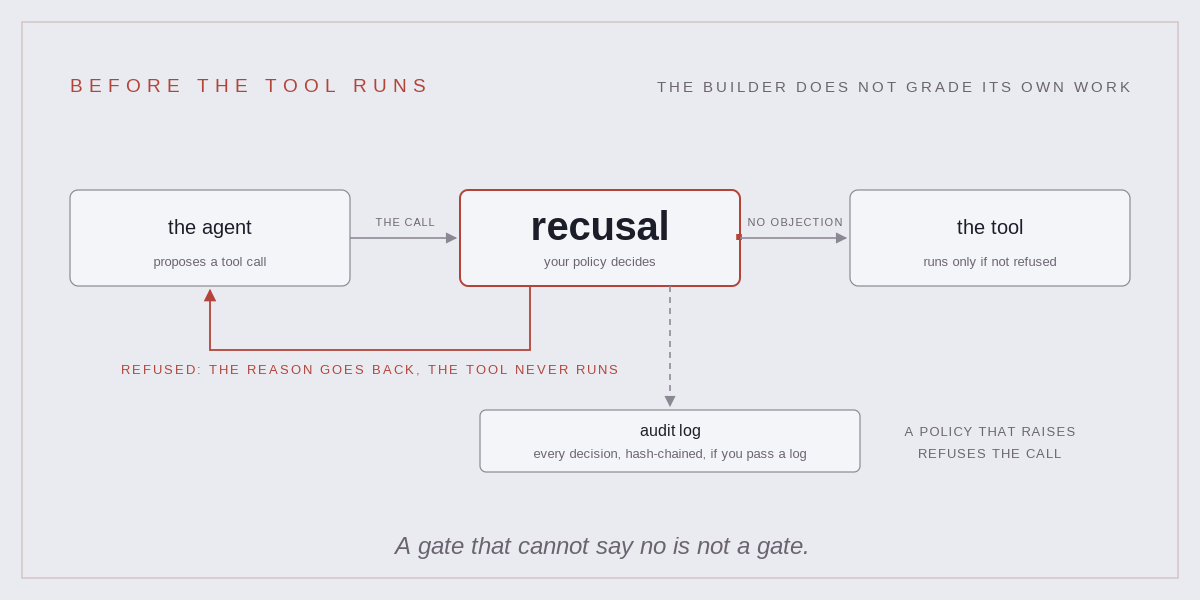
The Recusal gate for MCP tools on an OpenAI Agents SDK agent: every call to a local MCP server, and every hosted MCP call OpenAI asks approval for, is judged by your policy first.
New to Recusal? It checks each tool call an AI agent proposes against your policy and refuses the unsafe or unapproved ones before the tool runs. No model makes that decision. A policy is a plain Python function: it is given the tool's name and its arguments and returns a list of findings. An empty list lets the call run; a failing finding refuses it and gives the reason. Writing a policy covers the two postures, allowlist and deny-list.
This is a separate distribution from recusal. The kernel has zero runtime dependencies
and a frozen compatibility perimeter; this package carries the SDK and MCP dependencies
and its own version, so a release of either never forces a release of the kernel.
It builds on
recusal-openai-agents,
the function-tool gate, and depends on that package.
Install it from PyPI. recusal-openai-agents, which this package requires, comes with it:
pip install recusal-openai-agents-mcp
Requires Python 3.10+, recusal>=0.15.0, recusal-openai-agents>=0.2.0,
openai-agents>=0.24.0, mcp>=2.3.0, jsonschema>=4.26.0 and referencing>=0.37.0 (the
MCP SDK requires jsonschema itself, and referencing comes with jsonschema). It is
tested on every pull request against exactly openai-agents==0.24.0 with
openai==3.49.0, and weekly against the newest releases.
The package ships inline types (py.typed) for your editor and type checker.
Use
from agents import Agent
from recusal import Finding
from recusal_openai_agents_mcp import gated_agent


def policy(tool_name, tool_input):
    sql = tool_input.get("sql", "")
    if tool_name == "run_sql" and sql.lstrip().upper().startswith("DELETE"):
        return [Finding.fail("no_deletes", severity="CRITICAL", message="DELETE is not allowed")]
    return []


agent = gated_agent(Agent(name="assistant", tools=[...], mcp_servers=[server]), policy)
gated_agent gates all three kinds of tool at once: function tools (through
recusal-openai-agents), every server in mcp_servers, and every HostedMCPTool.
gate_mcp_server(server, policy) and gate_hosted_mcp(tool, policy) gate one of each.
Local MCP servers are gated in place, at server.call_tool. That is the one point
where the SDK hands the server its own tool name and the arguments that are sent to it,
after any approval a person gave. A refusal returns an MCP error result carrying
Recusal's reason, and the server is never reached. The policy sees the name the server
executes under, whatever public name the model called it by, so a policy keyed by tool
name must name the server's own tools.
The policy judges what is sent, checked against and completed from the server's listed
schema. A server does three things with what it receives that the gate cannot watch: it
fills what the call leaves out from its defaults, it converts a value of another type
(the string "false" to a boolean, "500" to a number), and where its schema offers
several object forms it picks one by a rule of its own. The tool's listed inputSchema is
the only statement of what the server accepts, and it states none of those rules, so
before the policy runs the gate:
- requires the arguments to be valid against the whole listed schema, as they stand.
They are validated with
jsonschema, in the draft the schema declares (2020-12 when it declares none; draft-07 and 2019-09 are read too, each under itshttporhttpsaddress, with or without the trailing#):anyOf,oneOfandallOf, a$refinto the schema's own$defsordefinitions,items,prefixItems,additionalProperties,required,enum, ranges and lengths. Aformatis not asserted. JSON Schema validation does not convert, so a string is not a boolean or a number. The gate is stricter in three places where a server would still convert:5.0is not aninteger; anenumorconstvalue must be of the same JSON type as the listed one (1.0andtrueare not1); and foruniqueItemstwo equal numbers are one item whatever their JSON type (1,1.0andtrue, which a Python set holds once). A JSON string sent for a parameter the schema types as an object or a list is refused like any other value of another type; the MCP Python SDK's server would parse it into one. - never evaluates a server's regular expression.
patternis not checked: the server checks it. A pattern can take longer on a few dozen characters than any limit, and the text is the model's. The same holds for the names of members: underpropertyNamesapatternis not checked, and besidepatternPropertiesthe gate does not work out which pattern a member's name matches, so every member of the object must meet the schema of every pattern listed there, a memberpropertiesdoes not name must also meetadditionalPropertieswhen that is a schema, andadditionalProperties: falseasserts nothing there (the server rejects a member no pattern matches). - refuses an object where the schema offers more than one object form, and a list
where it offers more than one list form. Two or more alternatives of an
anyOforoneOfthat admit an object are what aUnionof two models and a zodz.unionof two objects publish. Which form runs is the server's own rule, and it is not JSON Schema's: a server built on Pydantic takes the member with more of the fields that are set and converts strings to fit it, and one built on zod takes the first member that parses and drops the members that one does not know, although it listsadditionalProperties: false. So an object for such an argument is refused whatever it holds, at any depth, with one exception: where every object form fixes one same-named property to aconst(or anenumof one value) of its own, no two the same, and the object carries that property with the value of exactly one form, that form alone is used. A list has no such tag: where two or more alternatives admit a list, a list is refused. One object form, or one list form, beside alternatives that are not one (Optional[Model],Model | str,list[Model] | None) is unaffected. - refuses a string where the schema also admits the type a server reads its text as.
One rule for two readings. Pydantic's conversion reads the text of a number as the
number and a word for a boolean (
true,false,1,0,yes,no,on,off,t,f,y,n, in any case) as the boolean, at any depth, unless the value is taken as a string first:"1700000000"forwhen: Union[int, date]runs as the integer. The schema of such a parameter namesinteger,numberorbooleanbeside string (a string with aformatcounts), which is what the gate can see, so there a string that reads as a number (anything Python'sfloataccepts once the white space around it and its underscores are gone,infandnanincluded) or as a boolean is refused. And the MCP Python SDK's server decodes an argument whose text is JSON for null, a list or an object when the parameter is not annotated exactlystr:{"scope": "null"}forscope: Optional[str]runs asNone. So for an argument whose schema admits another JSON type than string (ananyOfor atypelist withnullin it, a schema with notype), such text is refused. In both cases: send the value as JSON, not as text. A schema that admits only strings keeps every string, one that names no type keeps the text of a number and of a boolean (a server does not convert for a parameter typedAny), and JSON text further in than an argument is the string it is, which no SDK decodes. - writes every default the schema lists for a property the arguments leave out, at
every depth. The gate walks the arguments with the schema, through
$ref,properties,items,prefixItems(in the older drafts a list ofitems, andadditionalItems),additionalProperties,allOf, and the one form of ananyOforoneOfthat admits the object or the list there (above), and adds each property that is left out and has a default. The default is the property's owndefault; when its schema lists none itself, it is the one listed by the schema its$refnames, by a member of itsallOfor by an alternative of itsanyOforoneOf(zod publishesz.boolean().default(true).nullable()that way), where all that are listed must be the same value. A default that is an object is completed in turn. The completed arguments are checked again, by all of the above.
The policy judges the completed arguments. They are what is sent, with one exception.
The exception: a listed default that cannot be sent is judged, as listed, and not
sent. There are two kinds. One that is not valid against its own property schema:
Pydantic publishes {"default": null, "type": "string"} for a parameter written
q: str = None, and the server would reject the null if it were sent. And one that
is text a call would be refused for sending: mode: Optional[str] = "null", which the
server would decode to None, and the text of a number where a number is listed too.
The policy is given the default as the schema lists it (q: None, mode: "null"), the
audit entry is bound to it, and the server is sent the arguments without it. This rests
on the listing being what the server runs with when the parameter is left out. That is
so for a server built with the MCP Python SDK, which lists the default it uses. It is
not always so for one built with zod, which derives the default another way in these
cases: z.number().default(Infinity) lists default: null and runs Infinity;
z.number().min(5).default(1).optional() lists default: 1 and runs with the parameter
absent; a Set or a Map default is listed as {}; and an object default that fails
its own schema is parsed again through that schema, which fills or drops members. The
gate cannot tell these listings from Pydantic's, so it judges the default as listed.
What the gate cannot check or complete, it refuses before the policy runs, with a
reason the model reads. The reason names the place in the arguments (opts.recursive,
items[1]), written only from property names the schema lists and positions in a list (a
key the schema does not list is written *), and says what the schema requires there. It
carries no argument text. Refused:
- arguments that are not valid against the schema. A value of another JSON type is told
the types the schema declares: send the declared type, and an object as an object, not
as JSON text. A value outside an
enum, arequiredproperty left out, a member thatadditionalProperties: falseforbids and any other constraint each say so; - an object where the schema offers more than one object form and no tag tells which, and a list where it offers more than one list form (above);
- a string whose text a server reads as another type the schema also admits there (above);
- a schema that is not a JSON object, is not a valid JSON Schema, or declares a draft other than draft-07, 2019-09 and 2020-12;
- a
$refthat does not resolve inside the listed schema itself. A remote reference is never fetched, and a reference to an$anchoris not resolved.$dynamicRef,$recursiveRefand a subschema with an$idof its own are refused too; - a
defaultlisted where the gate does not read one, because it cannot tell whether the server would apply it: underif,then,else,not,patternProperties,additionalPropertiesbesidepatternProperties,dependentSchemas,dependencies,contains,propertyNames,unevaluatedProperties,unevaluatedItemsandcontentSchema, and under any keyword the gate does not know (a vendor'sx-shape, a keyword of a later draft).const,enum,examples,exampleanddefaulthold data and are not looked into; - a property left out whose alternatives list different defaults
(
{"anyOf": [{"type": "boolean", "default": true}, {"type": "string", "default": "no"}]}), and a place two parts of the schema list different defaults for; - a property left out whose listed default has a member its own schema does not allow.
A Pydantic model whose fields have aliases, used as a parameter's default with
extra="forbid", lists that default under the field names and its schema under the aliases, so the gate cannot tell what the server would run with; - a property left out whose listed default holds an object or a list where the schema offers more than one form: Pydantic runs with such a default as listed, and zod parses it again through the union;
- a list that leaves out an item a
prefixItemsentry lists a default for; - a schema that leads back to itself through
$ref,allOf,anyOf,oneOf,not,if,then,else,dependentSchemasor the draft-07dependenciesalone, with no value in between ({"$ref": "#"}), or whose defaults never settle; - a schema that uses
unevaluatedPropertiestogether withpatternProperties, which could be applied only by evaluating the patterns; - arguments that cost more to check than the gate allows for their size (below);
- arguments that are not JSON data (a non-finite number such as
1e400), or that hold a value more than 64 levels below the arguments object.
An argument the schema neither names nor forbids is judged and sent as it is.
The two refusals for forms and for text are also made under the keywords no default is
written through (then, else, dependentSchemas, dependencies, patternProperties,
unevaluatedProperties, contains, unevaluatedItems), whether or not the keyword
applies to the value.
A default is never applied where a value is always present: on the schema of the
arguments themselves (the gate always sends an object), of the items of a list and of
additionalProperties. JSON cannot send a member or an item without a value.
The work is bounded by counting it, not by a timer. A step is one keyword of the
schema applied to one value (and one more for each member or item that value holds
directly), one value visited by the walk above, one value read for a comparison (enum,
const, uniqueItems), or one part of the place of a validation error. Every step is
counted against an allowance of 10,000 steps and 1,000 more for every value in the
arguments (an object, a list, and each member, item and scalar in them). Nothing is
validated twice for the same schema and the same value while the arguments stand as they
are, a list or an object is walked once for a schema, and the choices of an enum are
read once for a call, so a recursive schema (a model with child: Optional[Node]), a
list of 12,000 ordinary items under uniqueItems and 20,000 values against an enum
of 600 each cost in proportion to the arguments. One exception is open: integers chosen
to share one hash make the uniqueItems check slow, uncounted by the allowance (10,000
such integers held the event loop for seconds). What a single step costs beyond its
count is otherwise bounded by the size of that keyword in the listed schema, and
reading a string is in proportion to its length. What the schema alone says (the types
a subschema admits, the default it lists, the forms of a union) is read once, at the
first call after each listing. The largest ordinary
calls measured spend under a twentieth of the allowance; a call over it is refused before
the policy runs, with "the arguments are too costly to check against the server's listed
schema for this tool", and is one deny entry on an audit log.
What the rules above mean for ordinary schemas:
- A parameter typed as a
Unionof two models, or as a zodz.unionof two objects, cannot be called through the gate with an object, whatever the object holds, andextra="forbid"or.strict()does not change that. Give every model aLiteraltag field of its own (with or withoutField(discriminator=...)), or usez.discriminatedUnion, and have the call carry the tag; or publish one tool for each form. A tag field with a default must still be sent: without it the gate cannot tell the forms apart. - A parameter typed
list[A] | list[B], or a list besideAny, cannot be called with a list. Publishlist[Union[A, B]]with tagged members, or separate tools. - A parameter typed
Union[int, str],Union[float, str]orUnion[bool, str](zod:z.union([z.number(), z.string()])) cannot be sent a string that reads as a number or as a boolean, although such a server would keep it a string: its schema is the same as that ofUnion[int, date], for which the server converts. ADecimalparameter lists a number beside a string too: send the number. - A
NamedTupleor tuple parameter with a defaulted last member publishes aprefixItemsentry with a default, so a call that leaves that item out is refused; send every item. - A zod object publishes
additionalProperties: falseunless it is written with.passthrough(), so an argument its schema does not name is refused. - OpenAPI's
nullable: trueis not JSON Schema: the gate reads the declaredtype, sonullfor{"type": "string", "nullable": true}is refused. A schema that means null lists it ("type": ["string", "null"], or ananyOfwith{"type": "null"}). - A recursive model nested as deep as the 64-level limit on the arguments is completed.
To read the schema the gate also wraps the server's list_tools, in place. list_tools
returns what the server listed, unchanged, and the gate keeps each tool's schema from the
most recent listing: each listing replaces the one before, so a call to a tool the server
no longer lists is refused. A call to a tool that is not in the most recent listing makes
the gate call list_tools() itself, with no run context and no agent, once for that
call. A tool that is still not listed, and a server whose tools cannot be listed that
way, is refused.
A tool_filter hides tools from one agent; the schemas are the server's. The SDK's own
server classes keep the listing as it was fetched, before the filter (cached_tools),
and that whole listing is what the gate keeps. So two agents that share one server
object under a dynamic filter each reach the tools they were listed, and the gate's own
list_tools(), which such a filter cannot answer without an agent, still leaves it the
fetched listing. The gate does not enforce a filter: the SDK never routes a model's call
to a tool the filter hides, and a call your own code makes to one through
server.call_tool is judged by the policy like any other. A server class of your own
that keeps no such listing (cached_tools is None, the base class's answer) leaves
the gate with the tools of the latest listing as filtered for one agent: give each agent
its own server object there.
A server carries one policy. The gate is installed on the server object, so every
agent that lists that object shares it. Gating it again with the same policy is a no-op;
gating it with a different policy raises ValueError. Use a separate server object per
policy.
Hosted MCP is approval-gated, not execution-gated. Those calls run on OpenAI's
servers. gate_hosted_mcp returns a copy whose require_approval is "always" and
whose approval callback is Recusal's: a refusal answers {"approve": False, "reason": ...}, so the hosted call is not made. A hosted tool whose require_approval is anything
but "always" is reported as ungated. The policy sees the arguments as the model sent
them: the hosted server's schema is not read, so the check above does not apply.
Build the agent completely, then gate it. A tool or a server appended to the gated
agent afterwards is not gated, and is_gated(agent) then returns False. The gated copy
has its own tools, mcp_servers and handoffs lists, so a later change to the
original agent's lists does not reach it. The servers themselves are shared with the
original agent and stay gated for both. A sub-agent behind as_tool is accepted when it
is gated itself with this package's gated_agent, its own servers and hosted tools
included.
Put every decision on the record
from recusal.audit import AuditLog
from recusal_openai_agents_mcp import audited_agent

log = AuditLog(path="decisions.jsonl")
agent = audited_agent(Agent(name="assistant", mcp_servers=[server]), policy, log)
One log covers the three seams, each under its own surface label:
| Seam | Surface | Call id on the entry |
|---|---|---|
| Function tools | openai_agents.tool_input_guardrail |
the SDK's tool call id |
| Local MCP server | openai_agents.mcp.call_tool |
none: the SDK hands call_tool no id; the server is control.mcp_server |
| Hosted MCP | openai_agents.hosted_mcp.approval |
the approval request id; the server label is control.mcp_server |
Each entry holds a SHA-256 fingerprint of the arguments, never the arguments. For a local
server's judged call that is the fingerprint of the arguments as judged: the arguments
sent, completed with the listed defaults, and with any listed default that is not sent
(above). A call the gate refuses before the policy runs (arguments the schema does
not allow, an object or a list the schema offers more than one form for, a string a
server may read as another value, arguments too costly to check, a schema the gate
cannot check, a tool the server does not list, arguments that are not JSON data) is one
entry too, a deny, bound to the arguments as the SDK handed them.
Arguments that are not JSON data have no fingerprint of their own, so that entry is
bound to the text the gate writes them as, under the key input: JSON without
spaces, a non-finite number as nan, inf or -inf, an object that is not data as its
type's name in angle brackets, and ... for anything more than 64 levels down. If the
log cannot be written the call is refused. Check the log with
recusal audit verify decisions.jsonl.
What the gate does not see
- A parameter the call leaves out that has no listed default. It is the server's to
fill, and the schema does not say with what. Most optional parameters of hand-written
schemas are like this, and so is every Pydantic
default_factorydefault, which is not published. A policy that depends on such a parameter should refuse a call that leaves it out. - A server whose code does more than its schema says. The gate guarantees what is
sent, and that it is valid against the listed schema. What a server's own code then
makes of a value is not in the schema. Cases seen on servers built with the official
SDKs (
mcp2.3.0, and the TypeScript SDK with zod):- A parameter without an annotation. The MCP Python SDK lists
type: stringfor it and then decodes the string as JSON, so"null"runs asNoneand"[]"as a list. A schema that admits only strings keeps every string, so the gate does not refuse these. Annotate the parameterstr, and the server keeps the string. - A type the schema leaves out.
scope: str | SkipJsonSchema[None]liststype: stringonly, and the server still decodes"null"and runs withNone, for the same reason. - A string the schema says is encoded. A Pydantic
Json[...]parameter lists a string withcontentMediaType: application/json: the policy judges the string, and the server runs with what it decodes from it.contentMediaType,contentEncodingandcontentSchemaare not applied. - A numeric string for a date. A
formatis not asserted:"0"for a parameter typeddateruns as 1970-01-01 and"1700000000"for adatetimeas that timestamp. - A validator or a constraint that changes the value. A string constraint that
strips and lowers (
StringConstraints(strip_whitespace=True, to_lower=True),z.string().trim().toLowerCase()) runs" /ETC "as"/etc". This also changes a default the gate wrote: Pydantic does not validate a default when the parameter is left out, soname = "X "runs as"X "without the gate, and as"x"with it, because the gate sent the default and the server validated what it was sent. The policy judged"X ". - A fallback for a value that fails. zod's
.catch(...)is in no schema:z.boolean().catch(undefined).or(z.null())runsnullas undefined. - A default the server derives another way than it lists. A listed default that
cannot be sent is judged as listed (above): zod's
default(Infinity), such a default under.optional()(which runs with the parameter absent), aSetorMapdefault and an object default parsed again run as something else. So does a default a Pydantic model validates (validate_default=True).
- A parameter without an annotation. The MCP Python SDK lists
- An integer too large for a float parameter. A JSON integer above 2^53 sent for a
numberparameter is judged as the exact integer; a server that reads the parameter as a float runs the nearest float. - Whether the server reads a member its schema does not name there. An argument, or a member of an object at any depth, that the schema neither names nor forbids at that place is judged and sent as it is, a string that holds JSON text or the text of a number included: the text check reads the schema of the place, and there is none. A server that ignores such a member (a Pydantic model does, a zod intersection drops it) runs without it.
- A schema that changes after it was listed. The gate checks against the schema of
the most recent listing made through the gated server object. A server that changes a
tool between that listing and the call, and a listing the SDK serves from its cache
(
cache_tools_list=True), leave the gate with the older schema. - Request metadata. What a server's
tool_meta_resolverreturns is sent as_metabeside the arguments. It is not given to the policy and is not in the fingerprint. - Hosted MCP: the server's defaults and type conversion. The hosted server's schema
is not read, so the policy sees the arguments as the model sent them. Which of two
duplicate keys in the argument text the hosted server reads is not seen either: the
policy is given the last one, as
json.loadsreads it. - A hosted call OpenAI does not ask approval for. That is why the gate sets
require_approvalto"always". - A hosted approval the SDK answers from its own memory. The gate keeps no state between turns. When the provider repeats the id and the arguments of an approval request the gate already allowed, the SDK approves it again without asking the callback, so there are two approvals for one consultation of the policy and one entry. A policy that counts calls counts consultations, not approvals.
- What the tool's own approval callback answered after Recusal allowed a call. The entry records Recusal's decision, not that callback's.
- A call the SDK rejects before
call_tool. Arguments for a local MCP tool that are malformed JSON, or not a JSON object, are rejected by the SDK itself, and the model reads the SDK's tool error. Arguments that hold a lone surrogate character raiseUnicodeEncodeErrorinside the SDK and stop the run. Nothing runs and there is no entry. - Handoffs, an agent with a
prompt, an agent whosemodel_settingsput tools into the request, an ungated sub-agent behindas_tool, andAgentsubclasses.gated_agentraises for these at construction. A prompt stored on OpenAI's servers can configure tools, hosted MCP among them, that are not in the agent'stoolslist, and so canmodel_settings.extra_bodyorextra_argswith atools,prompt,plugins,web_search_optionsormcp_serverskey. - Model settings given to a run. Only the agent's own
model_settingsare read when it is gated.RunConfig(model_settings=...)is merged in when a run starts, and anextra_bodythere is not seen. - Legacy
functionsdefinitions inextra_body. Afunctionskey there is sent in the body of the request and is not refused. It only describes functions to the model: the SDK runs a call by looking its name up among the agent's own tools, so a call to a name that is not one of them raisesModelBehaviorErrorand nothing runs, and a call to a name that is one passes through that tool's gate.
Status
In-depth review under way. Its fixes so far are released in 0.2.0, and the review continues. Recusal is a Beta (0.x) open-source project in active
development: it is not a finished or certified security product, and it is provided under
Apache-2.0 without warranty.
What the reviews are, and where every adapter stands.
Open from the latest review round, not yet fixed, stated so you can judge them:
- Integers chosen to share one hash, under
uniqueItems(set[int]), make the check slow: about 10,000 of them held the event loop for seconds, uncounted by the allowance. - Not seen: a zod server's
z.coercebeside another type in a union reads text by JavaScript's rules ("0x1F"runs as 31); a Pydantic server converts the keys of adict[int, ...]parameter, which the listing does not show; an integer above 2^53 on a TypeScript server'sintegerparameter runs rounded; a member a Pydantic server ignores (field(init=False)) or reads from elsewhere (AliasPath); a union a Pydantic server reads left to right (union_mode='left_to_right'). - The refusal "Send the value as JSON, not as text" is wrong advice where the text is not
that number (a zip code
"01234"): the server's author should type that parameterstr.
Help make it better. Read the code, test this adapter against your own stack and tell us what you find. Reviews, bug reports and pull requests are all welcome: how to contribute, open issues. Please report a security gap privately, not in a public issue.
Compatibility
This package is outside the kernel's frozen perimeter (STABILITY.md, Integrations). Its
public names are the ones in recusal_openai_agents_mcp.__all__. It uses only the public
names of recusal-openai-agents.
A runnable offline demonstration, with an in-process MCP server and no API key, is
examples/openai_agents_mcp_gate.py
and
examples/openai_agents_mcp_audit.py.
More
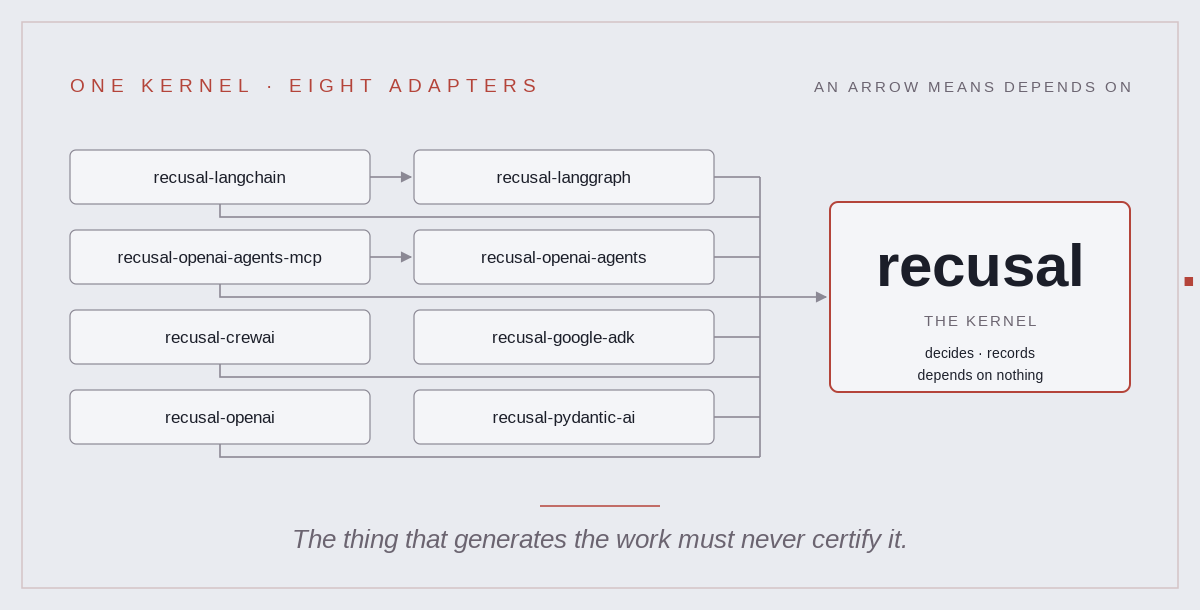
An arrow means "depends on". No arrow leaves the kernel, so a framework's breaking change is answered by a release of that framework's adapter, not by a release of the kernel.
- Framework notes for MCP tools on the OpenAI Agents SDK: the detail behind this page.
- All eight adapter packages and the kernel, which has zero runtime dependencies.
- Verifying a release: each release is built in CI, signed with Sigstore and published to PyPI by trusted publishing.
- Changelog, issues, security policy and support.
Licensed under Apache-2.0.
1 maintainer

Metadata
1 maintainer
Release files for recusal-openai-agents-mcp 0.2.0
For a detailed explanation of source distributions (sdists) and built distributions (wheels), please see the package formats documentation.
Source distribution (sdist)
| File | Size | Uploaded | Provenance | Actions |
|---|---|---|---|---|
| recusal_openai_agents_mcp-0.2.0.tar.gz | 56.1 kB | With provenance | Details for recusal_openai_agents_mcp-0.2.0.tar.gz |
Built distribution (wheel)
| File | Interpreter | ABI | Platform | Actions Reset |
|---|---|---|---|---|
| recusal_openai_agents_mcp-0.2.0-py3-none-any.whl | Python 3 | none | any | Details for recusal_openai_agents_mcp-0.2.0-py3-none-any.whl |
Total release size: 101.5 kB
Release files / recusal_openai_agents_mcp-0.2.0.tar.gz
| Download URL | recusal_openai_agents_mcp-0.2.0.tar.gz |
|---|---|
| Size | 56.1 kB |
| Tags | Source |
|
SHA-256 checksum How to use checksums |
2a3632f3814e8a4828ba5db2f58e0c382308b8656545cb1925c4060280967aa5
|
|
BLAKE2b-256 checksum How to use checksums |
1ea7738b1b1389948b4e6facf0f666287df45341e2aef5fb08105a457af15cd7
|
| Upload date | |
|
Uploaded using Trusted Publishing? What is trusted publishing? |
Yes |
| Uploaded via |
twine/7.0.0 CPython/3.13.16
|
Provenance
Provenance describes where a file came from. On PyPI, provenance is shared via attestations, which provide a verifiable record of the build or publishing details. View details, limitations and caveats.


PyPI Publish Attestation
PyPI verified that this artifact, at this checksum, originated from the publisher listed below.
Signed by GitHub Actions, verified by PyPI on Nov 23, 2026.
Transparency logRelease files / recusal_openai_agents_mcp-0.2.0-py3-none-any.whl
| Download URL | recusal_openai_agents_mcp-0.2.0-py3-none-any.whl |
|---|---|
| Size | 45.4 kB |
| Tags | Python 3 |
|
SHA-256 checksum How to use checksums |
d998dfec85297827e19dcd2f921a96b11050dbf2ce869408a63e2391e76733a3
|
|
BLAKE2b-256 checksum How to use checksums |
974bb9c8676f298f837381120d3e3cf66b1c531b293eb31c4458323044acae62
|
| Upload date | |
|
Uploaded using Trusted Publishing? What is trusted publishing? |
Yes |
| Uploaded via |
twine/7.0.0 CPython/3.13.16
|
Provenance
Provenance describes where a file came from. On PyPI, provenance is shared via attestations, which provide a verifiable record of the build or publishing details. View details, limitations and caveats.
PyPI Publish Attestation
PyPI verified that this artifact, at this checksum, originated from the publisher listed below.
Signed by GitHub Actions, verified by PyPI on Nov 23, 2026.
Transparency logSecurity for recusal-openai-agents-mcp 0.2.0
Provenance
Provenance describes where a file came from. On PyPI, provenance is shared via attestations, which provide a verifiable record of the build or publishing details. View details, limitations and caveats.
Full provenance
Both files in this release have been uploaded with provenance metadata.
Attestation for recusal_openai_agents_mcp-0.2.0.tar.gz
PyPI Publish Attestation
PyPI verified that this artifact, at this checksum, originated from the publisher listed below.
Signed by GitHub Actions, verified by PyPI on Nov 23, 2026.
Transparency logA note on package security
PyPI is a repository for distributing packages, not a service for auditing them. While third-party security researchers and our staff do their best to detect and remove malicious packages, PyPI cannot guarantee the quality, security or suitability of any given package.
To learn more about protecting yourself from malicious actors, visit our package security documentation.














