
One wildly used method for scRNA-seq data normalization is to make the total count, called the transcriptome size, of all genes in each cell to be the same, such as counts per million (CPM) or count per 10 thousand (CP10K)

Project description
ReDeconv
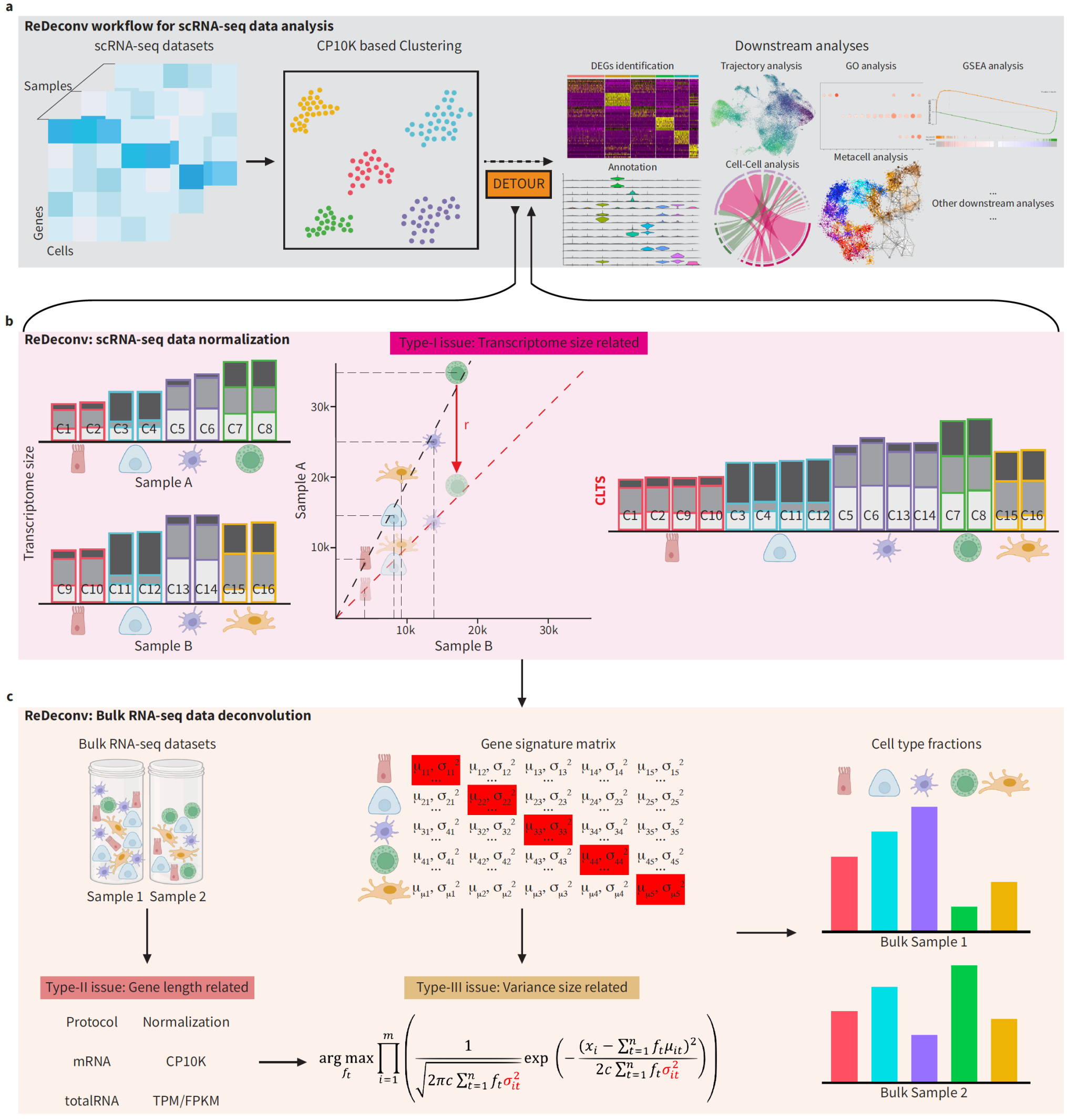
ReDeconv presents an innovative approach for deconvolving cell types in bulk RNA-seq data, utilizing single-cell RNA-seq or bulk sort RNA-seq data as a reference. The ReDeconv methodology comprises two primary elements. The first part involves the normalization of scRNA-seq data. The second part encompasses calculating the signature gene matrix and determining the proportions of varying cell types within mixed samples, using bulk RNA-seq data.
ReDeconv Workflow
Major contributions of ReDeconv
In ReDeconv, we mainly have following contributions to address some critical issues in cell type deconvolution:
- Address the issues of sequencing-depth normalization (Type-I issues).
- Address the issues of gene-length normalization (Type-II issues).
- A new way to find signature genes (Type-III issues).
- A new model for cell type deconvolution (Type-III issues).
When conducting deconvolution, certain issues may go unnoticed for a while since the authentic bulk RNA-seq data typically lacks a ground truth, and the synthetic bulk RNA-seq data does not necessarily exhibit these issues. For instance, if the synthetic bulk RNA-seq data is derived from CPM/CP10K scRNA-seq data, which is also used as a reference, we might not encounter Type-I and Type-II issues. However, in such situations, the transcriptome size - the total count of all genes in a cell - remains constant for each cell in the synthetic bulk. This scenario is generally not applicable to real-world bulk RNA-seq data.
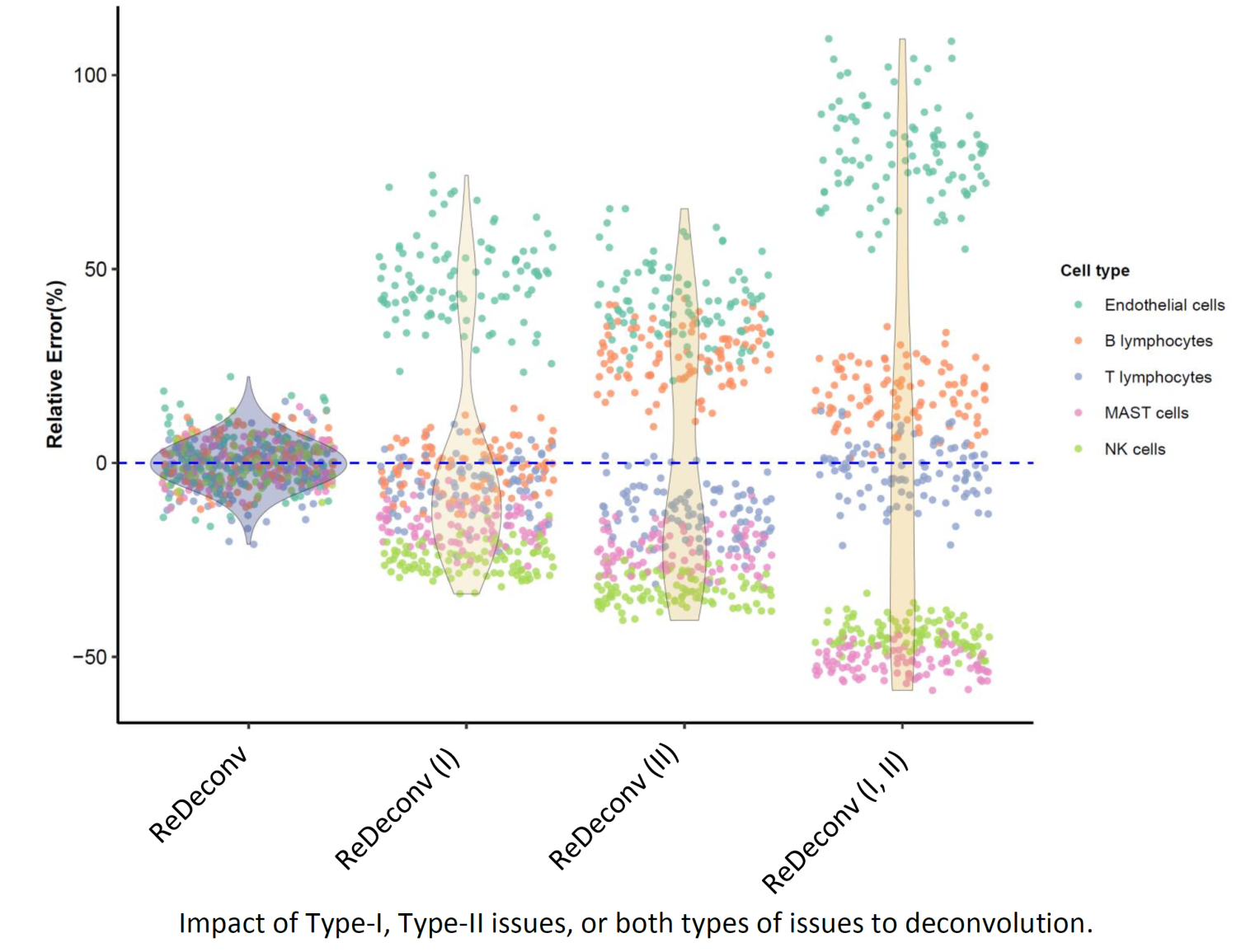
When using different deconvolution methods, including certain high-ranking ones, issues can arise due to improper normalization of scRNA-seq and/or bulk RNA-seq data. For instance, applying Counts Per Million (CPM) to reference scRNA-seq data can lead to a deconvolution issue where the transcriptome sizes of cells in the references are uniform, but vary in the actual bulk RNA-seq data (termed as Type-I issues). Moreover, if we use raw-count scRNA-seq data, which doesn't account for gene length, along with raw-count total RNA-seq data, which does, it results in a discrepancy in gene length normalization (defined as Type-II issues). These Type-II issues can occur when applying such data to various deconvolution methods, including the top ones. Additionally, using CPM scRNA-seq and bulk RNA-seq data as inputs for deconvolution can result in both Type-I and Type-II issues. We've adjusted our new cell type deconvolution model, ReDeconv, to include versions with Type-I issues (ReDeconv (I)), Type-II issues (ReDeconv (II)), or both (ReDeconv (I, II)). The outcomes show that predictions from ReDeconv (free from Type-I and Type-II issues) have a very low relative error, while those from the modified ReDeconv with these issues have a significantly higher relative error. In addition to tackling Type-I and Type-II issues, ReDeconv also includes other enhancements that significantly boost deconvolution performance. More about our contributions can be found in the Documentation.

How to install/start ReDeconv
[1] Windows Desktop Application
Download *.exe files to a local fold in a Windows system. Run “ReDeconv_Normalization.exe” for the scRNA-seq data normalization and “ReDeconv_Percentage.exe” for cell type deconvolution.
Note: You may need about one minute to load and start the program.
[2] by PyPI with conda (conda is optional, but recommended)
conda create -n redeconv python=3.8
conda activate redeconv
pip install redeconv
then in your Python script or interactive environment, import the package
from redeconv.__ReDeconv_N import *
from redeconv.__ReDeconv_P import *
[3] by source codes with conda (conda is optional, but recommended)
conda create -n redeconv python=3.8
conda activate redeconv
git clone https://github.com/jyyulab/redeconv.git
cd redeconv
python setup.py install
then in your Python script or interactive environment, import the package
from redeconv.__ReDeconv_N import *
from redeconv.__ReDeconv_P import *
[4] Web Portal
The web portal is a specially designed web application that often serves as the single point of access for ReDeconv.
Sign in at redeconv.stjude.org
Demo data
These data sets include demo data for normalization and deconvolution. The sizes of files in the demo data are not very large. So, the time to test our model should be finished within 20 minutes.
Data for ReDeconv evaluation
We provide all scRNA-seq, synthetic bulk RNA-seq, and real bulk RNA-seq data that were used to evaluate ReDeconv, which is suppressed into a .zip file. The excel file in the .zip file includes information about the data source and ground truth of the synthetic bulk RNA-seq data.
Funding Information
This work was supported in part by National Institutes of Health grants R01GM134382, U01CA264610, and U01CA281868 and by the American Lebanese Syrian Associated Charities.
Cite
Lu S, Yang J, Yan L, Liu J, Wang JJ, Jain R, Yu J. Transcriptome size matters for single-cell RNA-seq normalization and bulk deconvolution. Nat Commun. 2025 Feb 1;16(1):1246. doi: 10.1038/s41467-025-56623-1. PMID: 39893178; PMCID: PMC11787294.
Contact
Please contact Songjian Lu (Songjian.Lu 


Download files
Download the file for your platform. If you're not sure which to choose, learn more about installing packages.
Source Distribution
Built Distribution
Filter files by name, interpreter, ABI, and platform.
If you're not sure about the file name format, learn more about wheel file names.
Copy a direct link to the current filters
File details
Details for the file redeconv-1.2.1.tar.gz.
File metadata
- Download URL: redeconv-1.2.1.tar.gz
- Upload date:
- Size: 28.3 kB
- Tags: Source
- Uploaded using Trusted Publishing? No
- Uploaded via: twine/6.1.0 CPython/3.11.11
File hashes
| Algorithm | Hash digest | |
|---|---|---|
| SHA256 |
6c497cd4a8865955b4bfbc53f74b5c43ded597dcc89491990174c3e9b5649a56
|
|
| MD5 |
a1ca9ba845ddde72b61a5090a02a5ddb
|
|
| BLAKE2b-256 |
117fe4b881d409250e7b93e0eaca9bb4f49de0d1b01b9bb6f4b75ced5eafd82e
|
File details
Details for the file redeconv-1.2.1-py3-none-any.whl.
File metadata
- Download URL: redeconv-1.2.1-py3-none-any.whl
- Upload date:
- Size: 27.5 kB
- Tags: Python 3
- Uploaded using Trusted Publishing? No
- Uploaded via: twine/6.1.0 CPython/3.11.11
File hashes
| Algorithm | Hash digest | |
|---|---|---|
| SHA256 |
7a4a03a36bb3dc0199c05bd24cac027441e3420bf2e0ab4b362d1f401a72a29f
|
|
| MD5 |
b35d0f449150f9a02095b408bd7e3431
|
|
| BLAKE2b-256 |
76fa50053a263b1e33054fb8977761f2ee2d6bd59bc63fb479a89c6f34f95fe9
|






