
Bookmarks for terminal workflows.

Project description
Redo
A CLI tool for saving repeated terminal workflows and running them again with one command.
Stop retyping commands. Save workflows once, run them anytime.




Quick Start · How It Works · Commands · Placeholders · Local Development
What is Redo?
Redo is a command-line tool that turns repeated terminal command chains into reusable workflows.
Instead of typing the same commands again and again:
git add .
git commit -m "fixed bug"
git push
Save them once:
redo new ship
Run them anytime:
redo run ship
Think of Redo as bookmarks for terminal workflows.
Quick Start
Install Redo from PyPI:
pip install redo-cli
Check the available commands:
redo --help
Create a workflow:
redo new ship
Enter commands one by one:
Description: Commit and push code
Command: git add .
Command: git commit -m "{message}"
Command: git push
Command: :done
Run it later:
redo run ship
Preview it without running anything:
redo run ship --dry
Getting Help
Use Redo’s built-in help whenever you forget a command:
redo --help
Show help for a specific command:
redo new --help
redo run --help
redo import --help
Running redo with no command shows the Redo banner.
Running this shows version, storage path, and credit:
redo --info
Demo Flow
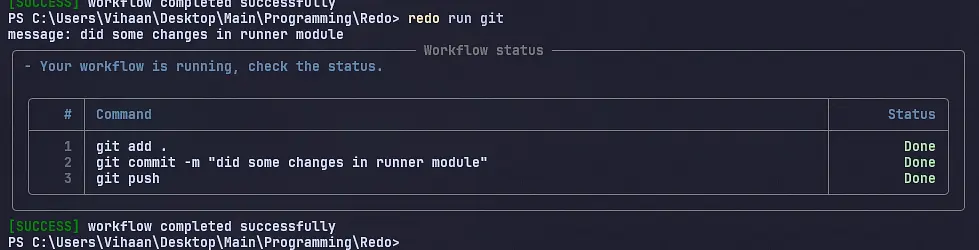
A typical Redo session looks like this:
redo new ship
redo list
redo show ship
redo run ship --dry
redo run ship
redo stats
Why It Matters
Developers repeat command chains constantly.
| Project setup | npm install, copy env files, start dev servers |
| Git workflows | git add, git commit, git push |
| Build flows | run tests, build apps, deploy projects |
| Cleanup flows | remove build folders, reinstall dependencies, reset local state |
Redo removes the small friction that adds up over time.
Features
| Feature | What it does |
|---|---|
| Named workflows | Save repeated command chains as reusable workflows |
| One-command replay | Run saved workflows with redo run <name> |
| Smart placeholders | Use values like {message} or {project_name} |
| Dry run mode | Preview commands before executing them |
| Safety checks | Detect risky commands before they surprise you |
| Focused errors | Stop on failure and show the command that broke |
| Usage stats | Track run counts and time-saved estimates |
| Import/export | Back up and move workflows between machines |
| Doctor/autofix | Check and repair workflow storage issues |
Commands
Every command supports command-specific help:
redo <command> --help
Core commands
redo init
redo new <name>
redo list
redo show <name>
redo run <name>
redo run <name> --dry
redo delete <name>
redo stats
Utility commands
redo search <query>
redo copy <source> <target>
redo rename <old-name> <new-name>
redo path
redo export workflows-backup.json
redo import workflows-backup.json
redo import workflows-backup.json --replace
redo doctor
redo autofix
redo guide
redo clearhistory
Example Workflow
Create a workflow:
redo new ship
Enter:
Description: Commit and push code
Command: git add .
Command: git commit -m "{message}"
Command: git push
Command: :done
Redo stores it like this:
{
  "ship": {
    "description": "Commit and push code",
    "commands": [
      "git add .",
      "git commit -m \"{message}\"",
      "git push"
    ],
    "runs": 0
  }
}
Run it:
redo run ship
Redo asks for the placeholder value:
message: fixed clumsy ui
Then it runs:
git add .
git commit -m "fixed clumsy ui"
git push
Placeholders
Use placeholders when part of a command changes each run.
git commit -m "{message}"
npm create vite@latest {project_name}
cd {project_name}
Redo asks once for each unique placeholder, then replaces every occurrence across the workflow.
Valid placeholder names:
{message}
{project_name}
{ticket_123}
Invalid placeholder names:
{123ticket}
{project-name}
{}
Placeholder values are quoted before execution so user input is treated as one literal value instead of shell syntax.
Safety
Redo detects risky commands before running them.
Examples:
rm -rf
del /s
format
sudo
git reset --hard
If a risky command is found, Redo asks for confirmation before continuing.
Use dry-run mode whenever you want to inspect a workflow first:
redo run cleanup --dry
Storage
Redo stores workflow data in:
%APPDATA%/Redo/workflows.json
If APPDATA is unavailable, Redo falls back to:
~/.redo/workflows.json
Print the exact storage path:
redo path
Override the storage directory:
REDO_DATA_DIR=<path>
Initialize storage manually:
redo init
Check storage health:
redo doctor
Repair common storage issues:
redo autofix
redo autofix can fix missing files, blank files, malformed JSON, and workflow entries with missing fields. If JSON is malformed, Redo saves a non-overwriting workflows.broken.json backup before resetting the main file.
Local Development
Requirements:
Python 3.11+
Clone the repository:
git clone https://github.com/VibeSlayer-code/Redo.git
cd Redo
Create and activate a virtual environment:
python -m venv .venv
.venv\Scripts\activate
Install dependencies:
pip install -r requirements.txt
pip install -e .
Run locally:
python main.py --help
redo --help
redo --info
Run tests:
pytest
How It Works
Redo is split into small modules instead of one large script.
storage.py       workflow JSON storage
placeholders.py  placeholder detection and replacement
runner.py        command execution and dry runs
ui.py            terminal output and tables
main.py          CLI commands
The workflow lifecycle:
load workflow
process placeholders
preview or run commands
stop on failure
update run count
This keeps the codebase simple while still supporting useful CLI features like dry runs, safety checks, repair tools, and stats.
Git Push Tip
If Git says the current branch has no upstream branch, run the command Git suggests once:
git push --set-upstream origin master
After that, workflows containing git push can push normally.
Roadmap
- Project-local workflow files
- Shell completion
- Workflow tags
- Workflow templates
- Shared workflows for repositories
- More detailed time-saved analytics
- Better safety rules for destructive commands
License
Source-available, all rights reserved.
You may view the source code, but you may not copy, modify, distribute, or use it without permission.


Download files
Download the file for your platform. If you're not sure which to choose, learn more about installing packages.
Source Distribution
Built Distribution
Filter files by name, interpreter, ABI, and platform.
If you're not sure about the file name format, learn more about wheel file names.
Copy a direct link to the current filters
File details
Details for the file redo_cli-0.1.4.tar.gz.
File metadata
- Download URL: redo_cli-0.1.4.tar.gz
- Upload date:
- Size: 27.2 kB
- Tags: Source
- Uploaded using Trusted Publishing? No
- Uploaded via: twine/6.2.0 CPython/3.13.13
File hashes
| Algorithm | Hash digest | |
|---|---|---|
| SHA256 |
e41bb41e4b754e36fb9bab3458726457e72ddf8bef6296ae80fb5b23689f0b62
|
|
| MD5 |
f260a72d493936918826a12e6fe246fe
|
|
| BLAKE2b-256 |
ca4305a12387050c3f72a378bba34f7c7271a0ba95c41d65e8ee69ef0ba02981
|
File details
Details for the file redo_cli-0.1.4-py3-none-any.whl.
File metadata
- Download URL: redo_cli-0.1.4-py3-none-any.whl
- Upload date:
- Size: 19.4 kB
- Tags: Python 3
- Uploaded using Trusted Publishing? No
- Uploaded via: twine/6.2.0 CPython/3.13.13
File hashes
| Algorithm | Hash digest | |
|---|---|---|
| SHA256 |
4e928590def0a6aea0f35d1d96b476d5de71f5fdaef7343377ca3f0c90ba81b8
|
|
| MD5 |
d74be6d6e0edb7a0fe24deca5db29245
|
|
| BLAKE2b-256 |
e262716024a93c0bf9b9184bdefc8e6236712acb20dba38e18b883e0d8baf65b
|






