
This release is a pre-release and may not be stable for production use.
RefacTrail






The Python refactorizer. A linter, formatter and verified refactoring tool with two independent engines, pure Python and Rust, built on its own parser. Run correctness checks and bounded formatting, or check structure, naming, types and documentation against a chosen profile.
Website: samtherocket.github.io/refactrail
Part of a family of standalone Python tools: FuncLoom (functionizer), RefacTrail (refactorizer) and FlowBlueprint (architect: script or notebook to architecture diagram). Each installs and works on its own.
Use RefacTrail to:
- auto-refactor Python safely: bounded fixes and rename previews that are verified, never guessed;
- lint for likely bugs and format code with a fast Rust engine, or the identical pure-Python engine, in CI (text, JSON or SARIF output);
- enforce naming, structure, type-hint and docstring conventions across a team with a chosen rule profile;
- check and format Jupyter notebooks as well as scripts.
Built for developers, data scientists and teams that want clean, consistent code; pair it with FuncLoom to turn scripts and notebooks into functions and FlowBlueprint to draw the architecture.
Status: alpha, version 0.5.1a0 on PyPI. Free and open source (MIT). Works offline: no AI model, account or internet connection needed.
Start in one minute
-
Install (needs Python 3.12 or newer; older Python? see below):
pip install refactrail
This also installs FuncLoom and the fast Rust engine. Nothing needs compiling: every system gets a ready-made package.
-
Run it in your project folder:
refactrail lint                # find likely bugs
refactrail lint --fix          # fix the safe ones (--diff to preview)
refactrail format --diff       # preview tidy formatting (--write applies)
refactrail check               # structure, naming, type hints, docstrings
-
Read the result. Each finding shows the file, line and a short reason. Exit code 0 means clean, 1 means findings, 2 means an error, so it drops straight into CI.
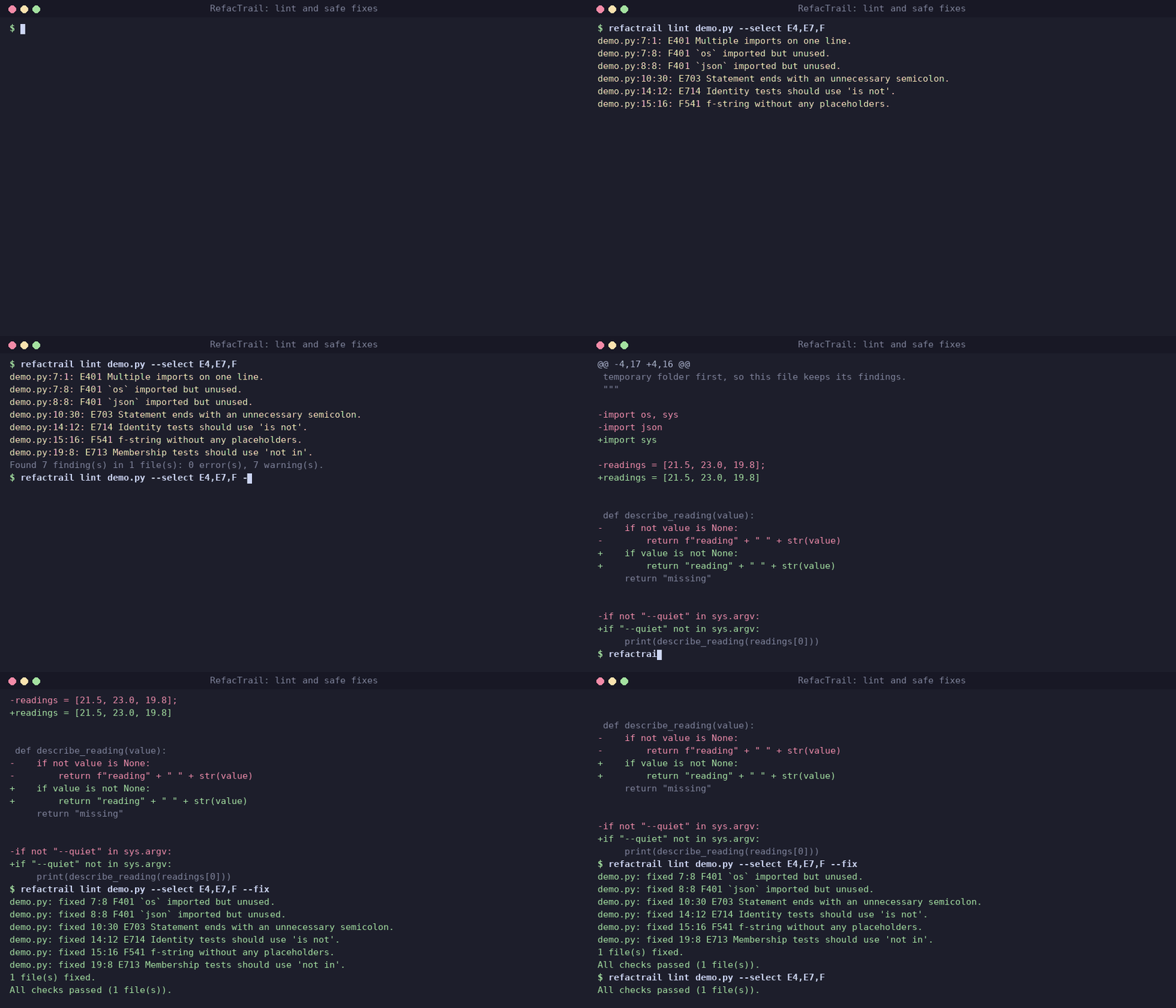
Already use Ruff? refactrail lint --select E4,E7,F checks the same
default rules with the same codes, so your # noqa comments keep
working. Typing just refactrail shows the most useful commands. If your
computer blocks the refactrail command, type python -m refactrail.
In VS Code
- Install RefacTrail from the Extensions view (search RefacTrail).
- Open a Python file, press Ctrl+Shift+P (Cmd+Shift+P on a Mac) and type RefacTrail.
- The first time, click Install when asked; the extension sets RefacTrail up in your Python for you.
Commands: Check active file and Lint general correctness (findings in the Problems panel), Preview fixes / Apply fixes, and Preview / Apply independent formatting (notebooks too).
Check on every commit (optional)
Add this to .pre-commit-config.yaml:
repos:
  - repo: https://github.com/SAMtheROCKET/refactrail
    rev: v0.5.1a0
    hooks:
      - id: refactrail-lint
      - id: refactrail-format
refactrail-format-check (fails instead of rewriting) and
refactrail-check are also available.
What's new in 0.5.1a0
- VS Code extension on the Marketplace, now with an icon: search RefacTrail in the Extensions view.
- Older-Python projects: a step-by-step guide, tested with code for Python 3.8, 3.9 and 3.10.
- A simpler README. Rules, fixes and engines are unchanged (refactrail-core 0.5.1a0 is the 0.5.0a0 engine, versioned in step); 0.5.0a0's Ruff-compatible rules and safe fixes are in the changelog.
Your project uses an older Python?
No problem. RefacTrail only reads your code, so it runs on its own Python 3.12 or newer while your project stays on Python 3.8, 3.9, 3.10 or 3.11. Do this once:
-
Make a separate Python for the tools (no admin rights needed):
# Windows (Command Prompt)
py -3.12 -m venv %USERPROFILE%\py-tools
%USERPROFILE%\py-tools\Scripts\python -m pip install refactrail

# macOS / Linux
python3.12 -m venv ~/py-tools
~/py-tools/bin/python -m pip install refactrail
No Python 3.12 on the machine? Run
pip install uv, thenuvx --python 3.12 refactrail lint my_project: uv downloads Python 3.12 for you. -
Run RefacTrail with that Python:
%USERPROFILE%\py-tools\Scripts\python -m refactrail lint my_project     # Windows
~/py-tools/bin/python -m refactrail lint my_project                       # macOS / Linux
-
In VS Code, open Settings, search for
refactrail.pythonPathand paste the path of that Python (for exampleC:\Users\YOU\py-tools\Scripts\python.exe).
Your project keeps using its own Python to run. More detail, limits and fixes for common errors: the older-Python guide.
If pip install refactrail says from versions: none, your Python is older
than 3.12 (use the steps above) or your company's package mirror does not
carry it yet (ask IT to allow it).
From source (for contributors)
Install FuncLoom from its source folder and the local engine fallback first, then RefacTrail:
python -m pip install -e ../funcloom ./rust/fallback
python -m pip install -e .
Nothing is uploaded by these local tools.
General correctness and independent formatting
python -m refactrail lint src
python -m refactrail lint src --output-format sarif
python -m refactrail lint src --select E4,E7,F --diff   # preview safe fixes
python -m refactrail lint src --select E4,E7,F --fix    # apply them
python -m refactrail format examples/general_demo.py --diff
python -m refactrail format examples/general_demo.py --check
python -m refactrail format examples/general_demo.py --write
lint provides nine RC correctness checks without imposing personal naming
rules. lint --select E4,E7,F adds pycodestyle- and Pyflakes-compatible
codes (same numbers, so # noqa: E701 comments carry over), including
unused imports (F401), undefined names (F821) and unused variables
(F841). Across Ruff's whole default rule set they agree with Ruff on
19,827 of 19,830 findings in a 6,988-file corpus; see
the rules. lint --fix (or --diff to preview) applies
safe fixes for unused imports (F401), f-strings without placeholders
(F541), is with literals (F632), trailing semicolons (E703) and
negated membership and identity tests (E713, E714); on the standard
library the fixed files are byte-identical to Ruff's --fix. The commands,
options, codes, exit codes and output formats that stay stable through
the beta are listed in stable interfaces. format uses an independent CPython AST/tokenize implementation; its
default is a read-only preview. It makes bounded whitespace edits and retains
literal/comment spelling, directives, BOM and original line endings.
Use --line-length 79 for bracketed comma-group wrapping. Explicit Python
notebooks and discovered stubs are supported; --notebooks includes notebooks
in folder formatting. This is a documented style subset, not full Black parity.
python -m refactrail format examples/analysis.ipynb --line-length 79 --diff
python -m refactrail scope examples/project_demo/invoice.py
python -m refactrail index examples/project_demo --changed invoice.py
python -m refactrail rename examples/project_demo/invoice.py --function calculate_total --old amount --new base_amount_int
scope exposes partial compiler binding evidence. index inventories symbols
and possible import impact under an explicit import root. rename produces a
read-only, hash-linked proposal for a bounded local-variable subset; parameters,
public APIs, nested scopes and dynamic namespaces are refused. See
the workflow and examples.
lint --jobs 4 enables worker processes on larger batches. Lint caching hashes
source bytes, rule selection, tool/interpreter version and path-sensitive policy;
use --no-cache to disable it. No cache is used to authorize source changes.
See the independent engines for contracts, APIs and limitations, and the expansion roadmap for broader formatter, data-flow and repository-refactoring work. These engines do not invoke or contain Ruff or Black. The FuncLoom structural-rewrite dependency remains as documented below.
Checking and fixing
check reports line, function and main-block sizes; docstrings and their
sections; missing annotations; naming conventions and verb prefixes;
constants and their location; and top-level script execution. The strict
profile adds generic-name and dtype-suffix checks. Defaults are 79 columns,
40 preferred / 50 maximum function lines, and 100 main-block lines.
python -m refactrail check src --profile strict --statistics
python -m refactrail check src --output-format json
python -m refactrail rules
python -m refactrail fix src --diff
python -m refactrail fix src
fix --diff previews edits without writing. fix edits files in place:
selected fixes add eligible -> None annotations, create function docstring
skeletons, wrap supported lines and split supported long functions. It
checks compilation, rejects linked files and changed source, and replaces
each file atomically. Review diffs and run your project's tests. A failed
file does not roll back other files in a multi-file run.
These are structural checks, not proof of unchanged behavior. Annotations
and docstrings can affect reflection. There is no automatic domain naming,
public-API renaming, inferred annotation insertion beyond the bounded None
case, or arbitrary repository restructuring. Missing meanings need user
context. Unsupported functions can remain long. Use FuncLoom's explicit
modularize command to create a separate package draft.
Exit codes: check returns 0 with no findings, 1 for findings, 2 for usage
errors. --exit-zero explicitly overrides finding failures. Diff returns 1
when edits are proposed or files are skipped; fix returns 1 for skipped
files. Syntax, encoding and internal errors cannot be hidden by selection
or ignore lists. Suppression markers apply only inside real comment tokens.
Configuration
[tool.refactrail]
profile = "strict"
line-length = 79
function-preferred-lines = 40
function-max-lines = 50
main-max-lines = 100
select = ["RT"]
ignore = []
Widths must be 40-200; the preferred function size cannot exceed the maximum. See the rule contract and design.
The Rust engine
--engine auto selects a compatible refactrail-core when installed and
otherwise uses Python. --engine python selects the reference implementation.
The native core is a separate PyO3/Rayon distribution built on
RefacTrail's own Rust lexer, parser, compile checks and symbol table; it
contains no Ruff code. It parses Python 3.12, 3.13 and 3.14 code with
each version's own grammar (the running Python's in the package;
--python-version in refactrail-native, default 3.14), verified
against each CPython version. check, lint and format accept --engine, and
the standalone refactrail-native binary runs check, lint, scope,
format, index and rules without Python. Outputs are byte-identical to the
Python engine on the recorded corpora and fuzzed inputs, with CPython as the
oracle; see the dual-engine record. Parity evidence
is not a guarantee for every Python program.
Native wheels (CPython 3.12+ ABI3) are built and tested in CI for Linux
x86_64 (manylinux2014), Windows x86_64 and macOS arm64; other platforms use
the Python engine. Install a local wheel with
pip install --no-index --no-deps WHEEL. See
benchmark evidence for measured timings and their
limits.
Editor and release preparation
The VS Code extension provides explicit check, diff-preview and fix commands. Install it from the Marketplace, select the Python environment containing these packages, and use a trusted workspace.
python scripts/verify.py
python scripts/release_check.py --output dist/0.5.1a0 --dependency-wheel path/to/funcloom-0.10.5a0-py3-none-any.whl
The release script builds and checks a wheel and source archive, installs both in fresh environments, tests installed code and checks uninstallation. CI runs the tests on Windows, Linux and macOS with Python 3.12-3.14, and the Release check workflow verifies the identical built files on all three systems. Release preparation lists the remaining launch work. No public release has been made.
MIT, copyright 2026 Sambit Supriya Dash.
1 maintainer

Metadata
1 maintainer
Release files for refactrail 0.5.1a0
For a detailed explanation of source distributions (sdists) and built distributions (wheels), please see the package formats documentation.
Source distribution (sdist)
| File | Size | Uploaded | |
|---|---|---|---|
| refactrail-0.5.1a0.tar.gz | 237.8 kB | Details |
Built distribution (wheel)
| File | Interpreter | ABI | Platform | Reset |
|---|---|---|---|---|
| refactrail-0.5.1a0-py3-none-any.whl | Python 3 | none | any | Details |
Total release size: 387.7 kB
Release files / refactrail-0.5.1a0.tar.gz
| Download URL | refactrail-0.5.1a0.tar.gz |
|---|---|
| Size | 237.8 kB |
| Tags | Source |
|
SHA-256 checksum How to use checksums |
b8e4b25426bd581deadc3e3066ff66280c9e68f01d6723e26964f6a31208b007
|
|
BLAKE2b-256 checksum How to use checksums |
637353469bf0935105851accb5b7be9b776c76fb295cc5379feaead6a3c7335f
|
| Upload date | |
|
Uploaded using Trusted Publishing? What is trusted publishing? |
Yes |
| Uploaded via |
twine/7.0.0 CPython/3.13.14
|
Provenance
Provenance describes where a file came from. On PyPI, provenance is shared via attestations, which provide a verifiable record of the build or publishing details. View details, limitations and caveats.


PyPI Publish Attestation
PyPI verified that this artifact, at this checksum, originated from the publisher listed below.
Signed by GitHub Actions, verified by PyPI on Oct 6, 2026.
Transparency logRelease files / refactrail-0.5.1a0-py3-none-any.whl
| Download URL | refactrail-0.5.1a0-py3-none-any.whl |
|---|---|
| Size | 149.9 kB |
| Tags | Python 3 |
|
SHA-256 checksum How to use checksums |
c7217627f5eb29b6b8bf66d8eab7c475412c0f1c7dff1252d4acf89258045a33
|
|
BLAKE2b-256 checksum How to use checksums |
3a6e336e6bc973aa3eb47fe50d3345e0bce3c898e41de3524e8a1eb672615aae
|
| Upload date | |
|
Uploaded using Trusted Publishing? What is trusted publishing? |
Yes |
| Uploaded via |
twine/7.0.0 CPython/3.13.14
|
Provenance
Provenance describes where a file came from. On PyPI, provenance is shared via attestations, which provide a verifiable record of the build or publishing details. View details, limitations and caveats.
PyPI Publish Attestation
PyPI verified that this artifact, at this checksum, originated from the publisher listed below.
Signed by GitHub Actions, verified by PyPI on Oct 6, 2026.
Transparency log













