
ReflectoSim


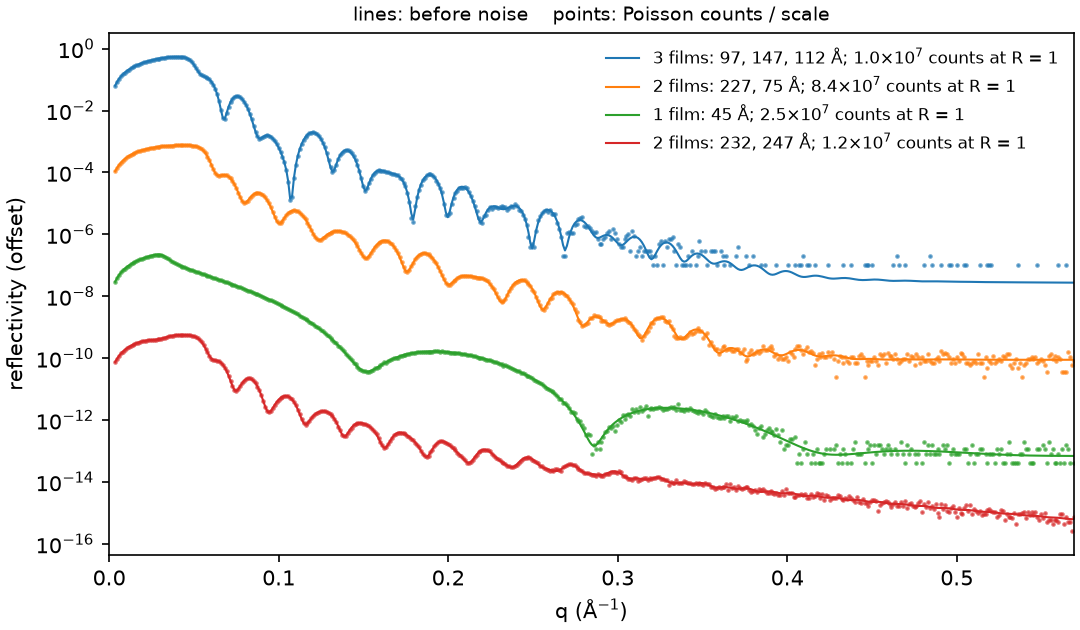
Realistic synthetic X-ray reflectivity (XRR) data for machine learning: priors over layer stacks and instruments, counting noise, and a dataset format that records how to regenerate it.
It is for anyone training or testing an inverse model for XRR who needs simulated curves that look like measured ones: random multilayers with roughness tied to thickness and a minimum contrast between neighbours, a native oxide placed where you say, Gaussian resolution, footprint, Kα₂, 2θ offset, background and Poisson counts. The package holds all the forward physics (Parratt recursion with Névot-Croce roughness, the resolution integral, a differentiable torch forward) and the generation on top of it. ReflectoFit, the fitting engine, depends on it, so a network trained on these curves and a fit of the same measurement use the same physics.
Status: early development.
Visual overview

The example prior bounds below are configurable input ranges, not empirical distributions. Coupled thickness/roughness and SLD-contrast constraints can alter the accepted distributions.

The XRR curves at the top of this README are generated by the simulator; solid curves show the pre-noise signal and dots show normalized Poisson counts. For a detailed interpretation, the layer-order diagram, units, reproducibility and caveats, see the visual guide.
Install
Not on PyPI yet. From a clone, with uv:
git clone https://github.com/NaNIsaac/ReflectoSim
cd ReflectoSim
uv sync
First run
Simulate 1000 curves of one to three films on SiO₂ on Si from the example prior, then summarise the file:
uv run reflectosim sim --prior examples/lab_films.toml --n 1000 --seed 20261024,1 -o train.npz
uv run reflectosim describe train.npz
train.npz holds q, counts, reflectivity (before noise), counts_scale and one array per
parameter (layer0.thickness, oxide.sld, tth_offset, ...; NaN where a curve has fewer layers).
Its metadata holds the priors, the seed and the versions; reflectosim.priors.from_metadata turns it
back into priors and the same seed gives the same file. Use a .h5 name for HDF5 (uv sync --extra hdf5).
Priors
A prior is a TOML file; examples/lab_films.toml shows every field. The native oxide position has no
default: oxide = "under" puts it on the substrate, "over" on top of the films, "none" leaves it
out. The two orders give curves that differ by tens of percent, so every prior states its choice.
Python
import numpy as np
from reflectosim import InstrumentPrior, StackPrior, simulate, tth_to_q

stack = StackPrior(
    n_layers=(1, 3),
    thickness=(20, 250),
    sld=(5, 80),
    roughness=(2, 10),
    min_contrast=4.0,
    oxide="none",
)
instrument = InstrumentPrior(
    sigma_q=(5e-4, 3e-3), tth_offset=(-0.01, 0.01), log_background=(-8.5, -7.0), log_counts=(6, 8)
)
batch = simulate(
    stack, instrument, tth_to_q(np.linspace(0.05, 8, 500)), n=10_000, seed=(20261024, 1)
)
batch.counts, batch.reflectivity, batch.params["layer0.thickness"]
Development
uv run pytest
License
MIT
1 maintainer

Metadata
1 maintainer
Release files for reflectosim 0.1.0
For a detailed explanation of source distributions (sdists) and built distributions (wheels), please see the package formats documentation.
Source distribution (sdist)
| File | Size | Uploaded | Provenance | Actions |
|---|---|---|---|---|
| reflectosim-0.1.0.tar.gz | 27.8 kB | With provenance | Details for reflectosim-0.1.0.tar.gz |
Built distribution (wheel)
| File | Interpreter | ABI | Platform | Actions Reset |
|---|---|---|---|---|
| reflectosim-0.1.0-py3-none-any.whl | Python 3 | none | any | Details for reflectosim-0.1.0-py3-none-any.whl |
Total release size: 60.6 kB
Release files / reflectosim-0.1.0.tar.gz
| Download URL | reflectosim-0.1.0.tar.gz |
|---|---|
| Size | 27.8 kB |
| Tags | Source |
|
SHA-256 checksum How to use checksums |
f2def4725877f1a7262510ca5203b6fa1625679be691fd25b6cd9eed939a40f2
|
|
BLAKE2b-256 checksum How to use checksums |
2ff3684ca3bab5fa75fd462bd8a54d704a950a15916f88451a6a4338bcb8b6f7
|
| Upload date | |
|
Uploaded using Trusted Publishing? What is trusted publishing? |
Yes |
| Uploaded via |
twine/7.0.0 CPython/3.13.16
|
Provenance
Provenance describes where a file came from. On PyPI, provenance is shared via attestations, which provide a verifiable record of the build or publishing details. View details, limitations and caveats.


PyPI Publish Attestation
PyPI verified that this artifact, at this checksum, originated from the publisher listed below.
Signed by GitHub Actions, verified by PyPI on Nov 5, 2026.
Transparency logRelease files / reflectosim-0.1.0-py3-none-any.whl
| Download URL | reflectosim-0.1.0-py3-none-any.whl |
|---|---|
| Size | 32.7 kB |
| Tags | Python 3 |
|
SHA-256 checksum How to use checksums |
50a8c79b2af1c283f977e2f38a6c0a30384cbde99a2a87863bad33f73c77d5c0
|
|
BLAKE2b-256 checksum How to use checksums |
30c82942285fce217a954f9f0c551f48eac1e011741d3e419b0a2b14d96891e9
|
| Upload date | |
|
Uploaded using Trusted Publishing? What is trusted publishing? |
Yes |
| Uploaded via |
twine/7.0.0 CPython/3.13.16
|
Provenance
Provenance describes where a file came from. On PyPI, provenance is shared via attestations, which provide a verifiable record of the build or publishing details. View details, limitations and caveats.
PyPI Publish Attestation
PyPI verified that this artifact, at this checksum, originated from the publisher listed below.
Signed by GitHub Actions, verified by PyPI on Nov 5, 2026.
Transparency logSecurity for reflectosim 0.1.0
Provenance
Provenance describes where a file came from. On PyPI, provenance is shared via attestations, which provide a verifiable record of the build or publishing details. View details, limitations and caveats.
Full provenance
Both files in this release have been uploaded with provenance metadata.
Attestation for reflectosim-0.1.0.tar.gz
PyPI Publish Attestation
PyPI verified that this artifact, at this checksum, originated from the publisher listed below.
Signed by GitHub Actions, verified by PyPI on Nov 5, 2026.
Transparency logA note on package security
PyPI is a repository for distributing packages, not a service for auditing them. While third-party security researchers and our staff do their best to detect and remove malicious packages, PyPI cannot guarantee the quality, security or suitability of any given package.
To learn more about protecting yourself from malicious actors, visit our package security documentation.













