
A Python library for the Reflexio


Project description







Quick Start · Features · Integrations · SDK · CLI · Architecture · Docs · Contributing
81% fewer planning steps · 72% less tokens · on real GDPVal knowledge-work tasks,
on top of what a SOTA self-improving Hermes agent already learns on its own.
See the benchmark →
Migration from claude_code integration (removed in this release)
The reflexio setup claude-code command and its hook files have been removed.
The replacement is claude-smart,
a standalone Claude Code plugin distributed via npm.
This migration only removes the hook/plugin installation path. The local
claude-code LLM provider routing (used to call Anthropic via the Claude Code
CLI binary as a model backend) remains available — only remove obsolete hook
entries, not your provider configuration.
If you had the old integration installed, your .claude/settings.json (per-project)
or ~/.claude/settings.json (global) likely has hook entries referencing files that no longer exist.
Open the file and remove any hooks entries that reference paths under reflexio/integrations/claude_code/
or integrations/claude_code/. Then run npx claude-smart install (or use the Claude Code plugin marketplace)
for the modern equivalent.
What is Reflexio?
Reflexio is an AI agent self-improvement harness that enables your AI agents to continuously learn from real user interactions. It turns user corrections into persisted behavioral improvements for agents and capturing successful execution paths for reuse.
What one user teaches, every user benefits from.
As your agent is used more, it becomes smarter, faster, and more effective at solving domain-specific tasks. The moat for AI agents is what your agent learns from every interaction it handles.
Our vision is that AI systems should get better with every interaction.
Benchmarked on GDPVal: on 4 of 5 real knowledge-work tasks from OpenAI's public GDPVal benchmark, Reflexio cuts a median −81% planning steps and −72% tokens on a Hermes agent running
minimax/MiniMax-M2.7— measured against a warm baseline: the same agent re-running the task after it has already learned from itself. In other words, Reflexio's savings come on top of what a SOTA self-improving agent has learnt on its own. See the full writeup → benchmark/gdpval/RESULTS.md.
flowchart LR
    A[AI Agent] -->|conversations| B[Reflexio]
    G[Human Expert] -->|ideal responses| B
    B --> C[User Profiles]
    B --> D[Playbook Extraction]
    D --> E[Playbook Aggregation]
    B --> F[Success Evaluation]
Publish conversations from your agent, and Reflexio closes the self-improvement loop:
- Never Repeat the Same Mistake: Transforms user corrections and interaction signals into improved decision-making processes — so agents adapt their behavior and avoid repeating the same mistakes.
- Lock In What Works: Persists successful strategies and workflows so your agent reuses proven paths instead of starting from scratch.
- Transfer Learning Across Users: What one user teaches, every user benefits from — corrections and successful strategies from one individual propagate to improve the agent for everyone, no retraining required.
- Learn from Human Experts: Publish expert-provided ideal responses alongside agent responses — Reflexio automatically extracts actionable playbooks from the differences.
For developers: See developer.md for project structure, environment setup, testing, and coding guidelines.
Table of Contents
- Demo
- Quick Start
- Features
- Integrations
- SDK Usage
- Architecture
- Documentation
- Contributing
- Star History
- License
Demo

Quick Start
Prerequisites
| Tool | Description |
|---|---|
| uv | Python package manager |
| Node.js >= 18 | Frontend runtime |

Setup
Option A — Install from PyPI (fastest, for users):
pip install reflexio-ai

# start/stop services. data saved under ~/.reflexio
reflexio services start           # API (8081), Docs (8082), SQLite storage
reflexio services stop            # Stop all services
Option B — Clone from source (for contributors):
# clone the repo
git clone https://github.com/ReflexioAI/reflexio.git
cd reflexio

# configure: copy env template, then set at least one LLM API key (OpenAI, Anthropic, etc.)
cp .env.example .env

# install dependencies
uv sync                                    # Python (includes workspace packages)
npm --prefix docs install                  # API docs

# start/stop services. data saved under ~/.reflexio
uv run reflexio services start             # API (8081), Docs (8082), SQLite storage
uv run reflexio services stop              # Stop all services
Alternative:
python -m reflexio.cli services startor./run_services.sh
Once running, open http://localhost:8082 to interactively browse and try out the API.

Try it in 30 seconds (CLI)
Reflexio ships a first-class CLI — the fastest way to see the loop end-to-end with no code. Publish a real multi-turn conversation where the user corrects the agent (that's the signal Reflexio learns from), then search for what was extracted:
uv run reflexio publish --user-id alice --wait --data '{
  "interactions": [
    {"role": "user",      "content": "Deploy the new service."},
    {"role": "assistant", "content": "Starting deployment to us-east-1..."},
    {"role": "user",      "content": "Wait — we never deploy production to us-east-1. Always use us-west-2."},
    {"role": "assistant", "content": "Understood. Switching to us-west-2."}
  ]
}'

# Search the extracted profiles and playbooks
uv run reflexio search "deployment region"
One conversation, two artifacts: a user profile (production region is us-west-2) and an agent playbook (confirm region before deploying). See the CLI reference for all input modes (inline JSON, --file, --stdin) and the full command list.
Integrate with the Python SDK
import reflexio

client = reflexio.ReflexioClient(
    url_endpoint="http://localhost:8081/"
)

# Publish a multi-turn conversation where the user corrects the agent —
# Reflexio extracts a profile ("prod region = us-west-2") and a playbook
# ("confirm region before deploying").
client.publish_interaction(
    user_id="alice",
    interactions=[
        {"role": "user",      "content": "Deploy the new service."},
        {"role": "assistant", "content": "Starting deployment to us-east-1..."},
        {"role": "user",      "content": "Wait — we never deploy production to us-east-1. Always use us-west-2."},
        {"role": "assistant", "content": "Understood. Switching to us-west-2."},
    ],
)
Reflexio will automatically generate profiles and extract playbooks in the background.
Features
Profile Generation
- Extracts behavioral profiles from conversations using configurable extractors
- Supports versioning (current → pending → archived) with upgrade/downgrade workflows
- Multiple extractors run in parallel with independent windows and strides
Read more about user profiles →
Playbook Extraction & Aggregation
- Extracts playbooks from user behavior patterns
- Clusters similar entries and aggregates with LLM (with change detection to skip unchanged clusters)
- Approval workflow: review and approve/reject agent playbooks
Read more about agent playbooks →
Expert Learning
- Publish human-expert ideal responses alongside agent responses via the
expert_contentfield - Reflexio automatically compares agent vs. expert responses, focusing on substantive differences (missing info, incorrect approach, reasoning gaps) while ignoring stylistic ones
- Generates actionable playbooks as trigger/instruction/pitfall SOPs that teach the agent what to do differently
Read more about interactions & expert content →
Agent Success Evaluation
- Session-level evaluation triggered automatically (10 min after last request)
- Shadow comparison mode: A/B test regular vs shadow agent responses
- Tool usage analysis for blocking issue detection
- Causal measurement of Reflexio's impact — session-level A/B grouping on the Evaluation page driven by
Request.metadata.reflexio_retrieval_enabled(with per-turn shadow comparison in development)
Search & Retrieval
- Hybrid search (vector + full-text) across profiles and playbooks
- LLM-powered query rewriting for improved recall
- Unified search across all entity types in parallel
- Fast at scale: unified search across ~3,000 indexed rows (profile + user playbook + agent playbook, ~1,000 rows each, queried in parallel) runs at ~57 ms p50 / ~73 ms p95 — measured service-layer with local SQLite on an Apple Silicon MacBook, 30 trials × 20 fixed queries. See the full benchmark report or reproduce with
reflexio.benchmarks.retrieval_latency.
Multi-Provider LLM Support
- OpenAI, Anthropic, Google Gemini, OpenRouter, Azure, MiniMax, and custom endpoints
- Powered by LiteLLM — configure your preferred provider via API keys or custom endpoints
SDK Usage
For detailed API documentation, see the full API reference.
Install the client:
pip install reflexio-client
Basic usage
import reflexio

client = reflexio.ReflexioClient(
    url_endpoint="http://localhost:8081/"
)

# Publish interactions
client.publish_interaction(
    user_id="user-123",
    interactions=[
        {"role": "user",      "content": "..."},
        {"role": "assistant", "content": "..."},
    ],
    agent_version="v1",       # optional: track agent versions
    session_id="session-abc", # optional: group requests into sessions
)

# Search profiles
profiles = client.search_user_profiles(
    reflexio.SearchUserProfileRequest(query="deployment region preference")
)

# Search agent playbooks
playbooks = client.get_agent_playbooks(
    reflexio.GetAgentPlaybooksRequest(agent_version="v1")
)
Configuration
# Update org configuration
client.set_config(reflexio.SetConfigRequest(
    config=reflexio.Config(
        api_key_config=reflexio.APIKeyConfig(openai="sk-..."),
        profile_extractor_config=reflexio.ProfileExtractorConfig(...),
        user_playbook_extractor_config=reflexio.PlaybookConfig(...),
    )
))
Integrations
Reflexio integrates with popular AI agent frameworks out of the box:
- OpenClaw -- Native integration with the OpenClaw agent framework.
Migration from the LangChain integration (removed in this release). The
reflexio.integrations.langchainpackage and thereflexio-client[langchain]extra have been removed. To inject Reflexio context into a LangChain chain or agent, call the Reflexio client's search API directly and add the formatted results to your prompt (e.g. as a system message) — no framework-specific glue is required.
Architecture
Client (SDK / Web UI)
  → FastAPI Backend
    → Reflexio Orchestrator
      → GenerationService
        ├─ ProfileGenerationService  → Extractor(s) → Deduplicator → Storage
        ├─ PlaybookGenerationService → Extractor(s) → Deduplicator → Storage
        └─ GroupEvaluationScheduler  → Evaluator(s) → Storage (deferred 10 min)
See developer.md for project structure, supported LLM providers, and development setup.
Documentation
For comprehensive guides, examples, and API reference, visit the Reflexio Documentation.
For coding agents adding Reflexio to another agent, see Integrating an AI Agent with Reflexio.
Contributing
We welcome contributions! Please see developer.md for guidelines.
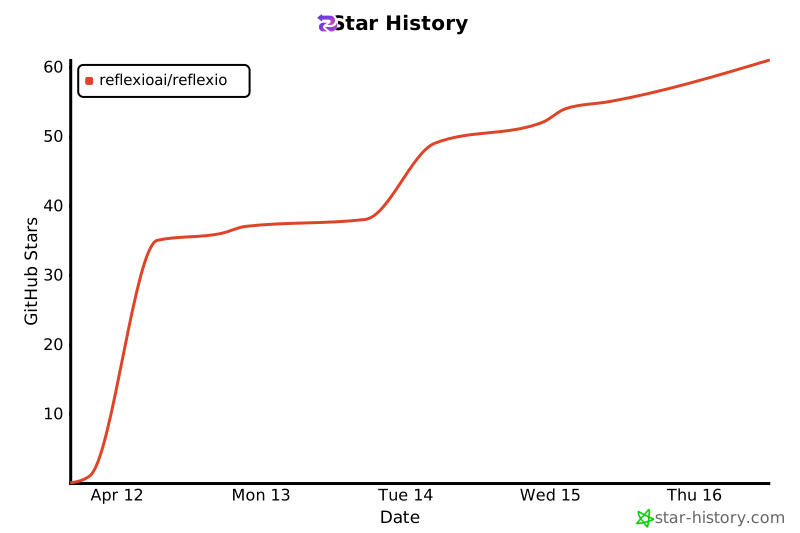
Star History
License
This project is currently licensed under Apache License 2.0.
Release history Release notifications | RSS feed


Download files
Download the file for your platform. If you're not sure which to choose, learn more about installing packages.
Source Distribution
Built Distribution
Filter files by name, interpreter, ABI, and platform.
If you're not sure about the file name format, learn more about wheel file names.
Copy a direct link to the current filters
File details
Details for the file reflexio_ai-0.2.25.tar.gz.
File metadata
- Download URL: reflexio_ai-0.2.25.tar.gz
- Upload date:
- Size: 754.8 kB
- Tags: Source
- Uploaded using Trusted Publishing? No
- Uploaded via: uv/0.11.17 {"installer":{"name":"uv","version":"0.11.17","subcommand":["publish"]},"python":null,"implementation":{"name":null,"version":null},"distro":{"name":"macOS","version":null,"id":null,"libc":null},"system":{"name":null,"release":null},"cpu":null,"openssl_version":null,"setuptools_version":null,"rustc_version":null,"ci":null}
File hashes
| Algorithm | Hash digest | |
|---|---|---|
| SHA256 |
4435145c865e397a9e4fb86560fa9378ba9094e99646f9c2df65cb4de7dd4fac
|
|
| MD5 |
0da4e4b7598657f80b06f87970ff939f
|
|
| BLAKE2b-256 |
0fda323d788e55db2041caf1ffbb52a3536b959ac12ee8e22d40e7d53da10e96
|
File details
Details for the file reflexio_ai-0.2.25-py3-none-any.whl.
File metadata
- Download URL: reflexio_ai-0.2.25-py3-none-any.whl
- Upload date:
- Size: 1.0 MB
- Tags: Python 3
- Uploaded using Trusted Publishing? No
- Uploaded via: uv/0.11.17 {"installer":{"name":"uv","version":"0.11.17","subcommand":["publish"]},"python":null,"implementation":{"name":null,"version":null},"distro":{"name":"macOS","version":null,"id":null,"libc":null},"system":{"name":null,"release":null},"cpu":null,"openssl_version":null,"setuptools_version":null,"rustc_version":null,"ci":null}
File hashes
| Algorithm | Hash digest | |
|---|---|---|
| SHA256 |
927b20323cbfe6a32df2092ce617ed2abec78a57b8c70e61eff501862b455dca
|
|
| MD5 |
48487abaf47e72b01c4ed616e20acdce
|
|
| BLAKE2b-256 |
167cef6cfaf172eecc02d6834828c549c314d013b6b3019bf7186dc50eeb9c5c
|






