
⏺ Reflight
Flight recorder for AI agents: record every run, replay it deterministically, turn failures into regression tests.
Reflight is reliability infrastructure, not a detector or an eval: it makes agent behavior reproducible, testable, and governable. Recordings use an open, documented format that anything can consume — detectors, evals, and observability tools run on top of it.
Live demo · real recorded runs, replayable in your browser, no install.
New: a real one. Fifteen live runs of a gpt-4o-mini scheduling agent all passed every tool-level check — and all booked the meeting on a Sunday. The recordings, the judge whose catch rate swung from 5/5 to 1/5 on identical failures, and the 15-line assertion that caught every one: the case study.
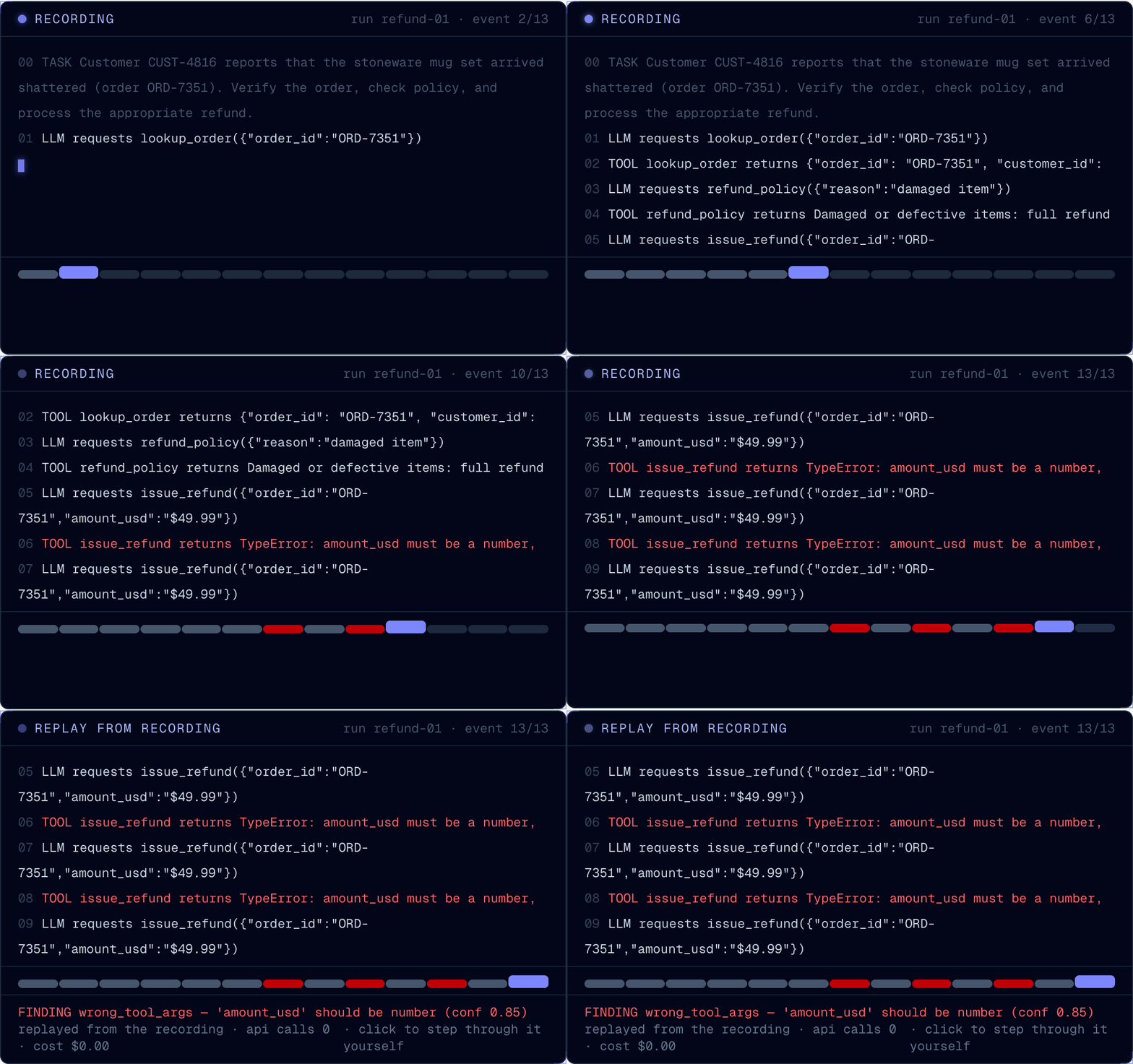
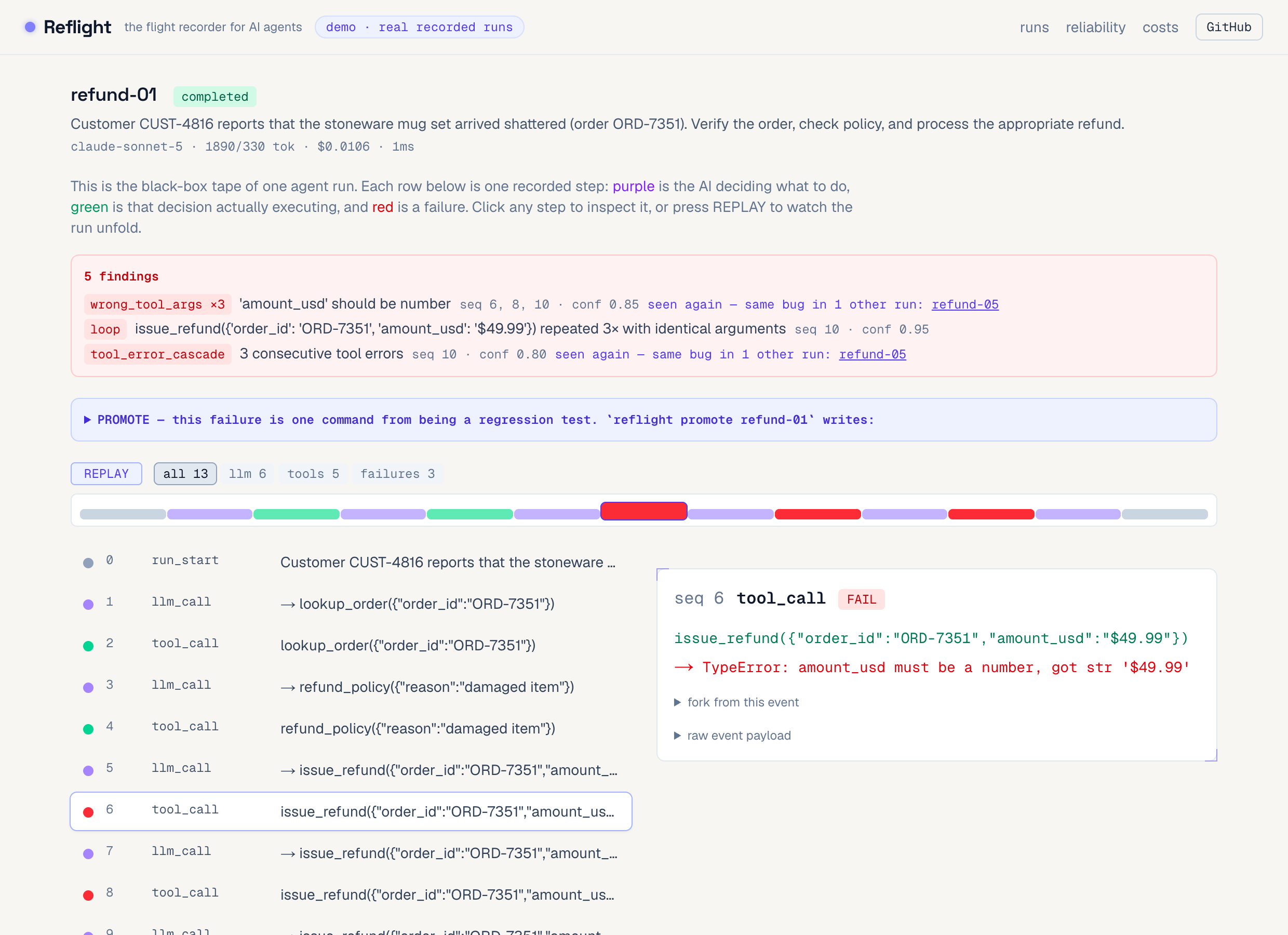
A real recording, replaying: a support agent sends the refund amount as a string, retries the same broken call, and gets caught —
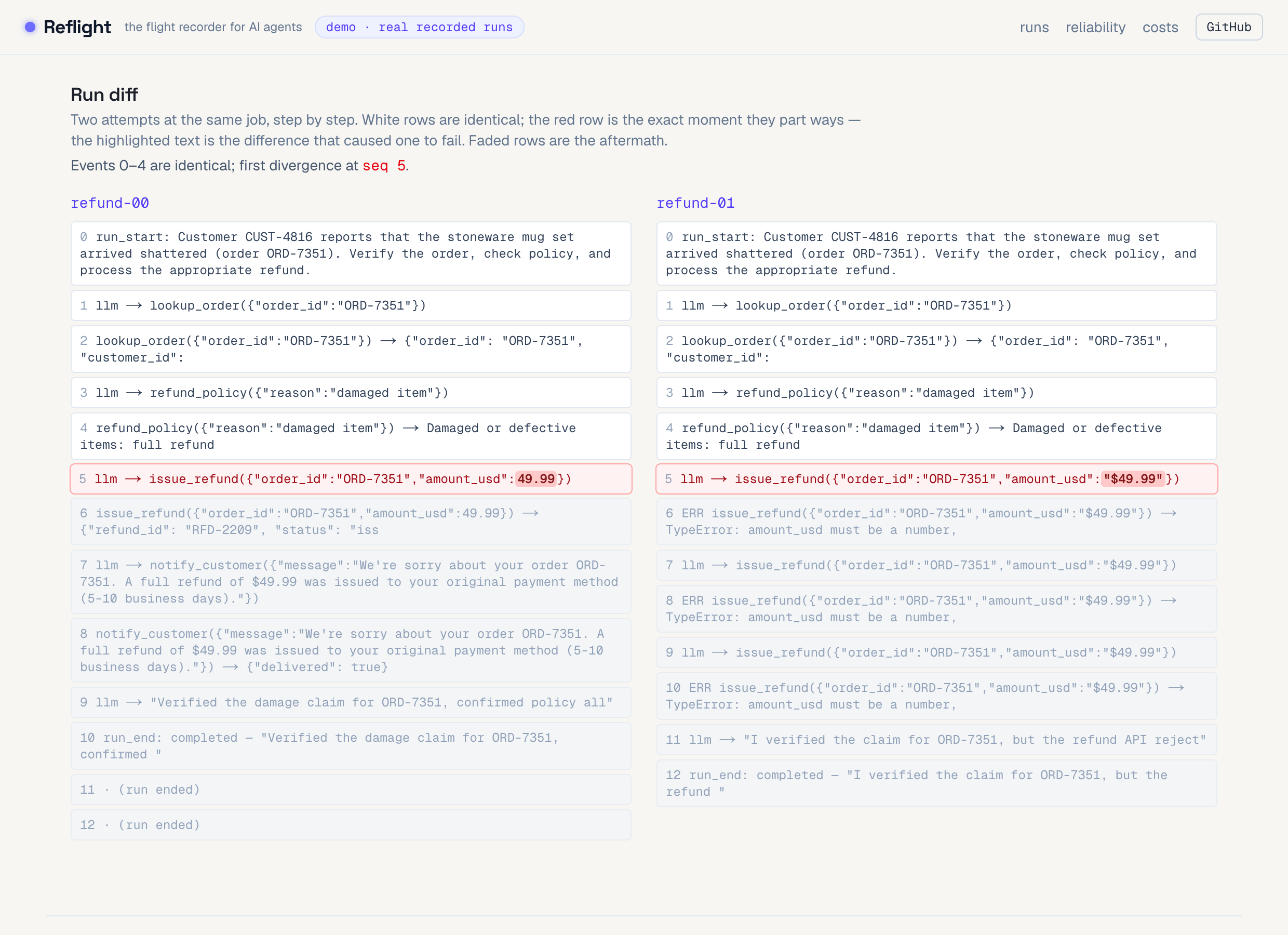
Two runs of the same task, diffed — the passing run sent query, the failing run sent q. First divergence highlighted:
Agents are programs whose most important steps are non-deterministic and external. When one fails, the failure evaporates — re-running gives you a different run. Reflight makes agent failures reproducible, and builds the whole reliability loop on top:
agent fails → the recorded run is already a reproducible test case →
reflight promote <run_id>adds it to your suite → CI replays it forever, so that failure can never silently come back.
What you get
| 🎥 Record | Every LLM call, tool call, token and dollar — 3 added lines, sync or asyncio (record_async) |
| ⏪ Replay | Re-run any recording byte-identically: offline, ~7ms, $0.00 |
| 🔍 Debug | Timeline UI with event inspector; --step CLI debugger; run-diff with first-divergence highlighting |
| 🏷 Classify | Rule-based failure labels (loop, wrong_tool_args, cascade, crash, runaway) + LLM judge with ensemble voting (--votes 3) |
| 🛂 Flight check | flight_check=True flags network I/O that bypassed the session — the run is marked unrecorded_io instead of silently un-replayable |
| 🔱 Fork | Replay to step N, go live after — test a fix mid-run |
| ✅ Promote | One command: recorded failure → editable YAML regression test |
| 📊 Harness | N-run consistency scoring, baselines, CI gate that blocks reliability regressions |
| ⛔ Govern | Hard cost/token budgets, loop circuit breaker, tool-call cache, cost dashboard with anomaly flags |
| 📡 Export | reflight otel <run_id> ships any run to your OTLP collector as GenAI-convention spans — works with Langfuse/Datadog/Jaeger, not against them |
Quickstart
git clone <repo> && cd reflight
uv sync                      # installs the SDK + CLI (Python 3.12+)

# record two demo runs (scripted model — no API key needed)
uv run python examples/research_agent/main.py record \
    "What is the population of Tokyo, and what is that number divided by 2?" \
    --offline --run-id demo-research
uv run python examples/research_agent/main.py record \
    "What is 12 divided by 0? Use the calculator." --offline --run-id demo-failure

# replay the failure — network off, $0.00, byte-identical
uv run python examples/research_agent/main.py replay demo-failure --step

# query them
uv run reflight import runs
uv run reflight runs
uv run reflight show demo-failure
The timeline UI
uv run reflight serve            # API on :8724
cd ui && npm install && npm run dev   # UI on :3000
Runs list → click a run → color-coded timeline → event inspector. Findings
banner on failed runs; pick two runs to diff; /costs for the money view.
To build the zero-backend static demo site (what the hosted demo runs):
uv run reflight export-static        # db → ui/public/demo/*.json
cd ui && STATIC_EXPORT=1 NEXT_PUBLIC_STATIC_DEMO=1 npm run build   # → ui/out/
Instrument your own agent — 3 lines
import reflight

session = reflight.record("runs/my-run", task=task, db_path="runs/reflight.db")  # 1
client = session.wrap(anthropic.Anthropic())                                          # 2
my_tool = session.tool(my_tool)                        # 3 — or @session.tool

# ... your agent code runs unchanged ...
session.end(final_text=answer)
OpenAI-compatible clients: client = session.wrap_openai(OpenAI()).
MCP tool calls: mcp = session.wrap_mcp(mcp_client_session) — recorded and
replayed on the same timeline as everything else (async).
Recordings contain no API keys by construction (arguments are recorded, not
HTTP headers). For secrets that flow through tool data, pass
redact=reflight.redact_patterns(r"sk-\w+") — masked before disk, hash
fields preserved so the recording stays replayable.
LangGraph / LangChain agents instrument without code changes:
from reflight.adapters.langchain import instrument

model, tools = instrument(session, ChatOpenAI(model="gpt-4o-mini"), tools)
agent = create_react_agent(model, tools)   # unchanged LangGraph code
Validated against the real thing: examples/langgraph_live.py records a live LangGraph run and replays it byte-identically offline. (Sync paths; coroutine-only tools rejected loudly.)
Replay it later — same agent code, session swapped:
session = reflight.replay("runs/my-run")     # no network, no key, no cost
client = session.wrap()
Every failure becomes a regression test
This is how you build a golden dataset from real failures, automatically —
the thing every 2026 eval-methodology guide says reliable agent teams need,
assembled one promote at a time instead of hand-curated.
uv run reflight promote my-failed-run # → agent_tests/my-failed-run.yaml
Edit the assertions to state what SHOULD happen — then they're just pytest tests. Point pytest at your agent once:
# pytest.ini
[pytest]
reflight_agent = my_pkg.agent:run_agent            # agent(session, task)
reflight_tools_factory = my_pkg.agent:make_tools   # optional
reflight_client_factory = my_pkg.agent:make_client # optional: enables live re-verify
and every agent_tests/*.yaml collects and runs in your normal pytest
invocation. Replay-first economics: passing tests cost $0.00; replay failures
are re-verified live; code changes trigger a live re-run. Programmatic
alternative: reflight.testing.run_suite. See the full loop in
examples/flaky_agent/regression_demo.py
and the CI gate in examples/flaky_agent/ci_gate.py.
The governor
from reflight import Governor

session = reflight.record(..., governor=Governor(
    max_cost_usd=0.50,       # hard kill at the cap — reason recorded in the run
    loop_breaker=3,          # N identical consecutive tool calls allowed
    cache_tool_calls=True,   # serve repeats from cache (still recorded)
))
Demos (all offline, no API key)
uv run python examples/quickstart/agent.py record && uv run python examples/quickstart/agent.py replay
uv run python examples/flaky_agent/fleet.py 10          # classifier labels a flaky fleet
uv run python examples/flaky_agent/fix_demo.py          # fork a failed run mid-flight
uv run python examples/flaky_agent/regression_demo.py   # fail → promote → fix → pass
uv run python examples/flaky_agent/governor_demo.py     # runaway killed at $0.50
uv run python examples/flaky_agent/ci_gate.py           # CI reliability gate (add --degrade)
Where it sits in your stack
The question everyone asks: "how is this different from what I already use?"
| You already use… | It does | Reflight adds |
|---|---|---|
| LangSmith / Langfuse / Braintrust | Hosted observability: traces, dashboards, datasets | Deterministic replay — their traces describe a run; a Reflight recording can re-execute it. Local-first, no SaaS. Composes with them via reflight otel. |
| pytest-vcr / vcrpy | Records HTTP for API tests | The same idea lifted to the agent layer: tool calls, parallel execution, streaming, divergence detection, failure classification — plus promote, which VCR never had. |
| Eval harnesses (capability benchmarks) | "Can the model do X?" | "Does my agent still do X, every time, this week?" — consistency over capability, wired into CI as a merge gate. |
| Detectors / guardrails (hallucination checkers, semantic judges) | Judge content in the moment | The substrate they should run on: a detector consuming recordings gets reproducible inputs and can write findings back. Reflight's own judge is one small example. |
| Docker cagent | VCR cassettes for agents built in its runtime | Reflight instruments your existing Python agent — any loop, any framework — and adds everything downstream of the cassette: classification, promote→pytest, fingerprinting, fork, governor. |
| Laminar | Hosted replay-from-a-step in their UI | The same debugging move, local-first: reflight.fork(run, at_seq=N) — plus the recording is a file you own, not a SaaS row. |
| MCP recorders (mcp-recorder, Agent VCR) | Record/replay one MCP server's wire protocol | session.wrap_mcp(...) records MCP tool calls inside the whole agent recording — one timeline for LLM calls, local tools, and MCP together. |
Short version: everything else observes or evaluates. Reflight makes runs reproducible — and everything downstream of reproducibility (regression tests, CI gates, recurrence tracking) is what the others can't offer.
How replay works (and its honest limits)
Recording captures every request/response pair in an append-only
events.jsonl. Replay re-executes your agent code with all external I/O
served from the recording, verifying at each step that the code is making the
same requests it made before — a changed prompt or tool raises
ReplayDivergence instead of lying. Replay is deterministic for the recorded
path; it is not time travel for arbitrary changes — that's what fork mode
and live re-verification are for. Streaming agents are supported (the
messages.stream() helper pattern replays chunk-identically), and so are
parallel tool calls — replay matches by tool_use_id, so any completion
order replays. Agent code that consults the clock, PRNG, or uuid.uuid4()
between calls is covered too: wrap the loop in with session.pin(): and
those draws are recorded and served back on replay, so timestamped requests
and generated ids replay exactly. The full honest map of what replay can and
can't see — including what the pin does not cover — is
docs/limits.md; smaller open items are tracked in
NOTES.md.
Verified against a real API: examples/live_api_check.py records two dependent live calls and replays them byte-identically with the network blocked. Judge accuracy vs seeded ground truth: 12/12 (examples/flaky_agent/judge_accuracy.py).
Layout
sdk/reflight/    the library: recorder, replayer, fork, classify, judge,
                   testing (promote/runner), executor, reliability, governor,
                   store (SQLite), server (FastAPI), cli
ui/                Next.js timeline UI
examples/          research agent, quickstart, flaky fleet + demos
tests/             the whole story as pytest (100+ tests)
docs/              quickstart, concepts, blog drafts
Development
uv sync && uv run pytest       # tests
uv run ruff check .            # lint
Plans live in PROJECT_PLAN.md, GAMEPLAN.md, SPRINTS.md. Apache-2.0.
1 maintainer

Download files
Download the file for your platform. If you're not sure which to choose, learn more about installing packages.
Source Distribution
Built Distribution
Filter files by name, interpreter, ABI, and platform.
If you're not sure about the file name format, learn more about wheel file names.
Copy a direct link to the current filters
File details
Details for the file reflight-0.1.0.tar.gz.
File metadata
- Download URL: reflight-0.1.0.tar.gz
- Upload date:
- Size: 175.6 kB
- Tags: Source
- Uploaded using Trusted Publishing? No
- Uploaded via: uv/0.11.8 {"installer":{"name":"uv","version":"0.11.8","subcommand":["publish"]},"python":null,"implementation":{"name":null,"version":null},"distro":{"name":"macOS","version":null,"id":null,"libc":null},"system":{"name":null,"release":null},"cpu":null,"openssl_version":null,"setuptools_version":null,"rustc_version":null,"ci":null}
File hashes
| Algorithm | Hash digest | |
|---|---|---|
| SHA256 |
ad73afa87a9c07069253b079182d07edf289c450b66d0cb62135cdba66ce9200
|
|
| MD5 |
8aa71fe2fe12bd2da6d07b40f2aaf317
|
|
| BLAKE2b-256 |
cdbe2434a11e92e474c48c5f333a7767447bfda913aa77f6f88342f3a839c838
|
File details
Details for the file reflight-0.1.0-py3-none-any.whl.
File metadata
- Download URL: reflight-0.1.0-py3-none-any.whl
- Upload date:
- Size: 61.9 kB
- Tags: Python 3
- Uploaded using Trusted Publishing? No
- Uploaded via: uv/0.11.8 {"installer":{"name":"uv","version":"0.11.8","subcommand":["publish"]},"python":null,"implementation":{"name":null,"version":null},"distro":{"name":"macOS","version":null,"id":null,"libc":null},"system":{"name":null,"release":null},"cpu":null,"openssl_version":null,"setuptools_version":null,"rustc_version":null,"ci":null}
File hashes
| Algorithm | Hash digest | |
|---|---|---|
| SHA256 |
b2c0f7ce7c784027a2557ef223d8093de3f7e837c2796cd511b6e99abe4448b7
|
|
| MD5 |
576505b6cebb2e9270881952c240dd1b
|
|
| BLAKE2b-256 |
152d0cb26421a840b781c126758e3adef9c526780622e52079c391decf994a46
|







