
Reformpy: A Python package for Rational Exploration of Fingerprint-Oriented Relaxation Methodology
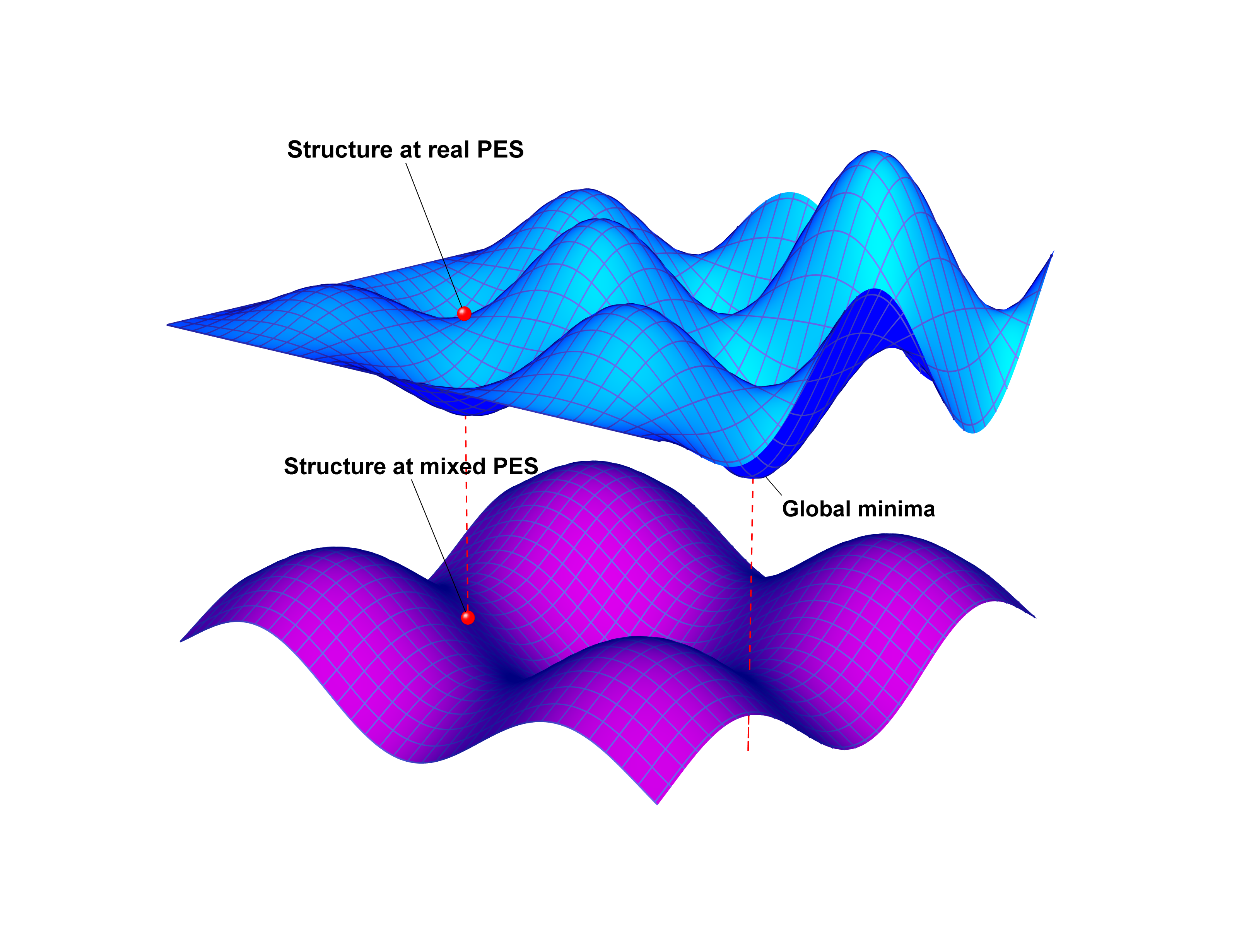
Implemented in Python3
Dependencies
- Python >= 3.8.5
- Numpy >= 1.24.4
- Scipy >= 1.10.1
- Numba >= 0.58.1
- ASE >= 3.22.1
- libfp >= 3.1.2
- mpi4py >= 3.1.6
- qepy >= 6.5.0 (optional)
Setup
To install the C implementation of Fingerprint Library
First, you need create a conda environment:
conda create -n reformpy python=3.8 pip ; conda activate reformpy

python3 -m pip install -U pip setuptools wheel
Then use conda to install LAPACK (or you can load intel module to use MKL):
conda install conda-forge::lapack
Next, you need to download the libfp using git:
git clone https://github.com/Rutgers-ZRG/libfp.git
Also set the corresponding DYLD_LIBRARY_PATH in your .bashrc file as:
export DYLD_LIBRARY_PATH="$CONDA_PREFIX/lib:$DYLD_LIBRARY_PATH"
Then:
cd libfp ; python3 -m pip install --no-cache-dir -e .
Then install the remaining Python dependencies through pip
python3 -m pip install numpy>=1.21.4 scipy>=1.8.0 numba>=0.56.2 ase==3.22.1
Finally, we can install ReformPy
git clone https://github.com/Rutgers-ZRG/ReformPy.git
cd ReformPy ; python3 -m pip install --no-cache-dir -e .
After installation, you can test the integrity of libfp and reformpy in Python3
import libfp
from reformpy.calculator import Reform_Calculator
If you saw MPI related error, you can try to reinstall mpi4py with MPICH or openmpi.
Following is an example to fix this issue using MPICH on CentOS cluster:
module load intel/17.0.4
python3 -m pip uninstall mpi4py
python3 -m pip install --no-cache-dir "mpi4py<4.0"
If you encounter errors when installing qepy from source, you probably need to manually set the build options and flags.
python3 -m pip uninstall -y qepy
cd qepy ; rm -rf build/ dist/ *.egg-info
Following is a install_QEpy.sh bash script using intel MKL library:
#!/bin/bash

# Set the installation directory
QE_DIR=$HOME/apps/qepy-qe-7.2

# Clean the old installation
if [ -d "${QE_DIR}" ]; then
    echo "Cleaning old QE installation..."
    rm -rf ${QE_DIR}
fi

# Set environment variables for compilation
export BLAS_LIBS="-L$MKLROOT/lib/intel64 -lmkl_intel_lp64 -lmkl_sequential -lmkl_core"
export LAPACK_LIBS="-L$MKLROOT/lib/intel64 -lmkl_intel_lp64 -lmkl_sequential -lmkl_core"
export CC=icc
export CXX=icpc
export FC=ifort
export F77=ifort
export F90=ifort
export MPIF90=mpif90
export MPICC=mpicc
export FFLAGS="-fPIC -O3"
export FCFLAGS="-fPIC -O3"
export CFLAGS="-fPIC -O3"
export try_foxflags="-fPIC"

# Extract QE from the release pack
echo "Extracting QE from release pack..."
mkdir -p ${QE_DIR}
tar -xzf $HOME/apps/qe-7.2-ReleasePack.tar.gz -C ${QE_DIR} --strip-components=1

# Configure QE with all necessary flags
echo "Configuring QE..."
cd ${QE_DIR}

# Create make.inc manually to ensure proper configuration
cat > make.inc << EOF
# make.inc for QE 7.2

DFLAGS         = -D__FFTW3 -D__MPI
FDFLAGS        = \$(DFLAGS)
IFLAGS         = -I. -I\$(TOPDIR)/include

CC             = icc
CFLAGS         = -fPIC -O3
CPPFLAGS       = -P -traditional -Uvector

F90            = ifort
MPIF90         = mpif90
F77            = ifort
FFLAGS         = -fPIC -O3
FFLAGS_NOOPT   = -O0 -g
F90FLAGS       = \$(FFLAGS) -cpp
F77FLAGS       = \$(FFLAGS)

LD             = mpif90
LDFLAGS        = -g

# BLAS and LAPACK
BLAS_LIBS      = -L\$(MKLROOT)/lib/intel64 -lmkl_intel_lp64 -lmkl_sequential -lmkl_core
LAPACK_LIBS    = -L\$(MKLROOT)/lib/intel64 -lmkl_intel_lp64 -lmkl_sequential -lmkl_core

# FFT (use MKL FFT)
FFT_LIBS       = -L\$(MKLROOT)/lib/intel64 -lmkl_intel_lp64 -lmkl_sequential -lmkl_core

# MPI
MPI_LIBS       =

# SCALAPACK (disabled)
SCALAPACK_LIBS =

# AR and ARFLAGS
AR             = ar
ARFLAGS        = ruv

# WGET
WGET           = wget -O

# ranlib
RANLIB         = ranlib
EOF

echo "Fixing specific files with FFTW3 allocate issue..."
if [ -f "FFTXlib/src/fft_scalar.FFTW3.f90" ]; then
    sed -i 's/ALLOCATE( data_dp, MOLD=data_dp_aux )/ALLOCATE( data_dp(SIZE(data_dp_aux)) )/g' FFTXlib/src/fft_scalar.FFTW3.f90
    sed -i 's/ALLOCATE( data_sp, MOLD=data_sp_aux )/ALLOCATE( data_sp(SIZE(data_sp_aux)) )/g' FFTXlib/src/fft_scalar.FFTW3.f90
fi

echo "Generating dependencies..."
for dir in LAXlib FFTXlib XClib UtilXlib upflib Modules PW PP KS_Solvers; do
    echo "Generating dependencies for $dir..."
    cd $dir
    if [ -d "src" ]; then
        cd src
        touch make.depend
        make depend
        cd ..
    else
        touch make.depend
        make depend
    fi
    cd ..
done

echo "Compiling QE..."
make all -j 8

echo "Cloning QEpy..."
cd ..
if [ -d "qepy" ]; then
    echo "Cleaning old QEpy installation..."
    rm -rf qepy
fi
git clone https://gitlab.com/shaoxc/qepy.git
cd qepy

export qedir=${QE_DIR}
export qepydev=no  # Clean build

echo "Installing QEpy..."
python3 -m pip install --no-cache-dir -e .

echo "Creating test script..."
cat > test_qepy.py << 'EOF'
#!/usr/bin/env python
import os
import sys

try:
    import qepy
    print("QEpy version:", qepy.__version__)
    print("QE directory:", os.environ.get('qedir', 'Not set'))
    print("QEpy successfully imported!")
except ImportError as e:
    print("Error importing qepy:", e)

try:
    import qepy.qepy_pw as qepy_pw
    print("Successfully imported qepy_pw module!")
except ImportError as e:
    print("Error importing qepy_pw:", e)
EOF

echo "Installation completed. Try running the test script:"
echo "export qedir=${QE_DIR}"
echo "python test_qepy.py"
Usage
Basic ASE style documentation
See details for ASE calculator class and ASE calculator proposal
    Fingerprint Calculator interface for ASE

        Implemented Properties:

            'energy': Sum of atomic fingerprint distance (L2 norm of two atomic
                                                          fingerprint vectors)

            'forces': Gradient of fingerprint energy, using Hellmann–Feynman theorem

            'stress': Cauchy stress tensor using finite difference method

        Parameters:

            atoms:  object
                Attach an atoms object to the calculator.

            contract: bool
                Calculate fingerprint vector in contracted Guassian-type orbitals or not

            ntype: int
                Number of different types of atoms in unit cell

            nx: int
                Maximum number of atoms in the sphere with cutoff radius for specific cell site

            lmax: int
                Integer to control whether using s orbitals only or both s and p orbitals for
                calculating the Guassian overlap matrix (0 for s orbitals only, other integers
                will indicate that using both s and p orbitals)

            cutoff: float
                Cutoff radius for f_c(r) (smooth cutoff function) [amp], unit in Angstroms
Calling Reformpy calculator from ASE API
import numpy as np
import ase.io
from ase.optimize import BFGS, LBFGS, BFGSLineSearch, QuasiNewton, FIRE
from ase.optimize.sciopt import SciPyFminBFGS, SciPyFminCG
from ase.constraints import StrainFilter, UnitCellFilter
from ase.io.trajectory import Trajectory

from reformpy.calculator import Reform_Calculator
# from reformpy.mixing import MixedCalculator
# from ase.calculators.vasp import Vasp

atoms = ase.io.read('.'+'/'+'POSCAR')
ase.io.vasp.write_vasp('input.vasp', atoms, direct=True)
trajfile = 'opt.traj'

from functools import reduce

chem_nums = list(atoms.numbers)
znucl_list = reduce(lambda re, x: re+[x] if x not in re else re, chem_nums, [])
ntyp = len(znucl_list)
znucl = znucl_list

calc = fp_GD_Calculator(
            cutoff = 6.0,
            contract = False,
            znucl = znucl,
            lmax = 0,
            nx = 300,
            ntyp = ntyp
            )

atoms.calc = calc

# calc.test_energy_consistency(atoms = atoms)
# calc.test_force_consistency(atoms = atoms)

print ("fp_energy:\n", atoms.get_potential_energy())
print ("fp_forces:\n", atoms.get_forces())
print ("fp_stress:\n", atoms.get_stress())

# af = atoms
# af = StrainFilter(atoms)
traj = Trajectory(trajfile, 'w', atoms=atoms, properties=['energy', 'forces', 'stress'])

############################## Relaxation method ##############################

# opt = BFGS(af, maxstep = 1.e-1)
opt = FIRE(af, maxstep = 1.e-1)
# opt = LBFGS(af, maxstep = 1.e-1, memory = 10, use_line_search = True)
# opt = LBFGS(af, maxstep = 1.e-1, memory = 10, use_line_search = False)
# opt = SciPyFminCG(af, maxstep = 1.e-1)
# opt = SciPyFminBFGS(af, maxstep = 1.e-1)

opt.attach(traj.write, interval=1)
opt.run(fmax = 1.e-3, steps = 500)
traj.close()

traj = Trajectory(trajfile, 'r')
atoms_final = traj[-1]
ase.io.write('fp_opt.vasp', atoms_final, direct = True, long_format = True, vasp5 = True)

final_cell = atoms_final.get_cell()
final_cell_par = atoms_final.cell.cellpar()
final_structure = atoms_final.get_scaled_positions()
final_energy_per_atom = float( atoms_final.get_potential_energy() / len(atoms_final) )
final_stress = atoms_final.get_stress()

print("Relaxed lattice vectors are \n{0:s}".\
      format(np.array_str(final_cell, precision=6, suppress_small=False)))
print("Relaxed cell parameters are \n{0:s}".\
     format(np.array_str(final_cell_par, precision=6, suppress_small=False)))
print("Relaxed structure in fractional coordinates is \n{0:s}".\
      format(np.array_str(final_structure, precision=6, suppress_small=False)))
print("Final energy per atom is \n{0:.6f}".format(final_energy_per_atom))
print("Final stress is \n{0:s}".\
      format(np.array_str(final_stress, precision=6, suppress_small=False)))
Citation
If you use this Fingerprint Library (or modified version) for your research please kindly cite our paper:
@article{taoAcceleratingStructuralOptimization2024,
  title = {Accelerating Structural Optimization through Fingerprinting Space Integration on the Potential Energy Surface},
  author = {Tao, Shuo and Shao, Xuecheng and Zhu, Li},
  year = {2024},
  month = mar,
  journal = {J. Phys. Chem. Lett.},
  volume = {15},
  number = {11},
  pages = {3185--3190},
  doi = {10.1021/acs.jpclett.4c00275},
  url = {https://pubs.acs.org/doi/10.1021/acs.jpclett.4c00275}
}
If you use Fingerprint distance as a metric to measure crystal similarity please also cite the following paper:
@article{zhuFingerprintBasedMetric2016,
  title = {A Fingerprint Based Metric for Measuring Similarities of Crystalline Structures},
  author = {Zhu, Li and Amsler, Maximilian and Fuhrer, Tobias and Schaefer, Bastian and Faraji, Somayeh and Rostami, Samare and Ghasemi, S. Alireza and Sadeghi, Ali and Grauzinyte, Migle and Wolverton, Chris and Goedecker, Stefan},
  year = {2016},
  month = jan,
  journal = {The Journal of Chemical Physics},
  volume = {144},
  number = {3},
  pages = {034203},
  doi = {10.1063/1.4940026},
  url = {https://doi.org/10.1063/1.4940026}
}
1 maintainer

Download files
Download the file for your platform. If you're not sure which to choose, learn more about installing packages.
Source Distribution
Built Distribution
Filter files by name, interpreter, ABI, and platform.
If you're not sure about the file name format, learn more about wheel file names.
Copy a direct link to the current filters
File details
Details for the file reformpy-1.3.1.tar.gz.
File metadata
- Download URL: reformpy-1.3.1.tar.gz
- Upload date:
- Size: 53.5 kB
- Tags: Source
- Uploaded using Trusted Publishing? No
- Uploaded via:
twine/6.1.0 CPython/3.10.16
File hashes
| Algorithm | Hash digest | |
|---|---|---|
| SHA256 |
7627ffe59e34298c9496b51917898b9faffe0e90eff25865a23d081b775759bd
|
|
| MD5 |
b8bcd2fe4a49a2dea0221fccbf035425
|
|
| BLAKE2b-256 |
a6210ae07979f78b835b47864362d183b50ca73e8b6fe0c975d3e5cc37b967c6
|
File details
Details for the file reformpy-1.3.1-py3-none-any.whl.
File metadata
- Download URL: reformpy-1.3.1-py3-none-any.whl
- Upload date:
- Size: 57.9 kB
- Tags: Python 3
- Uploaded using Trusted Publishing? No
- Uploaded via:
twine/6.1.0 CPython/3.10.16
File hashes
| Algorithm | Hash digest | |
|---|---|---|
| SHA256 |
160bca976e0cdebb616d85b45eb38e36acbdfe4f61c2764b273f2b27150eec77
|
|
| MD5 |
64c83a5cd6812c03c61e0be0cdefc787
|
|
| BLAKE2b-256 |
8f442e120af06f4af1fdc2596ab663e8e1c8a7e8e2dbd9c300c74e51f114b193
|







