
Numba-accelerated interpolation routines

Project description
regridding






Numba-accelerated multilinear and first-order conservative interpolation of Numpy arrays.
Installation
regridding is published on the Python Package Index and can be installed using pip
pip install regridding
Features
- 1D linear interpolation
- 1D conservative resampling
- 2D conservative resampling of logically-rectangular curvilinear grids
Gallery
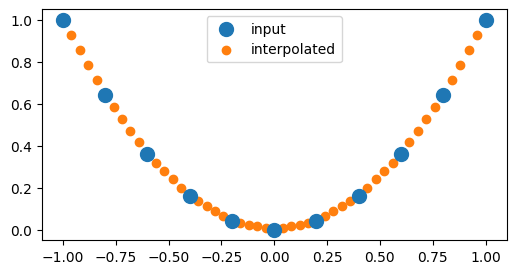
Regrid a 1D array using multilinear interpolation.
import numpy as np
import matplotlib.pyplot as plt
import regridding

# Define the input grid
x_input = np.linspace(-1, 1, num=11)

# Define the input array
values_input = np.square(x_input)

# Define the output grid
x_output = np.linspace(-1, 1, num=51)

# Regrid the input array onto the output grid
values_output = regridding.regrid(
    coordinates_input=(x_input,),
    coordinates_output=(x_output,),
    values_input=values_input,
    method="multilinear",
)

# Plot the results
plt.figure(figsize=(6, 3));
plt.scatter(x_input, values_input, s=100, label="input", zorder=1);
plt.scatter(x_output, values_output, label="interpolated", zorder=0);
plt.legend();
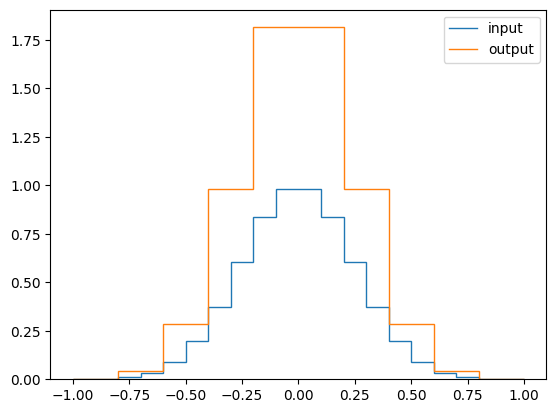
Regrid a 1D array using conservative resampling.
import numpy as np
import matplotlib.pyplot as plt
import regridding

# Define the edges of the input grid
x_input = np.linspace(-1, 1, num=21)

# Define the edges of the output grid
# with a small offset to prevent degenerate cells
x_output = np.linspace(-1, 1, num=11)[::-1] + 1e-6

# Compute the centers of the input grid
x = (x_input[1:] + x_input[:-1]) / 2

# Define an array of values for each cell
# of the input grid
values = np.exp(-(x / 0.25) ** 2 /2)

# Regrid the array of values onto the output grid
values_new = regridding.regrid(
    coordinates_input=x_input,
    coordinates_output=x_output,
    values_input=values,
    method="conservative",
)

# Plot the result
fig, ax = plt.subplots()
ax.stairs(values, x_input, label="input")
ax.stairs(values_new, x_output, label="output")
ax.legend();
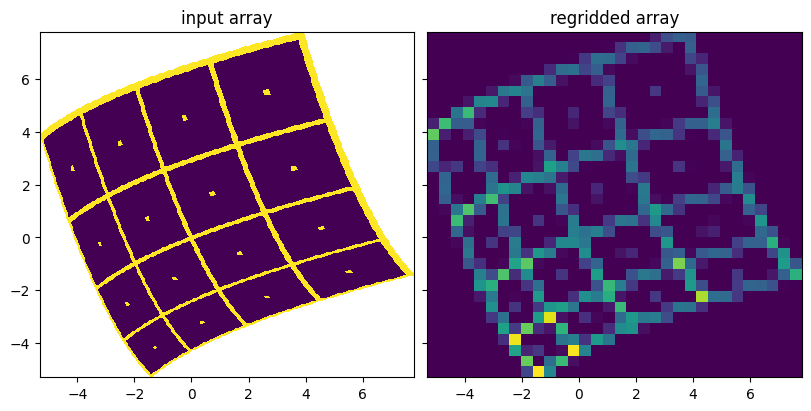
Regrid a 2D array using conservative resampling.
import numpy as np
import matplotlib.pyplot as plt
import regridding

# Define the number of edges in the input grid
num_x = 66
num_y = 66

# Define a dummy linear grid
x = np.linspace(-5, 5, num=num_x)
y = np.linspace(-5, 5, num=num_y)
x, y = np.meshgrid(x, y, indexing="ij")

# Define the curvilinear input grid using the dummy grid
angle = 0.4
x_input = x * np.cos(angle) - y * np.sin(angle) + 0.05 * x * x
y_input = x * np.sin(angle) + y * np.cos(angle) + 0.05 * y * y

# Define the test pattern
pitch = 16
a_input = 0 * x[:~0,:~0]
a_input[::pitch, :] = 1
a_input[:, ::pitch] = 1
a_input[pitch//2::pitch, pitch//2::pitch] = 1

# Define a rectilinear output grid using the limits of the input grid
x_output = np.linspace(x_input.min(), x_input.max(), num_x // 2)
y_output = np.linspace(y_input.min(), y_input.max(), num_y // 2)
x_output, y_output = np.meshgrid(x_output, y_output, indexing="ij")

# Regrid the test pattern onto the new grid
a_output = regridding.regrid(
    coordinates_input=(x_input, y_input),
    coordinates_output=(x_output, y_output),
    values_input=a_input,
    method="conservative",
)

fig, axs = plt.subplots(
    ncols=2,
    sharex=True,
    sharey=True,
    figsize=(8, 4),
    constrained_layout=True,
);
axs[0].pcolormesh(x_input, y_input, a_input);
axs[0].set_title("input array");
axs[1].pcolormesh(x_output, y_output, a_output);
axs[1].set_title("regridded array");
Release history Release notifications | RSS feed


Download files
Download the file for your platform. If you're not sure which to choose, learn more about installing packages.
Source Distribution
Built Distribution
Filter files by name, interpreter, ABI, and platform.
If you're not sure about the file name format, learn more about wheel file names.
Copy a direct link to the current filters
File details
Details for the file regridding-3.0.0.tar.gz.
File metadata
- Download URL: regridding-3.0.0.tar.gz
- Upload date:
- Size: 143.5 kB
- Tags: Source
- Uploaded using Trusted Publishing? No
- Uploaded via: twine/6.1.0 CPython/3.13.12
File hashes
| Algorithm | Hash digest | |
|---|---|---|
| SHA256 |
2c407f2be230de3451478705bf33adbdc10d7ed8a7d217d1819da77ede521946
|
|
| MD5 |
5956ec79ed7f2f8e80ef3ea439bfad51
|
|
| BLAKE2b-256 |
d6376b7e8950c12e6d62ff0898bc9d2d2296566684bb0e36126dace53ef99580
|
File details
Details for the file regridding-3.0.0-py3-none-any.whl.
File metadata
- Download URL: regridding-3.0.0-py3-none-any.whl
- Upload date:
- Size: 145.5 kB
- Tags: Python 3
- Uploaded using Trusted Publishing? No
- Uploaded via: twine/6.1.0 CPython/3.13.12
File hashes
| Algorithm | Hash digest | |
|---|---|---|
| SHA256 |
4bed433e630adafc2beca9ae64da5e588f360595caa3799ced6315ea20767ab3
|
|
| MD5 |
c948fbf0536378c85d628250b7babfa8
|
|
| BLAKE2b-256 |
53d09d7c2988c1a4852938c800402c9d8c3f001da0c5978b38da6558a5b8ffcf
|






