
A single agent that answers from your compiled corpus — every claim cited.

Project description

A single agent that answers from your compiled corpus — every claim cited.




📚 Documentation: https://construct-lab.github.io/reigner/
Reigner is a toolkit for building citation-faithful question-answering agents over a knowledge corpus. You compile your sources into bounded, schema-aware artifacts once, then a single retrieval agent answers over them — every factual claim traced back to its source. It is a library first: not a chat app, not a coding-agent harness, not a multi-agent orchestrator.
One core, three surfaces
You meet the same agent core — the harness, the artifact store, and a single
REIGNER.md instruction file — at three points in its lifecycle:
- Build — define a per-project agent as a library: a schema,
@tools, an extractor, a recipe, plugins. This is what you ship. - Test — iterate from the CLI:
ingest,chat, thensession fork/replayandevalto A/B/C variants of yourREIGNER.md, tools, or model. - Ship — serve the same agent over HTTP (FastAPI + SSE) so your apps consume it with no rewrite. (MCP export is planned; see status below.)
Features
- Compiled artifacts — ingestion compiles raw documents into a bounded, schema-aware store. The agent queries the compiled graph, never your raw files.
- Bounded, self-describing tools — every tool result reports
has_more,truncated, andavailable_keys, so a finite-context model always knows whether it got everything. - Citations are first-class — numeric and factual claims register a
CitationEventwith provenance; the eval suite fails answers that make uncited claims. - Forkable sessions — durable JSONL sessions on disk that you can fork and replay to compare variants without re-running from scratch.
- One typed event protocol — CLI, HTTP, and MCP all consume the same typed events.
- Provider-agnostic — Anthropic, OpenAI, and Gemini adapters behind one interface.
Quickstart
uv add 'reigner[anthropic,ingestion]'      # model adapter + PDF/URL loaders

reigner init mydocs --recipe document_qa   # scaffold a project
# drop your PDFs/text into mydocs/, then:
cd mydocs
reigner ingest                             # compile documents into artifacts
reigner chat                               # ask questions, get cited answers
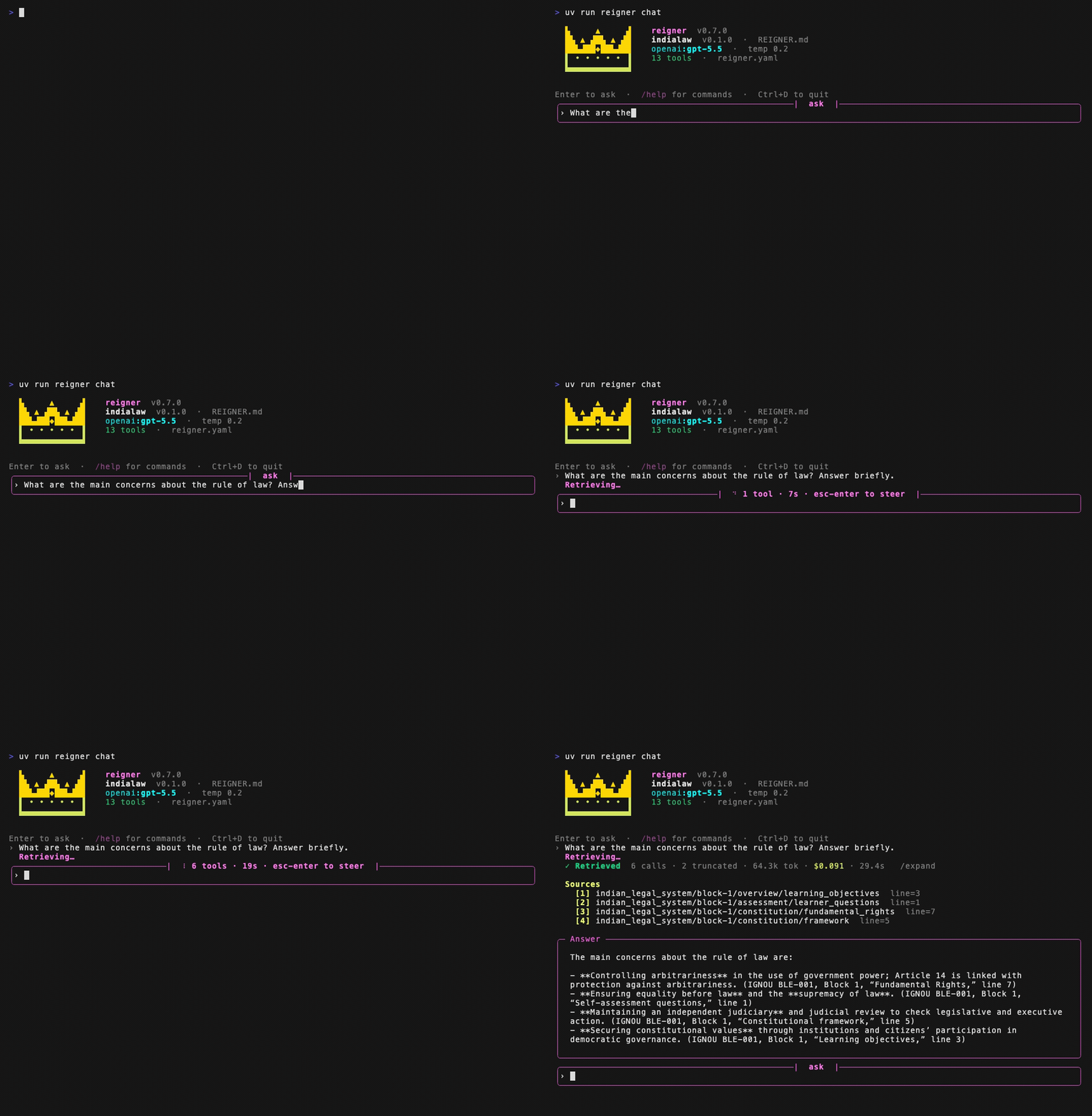
The full walkthrough — every command with real output and a per-feature status flag — is in the usage guide.
Install
uv add reigner
Reigner ships a thin core; each capability is an opt-in extra:
| Extra | Purpose |
|---|---|
reigner[anthropic] |
Anthropic model adapter |
reigner[openai] |
OpenAI model adapter |
reigner[gemini] |
Gemini model adapter |
reigner[server] |
FastAPI HTTP server with SSE |
reigner[mcp] |
MCP server export (planned — not wired yet) |
reigner[ingestion] |
PDF/URL loaders for the ingestion pipeline |
reigner[otel] |
OpenTelemetry metrics plugin |
reigner[all] |
Everything above |
License note
Reigner itself is MIT-licensed. The [ingestion] extra pulls in
PyMuPDF, which is AGPL-3.0. Downstream projects
that distribute or network-serve a closed-source product on top of reigner[ingestion]
must comply with AGPL or obtain a PyMuPDF Pro commercial license.
To avoid the AGPL entirely, override LLMExtractor.raw_to_text with a
permissive-licensed loader of your choice.
Learn more
- Usage guide — hands-on, install → scaffold → ingest → chat.
- Observability — OpenTelemetry spans for the agent loop.
- Design (spec) — package layout, guardrails, API contracts, event protocol.
- Principles — the rationale behind each design decision.
- API reference — the typed public API.
Development
uv sync --all-extras --group dev
uv run pre-commit install
uv run pytest
CI runs ruff check, ruff format --check, mypy, and pytest on every PR.
License
MIT — see LICENSE.
Release history Release notifications | RSS feed


Download files
Download the file for your platform. If you're not sure which to choose, learn more about installing packages.
Source Distribution
Built Distribution
Filter files by name, interpreter, ABI, and platform.
If you're not sure about the file name format, learn more about wheel file names.
Copy a direct link to the current filters
File details
Details for the file reigner-0.8.1.tar.gz.
File metadata
- Download URL: reigner-0.8.1.tar.gz
- Upload date:
- Size: 188.3 kB
- Tags: Source
- Uploaded using Trusted Publishing? No
- Uploaded via: uv/0.8.4
File hashes
| Algorithm | Hash digest | |
|---|---|---|
| SHA256 |
8be0cde72877c3bf02b05e2f544b783592c33a402d0384c6f59727010aa24e33
|
|
| MD5 |
91e96bec570c38b3da92de89f7ed4002
|
|
| BLAKE2b-256 |
5c457702612978381a02c3158841bcb04c4057b4e2b3a6a7faaae0e58508a2b9
|
File details
Details for the file reigner-0.8.1-py3-none-any.whl.
File metadata
- Download URL: reigner-0.8.1-py3-none-any.whl
- Upload date:
- Size: 256.9 kB
- Tags: Python 3
- Uploaded using Trusted Publishing? No
- Uploaded via: uv/0.8.4
File hashes
| Algorithm | Hash digest | |
|---|---|---|
| SHA256 |
fa7b8e0bb95d765d3e82ebcb233ffba0f03b3bae2202232f874ef71faedb937c
|
|
| MD5 |
36ee5d77b2e5c0fcf115e9464e43347e
|
|
| BLAKE2b-256 |
fc0c10dd4a043160060893d9bbec1667a82e19b2b9b5b784c76f28e70c9433c2
|






