
Relay Backend
API testing workflow covers discovery, authorization, requests, responses and exports.
An offline API testing interface for your FastAPI application. Install one Python package, mount it once, and open /relay on your backend's existing port.
Install
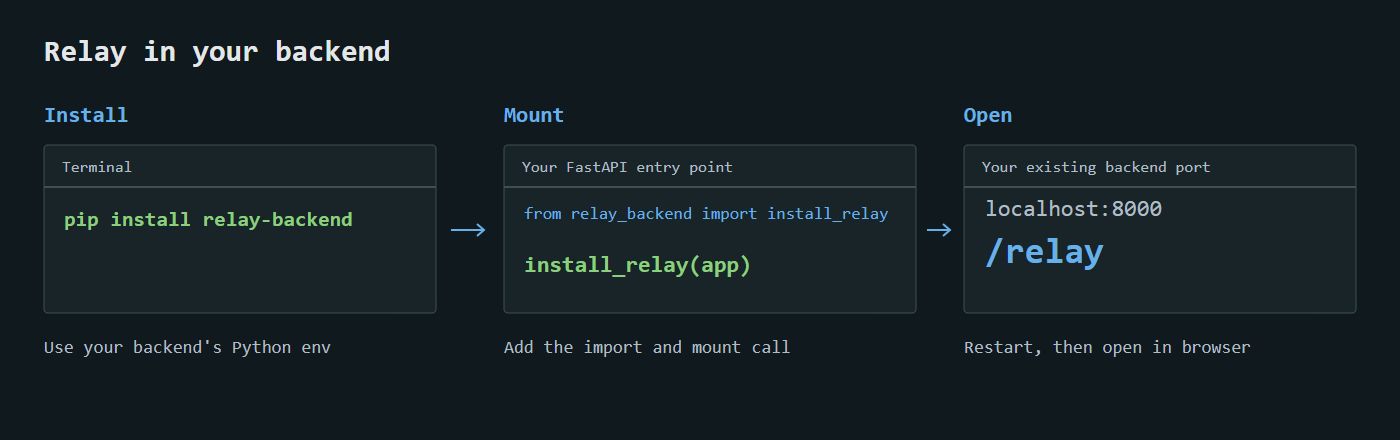
- Install in your backend's Python environment:
python -m pip install relay-backend
A fresh installation gets the latest stable release. To update an existing installation:
python -m pip install --upgrade relay-backend
Restart the backend after upgrading. The browser title uses your application's name: FastAPI(title="Ludo Portal") becomes Relay - Ludo Portal. Any application's title works.
- Add these lines where your FastAPI
appis created:
from relay_backend import install_relay
install_relay(app)
- Restart the backend with its usual command and open
/relayon its existing port.
Complete example for a new app
from fastapi import FastAPI
from relay_backend import install_relay

app = FastAPI()
install_relay(app)

@app.get("/health", tags=["System"])
def health():
    return {"status": "ok"}
Run your backend normally, for example uvicorn main:app --reload, then visit http://localhost:8000/relay/.
No repository clone, Node installation, frontend build, CDN, separate Relay process, or target URL is required. Existing applications only need the import and install_relay(app) call. Use install_relay(app, enabled=settings.DEBUG) to keep Relay under your application's development flag. Install it on the FastAPI object before wrapping that object in Socket.IO or another ASGI wrapper.
Included
- Code-generated OpenAPI endpoints grouped by tags, with inline request/response testing.
- Shared and per-endpoint bearer, Basic, API-key and explicit no-auth modes.
- Five color schemes, copy controls, response focus, and Relay/JSON endpoint exports.
- Manual endpoint status, defaulting to Done, with optional Git-shared status and inferred source attribution.
- A bundled standalone CLI for local OpenAPI backends and portable
.relayreports.
Python 3.11+ is required. This is a local development tool: only loopback hosts/clients are accepted. Request execution invokes your real application middleware, dependencies and handlers. Tests can change your development data. Multipart upload, OAuth browser flows, remote/shared deployment are outside v0.0.4. Opt into automatic team statuses with install_relay(app, sync_status=True) using the backend repository's existing Git remote. Team setup explains access and conflict handling.
Setup and handoff tools in 0.0.4
Run python -m relay_backend init --project ./backend to preview a supported FastAPI integration. Add --apply to write an unambiguous edit; factories and multiple apps receive manual guidance. python -m relay_backend doctor --target http://127.0.0.1:8000 --json checks the local runtime, OpenAPI and native mount with sanitized output. See setup documentation.
Endpoints include local Notes & activity, retained unsaved edits and explicit contract-change explanations. Named request examples load only when applied. Git shares statuses, not notes, credentials or request traffic.
The PyPI distribution is relay-backend; the Python import is relay_backend. The former relay_agent root import remains compatible. relay-agent on PyPI is an unrelated package.
Documentation · Source · Issues
Licensed under Apache-2.0. Bundled React, Lucide and JetBrains Mono assets retain their respective licenses; see THIRD_PARTY_NOTICES.md.
Realtime team statuses in 0.0.5
Keep your native integration. Set RELAY_TEAM_URL, RELAY_TEAM_PROJECT and your private RELAY_TEAM_TOKEN on the backend, then restart. Python uses pip install --upgrade "relay-backend[realtime]"; Node includes its realtime client. A team administrator runs the optional shared service once using the same Python package. Existing Git statuses can be reviewed and imported from /relay/ without modifying Git files. Local API testing remains usable during service outages.
1 maintainer

Metadata
1 maintainer
Release files for relay-backend 0.0.5
For a detailed explanation of source distributions (sdists) and built distributions (wheels), please see the package formats documentation.
Source distribution (sdist)
| File | Size | Uploaded | Provenance | Actions |
|---|---|---|---|---|
| relay_backend-0.0.5.tar.gz | 289.1 kB | With provenance | Details for relay_backend-0.0.5.tar.gz |
Built distribution (wheel)
| File | Interpreter | ABI | Platform | Actions Reset |
|---|---|---|---|---|
| relay_backend-0.0.5-py3-none-any.whl | Python 3 | none | any | Details for relay_backend-0.0.5-py3-none-any.whl |
Total release size: 572.6 kB
Release files / relay_backend-0.0.5.tar.gz
| Download URL | relay_backend-0.0.5.tar.gz |
|---|---|
| Size | 289.1 kB |
| Tags | Source |
|
SHA-256 checksum How to use checksums |
057d46ed5d8091772a6a367b56a77034fb3b498212e5ee5d115e6e364632ef8a
|
|
BLAKE2b-256 checksum How to use checksums |
877e3c6dd494d09065215931a2a4f89596a443e02c3d484499f0622b79842c8e
|
| Upload date | |
|
Uploaded using Trusted Publishing? What is trusted publishing? |
Yes |
| Uploaded via |
twine/7.0.0 CPython/3.13.16
|
Provenance
Provenance describes where a file came from. On PyPI, provenance is shared via attestations, which provide a verifiable record of the build or publishing details. View details, limitations and caveats.


PyPI Publish Attestation
PyPI verified that this artifact, at this checksum, originated from the publisher listed below.
Signed by GitHub Actions, verified by PyPI on Oct 27, 2026.
Transparency logRelease files / relay_backend-0.0.5-py3-none-any.whl
| Download URL | relay_backend-0.0.5-py3-none-any.whl |
|---|---|
| Size | 283.5 kB |
| Tags | Python 3 |
|
SHA-256 checksum How to use checksums |
183d340a7c5b22dc685ed6a2f553913ddc78da15cf6b9df388658ff2cc766aba
|
|
BLAKE2b-256 checksum How to use checksums |
e6515f89abd12e5ebf1fac60dcadfe02bbfaf9e68a55b3b9944cd9551a151cbd
|
| Upload date | |
|
Uploaded using Trusted Publishing? What is trusted publishing? |
Yes |
| Uploaded via |
twine/7.0.0 CPython/3.13.16
|
Provenance
Provenance describes where a file came from. On PyPI, provenance is shared via attestations, which provide a verifiable record of the build or publishing details. View details, limitations and caveats.
PyPI Publish Attestation
PyPI verified that this artifact, at this checksum, originated from the publisher listed below.
Signed by GitHub Actions, verified by PyPI on Oct 27, 2026.
Transparency logSecurity for relay-backend 0.0.5
Provenance
Provenance describes where a file came from. On PyPI, provenance is shared via attestations, which provide a verifiable record of the build or publishing details. View details, limitations and caveats.
Full provenance
All 2 files in this release have been uploaded with provenance metadata.
Attestation for relay_backend-0.0.5.tar.gz
PyPI Publish Attestation
PyPI verified that this artifact, at this checksum, originated from the publisher listed below.
Signed by GitHub Actions, verified by PyPI on Oct 27, 2026.
Transparency logA note on package security
PyPI is a repository for distributing packages, not a service for auditing them. While third-party security researchers and our staff do their best to detect and remove malicious packages, PyPI cannot guarantee the quality, security or suitability of any given package.
To learn more about protecting yourself from malicious actors, visit our package security documentation.














