
Bidirectional sync between reMarkable tablets and an Obsidian knowledge base with intelligent note processing
Verified details
These details have been verified by PyPIProject links
GitHub Statistics
Maintainers

Project description
reMark







Bidirectional sync between reMarkable tablets and an Obsidian knowledge base with multi-engine OCR, intelligent note processing, semantic search, and automatic action item extraction.
Write on your reMarkable. reMark handles the rest — your handwritten notes become structured, searchable Markdown in Obsidian (optionally mirrored to OneNote), complete with tags, summaries, and action items. Push responses back to the tablet, query your vault in natural language, drive Microsoft To Do / Calendar / Teams, and run the whole thing with a web dashboard + mobile PWA.
Latest: v0.8.0 — Offline & Scale: provider-agnostic LLM layer (Ollama or Anthropic), streaming downloads, batch embeddings, shared httpx pool, Bridge API v2 (note status, preview, vault search). Obsidian plugin now in the Community Store. See CHANGELOG.md for the full history.
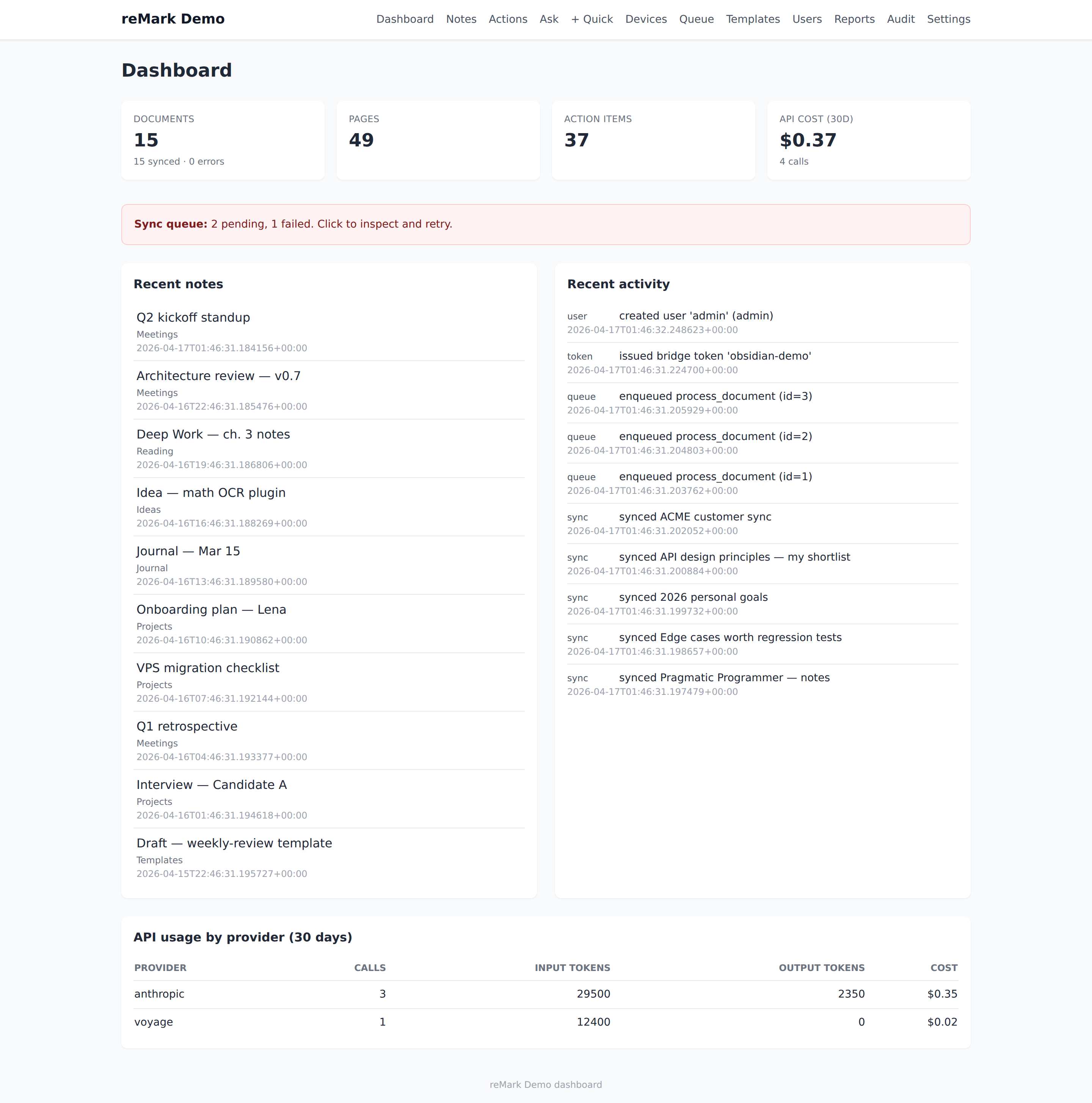
The dashboard on a demo-seeded vault. More views in the Screenshots section below and in the Wiki.
Features
Core sync & processing
- Multi-engine OCR pipeline — reMarkable built-in (MyScript), Google Cloud Vision, or VLM-based recognition with automatic fallback
- Intelligent structuring — raw handwriting becomes clean Markdown with inferred headings, lists, and formatting
- Action item extraction — tasks, questions, follow-ups from both text patterns and pen color annotations
- Auto-tagging and summarization — categorizes and condenses notes
- Real-time sync — WebSocket notifications or configurable cron schedule
Knowledge management
- Obsidian vault integration — YAML frontmatter, wiki-links, Git sync
- Semantic search (RAG) — embed the entire vault and query it with natural language. Backends for Voyage, OpenAI, or local sentence-transformers
- OneNote mirror (v0.3) — write notes in parallel to Microsoft OneNote
- Deletion-aware — notes removed from the tablet are archived in the vault automatically
Response + reverse push
- Response push — auto-generates PDFs or native reMarkable notebooks that answer questions in your notes
- Reverse sync (v0.3) — push Obsidian notes back to the tablet (frontmatter flag, folder-based, or on-demand)
- On-device templates (v0.3) — push structured templates (meeting, daily, project review) to the tablet and extract the filled fields back into frontmatter
Integrations
- Microsoft Outlook — action items → Microsoft To Do, deadlines → Outlook Calendar
- Microsoft Teams (v0.3) — daily/weekly digest Adaptive Cards, meeting ↔ note correlation
- MCP server — interact with your notes directly from Claude Desktop or Claude Code
Web + PWA
- Web dashboard (v0.3) — FastAPI + HTMX + Alpine.js + Tailwind, no build step
- Mobile PWA (v0.3) — installable app with Web Push notifications and quick-entry from your phone
- Start on demand via
remark-bridge serve-web
Extensibility
- Plugin system (v0.3) — custom action extractors, OCR backends, note post-processors, sync hooks. Load from a local directory or pip-installed packages.
Offline-first with Ollama
Set llm.provider: ollama (or flip it from /settings/llm) and
every LLM call — structuring, tagging, summaries, actions,
reports, OCR VLM, embeddings — goes to a local Ollama server
instead of Anthropic. See docs/OLLAMA.md.
Performance
- Streaming downloads: blobs above 5 MB spill to disk so RSS stays flat regardless of notebook size.
- Batch embeddings: reindexing a 1000-chunk vault is 3-5× faster than 0.7 thanks to cross-document batching.
- Shared httpx pool: auth + webhook dispatch reuse one keep-alive client.
remark-bridge bench— measure your own setup.
Operations
- Cost tracking — token usage and USD cost logged per API call
- Health check —
remark-bridge doctorverifies config, auth, vault, API keys, and system deps - Idempotent — SQLite state tracking with WAL mode; notes are never processed twice
Screenshots
All shots are regenerated automatically on every release — see .github/workflows/screenshots.yml. The full gallery (settings forms, /ask, /actions, /quick-entry, every device / queue / templates page) lives on the Wiki.
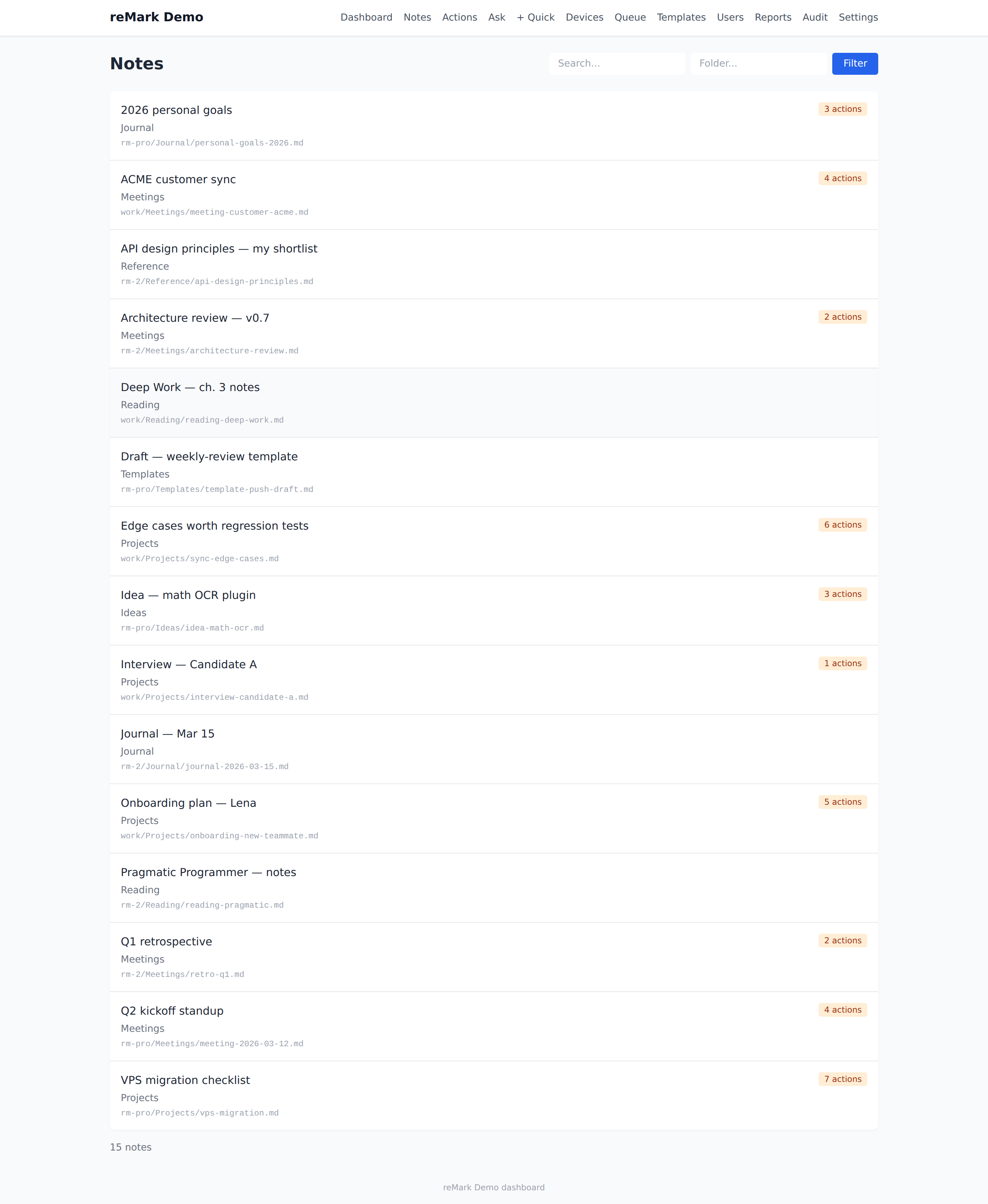
Notes list — DB-backed filter + folder scope |
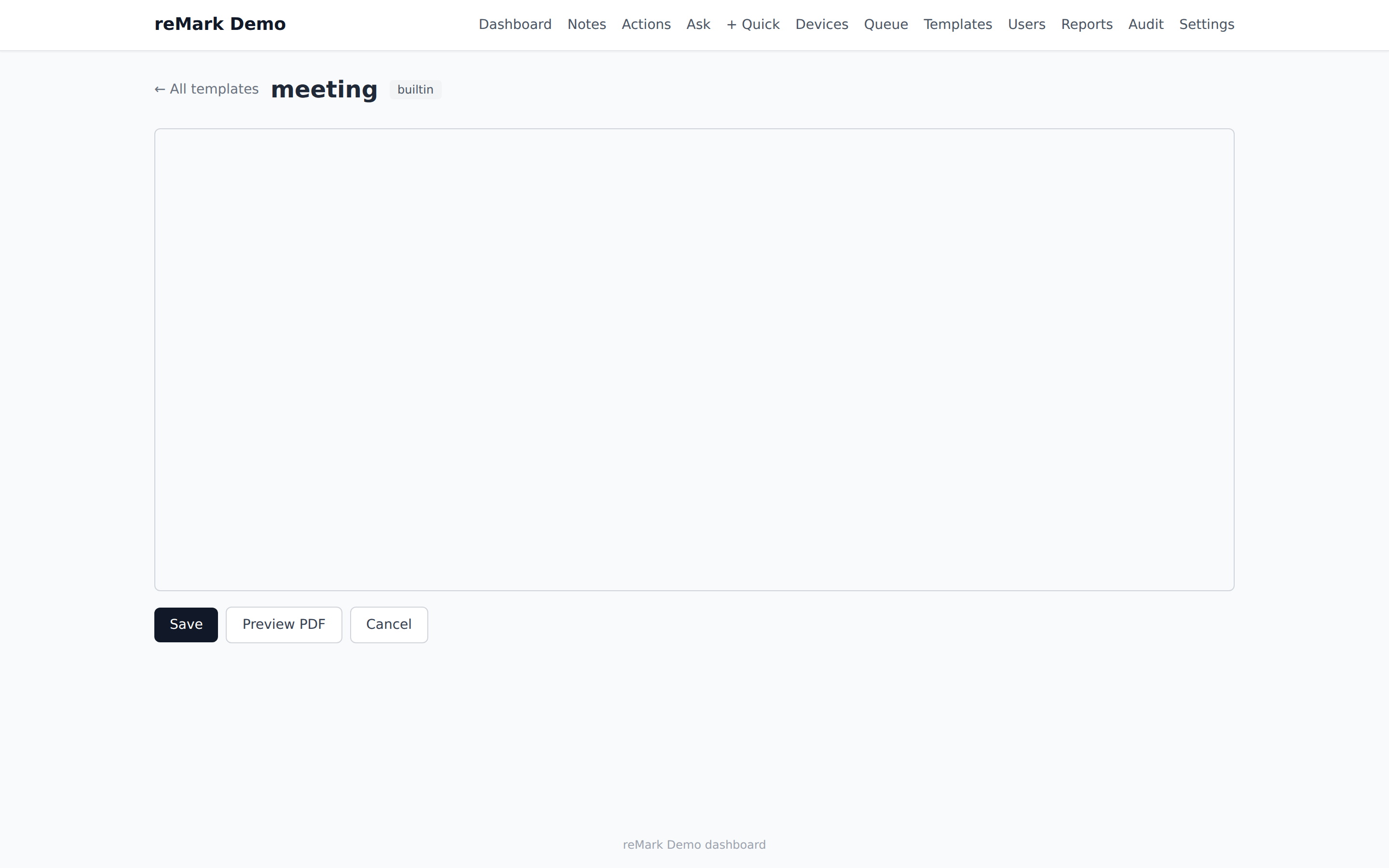
Template editor — CodeMirror 6 + live PDF preview |
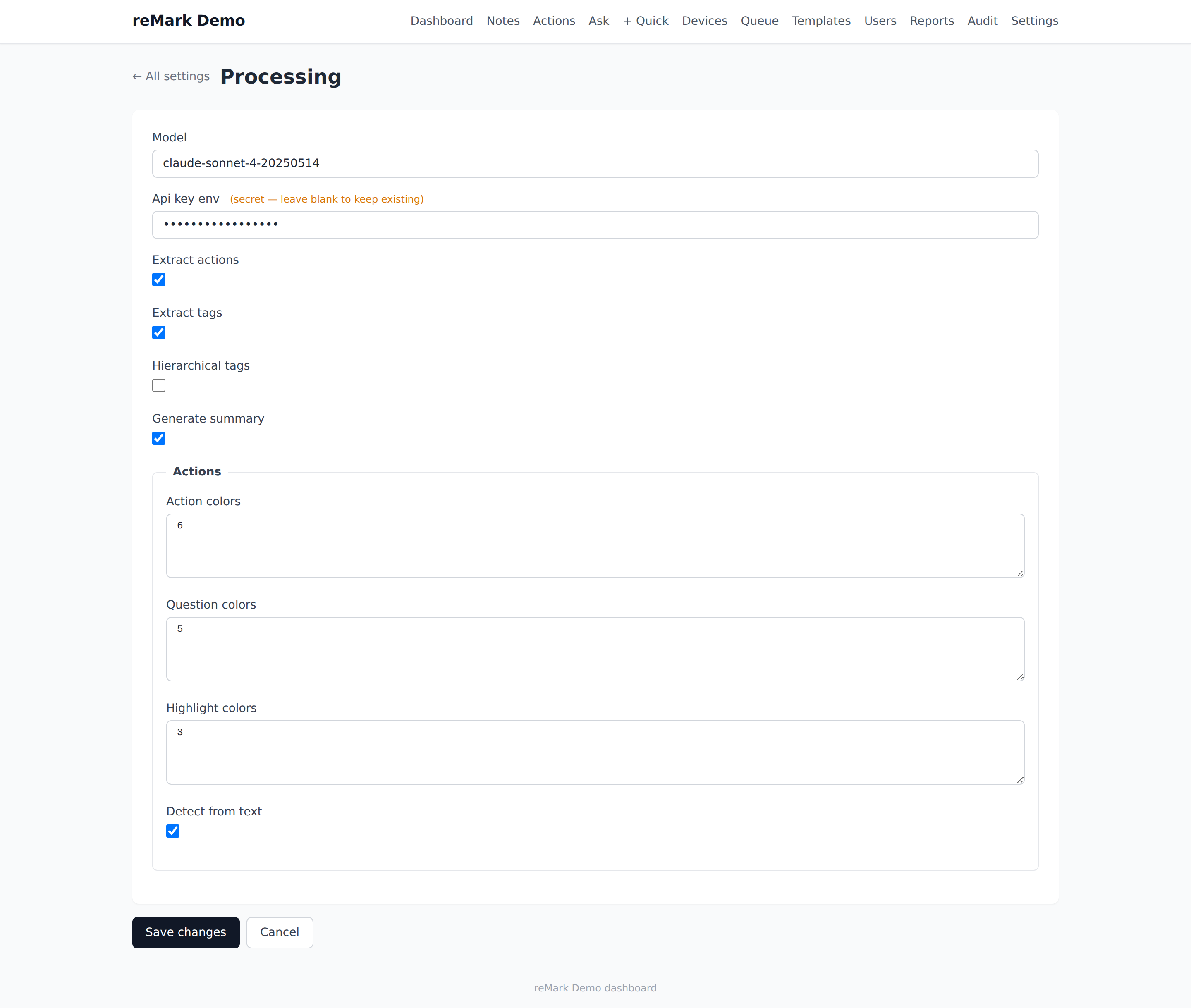
Settings form — auto-rendered from Pydantic, secrets masked |
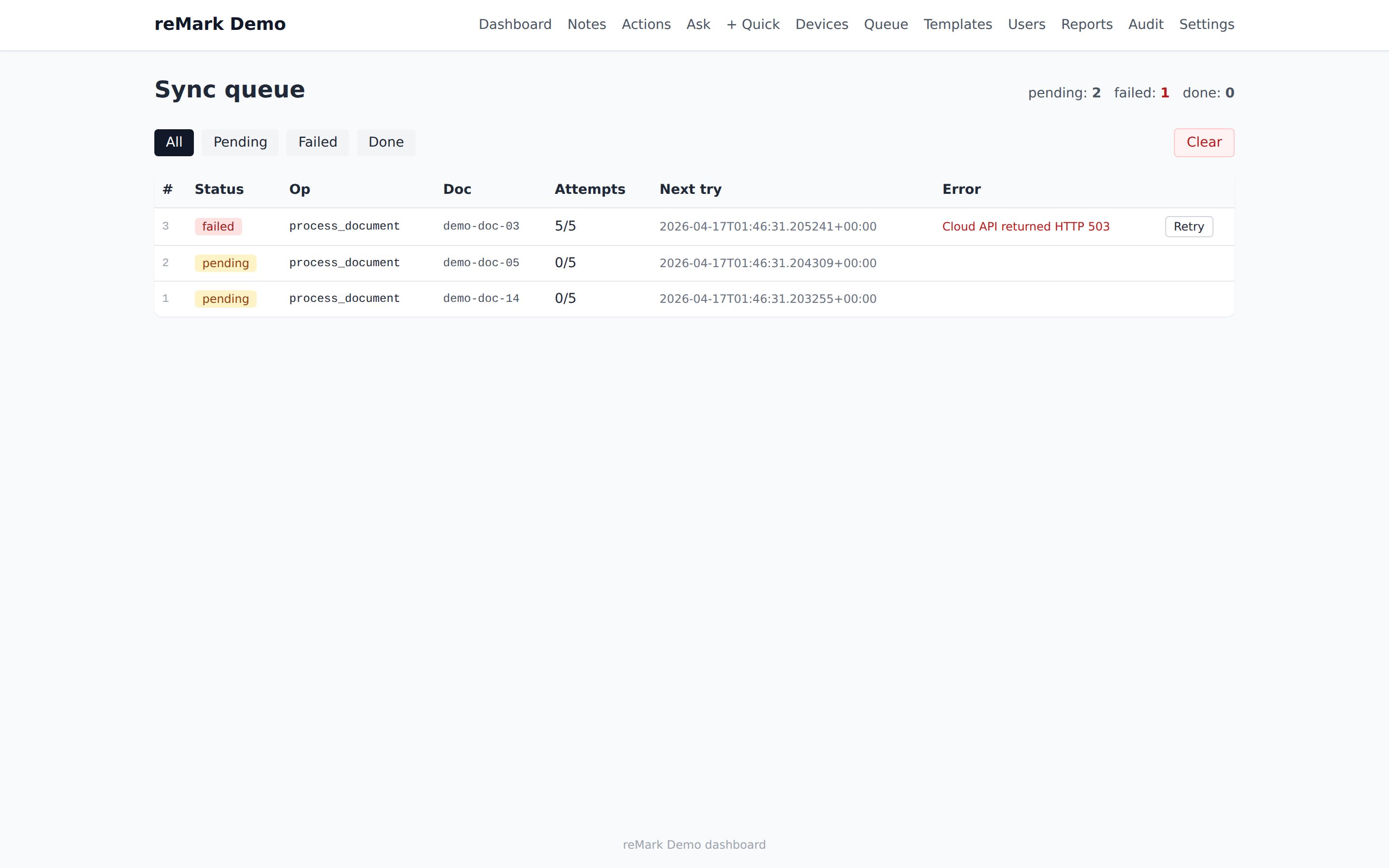
Offline / retry queue — per-row retry, back-off status |
Architecture
┌──────────────────┐    reMarkable Cloud API    ┌──────────────────────────┐
│  reMarkable       │◄─────────────────────────►│  reMark                  │
│  Paper Pro / rM2  │    (sync 1.5 / JWT)        │                          │
└──────────────────┘                              │  ┌────────────────────┐ │
        ▲                                         │  │ sync_engine        │ │
        │                                         │  │  ├─ ocr_pipeline   │ │
   (PDF│/notebook                                 │  │  ├─ processing     │ │
    push│back)                                    │  │  ├─ vault_writer   │ │
        │                                         │  │  ├─ search_indexer │ │
        │                                         │  │  ├─ response_push  │ │
        │                                         │  │  ├─ reverse_sync   │ │
        │                                         │  │  ├─ plugins        │ │
        │                                         │  │  └─ integrations   │ │
        │                                         │  └────────────────────┘ │
        │                                         │          │              │
        └───────response / reverse-push───────────┤          ▼              │
                                                  │  ┌────────────────────┐ │
                                                  │  │ Obsidian Vault     │ │
                                                  │  │  (Git-synced)      │ │
                                                  │  │ + OneNote (opt.)   │ │
                                                  │  └────────────────────┘ │
                                                  │          │              │
                                                  │          ▼              │
                                                  │  MCP · Web UI · PWA     │
                                                  │  Outlook · Teams        │
                                                  └──────────────────────────┘
Data Flow
1. DETECT    → New/changed notebook on reMarkable Cloud (poll or WebSocket)
2. DOWNLOAD  → Fetch .rm files + metadata via sync 1.5 protocol
3. CONVERT   → Extract text (CRDT → MyScript → primary OCR → fallback)
4. PROCESS   → Structure, actions, tags, summary, optional Q&A
5. STORE     → Write Markdown + YAML frontmatter to Obsidian vault
               (optional parallel write to OneNote)
6. INDEX     → Chunk and embed for semantic search (if enabled)
7. RESPOND   → Auto-generate response PDF / notebook; push back to tablet
8. INTEGRATE → Push action items to Microsoft To Do, deadlines to Calendar,
               post digest to Teams (if enabled)
9. REVERSE   → Pick up flagged vault notes and push them to the tablet
10. TRACK    → Update SQLite state DB, log API usage, commit vault to Git
Requirements
- Python 3.11+
- A reMarkable tablet (Paper Pro or reMarkable 2)
- An Obsidian vault (local or Git-synced)
- An Anthropic API key for note processing
- (Optional) Google Cloud Vision credentials for OCR fallback
VPS Deployment
- Ubuntu 22.04+ or Debian 12+
- 1 GB RAM minimum (2 GB recommended if using VLM OCR)
- 10 GB disk (vault + state + downloaded .rm files)
- Outbound HTTPS to
*.remarkable.com,api.anthropic.com,vision.googleapis.com
Installation
From PyPI (recommended)
pip install remark-bridge
From source
git clone https://github.com/BGGBTAC/reMark.git
cd reMark
pip install .
Note: reMark requires
libcairo2for SVG→PNG rendering. On Debian/Ubuntu:sudo apt install libcairo2-dev. On macOS:brew install cairo.
With Docker
Every release auto-publishes a multi-arch container to GitHub Container
Registry. The shipped docker-compose.yml defaults to pulling that
image so you don't need a local checkout to run it.
# 1. Grab the compose file and env template
curl -O https://raw.githubusercontent.com/BGGBTAC/reMark/main/docker-compose.yml
curl -o .env https://raw.githubusercontent.com/BGGBTAC/reMark/main/.env.example

# 2. Fill in .env — at minimum ANTHROPIC_API_KEY. Optionally pin
#    REMARK_IMAGE_TAG=0.4.0 to freeze on a specific release.

# 3. Prepare a config directory on the host
mkdir -p config
curl -o config/config.yaml https://raw.githubusercontent.com/BGGBTAC/reMark/main/config.example.yaml
# edit config/config.yaml — at minimum set vault_path to /vault

# 4. Pull and start both services
docker compose up -d
Prefer building from a checkout? The same compose file has a build:
block as fallback — just run docker compose build && docker compose up -d
from inside the repository.
The dashboard is reachable on http://localhost:8000 (set REMARK_WEB_PORT
in .env to change the host port). First-time reMarkable Cloud auth
runs inside the sync container:
docker compose exec sync remark-bridge auth
docker compose logs -f sync
Named volumes vault and state persist your Obsidian vault and the
SQLite state DB across container recreates. Healthchecks hit /healthz,
so docker compose ps flags a degraded deployment.
Available tags on ghcr.io/bggbtac/remark-bridge:
| Tag | Points at |
|---|---|
latest |
Most recent stable release |
0.8 |
Latest 0.8.x |
0.8.0 |
Exact release (immutable) |
Setup
# Interactive setup — authenticates with reMarkable Cloud,
# creates config, initializes vault structure and state DB
remark-bridge setup
During setup you'll need a one-time code from my.remarkable.com/device/browser/connect.
Configuration
Copy and edit the example config:
cp config.example.yaml config.yaml
Key sections:
| Section | What it controls |
|---|---|
llm |
LLM provider (anthropic / ollama) + model selection |
remarkable |
Cloud auth, folder filters, response folder |
ocr |
Primary/fallback OCR engines, confidence threshold |
processing |
Model selection, what to extract (actions, tags, summaries) |
obsidian |
Vault path, folder mapping, Git sync settings |
sync |
Trigger mode (realtime/scheduled/manual), streaming threshold |
response |
Response format (PDF/notebook), auto-trigger rules |
search |
Semantic search — backend, chunking, batch size, synthesis |
microsoft |
Outlook Tasks + Calendar + OneNote + Teams integration |
reverse_sync |
Obsidian → reMarkable push-back triggers |
plugins |
Plugin discovery + settings |
web |
Dashboard host/port, auth, VAPID keys |
templates |
On-device template engine |
See config.example.yaml for the full reference with comments.
Usage
# One-shot sync
remark-bridge sync --once

# Continuous sync (scheduled + realtime based on config)
remark-bridge sync

# Real-time WebSocket watcher only
remark-bridge watch

# Process a specific notebook
remark-bridge process "Meeting Notes 2026-04-13"

# Push a generated response back to the tablet
remark-bridge respond "Meeting Notes 2026-04-13" --format pdf

# Ask your vault a question (semantic search)
remark-bridge ask "what did I decide about the API migration"

# Rebuild the semantic search index
remark-bridge reindex

# Authenticate Microsoft for Outlook/To Do
remark-bridge setup-microsoft

# Run a health check
remark-bridge doctor

# Upload a PDF to your reMarkable
remark-bridge push report.pdf --folder "Work"

# Check sync status + API cost summary
remark-bridge status

# Start MCP server (for Claude Desktop / Claude Code)
remark-bridge serve

# Start the web dashboard + PWA (v0.3)
remark-bridge serve-web

# Push a vault note back to your tablet (v0.3)
remark-bridge push-note "My Vault Note"

# Post a Teams digest (v0.3)
remark-bridge digest --period weekly --teams

# Push an on-device template (v0.3)
remark-bridge template push meeting

# Plugin management (v0.3)
remark-bridge plugins list

# Generate VAPID keys for Web Push (v0.3)
remark-bridge vapid-keys

# One-time import of all existing notebooks
remark-bridge migrate

# Multi-device (0.4)
remark-bridge device add --id pro --label "Paper Pro" --subfolder rm-pro
remark-bridge device list
remark-bridge device remove --id pro
remark-bridge auth --device pro              # pair a registered tablet

# Offline retry queue (0.5)
remark-bridge queue list
remark-bridge queue retry --id 42
remark-bridge queue clear --status failed

# Backfill tags after flipping hierarchical_tags (0.5)
remark-bridge retag --dry-run
remark-bridge retag --limit 50

# Bridge API tokens for the Obsidian companion plugin (0.6)
remark-bridge bridge-token issue --label obsidian
remark-bridge bridge-token list
remark-bridge bridge-token revoke --id 3
Web Dashboard + PWA
remark-bridge serve-web      # pip install: defaults to http://localhost:8080
# docker compose up -d       # bind is 0.0.0.0:8000 (REMARK_WEB_PORT in .env)
The pip install form binds to web.host / web.port in config.yaml (default 127.0.0.1:8080); the Docker stack maps its internal :8000 to the host port set via REMARK_WEB_PORT. Routes include /notes, /actions, /ask, /quick-entry, /settings (editable per-section), /templates (YAML editor), /queue (offline-retry widget), and /devices (registered tablets). When VAPID keys are generated and the PWA is installed, Web Push notifications fire for high-priority action items.
Plugin System
reMark can be extended with user-written plugins. See docs/plugins.md for the full developer guide.
Quick overview:
- Create a
.pyfile in~/.config/remark/plugins/(configurable viaplugins.plugin_dir), or distribute a package exposing aremark_bridge.pluginsentry point. - Subclass one or more of the four hook types in src/plugins/hooks.py:
ActionExtractorHook— emit extra action items from note text.OCRBackendHook— provide an additional OCR engine.NoteProcessorHook— post-process the structured note before it's written to the vault.SyncHook— observe sync lifecycle events (before_sync,after_sync,after_document).
- Each plugin must expose a
metadataproperty returning aPluginMetadatadataclass with at least a uniquename. - Optional: implement
configure(settings)— receivesconfig.plugins.settings[<plugin-name>]fromconfig.yaml.
Manage plugins from the CLI:
remark-bridge plugins list              # discover + list with hooks
remark-bridge plugins info <name>       # show detailed metadata
remark-bridge plugins enable <name>
remark-bridge plugins disable <name>
Permanent disable list and per-plugin settings in config.yaml:
plugins:
  enabled: true
  plugin_dir: "~/.config/remark/plugins"
  disabled: ["plugin-name-to-skip"]
  settings:
    at-mention-extractor:
      default_priority: high
Reference plugin: src/plugins/examples/at_mention_extractor.py — turns @-mentions into follow-up action items in ~30 lines.
Semantic Search
Enable semantic search by setting search.enabled: true in config.yaml. Four backends are supported:
- local (default) — offline via
sentence-transformers, no API costs. Install withpip install 'remark-bridge[local-embeddings]'. - ollama — fully offline via a local Ollama server (
nomic-embed-textor similar). Setllm.provider: ollama. No extra install. - voyage — highest quality, requires
VOYAGE_API_KEY. Install withpip install 'remark-bridge[voyage]'. - openai — solid quality, requires
OPENAI_API_KEY. Install withpip install 'remark-bridge[openai]'.
Retrieval defaults to hybrid (vector + BM25 via SQLite FTS5, fused with Reciprocal Rank Fusion). Switch to search.mode: semantic or bm25 if you want a single signal. BM25 is served from FTS5 which ships with stock SQLite — no extra dependency. Embeddings are stored in the same database (via sqlite-vec), so the full search stack lives in one file.
Multi-Device
Sync more than one reMarkable tablet (e.g. Paper Pro + reMarkable 2) into the same vault. Each tablet gets a stable slug id, its own device token, and its own vault subfolder so notes stay separated but searchable together.
# 1. Register tablets with short slug ids
remark-bridge device add --id pro --label "Paper Pro" --subfolder rm-pro
remark-bridge device add --id rm2 --label "reMarkable 2" --subfolder rm-2

# 2. Pair each tablet (one-time codes from my.remarkable.com)
remark-bridge auth --device pro
remark-bridge auth --device rm2

# 3. Add the devices block to config.yaml so `sync` iterates them
#    See config.example.yaml for the exact schema.

remark-bridge device list
Single-tablet installs don't need any of this — leaving remarkable.devices empty keeps the legacy single-device behaviour unchanged.
Obsidian plugin
Install reMark Bridge from the Obsidian Community Plugin Browser. Plugin source, issues, and PRs: github.com/BGGBTAC/obsidian-remark-bridge.
Bridge HTTP API
For custom integrations (Alfred workflow, Raycast extension, another plugin) the same bearer-token auth is exposed via these endpoints:
| Endpoint | Method | Purpose |
|---|---|---|
/api/status |
GET | Version, sync stats, queue summary |
/api/push |
POST | {vault_path} — enqueue an Obsidian note for reverse-sync |
/api/notes/{path}/status |
GET | Per-note sync metadata (v0.8) |
/api/notes/{path}/preview |
GET | First-page PNG, 24h content-hash cache (v0.8) |
/api/search |
POST | {query, mode, limit} — semantic/bm25/hybrid (v0.8) |
Manage tokens with remark-bridge bridge-token issue|list|revoke.
Notion Integration
Mirror your synced notes into a Notion workspace:
- Create an internal integration at https://www.notion.so/my-integrations, copy its
secret_...token. - Open the Notion page that should hold the mirrored notes, click Share → invite the integration.
- Copy the page id from the URL and drop it into
config.yaml:
notion:
  enabled: true
  integration_token_env: "NOTION_TOKEN"
  vault_mirror_page_id: "abc123def4567890abc123def4567890"
Export the token: export NOTION_TOKEN=secret_... (or add it to your systemd EnvironmentFile / Docker .env). Each synced note becomes a child page under the mirror page. Headings, lists, and to-do items are preserved; richer inline formatting stays in Obsidian.
Microsoft Outlook Integration
Register an app at entra.microsoft.com (Public client, redirect URI https://login.microsoftonline.com/common/oauth2/nativeclient), add its client ID to config.yaml under microsoft.client_id, and run remark-bridge setup-microsoft. Action items will flow into Microsoft To Do; items with deadlines become Outlook Calendar events.
reMarkable Marking Conventions
Use pen colors and text patterns to mark up your notes. reMark detects both, so it works on the monochrome rM2 too (just use text patterns).
| Mark | Pen Color | Meaning | Detection |
|---|---|---|---|
| Action item | Red | Task to do | Color filter |
| Question | Blue | Needs follow-up | Color filter |
| Important | Yellow highlight | Key info | Color filter |
| Done | Green | Completed | Color filter |
TODO: text |
Any | Task | Text pattern |
Q: text |
Any | Question | Text pattern |
! prefix |
Any | Priority flag | Text pattern |
[ ] checkbox |
Any | Task checkbox | Text pattern |
Deployment (systemd)
# Install on VPS
sudo apt install libcairo2-dev
pip install remark-bridge

# Run setup
remark-bridge setup

# Copy the split service units (sync daemon + web dashboard)
sudo cp systemd/remark-bridge-sync.service /etc/systemd/system/
sudo cp systemd/remark-bridge-sync.timer   /etc/systemd/system/
sudo cp systemd/remark-bridge-web.service  /etc/systemd/system/

# Drop secrets into /etc/remark-bridge/env (read by both units)
sudo mkdir -p /etc/remark-bridge
sudo tee /etc/remark-bridge/env > /dev/null <<'ENV'
ANTHROPIC_API_KEY=sk-ant-...
# NOTION_TOKEN=secret_... (optional)
ENV
sudo chmod 600 /etc/remark-bridge/env

sudo systemctl daemon-reload

# Timer-driven sync (every 15 min by default) + always-on web UI
sudo systemctl enable --now remark-bridge-sync.timer
sudo systemctl enable --now remark-bridge-web.service
For continuous real-time sync (instead of the timer), swap the timer line
for sudo systemctl enable --now remark-bridge-sync.service which runs
the daemon in long-poll mode.
Project Structure
reMark/
├── src/
│   ├── main.py                     # CLI entry point (Click)
│   ├── config.py                   # Config loading + Pydantic validation
│   │
│   ├── remarkable/                 # reMarkable Cloud interaction
│   │   ├── auth.py                 # JWT auth flow
│   │   ├── cloud.py                # Cloud API client (sync 1.5)
│   │   ├── documents.py            # Document listing, download, upload
│   │   ├── websocket.py            # Real-time change notifications
│   │   └── formats.py              # .rm file parsing (wraps rmscene)
│   │
│   ├── ocr/                        # Handwriting recognition pipeline
│   │   ├── pipeline.py             # OCR orchestrator (strategy pattern)
│   │   ├── remarkable_builtin.py   # MyScript conversion reader
│   │   ├── google_vision.py        # Google Cloud Vision backend
│   │   ├── vlm.py                  # Claude / GPT-4o vision backend
│   │   └── renderer.py             # .rm → PNG/SVG rendering
│   │
│   ├── processing/                 # Intelligent note processing
│   │   ├── structurer.py           # Raw text → structured Markdown
│   │   ├── actions.py              # Action item extraction
│   │   ├── tagger.py               # Auto-tagging
│   │   ├── summarizer.py           # Note summarization
│   │   └── usage.py                # Token accounting + cost tracking
│   │
│   ├── obsidian/                   # Obsidian vault management
│   │   ├── vault.py                # Read/write, archive, action items
│   │   ├── frontmatter.py          # YAML frontmatter generation
│   │   ├── templates.py            # Note content templates
│   │   └── git_sync.py             # Git commit + push
│   │
│   ├── response/                   # Push-back to reMarkable
│   │   ├── pdf_generator.py        # E-ink optimized PDF
│   │   ├── notebook_writer.py      # Native .rm notebook
│   │   ├── generator.py            # Response orchestrator (Q&A + analysis)
│   │   └── uploader.py             # Upload to Cloud (PDF + notebook zip)
│   │
│   ├── sync/                       # Sync orchestration
│   │   ├── engine.py               # Main sync loop
│   │   ├── state.py                # SQLite state tracking (WAL)
│   │   ├── scheduler.py            # Cron / interval scheduling
│   │   ├── watcher.py              # WebSocket real-time watcher
│   │   └── reverse_sync.py         # Obsidian → reMarkable (v0.3)
│   │
│   ├── search/                     # Semantic search / RAG (v0.2)
│   │   ├── backends.py             # Voyage / OpenAI / local embeddings
│   │   ├── chunker.py              # Markdown-aware chunking
│   │   ├── index.py                # sqlite-vec VectorIndex
│   │   ├── indexer.py              # Chunking + embedding orchestrator
│   │   └── query.py                # Semantic query + Claude synthesis
│   │
│   ├── integrations/               # External integrations
│   │   └── microsoft/              # Microsoft Graph
│   │       ├── auth.py             # MSAL device-code flow
│   │       ├── graph.py            # Async Graph client
│   │       ├── todo.py             # Microsoft To Do (tasks)
│   │       ├── calendar.py         # Outlook Calendar (events)
│   │       ├── onenote.py          # OneNote mirror (v0.3)
│   │       ├── teams.py            # Teams digest + meeting corr. (v0.3)
│   │       └── service.py          # High-level facade
│   │
│   ├── plugins/                    # Plugin system (v0.3)
│   │   ├── hooks.py                # ActionExtractor / OCR / Processor / Sync
│   │   ├── registry.py             # Discovery + enable/disable
│   │   └── examples/               # Reference plugins
│   │
│   ├── web/                        # Web dashboard + PWA (v0.3)
│   │   ├── app.py                  # FastAPI app, routes
│   │   ├── push.py                 # VAPID Web Push helper
│   │   ├── templates/              # Jinja2 HTML templates
│   │   └── static/                 # Service worker, manifest, JS, icons
│   │
│   ├── templates/                  # On-device template engine (v0.3)
│   │   ├── engine.py               # Render PDF + extract fields
│   │   └── builtin/                # meeting / daily / project-review
│   │
│   └── mcp/                        # MCP server
│       └── server.py               # Tools for Claude Desktop / Code
│
├── tests/                          # Pytest suite across every module
├── scripts/                        # Setup + connection test helpers
├── systemd/                        # VPS unit files (sync + web, split)
├── contrib/obsidian-plugin/        # Companion Obsidian plugin (TypeScript)
├── vault_template/                 # Initial Obsidian vault structure
├── config.example.yaml             # Full reference config
├── pyproject.toml
├── CHANGELOG.md
└── LICENSE
Development
git clone https://github.com/BGGBTAC/reMark.git
cd reMark

python3 -m venv .venv
source .venv/bin/activate
pip install -e ".[dev]"

# Run tests
pytest tests/ -v

# Lint
ruff check src/ tests/
License
Creative Commons Attribution-NonCommercial 4.0 International (CC BY-NC 4.0) — see LICENSE.
You are free to use, modify, share, and fork this project (in whole or in part) for personal, academic, research, educational, and non-commercial purposes, as long as you give appropriate credit to BGGBTAC.
Commercial use — in whole or in part — requires prior written permission. This includes paid SaaS, paid products or services that incorporate this code, and revenue-generating internal use by for-profit organizations.
To request a commercial license, open an issue or contact the author via GitHub.
Project details
Verified details
These details have been verified by PyPIProject links
GitHub Statistics
Maintainers
Release history Release notifications | RSS feed


Download files
Download the file for your platform. If you're not sure which to choose, learn more about installing packages.
Source Distribution
Built Distribution
Filter files by name, interpreter, ABI, and platform.
If you're not sure about the file name format, learn more about wheel file names.
Copy a direct link to the current filters
File details
Details for the file remark_bridge-0.8.0.tar.gz.
File metadata
- Download URL: remark_bridge-0.8.0.tar.gz
- Upload date:
- Size: 244.4 kB
- Tags: Source
- Uploaded using Trusted Publishing? Yes
- Uploaded via: twine/6.1.0 CPython/3.13.12
File hashes
| Algorithm | Hash digest | |
|---|---|---|
| SHA256 |
2a94f0783af08a1f10c9b1b34a4e4d3e2e2e6b5cb1abec3225ad399498a800ce
|
|
| MD5 |
4678b13432e2c721a81e716d1f18bfc3
|
|
| BLAKE2b-256 |
5445a3f5c8806971e43a570479c09c3eeb30ff26ac6dee3cbf38c1832a42ce6b
|
Provenance
The following attestation bundles were made for remark_bridge-0.8.0.tar.gz:
Publisher:
release.yml on BGGBTAC/reMark
-
Statement:
-
Statement type:
https://in-toto.io/Statement/v1 -
Predicate type:
https://docs.pypi.org/attestations/publish/v1 -
Subject name:
remark_bridge-0.8.0.tar.gz -
Subject digest:
2a94f0783af08a1f10c9b1b34a4e4d3e2e2e6b5cb1abec3225ad399498a800ce - Sigstore transparency entry: 1320961512
- Sigstore integration time:
-
Permalink:
BGGBTAC/reMark@071a78b454f4f35b033fd8304762ee729b4ea25a -
Branch / Tag:
refs/tags/v0.8.0 - Owner: https://github.com/BGGBTAC
-
Access:
public
-
Token Issuer:
https://token.actions.githubusercontent.com -
Runner Environment:
github-hosted -
Publication workflow:
release.yml@071a78b454f4f35b033fd8304762ee729b4ea25a -
Trigger Event:
push
-
Statement type:
File details
Details for the file remark_bridge-0.8.0-py3-none-any.whl.
File metadata
- Download URL: remark_bridge-0.8.0-py3-none-any.whl
- Upload date:
- Size: 198.3 kB
- Tags: Python 3
- Uploaded using Trusted Publishing? Yes
- Uploaded via: twine/6.1.0 CPython/3.13.12
File hashes
| Algorithm | Hash digest | |
|---|---|---|
| SHA256 |
a97cdc17af44297401c216f4ad05271921965061715a8047336a03202caaf825
|
|
| MD5 |
947d3a17d71dcc5854004b404f2d9d70
|
|
| BLAKE2b-256 |
993422ad5bb2b25404d8324d788e0da3f918b8a8fa45d28ada7b6228ec88fde4
|
Provenance
The following attestation bundles were made for remark_bridge-0.8.0-py3-none-any.whl:
Publisher:
release.yml on BGGBTAC/reMark
-
Statement:
-
Statement type:
https://in-toto.io/Statement/v1 -
Predicate type:
https://docs.pypi.org/attestations/publish/v1 -
Subject name:
remark_bridge-0.8.0-py3-none-any.whl -
Subject digest:
a97cdc17af44297401c216f4ad05271921965061715a8047336a03202caaf825 - Sigstore transparency entry: 1320961569
- Sigstore integration time:
-
Permalink:
BGGBTAC/reMark@071a78b454f4f35b033fd8304762ee729b4ea25a -
Branch / Tag:
refs/tags/v0.8.0 - Owner: https://github.com/BGGBTAC
-
Access:
public
-
Token Issuer:
https://token.actions.githubusercontent.com -
Runner Environment:
github-hosted -
Publication workflow:
release.yml@071a78b454f4f35b033fd8304762ee729b4ea25a -
Trigger Event:
push
-
Statement type:






