
Rem3Di: REpresentation learning for Molecules with 3D Information
Steffen Wedig · Felix Burton · Rokas Elijošius* · Christoph Schran* · Lars L. Schaaf*
Paper Link

Documentation
📖 Full usage docs — installation, quickstart, evaluating models, training downstream heads, training from scratch, and concepts — are online at https://molsuit.github.io/Rem3Di/.
Setup
- pip install from pyproject.toml
- Additionally clone and install a torch-sim fork from https://github.com/steffen-wedig/torch-sim
Raw dataset download
We work with a number of different datasets for benchmarking Rem3Di.
Scripts to download these datasets from can be found in scripts/dataset_download. All scripts take the target destination folder as their first argument.
Example: Geom Drugs can be downloaded by:
mkdir raw_datasets
bash scripts/dataset_download/download_geomdrugs.sh ./raw_datasets
Generating a MoleculeDataset for Training
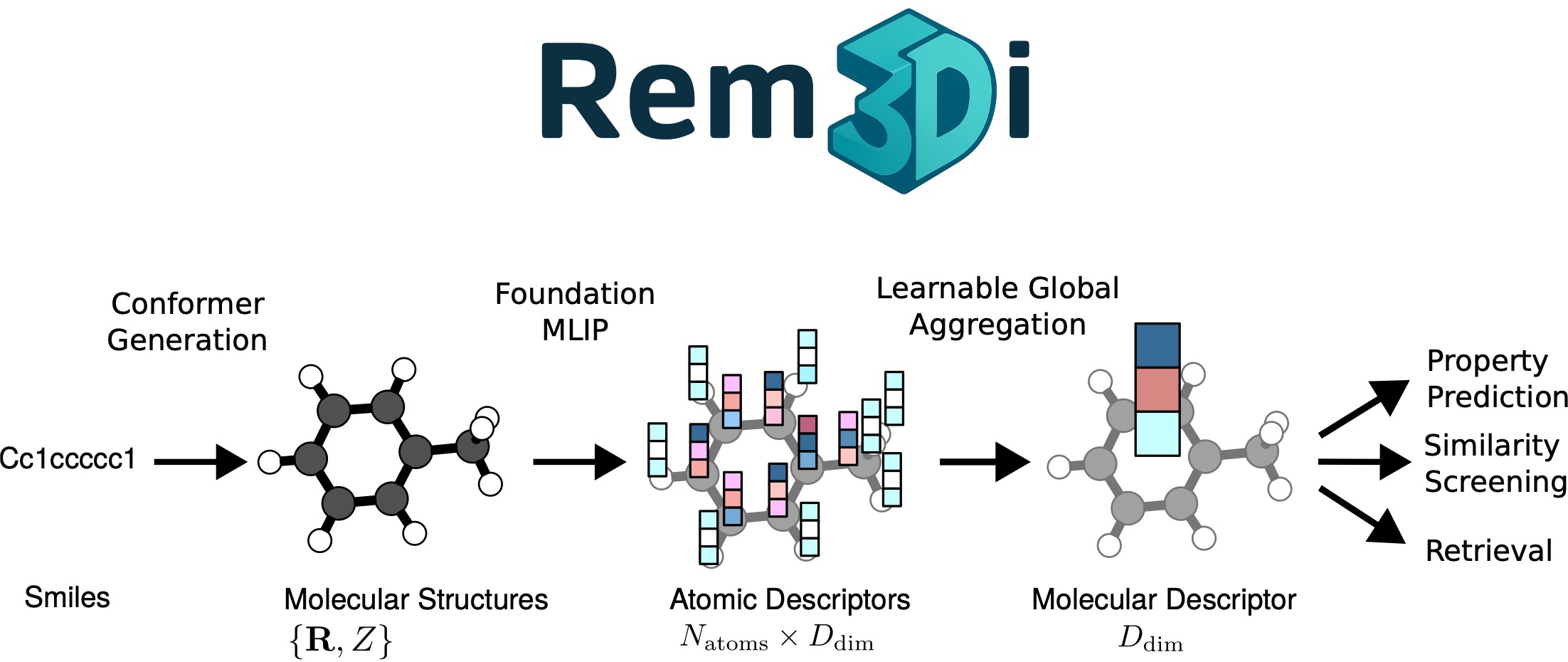
TL;DR: We generate molecular datasets containing molecular structures and their mace descriptors from various sources, examples can be found in scripts/dataset_creation.
Dataset Overview
MoleculeDatasets (remedi/data_handling/dataset/molecule_dataset.py) is the object that contains all embedding and structural data for our molecular datasets. The datasets can further contain system wide, molecular labels, or atomwise labels, which can be used for training regression models. Our datasets are backed by zarr arrays(Design motivitation: multithreaded read access from disk, when dataset size exceeds memory limit). As the size of molecules varies, the MoleculeDataset contain pointer values that point to the molecules atom limits.
Dataset Generation
Dataset generation is implemented batchwise to increase performance, as GPU memory can be fully utilized in this way. The pipeline goes through the following stages.
- MoleculeGenerators yield batches of smiles or processed ase atoms, in case the molecular structures are available in the datasets. For a new data source, like a new dataset that stores molecular data in its own way, you need to implement a new MoleculeGenerator.
- Configurable Orchestrator will execute the pipeline. E.g. perform conformal sampling, relaxation. Lastly, the mace descriptors will be configured
- Everything (Embeddings, structures, optional system wide or atom wise regression labels) will be shoved into the right zarr arrays in the MoleculeDataset.
Running Pretraining
- Create a training dir with a training_config.yaml and architecture_config.yaml or generate the architecture_config.yaml with the scripts/write_config_file.py script. In the train dir
- Run pretrainig via scripts/scripts/run_denoising_pretraining.py --train_dir "dir"
One note re. training: For training we create new dataset object (class TrainingMoleculeDataset). This contains additionally logic how multiple dataloader workers can simulatounsly retireve data from the same zarr files.
Using Pretrained Model
import torch
from remedi.configuration.architecture_config import EncoderOnlyArchitectureConfig
from remedi.evaluation.evaluation_utils import evaluate_molecular_descriptor_on_dataset
from remedi.data_handling.dataset.training_dataset import (
    TrainingMoleculeDataset,
    pos_emb_getitem,
)
ds = TrainingMoleculeDataset(training_config.dataset_path, get_item=pos_emb_getitem)
model = EncoderOnlyArchitectureConfig.from_directory(model_dir).build()
model.encoder.load_state_dict(torch.load(f"{model_dir}/encoder.pth"))
model.preprocessor.atomic_preprocessor.load_state_dict(
    torch.load(f"{model_dir}/atomic_preprocessor.pth")
)
model.preprocessor.geometric_preprocessor.load_state_dict(
    torch.load(f"{model_dir}/geometric_preprocessor.pth")
)
remedi_descriptors = evaluate_molecular_descriptor_on_dataset(model, ds)
Citation
If you use any of this code in your work, please cite our paper (OpenReview):
Wedig, Steffen, et al. "REM3DI: Learning smooth, chiral 3D molecular representations from equivariant atomistic foundation models." NeurIPS 2025 Workshop on Symmetry and Geometry in Neural Representations. 2025.
@inproceedings{wedig2025rem3di,
  title={REM3DI: Learning smooth, chiral 3D molecular representations from equivariant atomistic foundation models},
  author={Wedig, Steffen and Elijo{\v{s}}ius, Rokas and Schran, Christoph and Schaaf, Lars Leon},
  booktitle={NeurIPS 2025 Workshop on Symmetry and Geometry in Neural Representations},
  year={2025}
}
1 maintainer

Metadata
1 maintainer
Release files for remedi 0.1.1
For a detailed explanation of source distributions (sdists) and built distributions (wheels), please see the package formats documentation.
Source distribution (sdist)
| File | Size | Uploaded | Provenance | Actions |
|---|---|---|---|---|
| remedi-0.1.1.tar.gz | 798.2 kB | With provenance | Details for remedi-0.1.1.tar.gz |
Built distribution (wheel)
| File | Interpreter | ABI | Platform | Actions Reset |
|---|---|---|---|---|
| remedi-0.1.1-py3-none-any.whl | Python 3 | none | any | Details for remedi-0.1.1-py3-none-any.whl |
Total release size: 1.1 MB
Release files / remedi-0.1.1.tar.gz
| Download URL | remedi-0.1.1.tar.gz |
|---|---|
| Size | 798.2 kB |
| Tags | Source |
|
SHA-256 checksum How to use checksums |
2800646deb55fbd15dbd25305b0a69f449869a8bb809657ca2628739a667aa2e
|
|
BLAKE2b-256 checksum How to use checksums |
e8d1a1cbb9c27fa61fd6bd877604707080867baa291dfd12215fc2c8a31b4a76
|
| Upload date | |
|
Uploaded using Trusted Publishing? What is trusted publishing? |
Yes |
| Uploaded via |
twine/6.1.0 CPython/3.13.12
|
Provenance
Provenance describes where a file came from. On PyPI, provenance is shared via attestations, which provide a verifiable record of the build or publishing details. View details, limitations and caveats.


PyPI Publish Attestation
PyPI verified that this artifact, at this checksum, originated from the publisher listed below.
Signed by GitHub Actions, verified by PyPI on Jul 14, 2026.
Transparency logRelease files / remedi-0.1.1-py3-none-any.whl
| Download URL | remedi-0.1.1-py3-none-any.whl |
|---|---|
| Size | 300.0 kB |
| Tags | Python 3 |
|
SHA-256 checksum How to use checksums |
7b2fc47ada56d3fe376465d7fa3577930eab4b35c407c05a3a636f5520322930
|
|
BLAKE2b-256 checksum How to use checksums |
826bef7ec3a9d0ed77ba21fc9f8c69bbdea5c63eb92b0ea27a5caaa8f47117bf
|
| Upload date | |
|
Uploaded using Trusted Publishing? What is trusted publishing? |
Yes |
| Uploaded via |
twine/6.1.0 CPython/3.13.12
|
Provenance
Provenance describes where a file came from. On PyPI, provenance is shared via attestations, which provide a verifiable record of the build or publishing details. View details, limitations and caveats.
PyPI Publish Attestation
PyPI verified that this artifact, at this checksum, originated from the publisher listed below.
Signed by GitHub Actions, verified by PyPI on Jul 14, 2026.
Transparency logSecurity for remedi 0.1.1
Provenance
Provenance describes where a file came from. On PyPI, provenance is shared via attestations, which provide a verifiable record of the build or publishing details. View details, limitations and caveats.
Full provenance
All 2 files in this release have been uploaded with provenance metadata.
Attestation for remedi-0.1.1.tar.gz
PyPI Publish Attestation
PyPI verified that this artifact, at this checksum, originated from the publisher listed below.
Signed by GitHub Actions, verified by PyPI on Jul 14, 2026.
Transparency logA note on package security
PyPI is a repository for distributing packages, not a service for auditing them. While third-party security researchers and our staff do their best to detect and remove malicious packages, PyPI cannot guarantee the quality, security or suitability of any given package.
To learn more about protecting yourself from malicious actors, visit our package security documentation.














