
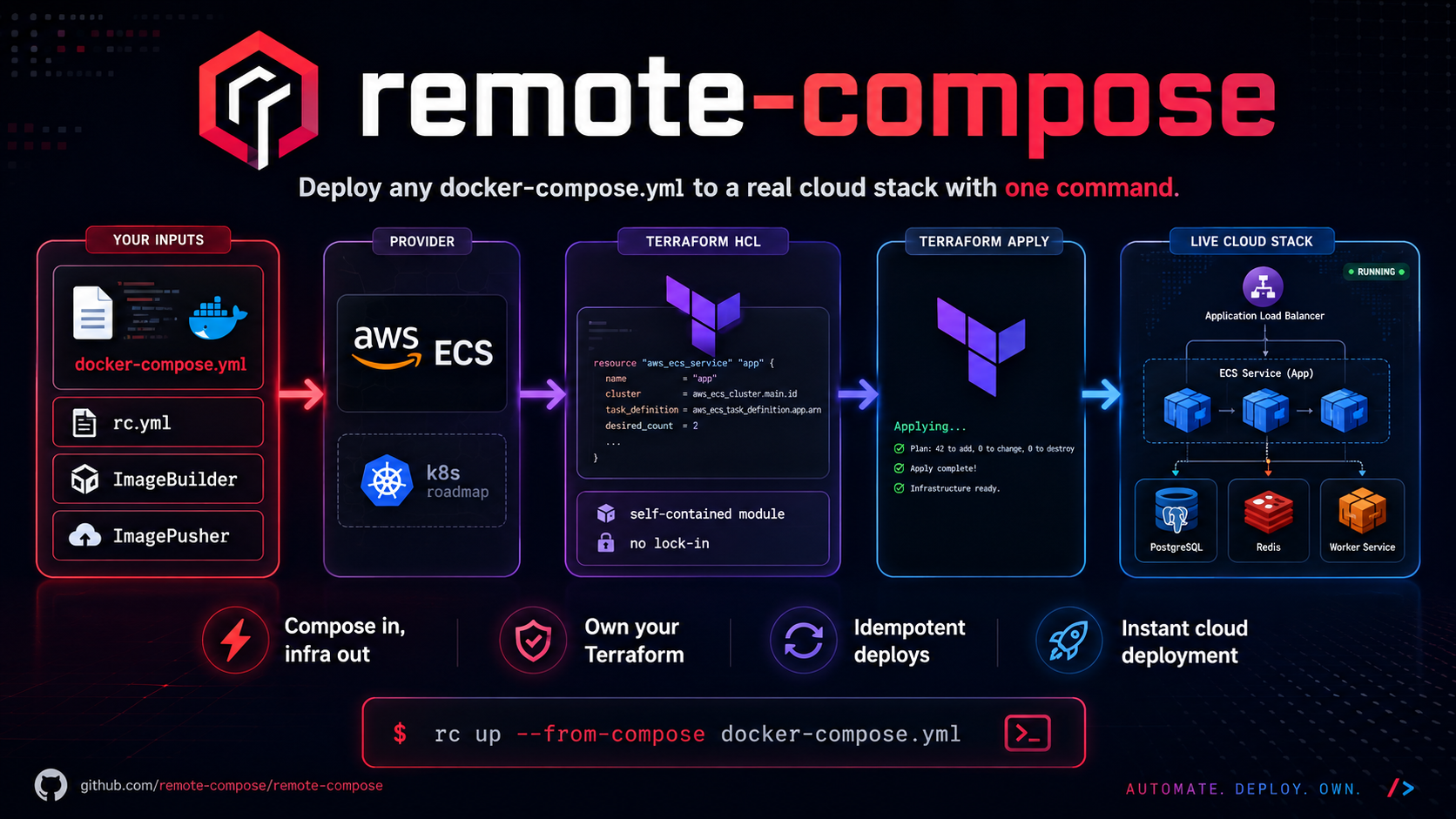
remote-compose
Take any docker-compose.yml and put it on AWS — as a fresh dev box with Claude already running inside, or as production infrastructure.
Two flavors of one tool:
🚀 rc dev up — disposable cloud dev environments with an agent inside
rc dev up alice \
  --repo https://github.com/owner/myapp \
  --compose docker-compose.yml \
  --gh-token "$(gh auth token)" --skip-permissions
In ~5 minutes you get a fresh EC2 box with: docker, your repo cloned, the compose stack running, and Claude Code pre-authenticated in a tmux session waiting for you to attach. rc dev attach alice drops you into it. One box per agent or per branch. Work in parallel on isolated infra. rc dev destroy when done.
Multi-repo deploys, env-file shipping, gh/bd pre-installed, shared SSH key + auth lifecycle — all built in.
🏗️ rc deploy — generate a real terraform module from your compose
rc up --from-compose docker-compose.yml
Reads your compose, asks for the handful of things compose can't express (CPU/memory, secrets, public hostname, EFS uid), generates a clean ECS terraform module, applies it. Then everyday verbs: rc deploy, rc lifecycle migrate, rc db push, rc destroy. The module is yours — cd terraform/ && terraform apply works without rc.
Status: alpha. Hand-tested against a real production Django stack. Active branch:
portable-deploy. Legacy v1 (SSH/Django-app) lives below for users onmain. See ARCHITECTURE.md for design + validation, AGENTS.md for workflow.
Why both modes share one tool
Same insight, two surfaces. Compose is already the spec for "how my services fit together." For dev we ship that spec to an EC2 box and start an agent inside. For production we render it to ECS terraform. You write the compose file once.
Most deploy tooling makes you choose between cloud-specific knobs (ECS task defs, k8s manifests, Helm), opinionated black-box PaaS (Heroku, Fly, Render), or hand-rolled terraform (flexible but a 500-line module per service). remote-compose takes the other bet: your compose file is the topology. The tool's job is to add the few things compose can't express and emit something clean — terraform you own, or an EC2 box that disappears when you're done with it.
Quick start
Bootstrapping a fresh machine? Run
bash scripts/bootstrap-from-zero.shinstead of step 1 — it installs terraform via the platform package manager (brew/apt/dnf), creates a.venv, runspip install -e ".[ecs]", and verifiesrc doctoris all-green. Idempotent — safe to re-run.
# 1. Install (only ECS provider ships today — k8s is roadmap)
pip install -e ".[ecs]"

# 2. In your app repo (alongside docker-compose.yml)
rc init --from-compose docker-compose.yml   # scaffold a v2 rc.yml from your compose
$EDITOR rc.yml                              # tweak cpu/memory/health checks

# 3. Configure cloud creds (ECS example)
export AWS_PROFILE=myprofile

# 4. One-shot: scaffold (if missing) → deploy → push secrets → ALB URL
rc up --from-compose docker-compose.yml     # the lazy path, idempotent

# 4b. Or step through it manually
rc plan                            # show what terraform would create
rc deploy                          # build images, terraform apply, force-rolls
rc secrets push                    # upload .env files into AWS Secrets Manager
rc lifecycle migrate               # run a named hook in a live container
rc status                          # ECS service health table
rc exec django -- /bin/bash        # interactive shell
rc db push /tmp/local-dump.dump    # seed the deployed db from a local dump
rc destroy --yes                   # tear it all down
To verify the documented commands exist as advertised, run
bash scripts/test-readme-quickstart.sh — it audits rc --help against
this section without touching AWS.
Every command is declarative + idempotent. Re-running rc deploy after
no changes prints no changes — infrastructure matches config.
First-deploy walkthrough
If you want to verify rc actually works end-to-end against real AWS
before you commit to it, the repo ships a scripted acceptance trace
that takes a clean account → a fully-running production-shape Django +
celery + nginx stack → clean teardown. Single command, no aws-cli, no
sed, no /tmp dance.
# Prereqs: terraform installed (or run scripts/bootstrap-from-zero.sh
# first), an AWS profile with creds, and a Django+celery compose to
# point at. We use start-simpli (private repo) — substitute your own
# via the START_SIMPLI / COMPOSE_FILE / REGION / AWS_PROFILE_OVERRIDE
# env vars at the top of the script.

bash scripts/test-startsimpli-end-to-end.sh
What it does, step by step:
rc destroy --all-ephemeral— clean slate. Removes any prior ephemeral stacks from the local registry.rc up --from-compose docker-compose.local.yml --aws-profile X --region Y --ttl 4h— single-command full deploy. Scaffolds an rc.yml from your compose, auto-fixes nginx for ECS Cloud Map (variable-based proxy_pass + VPC resolver), imports any orphan Container Insights log group, runs terraform apply, builds + pushes images, force-rolls services, pushes file-sourced secrets into Secrets Manager, runs auto_on_deploy lifecycle hooks (e.g.python manage.py migrate --noinput).rc statuspolling — waits for all services to reachhealth=healthy.- Plain
curl http://<ALB>/api/v1/health/— no Host: header rewrite, nohttps, no--insecure. The patient retry loop tolerates the ~60-90s window where ECS marks the task healthy but Django is still finishing migrations + collectstatic + runserver. When it returns 200, the body is checked for{"celery":"healthy"}— real workers responding to ping, not "no_workers". rc destroy --yes— clean teardown. Removes every AWS resource taggedProject=<this-stack>and unregisters the entry from the ephemeral registry.rc list --ephemeral— registry empty. No stale rows.
Scripted. Repeatable. The tracking bead is
rc-e5u.46 (bd show rc-e5u.46).
What rc.yml v2 looks like
version: 2
project: my-app
compose_file: docker-compose.yml
provider: ecs

provider_config:
  ecs:
    cluster: my-app-prod
    region: us-west-1
    aws_profile: myprofile
    vpc_cidr: 10.0.0.0/16
    route53_zone: rctest.example.com   # override if zone != domain[-2:]

terraform:
  output_dir: ./terraform/${provider}
  backend:
    type: s3                           # or local
    bucket: my-app-tf-state
    key: ecs.tfstate
    region: us-west-1

# Auto-creates the backup S3 bucket via terraform with versioning + AES256
# + 14-day expiration. Set bucket_managed: false to point at an existing
# bucket you own elsewhere.
backup:
  bucket: my-app-backups
  service: postgres                    # which container hosts pg_restore
  retention_days: 14                   # or "never"

# .env files become Secrets Manager JSON blobs; provider emits one
# task-def `secrets[]` entry per KEY using arn:KEY:: selectors so each
# key arrives as its own env var (vs one giant blob).
secrets:
  - name: django
    source: file
    path: .envs/.production/.django
  - name: postgres
    source: file
    path: .envs/.production/.postgres

# Compose-driven deploy set. Default: every compose service deploys with
# sensible defaults; rc.yml services[] is for overrides. Use exclude/include
# for dev-only services (ngrok, debug profiles, etc.).
compose:
  exclude: [ngrok]                     # mutually exclusive with include

services:
  postgres:
    type: infrastructure
    cpu: 512
    memory: 1024
    volumes:
      - name: pgdata
        mount: /var/lib/postgresql/data
        # Per-service posix_user on the EFS access point so initdb
        # can chown — postgres:17 alpine = uid 70, debian = 999.
        uid: 999
        gid: 999
        mode: "0700"

  django:
    type: application
    cpu: 1024
    memory: 2048
    port: 8001
    health_check_path: /api/v1/health/
    ephemeral_storage: 21              # GiB; FARGATE 21–200
    lifecycle:
      migrate:
        command: ["python", "manage.py", "migrate", "--noinput"]
        auto_on_deploy: true           # runs after every rc deploy
      createsuperuser:
        command: ["python", "manage.py", "createsuperuser", "--noinput"]
        run_once: true                 # skips when probe exits 0
        probe:
          - python
          - -c
          - |
            import os, django, sys
            django.setup()
            from django.contrib.auth import get_user_model
            sys.exit(0 if get_user_model().objects.filter(
                email=os.environ['DJANGO_SUPERUSER_EMAIL']
            ).exists() else 1)
      shell:
        command: ["python", "manage.py", "shell"]
        interactive: true              # forwards a TTY

  nginx:
    type: proxy
    cpu: 256
    memory: 512
    port: 80
    public: true
    default_target: true               # catches anything the host rules don't
    domain: app.example.com            # primary; this name routes here
    aliases:                           # extra hostnames same service answers for
      - api.app.example.com            #   (cert SANs + R53 records, no listener rules)
    health_check_path: /health
Full schema reference: ARCHITECTURE.md § rc.yml v2 at a glance.
Feature index
What's built and live-verified on the portable-deploy branch:
Provider abstraction
ProviderABC — every cloud target (ECS today, K8s next) implementsemit_terraform,plan,deploy,redeploy,status,logs,exec,rollback,destroyagainst a sharedDeployContext.FakeProviderfor tests — every contract test runs against bothECSProviderandFakeProviderso adding a new provider is a copy-paste exercise.- rc-test- tag* — every project named
rc-test-*getsEnvironment=rc-testtags +force_destroy=trueon destructive resources, so test stacks always tear down clean.
ECS provider — what terraform we generate
- VPC + 2 public + 2 private subnets, IGW, security groups, default routing
- ECS cluster with Container Insights (log group terraform-managed)
- Per-service: ECR repo, task def, ECS service, Cloud Map service-discovery entry
- ALB with HTTP→HTTPS redirect (when
domainis set) + ACM cert + R53 alias records - EFS file system + access point per stateful volume; per-service posix uid/gid/mode
- AWS Secrets Manager: one secret per
.envfile, JSON-blobbed, individual keys exposed via ECSarn:KEY::selectors - ECS Exec wired (task role gets
ssmmessages:*);enable_execute_command = trueon every service - ALB host-routing: per-service
domain→ ALB listener rule + per-service target group - Single fronting service:
aliases:adds cert SANs + R53 records without listener rules - S3 backup bucket auto-created with versioning + lifecycle when
backup.bucketis declared - Stateful services (any with EFS) auto-set
deployment_minimum_healthy_percent = 0so rolling deploys can't race-corrupt postgres data
CLI
| command | does |
|---|---|
rc init |
scaffold a v2 rc.yml |
rc migrate --in rc.yml --out rc.v2.yml |
convert legacy v1 |
rc plan |
terraform plan summary |
rc deploy [--no-build] |
build, push, terraform apply, force-roll, run auto_on_deploy hooks |
rc destroy --yes |
terraform destroy |
rc status |
ECS service health table |
rc exec <service> -- <cmd...> |
run a one-off command inside a live task; reliable stdout via sentinels; full TTY when stdin is a tty |
rc lifecycle <hook> [<service>] |
run a named hook from rc.yml (resolves declarer; handles run_once probes) |
rc secrets push [--rollout/--no-rollout] |
parse each .env file → upload as JSON to its SM secret → force-rolls every service |
rc db backup / rc db restore / rc db list |
postgres backup round-trips through S3 (host-side presigned URLs; tasks just curl) |
rc db push <file> |
upload a local dump → exec pg_restore inside the deployed container; auto-detects format from extension (.dump, .tar.gz, .sql); bootstraps curl + ca-certificates in containers that don't ship them |
rc copilot import |
migrate an AWS Copilot app to rc.yml v2 + docker-compose; supports --env <name> for per-environment overrides (guide) |
rc doctor |
preflight: terraform/docker/python/boto/AWS creds checked |
rc install |
platform package-manager fix for missing deps |
Compose feature support
build:with optionaltarget:(multi-stage),args:,dockerfile:— relative dockerfile resolved against the build context (the natural compose semantic)image:— pre-built image used verbatim, ECR push skippedcommand:— overrides the container CMDenvironment:(dict or list) ANDenv_file:(list or single string, paths relative to compose dir, multiple files merge in declaration order,environment:map wins on conflict)ports:— when public, primary port goes to ALB target group; remaining ports become additionalcontainerPorts in the task def, intra-VPC reachable via the existing tasks SG (use this for VNC, devtools, internal-only ports)volumes:— EFS-backed when declared in rc.yml with explicitmount:and uid/gid
Lifecycle commands
Declarative one-off operations live in rc.yml as services[*].lifecycle.<hook>:
lifecycle:
  migrate:
    command: ["python", "manage.py", "migrate", "--noinput"]
    auto_on_deploy: true        # rc deploy runs this after rollout
  createsuperuser:
    command: ["python", "manage.py", "createsuperuser", "--noinput"]
    run_once: true
    probe: [python, -c, "import sys; sys.exit(0 if user_exists() else 1)"]
  shell:
    command: ["python", "manage.py", "shell"]
    interactive: true           # TTY passthrough
auto_on_deploy: true runs the hook after every successful rc deploy,
in declaration order, with hook failures surfaced as warnings (not deploy
failures — rerun rc lifecycle <hook> for full output).
run_once: true runs the probe: first; non-zero exit ⇒ "not yet
done" ⇒ run the hook. Idempotent createsuperuser, fixture loading,
schema bootstrap.
AWS Copilot migration
AWS Copilot reaches end-of-support on 2026-06-12. Every team
running on Copilot needs a path off it. rc copilot import is that
path — it reads any copilot/ directory tree (services, environments,
addons, pipelines) and writes a working rc.yml v2 + docker-compose.yml
IMPORT_SUMMARY.md.
rc copilot import \
    --from ./copilot \
    --out  . \
    --env  production \
    --project my-app
What translates today:
| Copilot construct | rc translation |
|---|---|
Backend Service |
private rc service (no public, no ALB) |
Worker Service |
rc service type: worker |
Load Balanced Web Service |
public rc service + port + default_target + domain (from http.alias) + aliases |
image.build: { context, dockerfile, target, args } |
docker-compose build: block (multi-stage target honored) |
image.location |
docker-compose image: (Copilot's ${TAG} interpolation preserved) |
cpu, memory, count |
rc.yml cpu, memory, replicas |
storage.volumes.<n>: { path, efs: {uid, gid} } |
rc.yml volumes with EFS access-point uid/gid |
variables: { KEY: value } |
docker-compose environment: |
secrets: { KEY: { secretsmanager: arn } } |
rc.yml secrets: source: aws_sm |
environments.<env> overrides |
deep-merged when --env <env> passed |
${COPILOT_ENVIRONMENT_NAME} |
resolved when --env is passed; left literal otherwise |
What gets flagged for review (typed warnings grouped in IMPORT_SUMMARY.md):
| Copilot construct | warning |
|---|---|
Request-Driven Web Service |
UnsupportedServiceTypeWarning — App Runner is a different runtime; best-effort translated to public ECS for review |
Static Site |
UnsupportedServiceTypeWarning — CloudFront+S3 has no ECS analogue; emitted to compose.exclude so it's not silently dropped |
count: { range, cpu_percentage } |
ScalingNotSupportedWarning — autoscaling not yet emitted; replicas pinned to range floor |
count: 0 |
ScalingNotSupportedWarning — ECS doesn't scale-to-zero; replicas=1 |
exec: false |
ExecDisabledIgnoredWarning — provider always enables ECS Exec |
network.vpc.placement: private |
PrivateSubnetUnsupportedWarning — public-subnet Fargate today (rc-e5u.25 tracks the NAT variant) |
| addons CFN templates | listed in summary — translate to terraform manually (P3 backlog) |
Tested against a corpus of real Copilot apps including:
- aws/copilot-cli e2e fixtures (canonical LBWS, app-with-domain, static-site)
- a public external example (ShanikaEdiriweera/aws-copilot-example)
- a 15-service production-grade app (sentinal: backend + workers + nginx + multi-env + secretsmanager refs)
Local-data seeding (rc db push)
Spin up a test stack in a separate region, seed it with real data from a local Docker volume, validate, tear down. Repeat. The flow:
docker exec my_postgres pg_dump -Fc -U postgres my_db > /tmp/seed.dump
rc deploy
rc secrets push
rc db push /tmp/seed.dump
rc db push uploads to the configured backup bucket via host-side boto3,
generates a presigned GET URL, exec's a sentinel-bracketed restore script
inside the deployed postgres container that downloads with curl (or
bootstraps curl via apt-get when the image doesn't ship it), runs
pg_restore --no-owner --clean --if-exists, and deletes the S3 staging
object on success.
Mental model in 5 lines
- Compose is the topology. Adding a service to
docker-compose.ymldeploys it (defaults: 256 CPU / 512 MB /applicationif it has ports,workerotherwise). - rc.yml is the tuning. Override CPU, memory, port, public, domain, lifecycle, secrets, volumes, EFS uid, etc. per-service.
- The provider is thin. It generates a terraform module from the merged config; you can
cd terraform/ && terraform applywithoutrcever again. - Secrets are JSON in SM. Each
.envfile becomes one secret; each KEY in that file becomes a separate task-def env var via ECS JSON-key selectors. - Test stacks are disposable.
rc-test-*projects auto-setforce_destroy=trueon every resource;rc destroytears them down clean.
Codebase map
remote_compose/
├── cli.py                           # legacy v1 commands + v2 dispatch
├── cli_v2.py                        # v2 CLI: load_rc_yml, build_deploy_context, dispatch_if_v2
├── config/
│   ├── v1_schema.py                 # legacy flat schema loader
│   ├── v2_schema.py                 # ServiceV2, RcConfigV2, ComposeConfig, BackupConfig, ...
│   └── migrate.py                   # v1 → v2 with warnings on stateful services
├── envfile.py                       # standalone .env parser (used by provider + rc db push + lifecycle)
├── copilot/
│   ├── discover.py                  # walk copilot/ → typed CopilotApp model
│   └── translate.py                 # 5 focused translators + composer + warning types
├── provider/
│   ├── base.py                      # Provider ABC, ServiceSpec, DeployContext, ExecResult, ...
│   ├── fake.py                      # in-memory provider for the contract suite
│   └── ecs/
│       ├── provider.py              # ECSProvider implementation
│       ├── autosize.py              # EC2 capacity provider sizing
│       ├── ecr_auth.py              # ECR login for image push
│       └── templates/
│           ├── alb.tf.j2            # ALB + listeners + per-service target groups + host rules
│           ├── backend.tf.j2        # terraform backend
│           ├── backup.tf.j2         # S3 backup bucket + lifecycle
│           ├── capacity.tf.j2       # EC2 capacity provider
│           ├── cluster.tf.j2        # ECS cluster + container-insights log group
│           ├── domain.tf.j2         # ACM cert (with SANs) + R53 records
│           ├── efs.tf.j2            # EFS + access points (uid/gid/mode)
│           ├── iam.tf.j2            # task-execution + task roles + ssmmessages policy
│           ├── network.tf.j2        # VPC, subnets, IGW, route tables
│           ├── outputs.tf.j2        # ECR repo URLs, ALB DNS
│           ├── providers.tf.j2      # AWS provider block
│           ├── secrets.tf.j2        # SM secret placeholders
│           ├── security_groups.tf.j2
│           ├── service_discovery.tf.j2  # Cloud Map private namespace
│           ├── services.tf.j2       # ECS task def + service per compose service
│           └── variables.tf.j2
├── image/
│   ├── builder.py                   # docker build wrapper (handles relative dockerfile)
│   └── pusher.py                    # docker push to ECR/GCR/etc.
└── terraform/
    ├── backend.py                   # render_backend_block
    ├── emitter.py                   # Jinja2-based directory render
    └── runner.py                    # subprocess wrapper for terraform CLI

tests/
├── unit/                            # per-module unit tests
├── contract/test_provider_contract.py   # runs against ECSProvider + FakeProvider
├── integration/test_provider_ecs_terraform.py  # invokes real `terraform validate`
├── e2e/                             # opt-in real-AWS tests (RC_E2E=1)
└── fixtures/golden/ecs_minimal/     # byte-for-byte expected HCL output

examples/
├── demo-app/                        # FastAPI + worker + postgres + redis reference stack
└── sample-app/                      # minimal hello-world
ARCHITECTURE.md § Layers has the import-rule diagram.
Build & test
# Dev install
pip install -e ".[ecs]"
pip install -r requirements/dev.txt

# Fast (12s): unit + contract
pytest tests/unit/ tests/contract/

# Adds: real `terraform init -backend=false && terraform validate`
pytest tests/integration/

# Full opt-in real-AWS suite (~25 min, requires creds)
RC_E2E=1 pytest -m e2e tests/e2e/

# Regenerate the byte-identical golden HCL fixture
python -m tests.unit.test_provider_ecs.test_golden --regenerate

# Linters
black remote_compose/
flake8 remote_compose/
The contract suite is the heart of provider parity. Any new provider
ships only when pytest tests/contract/test_provider_contract.py is
green against it.
Roadmap / open work
Tracked in beads. To inspect:
bd ready                      # available work
bd show rc-e5u                # the umbrella epic
bd list --status=open         # everything still open
High-signal open items (as of this writing):
- Kubernetes provider (
rc-e5u.8) — proves the multi-cloud claim - Private subnets + NAT (
rc-e5u.25) — currently public-subnet Fargate for cost - EFS encryption on fresh accounts (
rc-e5u.26) — KMS key bootstrap rc audit(rc-e5u.37.4) — post-destroy AWS-side cleanup verificationrc db dump-local(rc-e5u.37.3) — wrapsdocker exec pg_dumpwith port autodiscoveryrc compose import(rc-e5u.41.3) — scaffold rc.yml from a compose file- Framework presets (
rc-e5u.35.7) — auto-default lifecycle hooks for django/rails/phoenix/laravel - Provider auto-import of orphan log groups (
rc-e5u.37.5) — terraform import on first-run conflicts
Design principles
- Be a generator, not a runtime. Every piece of state we own should also be readable as plain terraform / plain JSON. Users escape
rccleanly. - Compose is the contract. Don't invent parallel config; consume the file the team already maintains.
- Test against real clouds. Unit tests catch shape regressions; the real validator is
terraform validate+ a live e2e againstrc-test-*projects. - One-off operations get first-class commands. Lifecycle hooks, db push, exec, secrets push — all CLI verbs, not bash scripts users have to copy.
- Reproducible test stacks.
rc-test-*namespaces auto-tear-down; isolation is a property of the project name, not user discipline. - No backwards-compat ratchets in alpha. When the right shape conflicts with the old shape, file a bead, change both at once. Backward-compat shims live only as long as we're sure they don't trap us.
See AGENTS.md for the day-to-day workflow.
Related docs
- ARCHITECTURE.md — full design, validation ladder, dependency graph, e2e setup
- AGENTS.md — workflow conventions for humans + AI agents
- examples/demo-app/README.md — runnable reference stack
- CLAUDE.md — instructions for Claude Code when working in this repo
Legacy v1 (pre-portable)
The content below describes the v1 SSH/Django-app deploy path on main.
The portable provider work above lives on portable-deploy. v1 still ships
for users on the older path; v2 is the active line.
Features (v1)
- Docker Context Management: Create and manage Docker contexts for remote deployment targets
- Docker Compose Deployment: Deploy docker-compose.yml files to remote hosts via SSH
- AWS EC2 Integration: Auto-discover EC2 instances and create deployment targets
- AWS ECS Integration: Deploy to AWS ECS (Fargate or EC2) without SSH
- Async Deployments: Celery tasks for background deployment operations
- Health Monitoring: Continuous health checks for targets and deployments
- Multi-Service Orchestration: Deploy multiple services with sequential, parallel, rolling, or canary strategies
- Rate Limiting: Protect against deployment abuse with configurable rate limits
- Audit Logging: Track all deployment-related actions for compliance
- Secure Credential Storage: Fernet-encrypted storage for SSH keys and AWS credentials
- Log Sanitization: Automatic masking of sensitive data in logs
- Webhooks & Notifications: Slack, email, and custom webhook notifications
- Deployment History: Full deployment tracking with rollback capability
For the full v1 reference (Django settings, management commands, API
viewsets, etc.) see the file history of this README in git log —
the prior version is preserved at git show main:README.md.
License
MIT — see LICENSE for terms.
1 maintainer

Metadata
1 maintainer
Release files for remote-compose 0.4.1
For a detailed explanation of source distributions (sdists) and built distributions (wheels), please see the package formats documentation.
Source distribution (sdist)
| File | Size | Uploaded | Provenance | |
|---|---|---|---|---|
| remote_compose-0.4.1.tar.gz | 487.3 kB | With provenance | Details |
Built distribution (wheel)
| File | Interpreter | ABI | Platform | Reset |
|---|---|---|---|---|
| remote_compose-0.4.1-py3-none-any.whl | Python 3 | none | any | Details |
Total release size: 1.1 MB
Release files / remote_compose-0.4.1.tar.gz
| Download URL | remote_compose-0.4.1.tar.gz |
|---|---|
| Size | 487.3 kB |
| Tags | Source |
|
SHA-256 checksum How to use checksums |
42c0167448ac380d7d805e080a60ddcf55b5d84842f139cb1da5c8efa05e15ef
|
|
BLAKE2b-256 checksum How to use checksums |
0a83f72908ebf72da48721f8d7cbd91144a203e43b9f456925ff571af04d09f4
|
| Upload date | |
|
Uploaded using Trusted Publishing? What is trusted publishing? |
Yes |
| Uploaded via |
twine/6.1.0 CPython/3.13.12
|
Provenance
Provenance describes where a file came from. On PyPI, provenance is shared via attestations, which provide a verifiable record of the build or publishing details. View details, limitations and caveats.


PyPI Publish Attestation
PyPI verified that this artifact, at this checksum, originated from the publisher listed below.
Signed by GitHub Actions, verified by PyPI on May 27, 2026.
Transparency logRelease files / remote_compose-0.4.1-py3-none-any.whl
| Download URL | remote_compose-0.4.1-py3-none-any.whl |
|---|---|
| Size | 578.2 kB |
| Tags | Python 3 |
|
SHA-256 checksum How to use checksums |
440d9cc67f3242b4611d2be5707c3aa7a8fd6bbba242ece503d123b46cb26b97
|
|
BLAKE2b-256 checksum How to use checksums |
0e1ff136c29ea0904598946573a3c055bab8d428406a3339aa02e46eec8a382f
|
| Upload date | |
|
Uploaded using Trusted Publishing? What is trusted publishing? |
Yes |
| Uploaded via |
twine/6.1.0 CPython/3.13.12
|
Provenance
Provenance describes where a file came from. On PyPI, provenance is shared via attestations, which provide a verifiable record of the build or publishing details. View details, limitations and caveats.
PyPI Publish Attestation
PyPI verified that this artifact, at this checksum, originated from the publisher listed below.
Signed by GitHub Actions, verified by PyPI on May 27, 2026.
Transparency logSecurity for remote-compose 0.4.1
Provenance
Provenance describes where a file came from. On PyPI, provenance is shared via attestations, which provide a verifiable record of the build or publishing details. View details, limitations and caveats.
Full provenance
All 2 files in this release have been uploaded with provenance metadata.
Attestation for remote_compose-0.4.1.tar.gz
PyPI Publish Attestation
PyPI verified that this artifact, at this checksum, originated from the publisher listed below.
Signed by GitHub Actions, verified by PyPI on May 27, 2026.
Transparency logA note on package security
PyPI is a repository for distributing packages, not a service for auditing them. While third-party security researchers and our staff do their best to detect and remove malicious packages, PyPI cannot guarantee the quality, security or suitability of any given package.
To learn more about protecting yourself from malicious actors, visit our package security documentation.














