
System dynamics modeling with bayesian inference

Project description
Reno System Dynamics (reno-sd)






Reno is a tool for creating, visualizing, and analyzing system dynamics models in Python. It additionally has the ability to convert models to PyMC, allowing Bayesian inference on models with variables that include prior probability distributions.
Reno models are created by defining the equations for the various stocks, flows,
and variables, and can then be simulated over time similar to something like
Insight Maker, examples of which can be seen below
and in the notebooks folder.
Currently, models only support discrete timesteps (technically implementing difference equations rather than true differential equations.)
Installation
Install from PyPI via:
pip install reno-sd
Install from conda-forge with:
conda install reno-sd
Example
A classic system dynamics example is the predator-prey population model, described by the Lotka-Volterra equations.
Implementing these in Reno would look something like:
import reno

m = reno.Model(name="m", steps=200, doc="Classic predator-prey interaction model example")

# make stocks to monitor the predator/prey populations over time
m.rabbits = reno.Stock(init=100.0)
m.foxes = reno.Stock(init=100.0)

# free variables that can quickly be changed to influence equilibrium
m.rabbit_growth_rate = reno.Variable(.1, doc="Alpha")
m.rabbit_death_rate = reno.Variable(.001, doc="Beta")
m.fox_death_rate = reno.Variable(.1, doc="Gamma")
m.fox_growth_rate = reno.Variable(.001, doc="Delta")

# flows that define how the stocks are influenced
m.rabbit_births = reno.Flow(m.rabbit_growth_rate * m.rabbits)
m.rabbit_deaths = reno.Flow(m.rabbit_death_rate * m.rabbits * m.foxes, max=m.rabbits)
m.fox_deaths = reno.Flow(m.fox_death_rate * m.foxes, max=m.foxes)
m.fox_births = reno.Flow(m.fox_growth_rate * m.rabbits * m.foxes)

# hook up inflows/outflows for stocks
m.rabbits += m.rabbit_births
m.rabbits -= m.rabbit_deaths

m.foxes += m.fox_births
m.foxes -= m.fox_deaths
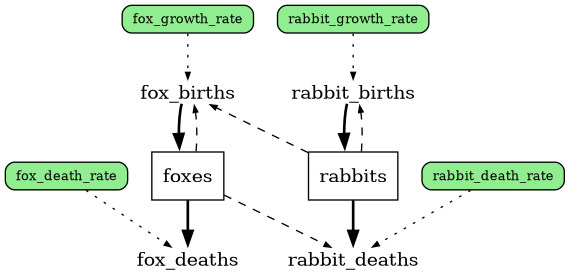
The stock and flow diagram for this model (obtainable via m.graph()) looks
like this: (green boxes are variables, white boxes are stocks, the labels between
arrows are the flows)
Once a model is defined it can be called like a function, optionally configuring
any free variables/initial values by passing them as arguments. You can print the
output of m.get_docs() to see a docstring showing all possible arguments and
what calling it should look like:
>>> print(m.get_docs())
Classic predator-prey interaction model example

Example:
	m(rabbit_growth_rate=0.1, rabbit_death_rate=0.001, fox_death_rate=0.1, fox_growth_rate=0.001, rabbits_0=100.0, foxes_0=100.0)

Args:
	rabbit_growth_rate: Alpha
	rabbit_death_rate: Beta
	fox_death_rate: Gamma
	fox_growth_rate: Delta
	rabbits_0
	foxes_0
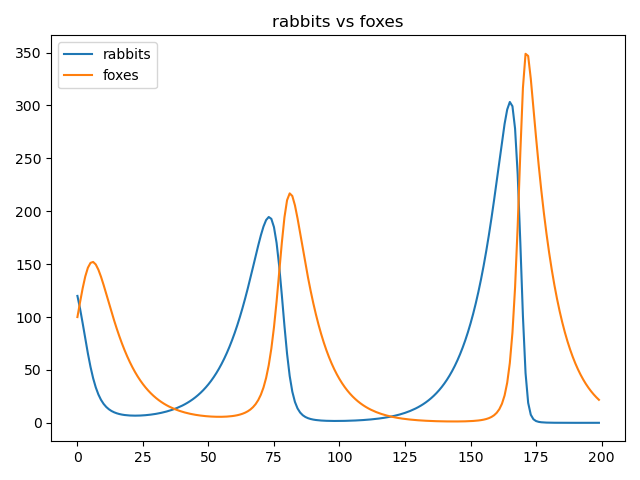
To run and plot the population stocks:
m(fox_growth_rate=.002, rabbit_death_rate=.002, rabbits_0=120.0)
reno.plot_refs([(m.rabbits, m.foxes)])
To use Bayesian inference, we define one or more metrics that can be observed (can
have defined likelihoods.) For instance, we could determine what rabbit population
growth rate would need to be for the fox population to oscillate somewhere between
20-120. Transpiling into PyMC and running the inference process is similar to the
normal model call, but with .pymc(), specifying any free variables (at least
one will need to be defined as a prior probability distribution), observations
to target, and any sampling/pymc parameters:
m.minimum_foxes = reno.Metric(reno.series_min(m.foxes))
m.maximum_foxes = reno.Metric(reno.series_max(m.foxes))

trace = m.pymc(
    n=1000,
    fox_growth_rate=reno.Normal(.001, .0001),  # specify some variables as distributions to sample from
    rabbit_growth_rate=reno.Normal(.1, .01),   # specify some variables as distributions to sample from
    observations=[
        reno.Observation(m.minimum_foxes, 5, [20]),  # likelihood normally distributed around 20 with SD of 5
        reno.Observation(m.maximum_foxes, 5, [120]), # likelihood normally distributed around 120 with SD of 5
    ]
)
To see the shift in prior versus posterior distributions, we can plot the random
variables and some of the relevant stocks using plot_trace_refs:
reno.plot_trace_refs(
    m,
    {"prior": trace.prior, "post": trace.posterior},
    ref_list=[m.minimum_foxes, m.maximum_foxes, m.fox_growth_rate, m.rabbit_growth_rate, m.foxes, m.rabbits],
    figsize=(8, 5),
)
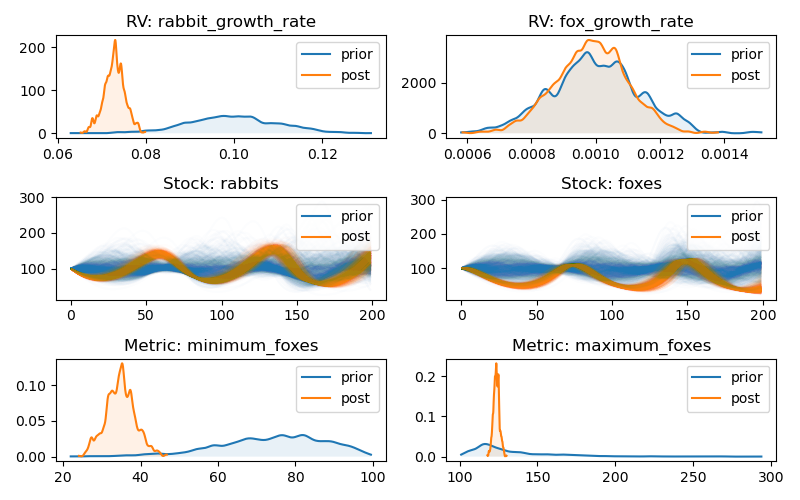
showing that the rabbit_growth_rate needs to be around 0.07 in order for
those observations to be met.
For a more in-depth introduction to reno, see the tub example in the ./notebooks folder.
Documentation
For the API reference as well as (eventually) the user guide, see https://ornl.github.io/reno/stable
Citation
To cite usage of Reno, please use the following bibtex:
@misc{doecode_166929,
    title = {Reno},
    author = {Martindale, Nathan and Stomps, Jordan and Phathanapirom, Urairisa B.},
    abstractNote = {Reno is a tool for creating, visualizing, and analyzing system dynamics models in Python. It additionally has the ability to convert models to PyMC, allowing Bayesian inference on models with variables that include prior probability distributions.},
    doi = {10.11578/dc.20251015.1},
    url = {https://doi.org/10.11578/dc.20251015.1},
    howpublished = {[Computer Software] \url{https://doi.org/10.11578/dc.20251015.1}},
    year = {2025},
    month = {oct}
}
Release history Release notifications | RSS feed


Download files
Download the file for your platform. If you're not sure which to choose, learn more about installing packages.
Source Distribution
Built Distribution
Filter files by name, interpreter, ABI, and platform.
If you're not sure about the file name format, learn more about wheel file names.
Copy a direct link to the current filters
File details
Details for the file reno_sd-0.6.0.tar.gz.
File metadata
- Download URL: reno_sd-0.6.0.tar.gz
- Upload date:
- Size: 123.7 kB
- Tags: Source
- Uploaded using Trusted Publishing? No
- Uploaded via: twine/6.2.0 CPython/3.12.11
File hashes
| Algorithm | Hash digest | |
|---|---|---|
| SHA256 |
551a8c97d87aee79b35e0b6b8c8040a7daf91fc0bd16ec3726a9de4b028e5593
|
|
| MD5 |
e7c4d02f235497e60aa90a99f340dede
|
|
| BLAKE2b-256 |
fdb83a3e4816587a98d6191b83c70dfe31d78ddd74e3f97ebbede43cbcd49452
|
File details
Details for the file reno_sd-0.6.0-py3-none-any.whl.
File metadata
- Download URL: reno_sd-0.6.0-py3-none-any.whl
- Upload date:
- Size: 109.4 kB
- Tags: Python 3
- Uploaded using Trusted Publishing? No
- Uploaded via: twine/6.2.0 CPython/3.12.11
File hashes
| Algorithm | Hash digest | |
|---|---|---|
| SHA256 |
803ed00d4fe8e581fa20dcdfae11a6f2198e3ca3e91d4a40671e72f0c8540030
|
|
| MD5 |
a5a827372403d147a953e58e68424bb9
|
|
| BLAKE2b-256 |
09022f5c9cde10518b290a10fe9303f4f894054d5755947649c78cdd178b26d4
|






