
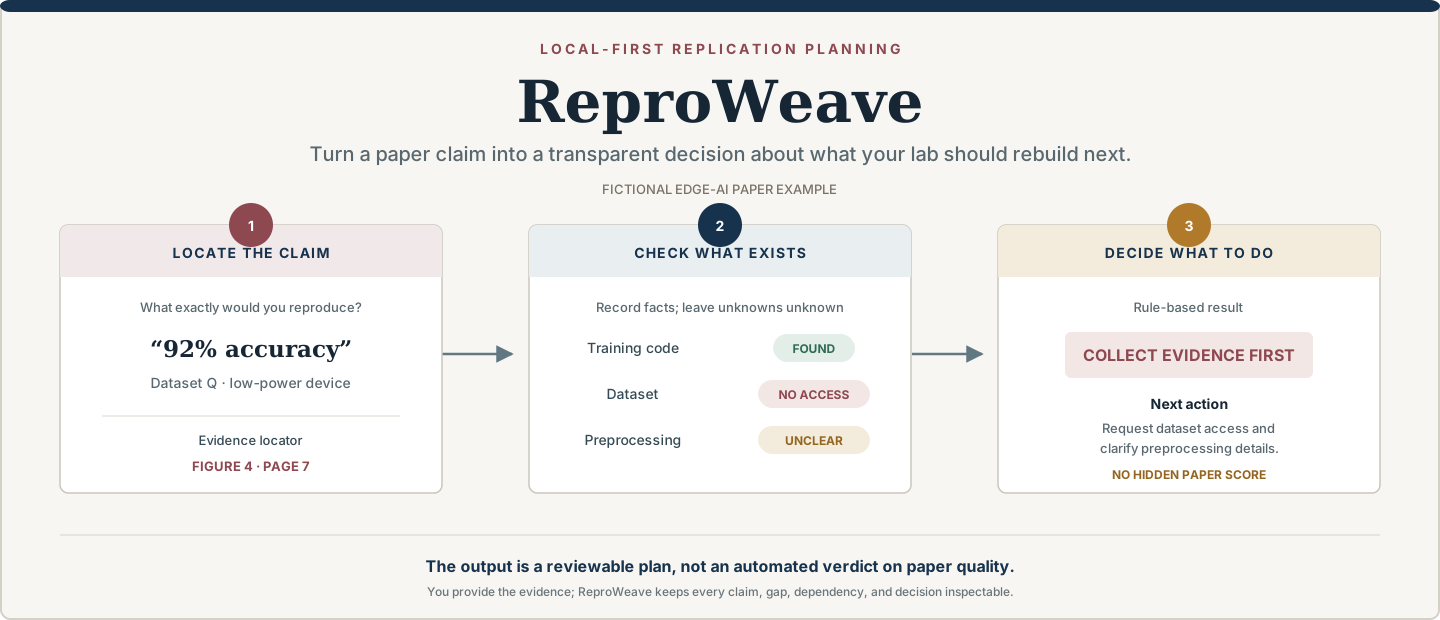
ReproWeave
Decide what can be rebuilt before committing the lab.
Local-first · Python 3.11+ · zero runtime dependencies · MIT
ReproWeave is a file-native research tool for engineers and AI researchers. It connects each paper to the claims you care about, the exact figure or appendix that supports them, the experiments and resources they depend on, a transparent reconstructability assessment, and a dependency-aware plan for testing the work yourself. Its rule-based triage joins those records into a practical queue: run now, prepare, collect evidence first, or finish the plan.
It deliberately does not scrape PDFs, call a language model, assign a hidden “paper quality” score, or require a cloud account. You supply the evidence; ReproWeave keeps the reasoning reviewable.
See it before installing
- Project website
- PyPI package
- Interactive synthetic evidence report
- Synthetic evidence matrix
- Synthetic reviewer agreement status
- Synthetic replication triage
- Synthetic replication plan
Every record in the demonstration is fictional. It exists to show the workflow without misrepresenting a real paper, author, repository, score, or experimental result.
The problem it solves
A citation library answers “what did I save?” A reproducibility checklist asks “what did the authors disclose?” A project tracker asks “what should I do next?” ReproWeave joins these views without pretending they are the same:
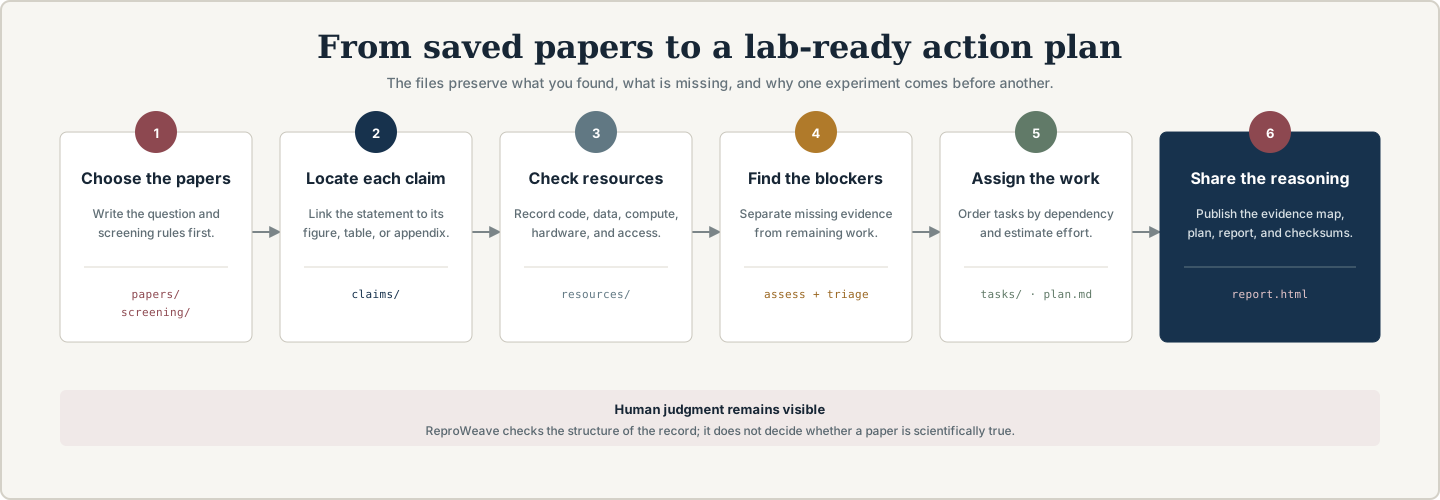
The workflow keeps source evidence, missing information, and human decisions separate.
The result is useful when deciding which paper to reproduce, preparing a lab meeting, scoping a benchmark, handing work to a collaborator, or explaining why an experiment is blocked.
Quick start
ReproWeave needs Python 3.11 or newer and has no runtime dependencies. Install from PyPI:
python -m pip install reproweave
reproweave demo my-review
reproweave audit --workspace my-review
reproweave agreement --workspace my-review
reproweave triage --workspace my-review --format markdown --output my-review/reports/triage.md
reproweave report --workspace my-review
For an isolated one-off demonstration with pipx:
pipx run reproweave demo my-review
PyPI distributions are published from the tagged GitHub workflow with a short-lived OIDC credential and a public provenance attestation. GitHub Release assets include the same wheel, source archive, and SHA-256 checksums.
For development directly from the repository:
git clone https://github.com/CAOShurong/reproweave.git
cd reproweave
python -m pip install -e .
reproweave demo scratch/demo
Open scratch/demo/reports/evidence-report.html in any modern browser. The report is one
self-contained HTML file: no server, JavaScript package, font request, or analytics endpoint.
A real workflow
1. Create the review boundary
reproweave init reviews/edge-ai \
  --title "Edge AI replication candidates" \
  --question "Which latency claims can be reconstructed on our hardware?" \
  --owner "Your Lab"
Edit reviews/edge-ai/reproweave.json to record inclusion criteria before screening.
2. Import references offline
reproweave import bibtex library.bib --workspace reviews/edge-ai --dry-run
reproweave import bibtex library.bib --workspace reviews/edge-ai
reproweave import csl-json selected.json --workspace reviews/edge-ai
reproweave duplicates --workspace reviews/edge-ai --format markdown
The importers cover the portable subset needed for review records. Keep the original export in version control because ReproWeave is not a full BibTeX macro engine or citation manager. Every batch is parsed and validated before the first file is written. Exact DOI matches and conservative title/year/first-author candidates stop the import until their candidate IDs are reviewed and accepted explicitly; ReproWeave never merges or deletes papers automatically.
3. Add evidence artifacts
Artifacts are plain JSON. Add them by writing files in their documented directories or through the validated CLI:
reproweave add claim claim.json --workspace reviews/edge-ai
reproweave add assessment assessment.json --workspace reviews/edge-ai
reproweave add task task.json --workspace reviews/edge-ai
Each claim requires an evidence_locator such as Figure 4, Appendix B.2, or
repository/results.csv. A rating requires a written evidence note. Missing facts remain
unknown; they are never filled by inference.
If two or more people assess the same paper, keep every review as kind: "individual" and add
one kind: "consensus" assessment whose source_assessment_ids cover all current individual
reviews and whose source_assessment_hashes bind their current canonical content. ReproWeave does
not average ratings, infer a majority, or choose the last file. Inspect the state and copy the
reported hashes before generating derived rankings:
reproweave agreement --workspace reviews/edge-ai --format markdown
See reviewer consensus and migration for the JSON shape, evidence behind this choice, and the limits of self-reported reviewer names.
4. Triage candidates before committing resources
reproweave assess --workspace reviews/edge-ai
reproweave matrix --workspace reviews/edge-ai --format csv --output matrix.csv
reproweave backlog --workspace reviews/edge-ai
reproweave triage --workspace reviews/edge-ai --format markdown --output triage.md
reproweave plan --workspace reviews/edge-ai --format markdown --output plan.md
Triage combines the recorded assessment, experiment resources, task states, dependencies, and remaining effort. Hard blockers are evaluated before effort; there is no hidden composite score. Test a resource-access scenario without editing the workspace:
reproweave triage --workspace reviews/edge-ai \
  --resource rf-spectra-v2=available \
  --format markdown --output triage-with-data.md
The override changes only the generated scenario. Task dependencies then become execution waves. Tasks in one wave can run in parallel; later waves wait for declared prerequisites. Availability and effort remain reviewer-supplied inputs.
The next figure shows why that distinction matters. Two papers can look equally interesting, yet one can start now while the other first needs missing data or hardware details.
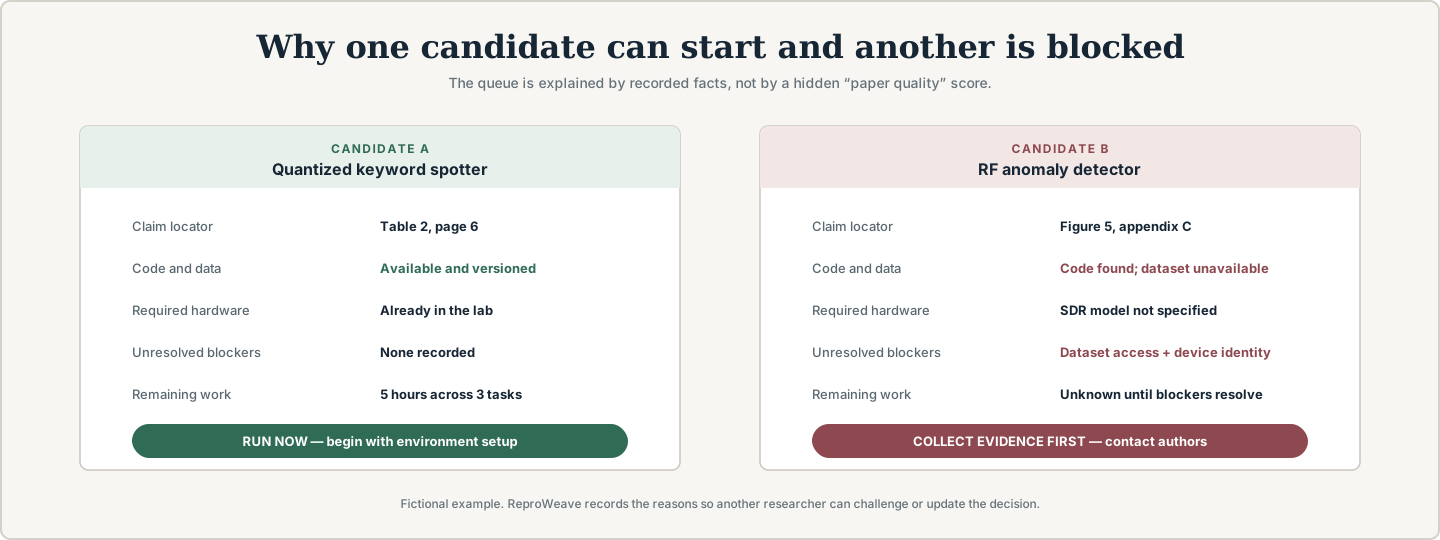
The labels “run now” and “collect evidence first” are explained by visible facts, not a secret score.
5. Audit and seal the review
reproweave audit --workspace reviews/edge-ai
reproweave seal --workspace reviews/edge-ai
reproweave verify --workspace reviews/edge-ai
The audit checks artifact schemas, filename/ID integrity, workspace-wide ID uniqueness, cross references, reviewer consensus, task cycles, and assessment coverage. The seal hashes the manifest and every source artifact with SHA-256. It proves that a specific workspace snapshot has not changed; it does not prove that a scientific claim is true.
The eight-dimension rubric
| Dimension | What the reviewer must establish | Weight |
|---|---|---|
| Method specificity | An independent reader can reconstruct the method | 1.25 |
| Data availability | Exact inputs are available or reconstructable | 1.25 |
| Code availability | Runnable, versioned, sufficiently licensed code exists | 1.00 |
| Environment capture | Software, dependencies, hardware, and seeds are recorded | 1.00 |
| Metric definition | Metrics, aggregation, and uncertainty are specified | 1.00 |
| Baseline traceability | Baseline identity and settings can be found | 0.75 |
| Compute disclosure | Training or experimental compute is bounded | 0.75 |
| Result traceability | Headline results link to configurations and artifacts | 1.25 |
Ratings are yes, partial, no, unknown, or na. Scores summarize documented
reconstructability only. They do not measure correctness, novelty, importance, statistical
validity, fairness, or research integrity. Read
the scoring methodology
before comparing projects.
Workspace anatomy
review/
├── reproweave.json          # scope and screening criteria
├── papers/                  # bibliographic identity
├── claims/                  # bounded statements + evidence locators
├── experiments/             # protocol summaries and resource links
├── resources/               # code, data, environments, models, hardware
├── assessments/             # explicit rubric ratings and next actions
├── tasks/                   # replication DAG, states, estimates, acceptance
├── screening/               # inclusion/exclusion decision trail
├── reports/                 # generated HTML, CSV, Markdown, and JSON
└── reproweave-seal.json     # content-addressed source snapshot
Seven published JSON Schemas document the durable artifacts. Runtime validation uses the same conservative vocabulary without adding a JSON Schema dependency.
Commands
| Command | Purpose |
|---|---|
init |
Create a review workspace |
import |
Preflight and import BibTeX or CSL JSON |
duplicates |
Report duplicate candidates as stable JSON, CSV, or Markdown |
add |
Validate and add one JSON artifact |
assess |
Calculate rubric coverage and common gaps |
agreement |
Show individual reviews, conflicts, and explicit consensus status |
matrix |
Export a paper-by-dimension matrix |
backlog |
Rank unresolved evidence work |
triage |
Build a rule-based candidate queue and test resource-access scenarios |
graph |
Export the typed evidence graph |
plan |
Build dependency waves and effort summaries |
audit |
Check artifacts, references, cycles, and coverage |
report |
Generate a self-contained interactive HTML report |
seal |
Hash the complete source set |
verify |
Compare the current source set with a saved seal |
demo |
Generate the fictional EE/AI example |
Run reproweave COMMAND --help for exact options.
Why local-first?
Literature assessments often contain unpublished research questions, early replication choices, reviewer notes, or links to restricted datasets. ReproWeave keeps those records in ordinary files that can stay on your device, live in a private repository, or enter your lab's existing backup system. No data is uploaded by the application.
“Local-first” is not a security guarantee. Repository permissions, disk encryption, backups, and the sensitivity of quoted material remain your responsibility. See SECURITY.md.
What ReproWeave is not
- It is not Zotero, a PDF reader, a systematic-review search engine, or a reference formatter.
- It does not claim formal PRISMA compliance or automate database search.
- It does not execute third-party repositories or sandbox untrusted research code.
- It does not reproduce an experiment merely because the audit passes.
- It does not use LLMs to infer evidence, judge papers, or fill missing fields.
- It is not an institutional record of research integrity.
These boundaries are features: the tool makes a narrow, inspectable record instead of hiding uncertainty behind automation.
Where it fits
Reference managers organize literature, systematic-review platforms support search and screening, and experiment trackers record runs. ReproWeave starts after a candidate set has been chosen. It preserves the claim-to-artifact chain and turns missing evidence and resources into an inspectable execution decision.
That positioning is intentionally narrower than “a complete systematic-review platform.” The project does not claim that evidence maps, reproducibility checklists, or replication planners are new ideas. Its contribution is a dependency-free, file-native bridge between them, including what-if resource triage and content-addressed verification. See the competitive landscape for tested boundaries and alternatives.
Documentation
- Methodology and score interpretation
- Data model
- Reviewer consensus and migration
- Replication planning
- Audit and evidence seals
- Import behavior
- Competitive landscape
- Validation evidence
- Roadmap
Development
python -m unittest discover -s tests -v
ruff check src tests scripts
ruff format --check src tests scripts
python -m compileall -q src tests scripts
python scripts/check_repository.py
python -m build
The test suite uses only the Python standard library. CI runs on Windows and Ubuntu with Python 3.11 and 3.13, then installs the built wheel in a clean environment and exercises the CLI.
Contributing
Bug reports, schema discussions, and focused pull requests are welcome. Please read CONTRIBUTING.md and the Code of Conduct. Scientific disagreement is welcome; personal evaluation of authors is not.
License and citation
ReproWeave is released under the MIT License. Cite the versioned software release using CITATION.cff.
Questions and real replication-planning workflows belong in Discussions. Reproducible defects and methodology proposals belong in Issues.
Created and maintained by Shurong Cao.
1 maintainer

Metadata
1 maintainer
Release files for reproweave 0.4.2
For a detailed explanation of source distributions (sdists) and built distributions (wheels), please see the package formats documentation.
Source distribution (sdist)
| File | Size | Uploaded | |
|---|---|---|---|
| reproweave-0.4.2.tar.gz | 138.5 kB | Details |
Built distribution (wheel)
| File | Interpreter | ABI | Platform | Reset |
|---|---|---|---|---|
| reproweave-0.4.2-py3-none-any.whl | Python 3 | none | any | Details |
Total release size: 194.1 kB
Release files / reproweave-0.4.2.tar.gz
| Download URL | reproweave-0.4.2.tar.gz |
|---|---|
| Size | 138.5 kB |
| Tags | Source |
|
SHA-256 checksum How to use checksums |
2275596e4d5dc71e6cff751e5337ae646c274121246903652067d0206a403634
|
|
BLAKE2b-256 checksum How to use checksums |
c1325b9cb01088f7f6aa1816ebd0fd2eb9cae6d95c5c50a00924b46bb27f087e
|
| Upload date | |
|
Uploaded using Trusted Publishing? What is trusted publishing? |
Yes |
| Uploaded via |
twine/7.0.0 CPython/3.13.14
|
Provenance
Provenance describes where a file came from. On PyPI, provenance is shared via attestations, which provide a verifiable record of the build or publishing details. View details, limitations and caveats.


PyPI Publish Attestation
PyPI verified that this artifact, at this checksum, originated from the publisher listed below.
Signed by GitHub Actions, verified by PyPI on Aug 12, 2026.
Transparency logRelease files / reproweave-0.4.2-py3-none-any.whl
| Download URL | reproweave-0.4.2-py3-none-any.whl |
|---|---|
| Size | 55.6 kB |
| Tags | Python 3 |
|
SHA-256 checksum How to use checksums |
63affd6e828dc988ca07d4891a08e77bc0bdd8d57eb002caf6d72a40f616e6d4
|
|
BLAKE2b-256 checksum How to use checksums |
312a451066799f4aa7f0fad2cd30a320843ecae4f619fc541c544b125f7ede55
|
| Upload date | |
|
Uploaded using Trusted Publishing? What is trusted publishing? |
Yes |
| Uploaded via |
twine/7.0.0 CPython/3.13.14
|
Provenance
Provenance describes where a file came from. On PyPI, provenance is shared via attestations, which provide a verifiable record of the build or publishing details. View details, limitations and caveats.
PyPI Publish Attestation
PyPI verified that this artifact, at this checksum, originated from the publisher listed below.
Signed by GitHub Actions, verified by PyPI on Aug 12, 2026.
Transparency log













