
Requivo




Find what could change the solution before you commit to the scope.
Start from a client request, a stakeholder ask, or your own half-formed idea for what to build. Requivo identifies the assumptions and missing decisions that could change the workflow, integrations, permissions, timeline or effort — then produces one brief you can review before estimating.
The shared understanding is the source of truth. Every document is generated from it.
Built for the person who owns scoping — solutions engineers, consultants, technical PMs and agency leads — on complex, configurable B2B products. Run it locally, then hand the decision brief (or the Requivo Web session) to the PM or client who needs to sign off.
Start here
You have an Anthropic API key → Requivo Web
- Install uv, if you don't already have it:
curl -LsSf https://astral.sh/uv/install.sh | sh - Set your key:
export ANTHROPIC_API_KEY="…" - Run it:
uvx --from "requivo[web,anthropic]" requivo web
Opens http://127.0.0.1:8765. No key? It still opens and offers Explore a worked example — the
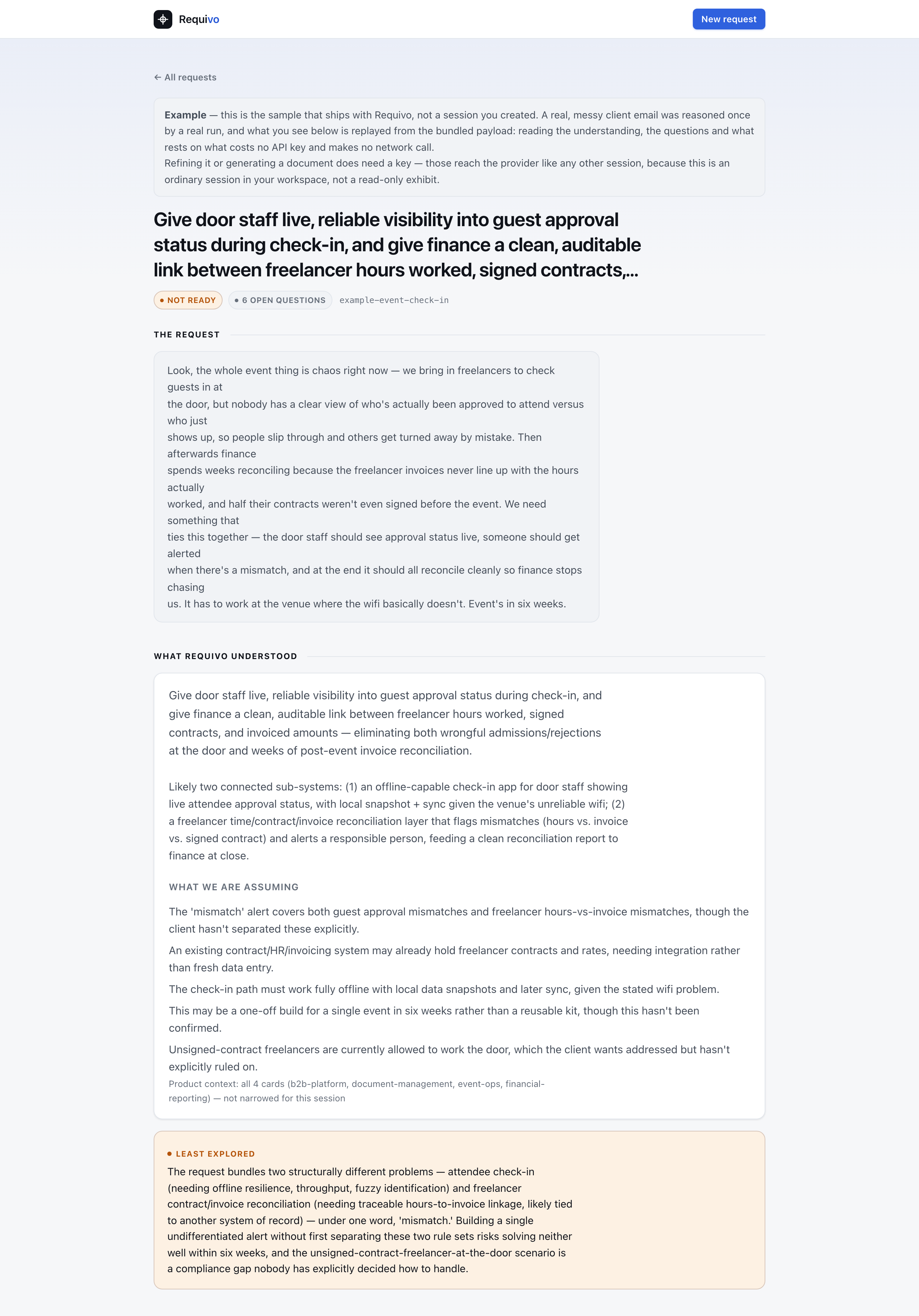
same client email requivo demo replays, materialised as a real session (demo video).
Analysing your own request costs cents: a first discovery measured $0.06–$0.14, and all seven
documents from one model $0.54 — a real run's own usage ledger, not a calculation; the per-command
table is in docs/providers.md. Other install routes and the full platform list:
docs/getting-started.md.
You use Claude Code → the plugin
On native Windows, install Git for Windows first — it gives Claude Code the Bash tool the skills run through; nothing extra is needed on macOS, Linux or WSL.
All four steps are typed inside Claude Code:
/plugin marketplace add jbkkz/requivo/plugin install requivo@requivo/reload-plugins- Run it:
/requivo:run "We'd like a leave approval system."
No Anthropic key needed — reasoning happens in your own Claude session. The first
/requivo:run doubles as the CLI check: if requivo isn't on your PATH yet and you already have
uv or pipx, the plugin names the exact install command and only runs it once you say yes. Have
neither? It tells you the two lines to run yourself and to re-run the skill after — the one case
that still touches a terminal. Full skill list and detail: plugin README.
Why Requivo, and how it works
An LLM will happily turn a half-understood request into a polished PRD. Clean documentation is not the same as a correct understanding — and the expensive mistakes come from the question nobody thought to ask, the one that turns a "small feature" into a three-month build.
The rule that follows is information value = uncertainty × impact: Requivo asks a question only when the answer would materially change the solution, and leaves the rest as an explicit assumption to confirm. Impact is estimated from the product context you give it, so better context means sharper questions.
- Bring a request — a sentence or a rambling email; a symptom, not a spec.
- Clarify high-impact unknowns — the gaps the rule above flags as worth asking about; everything else stays an assumption to confirm.
- Build and validate the understanding — a versioned, typed model that is the durable product.
- Write the decision brief, and see what a changed answer costs — a computed answer to "what does this invalidate?", read off the dependency graph rather than re-reasoned from scratch — and, once an assumption has been confirmed, which decisions on record were made before that evidence arrived and are worth re-reading.
Because it keeps the understanding rather than just the answer, step 4 is more than a document — it can tell you what a changed answer costs:
You change one answer:
  "The migration is one-time. After cutover, the legacy system is read-only."

Requivo:
  What changed        Integrations & notifications
  Needs review        the two-way sync decision · the reconciliation risk · the decision brief
That is the part a chat transcript cannot do.
The decision brief is the smallest document a scope review can be run from: what is confirmed, what is assumed, the decisions on record, the premises worth contesting, and what is still open. It is not a PRD; it is what you read before writing one. And every downstream document — a PRD, user stories, acceptance criteria, an uncertainty-aware estimate — generates from the same understanding, without redoing the discovery. A delivery epic — with GitHub/GitLab issue plans — and release notes follow the same rule once scoping is settled.
The canonical example is examples/leave-approval/ — one line of
request, taken through the questions, the brief, and a changed answer that moves the scope. A harder,
messy multi-feature one lives in
examples/event-checkin-reconciliation/, and is what
requivo demo replays. The vocabulary — what we know, what we are assuming, open question, needs
updating, are we ready — and the model underneath it: docs/requirements-model.md.
Documentation
| Doc | What it covers |
|---|---|
| Getting started | Install and first run for each interface, supported platforms |
| Web | The primary interface — the local browser workspace |
| CLI reference | Every command and flag |
| Requirements model | The vocabulary, readiness, dependencies |
| Architecture | Core, providers, services, interfaces — how the pieces fit |
| Roadmap | What's stable, what's next, the compatibility promise |
| Everything else | Session format, providers, context cards, evaluations |
Ran it on a real request? Tell us how it did — say whether the questions were useful, useless or redundant, and what a senior PM/BA would have asked instead (anonymise anything client-confidential first).
Contributing and license
Contributions are welcome — see CONTRIBUTING.md. Requivo is written by AI coding agents under maintainer direction and review — CONTRIBUTING.md has the account of the controls around that. The Core, CLI and Claude Code integration are open source under Apache-2.0; the Requivo name and identity are separate from the code license — see TRADEMARKS.md.
Apache-2.0 © jbkkz — Requivo was previously named Product Copilot.
1 maintainer

Metadata
1 maintainer
Release files for requivo 3.4.1
For a detailed explanation of source distributions (sdists) and built distributions (wheels), please see the package formats documentation.
Source distribution (sdist)
| File | Size | Uploaded | |
|---|---|---|---|
| requivo-3.4.1.tar.gz | 1.2 MB | Details |
Built distribution (wheel)
| File | Interpreter | ABI | Platform | Reset |
|---|---|---|---|---|
| requivo-3.4.1-py3-none-any.whl | Python 3 | none | any | Details |
Total release size: 2.5 MB
Release files / requivo-3.4.1.tar.gz
| Download URL | requivo-3.4.1.tar.gz |
|---|---|
| Size | 1.2 MB |
| Tags | Source |
|
SHA-256 checksum How to use checksums |
fec36ac5222245477723016004a17cc4a4d782d1bf7934d9815fca77372bceab
|
|
BLAKE2b-256 checksum How to use checksums |
e4017b8bee23c9fb57b452225a6489478f32d1eeab2cff103b51a701341b738b
|
| Upload date | |
|
Uploaded using Trusted Publishing? What is trusted publishing? |
Yes |
| Uploaded via |
twine/7.0.0 CPython/3.13.14
|
Provenance
Provenance describes where a file came from. On PyPI, provenance is shared via attestations, which provide a verifiable record of the build or publishing details. View details, limitations and caveats.


PyPI Publish Attestation
PyPI verified that this artifact, at this checksum, originated from the publisher listed below.
Signed by GitHub Actions, verified by PyPI on Oct 2, 2026.
Transparency logRelease files / requivo-3.4.1-py3-none-any.whl
| Download URL | requivo-3.4.1-py3-none-any.whl |
|---|---|
| Size | 1.3 MB |
| Tags | Python 3 |
|
SHA-256 checksum How to use checksums |
469e2826c9657f96805eaf5e8da3447fcd468ccff6d68742a79fce971d930065
|
|
BLAKE2b-256 checksum How to use checksums |
ee1c47fa36c44f92e50ec4778339aa04ba54fc4597e547242d35542ad916914d
|
| Upload date | |
|
Uploaded using Trusted Publishing? What is trusted publishing? |
Yes |
| Uploaded via |
twine/7.0.0 CPython/3.13.14
|
Provenance
Provenance describes where a file came from. On PyPI, provenance is shared via attestations, which provide a verifiable record of the build or publishing details. View details, limitations and caveats.
PyPI Publish Attestation
PyPI verified that this artifact, at this checksum, originated from the publisher listed below.
Signed by GitHub Actions, verified by PyPI on Oct 2, 2026.
Transparency log













