
Resilient Automation Test Stand




A ready-to-run deterministic failure sandbox for browser automation.
Use it to prove that Playwright, Selenium, scrapers, and HTTP automation workers recover from real, repeatable failure sequences—not just happy-path responses. Unlike a static mock endpoint, it ships browser and API workflows with deterministic stateful failures, stable locators, login, and pagination.
Try the Resilience Challenge · See the C# reference consumer for a production-style worker that is validated against a pinned Test Stand release. · Read the public compatibility contract
Start in minutes
These two paths work without cloning this repository.
Install from PyPI
Requires Python 3.11 or newer.
python -m pip install resilient-automation-test-stand
automation-test-stand --port 8080
Run the released container
docker run --rm -p 8080:8080 \
  ghcr.io/bockuden/resilient-automation-test-stand:1.1.5
After starting either distribution, open this URL in a browser or navigate to it with an automation worker:
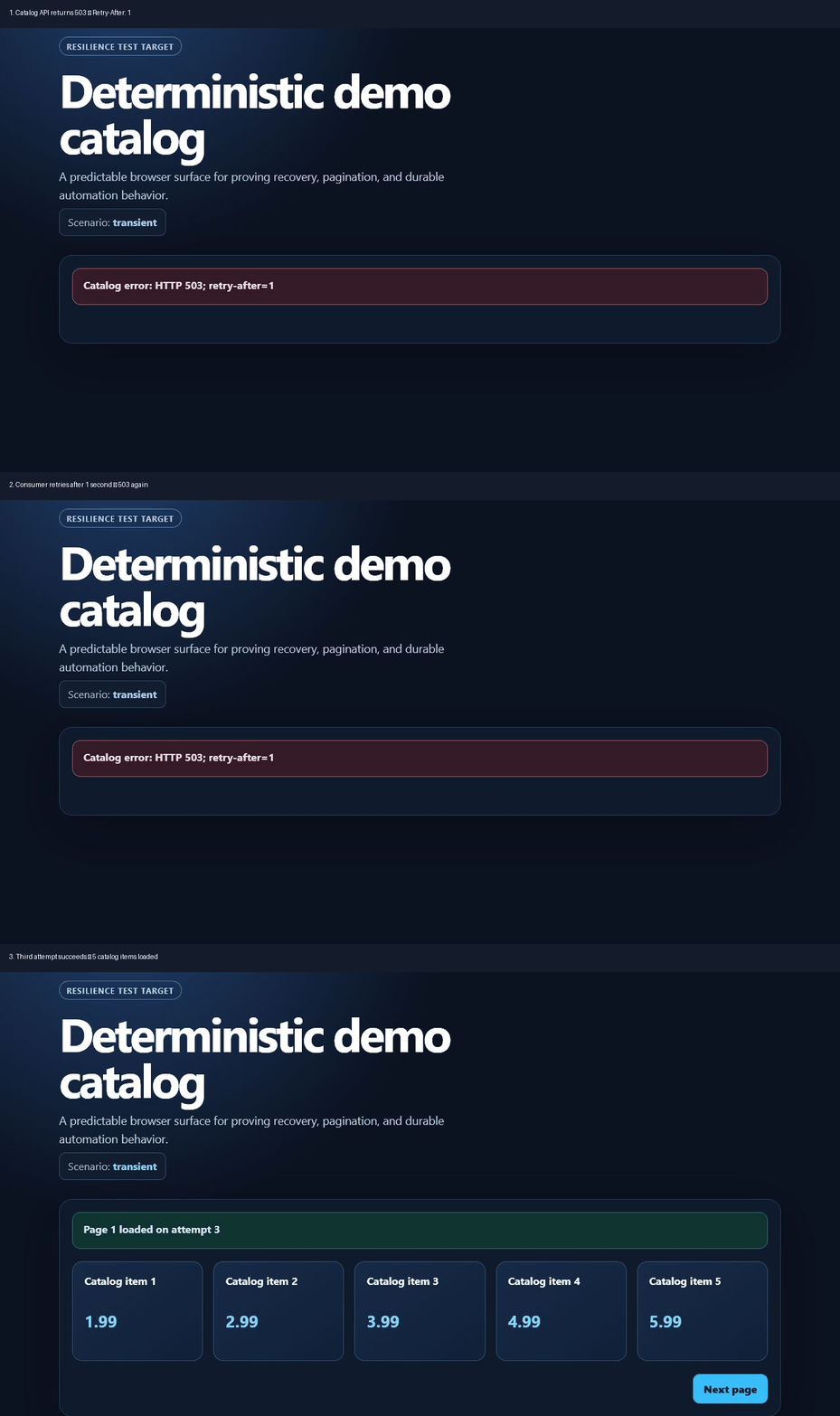
http://localhost:8080/catalog?scenario=transient&run_id=demo&fail_for=2
The consumer—not the stand—owns the retry policy. The first two catalog API
requests for this run_id return 503 with Retry-After: 1; the third
succeeds. Use a new run_id for a clean, independent failure sequence.
Who this is for
- QA and SDET engineers validating retry, timeout, checkpoint, and evidence handling in browser workers.
- Scraping and data engineers who need a deterministic target for pagination, duplicates, DOM changes, and resumable collection.
- Library authors who want contract fixtures before integrating with a variable third-party website.
- Educators teaching resilient automation without depending on a live site.
What each case proves
An ordinary mock often returns one static response. This stand keeps a small,
isolated state machine per run_id, so a consumer has to prove its behavior
across an ordered sequence of requests.
| Case | Deterministic behavior | What the consumer must prove |
|---|---|---|
success |
Every in-range page returns five stable items and 200. |
It can complete the baseline paginated workflow. |
transient |
The first fail_for requests per page return 503 with Retry-After: 1, then 200. |
It honors the delay, caps its retry budget, and eventually succeeds. |
permanent |
Every catalog API request returns 500. |
It stops retrying and reports a terminal failure instead of looping forever. |
slow |
Each API response waits for delay_ms, then returns the normal page. |
Its timeout and cancellation policies end the operation cleanly. |
resume |
Only fail_page returns 500; the other pages remain available. |
It persists a checkpoint and resumes without reprocessing completed pages. |
duplicates |
Each page after the first begins with the previous page's final item ID. | It deduplicates records across pagination boundaries. |
dom-change |
CSS classes and element nesting change while stable data-testid locators remain. |
It uses semantic or stable locators rather than DOM shape. |
protected=true |
The browser route redirects through the fixed demo login and back to the original catalog URL. | It preserves the session cookie and return URL. |
Where WireMock and Toxiproxy fit
This stand complements general-purpose mocking and network-fault tools. Start with the tool whose primary surface matches the behavior you need to test.
| Primary need | Start with |
|---|---|
| Arbitrary HTTP mappings and configurable state-machine transitions | WireMock |
| TCP latency, bandwidth limits, timeouts, connection shutdowns, and resets | Toxiproxy |
| A ready-made browser workflow with login, UI, API, pagination, and recovery cases | Resilient Automation Test Stand |
WireMock lets a team define its own mappings and scenario states. Toxiproxy manipulates connections between a client and an upstream service. This stand trades that generality for a shorter path from startup to a reproducible browser-automation resilience test.
Development setup
Use this section after cloning the repository. Requirements: Python 3.11 or newer.
Only virtual-environment creation and activation differ by platform.
Windows PowerShell:
python -m venv .venv
.\.venv\Scripts\Activate.ps1
Linux and macOS:
python3 -m venv .venv
source .venv/bin/activate
After activation, installation and startup are identical in PowerShell, Linux, and macOS shells:
python -m pip install -e '.[dev]'
automation-test-stand --port 8080
The module entry point is equivalent on every platform:
python -m resilient_automation_test_stand --port 8080
Docker Compose
These commands are the same in PowerShell, Linux shells, and macOS Terminal:
docker compose up --build --detach --wait
docker compose down
Check readiness while the service is running.
Windows PowerShell:
Invoke-RestMethod http://localhost:8080/health
Linux and macOS:
curl --fail http://localhost:8080/health
The development image is named resilient-automation-test-stand:dev.
Released images are published as
ghcr.io/bockuden/resilient-automation-test-stand:<version>.
Troubleshooting
| Symptom | Resolution |
|---|---|
Port 8080 is already in use |
Change the Compose port mapping or stop the process that owns the port, then run docker compose up --build --detach --wait again. |
| A transient scenario succeeds or fails at an unexpected attempt | Use a new run_id, or call POST /admin/reset before the test. Counters are intentionally shared only within one run_id. |
| A protected catalog returns the login form again | Preserve the demo_session cookie after submitting the login form; direct API requests to /api/catalog do not require it. |
| Docker cannot run the image on the current machine | Use a Docker engine that can run the image platform, or run the Python quick start locally instead. |
Demo authentication
Add protected=true to a /catalog URL, or select a preset with
protected = true, to redirect the browser to the login form. The credentials
are fixed test-stand values:
| Value | Input |
|---|---|
| Username | demo |
| Password | automation |
They are intentionally not configured in scenarios.toml. That file selects
whether login is required; a user enters the values above in the form, while an
automation script fills input[name="username"] and
input[name="password"], then submits the form.
The equivalent form request is:
POST /login
Content-Type: application/x-www-form-urlencoded

username=demo&password=automation&next_url=/catalog?protected=true
Successful login sets the demo_session=authenticated cookie and redirects
back to next_url. A script that posts the form directly must preserve this
cookie for the following /catalog request. Authentication protects the
browser catalog route; /api/catalog remains directly accessible for API-only
tests.
Scenario cookbook
Start the server first, then use one of the commands below. Protected scenarios redirect to the demo login form described above.
Windows PowerShell
$catalog = 'http://localhost:8080/catalog'

# Ten successful catalog pages.
Start-Process "$catalog?scenario=success&run_id=ten-pages&total_pages=10"

# Login, then ten successful catalog pages.
Start-Process "$catalog?protected=true&scenario=success&run_id=login-ten-pages&total_pages=10"

# Login, then two delayed 503 responses per page before recovery.
Start-Process "$catalog?protected=true&scenario=transient&run_id=login-delayed-503&total_pages=10&fail_for=2&failure_delay_ms=1500"
Linux
catalog='http://localhost:8080/catalog'

xdg-open "${catalog}?scenario=success&run_id=ten-pages&total_pages=10"
xdg-open "${catalog}?protected=true&scenario=success&run_id=login-ten-pages&total_pages=10"
xdg-open "${catalog}?protected=true&scenario=transient&run_id=login-delayed-503&total_pages=10&fail_for=2&failure_delay_ms=1500"
macOS
catalog='http://localhost:8080/catalog'

open "${catalog}?scenario=success&run_id=ten-pages&total_pages=10"
open "${catalog}?protected=true&scenario=success&run_id=login-ten-pages&total_pages=10"
open "${catalog}?protected=true&scenario=transient&run_id=login-delayed-503&total_pages=10&fail_for=2&failure_delay_ms=1500"
The delayed transient example waits 1.5 seconds before each of the first two
503 responses on every page. A manual browser displays the error and can be
reloaded; an automation worker can exercise its retry policy and recover on the
third attempt.
Runnable resilience examples
Start the stand first. Each example generates a fresh run_id unless one is
provided, prints reproducible JSON evidence, and exits nonzero when the expected
behavior is not proved.
Playwright: login and bounded browser retries
Install the optional browser dependency once, then run the standalone Playwright example:
python -m pip install playwright
playwright install chromium
python -m resilient_automation_test_stand.examples.playwright_resilience
The script logs in with the fixed demo account, reads Retry-After, performs at
most three browser attempts, and asserts five items on recovery.
HTTP API: retry, pagination, and deduplication
The standard-library API example needs no additional dependency:
python -m resilient_automation_test_stand.examples.api_retry_dedup
It first completes three transient pages with a bounded retry budget, then collects the duplicate scenario and reports raw, unique, and removed item IDs.
Checkpoint and resume
The first invocation intentionally stops with a nonzero exit code on page 3 and leaves a checkpoint containing the ten items from pages 1 and 2:
python -m resilient_automation_test_stand.examples.resume_checkpoint \
  --checkpoint .tmp/resume-example.json
After the simulated dependency recovers, run the same consumer against the success scenario. It reads the checkpoint and requests only pages 3 and 4:
python -m resilient_automation_test_stand.examples.resume_checkpoint \
  --scenario success \
  --checkpoint .tmp/resume-example.json
These examples correspond to Levels 2–3 and the recovery-evidence bonus in the Resilience Challenge.
For a production-style .NET consumer with retries, checkpoints, cancellation, and browser evidence, see resilient-browser-automation.
Resilience Challenge
Work through the four-level, reproducible Resilience Challenge to validate a consumer against success, transient recovery, login, DOM changes, duplicates, resume, and cancellation.
Named scenario presets
For repeated scenarios, the same values can be stored in a TOML file instead
of copied into every startup command. The repository includes
examples/scenarios.toml with the three cookbook
scenarios above.
These CLI commands are identical in PowerShell, Linux, and macOS shells:
automation-test-stand --config examples/scenarios.toml --list-presets
automation-test-stand --config examples/scenarios.toml --print-url login-delayed-retry
automation-test-stand --config examples/scenarios.toml --preset login-delayed-retry --port 8080
--print-url emits a self-contained URL that no longer depends on the config
file. --preset starts the server with that preset as its defaults. An explicit
query parameter overrides only the matching preset field, so the following URL
uses the preset's ten pages but disables its transient failures:
http://localhost:8080/catalog?scenario=success&run_id=override-example
Preset files use this shape; omitted fields inherit the built-in defaults:
[presets.login-delayed-retry]
protected = true
scenario = "transient"
total_pages = 10
fail_for = 2
failure_delay_ms = 1500
To fetch all ten pages directly from the API, use either loop below.
Windows PowerShell:
1..10 | ForEach-Object {
    Invoke-RestMethod "http://localhost:8080/api/catalog?scenario=success&run_id=api-ten-pages&page=$_&total_pages=10"
}
Linux and macOS:
page=1
while [ "$page" -le 10 ]; do
  curl --fail "http://localhost:8080/api/catalog?scenario=success&run_id=api-ten-pages&page=${page}&total_pages=10"
  printf '\n'
  page=$((page + 1))
done
Endpoints
| Method | Path | Purpose |
|---|---|---|
GET |
/health |
Container and service readiness |
GET |
/catalog |
JavaScript-rendered catalog and pagination shell |
GET |
/api/catalog |
Deterministic paginated catalog data |
GET |
/login |
Predictable login form |
POST |
/login |
Authenticate the demo user and set a session cookie |
POST |
/admin/reset |
Clear all in-memory attempt counters |
GET |
/api-docs |
Interactive OpenAPI documentation |
Scenario parameters
Both /catalog and /api/catalog accept the parameters below. /api/catalog
also accepts page from 1 through 20.
| Parameter | Built-in default | Meaning |
|---|---|---|
scenario |
success |
Selects a case from the proof matrix |
run_id |
manual |
Isolates request-attempt counters between test cases |
total_pages |
4 |
Number of catalog pages to expose (1-20) |
fail_for |
2 |
Initial 503 responses per page in transient (0-10) |
failure_delay_ms |
0 |
Delay before each transient 503 response (0-30000 ms) |
delay_ms |
1500 |
Delay per API request in slow (0-30000 ms) |
fail_page |
3 |
Permanently failing page in resume (1-20) |
protected |
false |
Require the demo login before serving /catalog |
The same run_id, scenario, and page share an attempt counter. Call
POST /admin/reset or choose a fresh run_id when a test needs clean state.
Development and contract checks
After activating the virtual environment:
python -m pip install -e '.[dev]' build
python -m pytest
python scripts/export_openapi.py --check
python -m build
The committed contract is docs/api/openapi.json. If an endpoint or model changes, regenerate it with:
python scripts/export_openapi.py
Contract changes require an updated snapshot, release notes, a package version change, and a backward-compatibility review. The release roadmap is tracked in the development plan. The intended 1.0 public contract and compatibility policy are documented in docs/compatibility.md. Release prerequisites and the one-time PyPI Trusted Publisher setup are documented in docs/release-checklist.md.
License
MIT. See LICENSE.
1 maintainer

Download files
Download the file for your platform. If you're not sure which to choose, learn more about installing packages.
Source Distribution
Built Distribution
Filter files by name, interpreter, ABI, and platform.
If you're not sure about the file name format, learn more about wheel file names.
Copy a direct link to the current filters
File details
Details for the file resilient_automation_test_stand-1.1.5.tar.gz.
File metadata
- Download URL: resilient_automation_test_stand-1.1.5.tar.gz
- Upload date:
- Size: 375.8 kB
- Tags: Source
- Uploaded using Trusted Publishing? Yes
- Uploaded via:
twine/6.1.0 CPython/3.13.14
File hashes
| Algorithm | Hash digest | |
|---|---|---|
| SHA256 |
4cf40360ca270dee92cade567749cf86b2f4bb87081d3cc5d979083685aaf926
|
|
| MD5 |
13f13fe04cadb07d0e74dac85514ce09
|
|
| BLAKE2b-256 |
e9d7a20a5e8b3e3f640b6368ee0313b30cacbedbefbec360c0548ba29e891e24
|
Provenance
The following attestation bundles were made for resilient_automation_test_stand-1.1.5.tar.gz:
Publisher:
release.yml on bockuden/resilient-automation-test-stand
-
Statement:
-
Statement type:
https://in-toto.io/Statement/v1 -
Predicate type:
https://docs.pypi.org/attestations/publish/v1 -
Subject name:
resilient_automation_test_stand-1.1.5.tar.gz -
Subject digest:
4cf40360ca270dee92cade567749cf86b2f4bb87081d3cc5d979083685aaf926 - Sigstore transparency entry: 2276211967
- Sigstore integration time:
-
Permalink:
bockuden/resilient-automation-test-stand@99ba34168b769edbfe7e1709e2f9a52ea7134f56 -
Branch / Tag:
refs/tags/v1.1.5 - Owner: https://github.com/bockuden
-
Access:
public
-
Token Issuer:
https://token.actions.githubusercontent.com -
Runner Environment:
github-hosted -
Publication workflow:
release.yml@99ba34168b769edbfe7e1709e2f9a52ea7134f56 -
Trigger Event:
push
-
Statement type:
File details
Details for the file resilient_automation_test_stand-1.1.5-py3-none-any.whl.
File metadata
- Download URL: resilient_automation_test_stand-1.1.5-py3-none-any.whl
- Upload date:
- Size: 25.3 kB
- Tags: Python 3
- Uploaded using Trusted Publishing? Yes
- Uploaded via:
twine/6.1.0 CPython/3.13.14
File hashes
| Algorithm | Hash digest | |
|---|---|---|
| SHA256 |
514303fac264475f15336f01825431d287d4fabc6de25b9a780984f75fb6e702
|
|
| MD5 |
28ad017cf8f8fbd63f2cb008944a1114
|
|
| BLAKE2b-256 |
580536fd71f09517cc45ec6959376dc2bef154e11154b023d644b33a45c45551
|
Provenance
The following attestation bundles were made for resilient_automation_test_stand-1.1.5-py3-none-any.whl:
Publisher:
release.yml on bockuden/resilient-automation-test-stand
-
Statement:
-
Statement type:
https://in-toto.io/Statement/v1 -
Predicate type:
https://docs.pypi.org/attestations/publish/v1 -
Subject name:
resilient_automation_test_stand-1.1.5-py3-none-any.whl -
Subject digest:
514303fac264475f15336f01825431d287d4fabc6de25b9a780984f75fb6e702 - Sigstore transparency entry: 2276212065
- Sigstore integration time:
-
Permalink:
bockuden/resilient-automation-test-stand@99ba34168b769edbfe7e1709e2f9a52ea7134f56 -
Branch / Tag:
refs/tags/v1.1.5 - Owner: https://github.com/bockuden
-
Access:
public
-
Token Issuer:
https://token.actions.githubusercontent.com -
Runner Environment:
github-hosted -
Publication workflow:
release.yml@99ba34168b769edbfe7e1709e2f9a52ea7134f56 -
Trigger Event:
push
-
Statement type:














