
Systematic exploration of clustering resolutions in single-cell analysis

Project description
ResolutionTree
Systematic exploration of clustering resolutions in single-cell analysis


Overview
ResolutionTree is a Python package that automates the exploration of different clustering resolutions in single-cell RNA sequencing data. Instead of manually testing different resolution parameters, ResolutionTree systematically evaluates how subclusters emerge from parent clusters as resolution increases, providing a hierarchical view of cluster relationships along with key differentially expressed genes (DEGs) that distinguish them.
The Problem
One of the most common questions in single-cell analysis is: "How do you decide on the clustering resolution?" The reality is:
- There's no universal "golden standard" for selecting the best resolution
- The choice depends on your specific biological question
- Traditional approaches require manual iteration through multiple resolutions
- The process is time-consuming and subjective
The Solution
ResolutionTree provides:
- Automated resolution exploration across user-defined ranges
- Hierarchical cluster visualization showing parent-child relationships
- Differential gene expression analysis highlighting key distinguishing features
- Customizable visualization options for publication-ready figures
- Integration with Scanpy workflow
Installation
From GitHub Release (Recommended)
pip install resolutiontree
From Source
pip install git+https://github.com/joe-jhou2/resolutiontree.git
Dependencies
pip install scanpy pandas numpy scipy matplotlib seaborn networkx igraph-python
Quick Start
import scanpy as sc
import resolutiontree as rt

# Load your data
adata = sc.datasets.pbmc3k()

# Standard preprocessing
sc.pp.normalize_total(adata, inplace=True)
sc.pp.log1p(adata)
sc.pp.pca(adata)
sc.pp.neighbors(adata)
sc.tl.umap(adata)

# Define resolutions to explore
resolutions = [0.0, 0.2, 0.5, 1.0, 1.5, 2.0]

# If you don't want to modify the original AnnData object, make a copy first
adata_new = adata.copy()

# Step 1: Find optimal resolution with DEG analysis
rt.cluster_resolution_finder(adata_new,
                             resolutions=resolutions,
                             n_top_genes=3,
                             min_cells=2,
                             deg_mode="within_parent"
                             )

# Step 2: Visualize the hierarchical clustering tree
rt.cluster_decision_tree(adata_new, resolutions=resolutions,
                        output_settings = {
                            "output_path": "result.png",
                            "draw": False,
                            "figsize": (12, 6),
                            "dpi": 300
                            },
                        node_style = {
                            "node_size": 500,
                            "node_colormap": None,
                            "node_label_fontsize": 12
                            },
                        edge_style = {
                            "edge_color": "parent",
                            "edge_curvature": 0.01,
                            "edge_threshold": 0.01,
                            "show_weight": True,
                            "edge_label_threshold": 0.05,
                            "edge_label_position": 0.8,
                            "edge_label_fontsize": 8
                            },
                        gene_label_settings = {
                            "show_gene_labels": True,
                            "n_top_genes": 2,
                            "gene_label_threshold": 0.001,
                            "gene_label_style": {"offset":0.5, "fontsize":8},
                            },
                        level_label_style = {
                            "level_label_offset": 15,
                            "level_label_fontsize": 12
                            },
                        title_style = {
                            "title": "Hierarchical Leiden Clustering",
                            "title_fontsize": 20
                            },
                        layout_settings = {
                            "node_spacing": 5.0,
                            "level_spacing": 1.5
                            },
                        clustering_settings = {
                            "prefix": "leiden_res_",
                            "edge_threshold": 0.05
                            }
                    )
Key Features
1. Resolution Finding
The cluster_resolution_finder() function systematically tests multiple clustering resolutions and identifies key differentially expressed genes:
DEG Comparison Modes:
"within_parent": Compare sibling clusters from the same parent (recommended)"per_resolution": Compare all clusters at each resolution
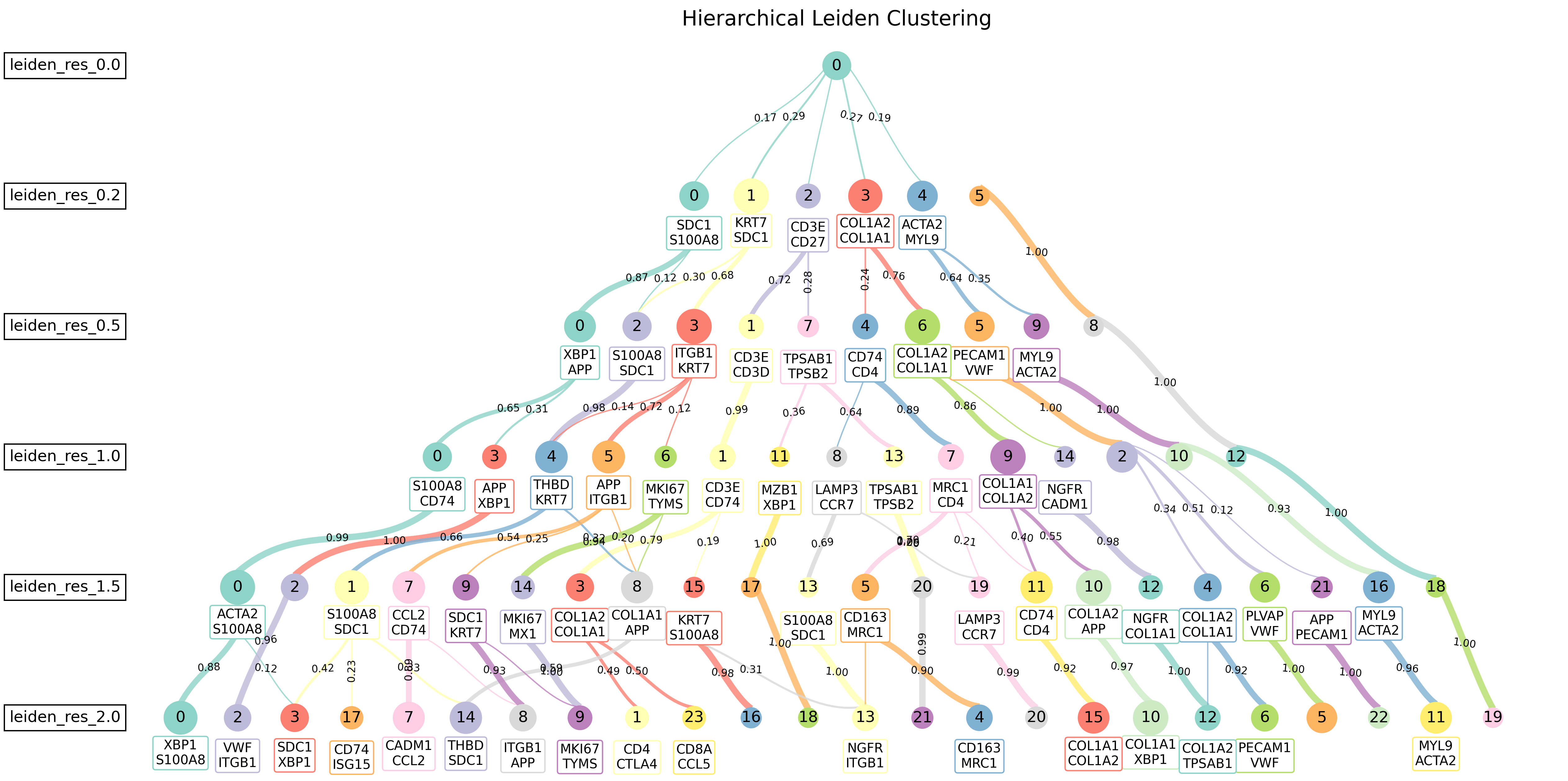
2. Hierarchical Visualization
The cluster_decision_tree() function creates publication-ready hierarchical cluster trees:
3. Customization Options
The detailed customization options allow you to tailor the visualization to your needs: see my blog: Optimizing Clustering Resolution in Single-Cell Analysis
Example Output
The package generates hierarchical trees showing:
- Cluster evolution across resolutions
- Parent-child relationships between clusters
- Key differentiating genes for each split
- Cluster sizes and transition weights
Use Cases
Fine-grained Cell Type Discovery
- T cell subsets: Higher resolutions reveal distinct T helper, regulatory, and cytotoxic populations
- Immune cell states: Identify activation states and differentiation trajectories
- Rare cell populations: Detect small but biologically important cell clusters
Quality Control
- Over-clustering detection: Identify when resolution becomes too high
- Biological validation: Use DEGs to confirm cluster biological relevance
- Resolution optimization: Find the sweet spot between under- and over-clustering
Integration with Scanpy
ResolutionTree seamlessly integrates with standard Scanpy workflows:
# Standard Scanpy preprocessing
sc.pp.filter_cells(adata, min_genes=200)
sc.pp.filter_genes(adata, min_cells=3)
sc.pp.normalize_total(adata, target_sum=1e4)
sc.pp.log1p(adata)
sc.pp.highly_variable_genes(adata)
sc.pp.pca(adata)
sc.pp.neighbors(adata)

# ResolutionTree analysis
rt.cluster_resolution_finder(adata, resolutions=[0.2, 0.5, 1.0, 1.5])
rt.cluster_decision_tree(adata, resolutions=[0.2, 0.5, 1.0, 1.5])

# Continue with Scanpy
sc.tl.umap(adata)
sc.pl.umap(adata, color='leiden_res_1.0')
Citation
If you use ResolutionTree in your research, please cite:
@software{resolutiontree2025,
  author = {Joe Hou},
  title = {ResolutionTree: Systematic exploration of clustering resolutions in single-cell analysis},
  url = {https://github.com/joe-jhou2/resolutiontree},
  year = {2025}
}
Blog Post
For a detailed explanation of the methodology and examples, see the blog post: Optimizing Clustering Resolution in Single-Cell Analysis
Contributing
Contributions are welcome! Please feel free to submit a Pull Request. For major changes, please open an issue first to discuss what you would like to change.
License
This project is licensed under the MIT License - see the LICENSE file for details.
Changelog
v0.1.0 (2025-06-03)
- Initial release
- Core resolution finding functionality
- Hierarchical cluster tree visualization
- Scanpy integration
- Comprehensive documentation and examples
Keywords: single-cell RNA-seq, clustering, resolution selection, differential gene expression, hierarchical clustering, scanpy, bioinformatics
Release history Release notifications | RSS feed


Download files
Download the file for your platform. If you're not sure which to choose, learn more about installing packages.
Source Distribution
Built Distribution
Filter files by name, interpreter, ABI, and platform.
If you're not sure about the file name format, learn more about wheel file names.
Copy a direct link to the current filters
File details
Details for the file resolutiontree-0.1.0a1.tar.gz.
File metadata
- Download URL: resolutiontree-0.1.0a1.tar.gz
- Upload date:
- Size: 24.4 kB
- Tags: Source
- Uploaded using Trusted Publishing? No
- Uploaded via: twine/6.1.0 CPython/3.10.9
File hashes
| Algorithm | Hash digest | |
|---|---|---|
| SHA256 |
64929a5c04abc9366542b2974c0251898f66b02073358b638001fe0cd226e286
|
|
| MD5 |
d8a0d17d03cb3d1188fc04e7956048fb
|
|
| BLAKE2b-256 |
79783319ecb88542cb8b66d39ab8a22b21825094e5c1b72082b60b3795c81187
|
File details
Details for the file resolutiontree-0.1.0a1-py3-none-any.whl.
File metadata
- Download URL: resolutiontree-0.1.0a1-py3-none-any.whl
- Upload date:
- Size: 19.6 kB
- Tags: Python 3
- Uploaded using Trusted Publishing? No
- Uploaded via: twine/6.1.0 CPython/3.10.9
File hashes
| Algorithm | Hash digest | |
|---|---|---|
| SHA256 |
f1fe1435a436b8bc007d5c0a74dadaad8d96332e6701ece1a84e084385c0ddbe
|
|
| MD5 |
9233e29daa018ee77de786843d4e7f72
|
|
| BLAKE2b-256 |
66d6926e339aaa91cc317aee407a34d855fe4a16242793e887044e0814e284e6
|






