

RESOURCERA
Know your resources. Admit work with confidence.
Resource intelligence, capacity estimation, and resource-aware concurrency for Python applications.






Documentation · Quickstart · Examples · Agent skills · Contributing
RESOURCERA is an embeddable, async-first library that observes local resources, estimates capacity for a workload, and helps cooperating application tasks make explainable admission decisions. It is framework-neutral and does not require an accelerator SDK.
What you can do
| Capability | How it helps |
|---|---|
| Observe | Inspect CPU, memory, disk, network, container limits, and visible accelerators with explicit freshness and capability states. |
| Estimate | Describe workload requirements and identify the limiting resource without treating missing data as free capacity. |
| Admit | Bound concurrent work with explainable acceptance or rejection and optional finite waiting. |
| Adapt | Replace hardcoded semaphores, limiters, and thread-pool sizes with resource-derived, self-adjusting concurrency limits. |
| Coordinate | Hold logical leases within an interpreter or between cooperating processes on one machine. |
| Control overhead | Use bounded, adaptive sampling with observable self-overhead safeguards. |
RESOURCERA is not a dashboard, distributed execution engine, or physical resource isolation mechanism. Measurements and estimates are observations, not guarantees.
Installation
Python 3.12, 3.13, 3.14, and 3.15 are supported (3.12 or newer is required). Install from a checkout:
python -m pip install .
The intended distribution name is resourcera once a release is published. For
optional NVIDIA NVML telemetry, install .[nvidia] from a checkout and provide a
compatible driver and NVML library. RESOURCERA never installs SDKs or drivers.
Quickstart
import anyio

from resourcera import AdmissionRejectedError, ResourceManager


async def main():
    async with ResourceManager(scope="machine") as resources:
        snapshot = await resources.snapshot()
        print("Available memory:", snapshot.memory.available_bytes.value, "bytes")

        try:
            async with resources.admission({"memory": "64MiB"}) as decision:
                print("Admitted:", decision.lease_id)
                await anyio.sleep(0.01)  # Your workload goes here.
        except AdmissionRejectedError as error:
            print("Not admitted:", error.decision.reason)


anyio.run(main)
The manager owns its sampling and lease lifecycle. CPU and throughput rates need two samples; unavailable, stale, or failed required measurements reject admission. Keep the admission context open while the work runs.
Adaptive concurrency
Instead of asyncio.Semaphore(100) or ThreadPoolExecutor(max_workers=10), let
capacity decide:
async with resources.adaptive_concurrency(
    {"cpu": 0.5, "memory": "256MiB"}, max_concurrency=50
) as controller:
    async with controller.slot():
        await do_work()

recommendation = await resources.recommend_concurrency(
    {"memory": "64MiB", "profile": "io-bound"}, max_concurrency=32
)
executor = ThreadPoolExecutor(max_workers=recommendation.recommended_limit)
Each slot holds a real lease. Limits fall immediately when capacity drops and rise cautiously, and unknown capacity is never treated as unlimited. See the adaptive concurrency guide.
How it fits together
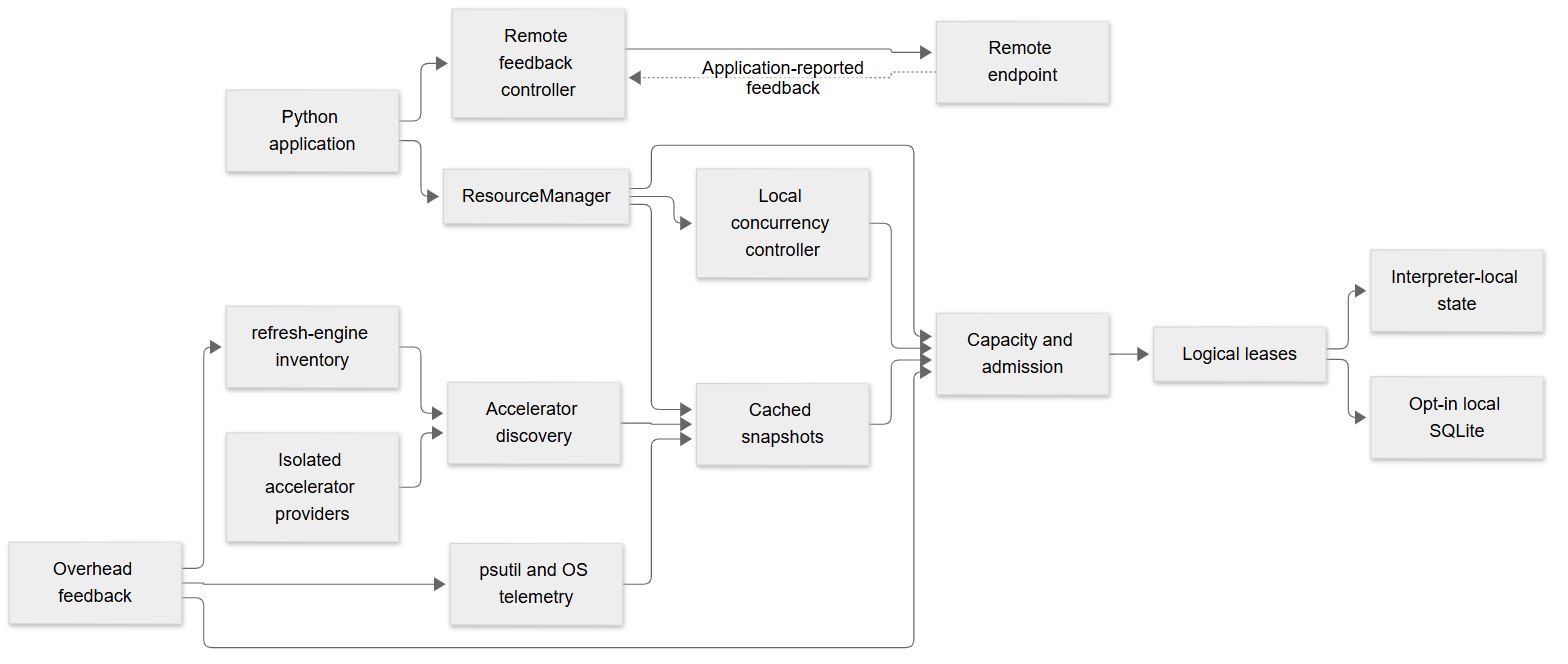
Start with the quickstart, then explore capacity estimates, admission, and coordination guarantees. Platform-specific accelerator capabilities and their limitations are described in the accelerator guide.
Agent skills
The repository includes two optional Agent Skills:
resourcera for using the public API safely, and resourcera-provider for
building isolated accelerator providers. They are instructions for compatible
coding agents, not runtime dependencies. See the
installation guide.
Project
- Documentation and examples
- Contributing, security, and changelog
- Licensed under the Apache License 2.0
1 maintainer

Metadata
1 maintainer
Release files for resourcera 0.2.0
For a detailed explanation of source distributions (sdists) and built distributions (wheels), please see the package formats documentation.
Source distribution (sdist)
| File | Size | Uploaded | Provenance | Actions |
|---|---|---|---|---|
| resourcera-0.2.0.tar.gz | 1.2 MB | Without provenance | Details for resourcera-0.2.0.tar.gz |
Built distribution (wheel)
| File | Interpreter | ABI | Platform | Actions Reset |
|---|---|---|---|---|
| resourcera-0.2.0-py3-none-any.whl | Python 3 | none | any | Details for resourcera-0.2.0-py3-none-any.whl |
Total release size: 1.2 MB
Release files / resourcera-0.2.0.tar.gz
| Download URL | resourcera-0.2.0.tar.gz |
|---|---|
| Size | 1.2 MB |
| Tags | Source |
|
SHA-256 checksum How to use checksums |
87c3e3210e03ff762bd55ddb66d1532e29c058fcadd46cfff19bf73aca2b8d1b
|
|
BLAKE2b-256 checksum How to use checksums |
91de84e04e0c8dedad7d674c85b4878558dc1f27ac2bb5535a6e2a8812bd2d80
|
| Upload date | |
|
Uploaded using Trusted Publishing? What is trusted publishing? |
No |
| Uploaded via |
uv/0.13.6 {"installer":{"name":"uv","version":"0.13.6","subcommand":["publish"]},"python":null,"implementation":{"name":null,"version":null},"distro":null,"system":{"name":null,"release":null},"cpu":null,"openssl_version":null,"setuptools_version":null,"rustc_version":null,"ci":null}
|
Release files / resourcera-0.2.0-py3-none-any.whl
| Download URL | resourcera-0.2.0-py3-none-any.whl |
|---|---|
| Size | 72.1 kB |
| Tags | Python 3 |
|
SHA-256 checksum How to use checksums |
2d21c9227c52c7e83cc80d4313af486b0ebd4a0c6cef20e9c0fd2ac40a0acd27
|
|
BLAKE2b-256 checksum How to use checksums |
fa1059f7b12400f7e736fbe6b101dcaf389117bbf74b91d0398cedd559375112
|
| Upload date | |
|
Uploaded using Trusted Publishing? What is trusted publishing? |
No |
| Uploaded via |
uv/0.13.6 {"installer":{"name":"uv","version":"0.13.6","subcommand":["publish"]},"python":null,"implementation":{"name":null,"version":null},"distro":null,"system":{"name":null,"release":null},"cpu":null,"openssl_version":null,"setuptools_version":null,"rustc_version":null,"ci":null}
|
Security for resourcera 0.2.0
Provenance
Provenance describes where a file came from. On PyPI, provenance is shared via attestations, which provide a verifiable record of the build or publishing details. View details, limitations and caveats.
No provenance found
None of the files in this release were uploaded with provenance metadata.
A note on package security
PyPI is a repository for distributing packages, not a service for auditing them. While third-party security researchers and our staff do their best to detect and remove malicious packages, PyPI cannot guarantee the quality, security or suitability of any given package.
To learn more about protecting yourself from malicious actors, visit our package security documentation.














