
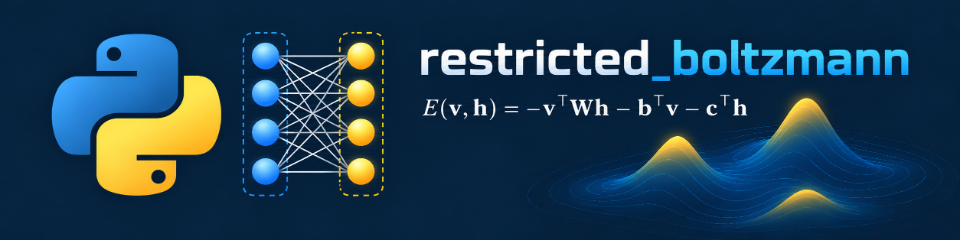




restricted_boltzmann
Package for the implementation of restricted Boltzmann machines
Installation
This package can be easily installed with pip:
pip install git+https://github.com/jzsmoreno/restricted_boltzmann
Features
- Training: Implements Contrastive Divergence (CD) and other training algorithms for RBMs.
- Inference: Support for both Gibbs sampling and deterministic inference methods.
- Customization: Allows the configuration of various hyperparameters such as the number of hidden units, learning rate, and batch size.
- Compatibility: Can be easily integrated with popular deep learning frameworks like TensorFlow or PyTorch for more advanced use cases.
Applications
RBMs are widely used in various real-world applications, including:
- Pattern Recognition: Feature extraction in pattern recognition problems, such as handwriting recognition or pattern classification.
- Recommendation Systems: Collaborative filtering for recommending products, movies, or other items based on user behavior (e.g., movie or book recommendations).
- Radar Target Recognition: Used in radar systems to detect low signal-to-noise ratio (SNR) targets in environments with high noise levels.
Key Features of RBMs
- Unsupervised Learning: RBMs learn from input data without requiring labeled responses.
- Recurrent and Symmetric Structure: The network structure is symmetric, with the same types of connections between visible and hidden layers.
- No Intra-Layer Connections: There are no connections within the visible layer or within the hidden layer, making the model computationally efficient.
- Energy-Based Model: RBMs associate high probability with low-energy configurations.
Contributing
If you'd like to contribute to the development of this package, feel free to fork the repository and submit a pull request. Please make sure your contributions adhere to the coding style and include relevant tests.
License
This package is licensed under the MIT License. See the LICENSE file for more information.
1 maintainer

Metadata
1 maintainer
Release files for restricted-boltzmann 0.3.5
For a detailed explanation of source distributions (sdists) and built distributions (wheels), please see the package formats documentation.
Source distribution (sdist)
| File | Size | Uploaded | Provenance | Actions |
|---|---|---|---|---|
| restricted_boltzmann-0.3.5.tar.gz | 17.8 kB | Without provenance | Details for restricted_boltzmann-0.3.5.tar.gz |
Built distribution (wheel)
| File | Interpreter | ABI | Platform | Actions Reset |
|---|---|---|---|---|
| restricted_boltzmann-0.3.5-py3-none-any.whl | Python 3 | none | any | Details for restricted_boltzmann-0.3.5-py3-none-any.whl |
Total release size: 33.5 kB
Release files / restricted_boltzmann-0.3.5.tar.gz
| Download URL | restricted_boltzmann-0.3.5.tar.gz |
|---|---|
| Size | 17.8 kB |
| Tags | Source |
|
SHA-256 checksum How to use checksums |
07802f70581de1ff5b8d35c56f6ab1fe9b57c87bf1c38368f3c59718377768fd
|
|
BLAKE2b-256 checksum How to use checksums |
f71cc41b5c8a558435f9dcfc9695107fdb047a2970ed246f934898ec6f816a24
|
| Upload date | |
|
Uploaded using Trusted Publishing? What is trusted publishing? |
No |
| Uploaded via |
twine/7.0.0 CPython/3.13.14
|
Release files / restricted_boltzmann-0.3.5-py3-none-any.whl
| Download URL | restricted_boltzmann-0.3.5-py3-none-any.whl |
|---|---|
| Size | 15.7 kB |
| Tags | Python 3 |
|
SHA-256 checksum How to use checksums |
f48aab1edf989fa5314093e8f63784033f6f9a283fa73056a253834ba9adc383
|
|
BLAKE2b-256 checksum How to use checksums |
9e53c6d957a9865e01277a5bebcba4261107f85dee44649ae8078923e234c7b0
|
| Upload date | |
|
Uploaded using Trusted Publishing? What is trusted publishing? |
No |
| Uploaded via |
twine/7.0.0 CPython/3.13.14
|
Security for restricted-boltzmann 0.3.5
Provenance
Provenance describes where a file came from. On PyPI, provenance is shared via attestations, which provide a verifiable record of the build or publishing details. View details, limitations and caveats.
No provenance found
None of the files in this release were uploaded with provenance metadata.
A note on package security
PyPI is a repository for distributing packages, not a service for auditing them. While third-party security researchers and our staff do their best to detect and remove malicious packages, PyPI cannot guarantee the quality, security or suitability of any given package.
To learn more about protecting yourself from malicious actors, visit our package security documentation.













