
Local-first retrieval reliability for evaluating, comparing, and debugging multi-stage RAG retrieval
Verified details
These details have been verified by PyPIProject links
GitHub Statistics
Maintainers

Project description
retobs


retobs is a local-first retrieval reliability layer for multi-stage RAG pipelines. It helps ML engineers evaluate a retriever, compare a baseline and candidate, and trace a failed query to the operator and candidate transition that actually occurred.
It is not an answer evaluator or a leaderboard. Conclusions are withheld when ground truth, run identity, paired samples, or replay evidence is insufficient.
Five-minute callable quickstart
python -m venv .venv
source .venv/bin/activate
pip install "retrieval-observatory[dashboard]"
Create retrieval_eval.py:
CORPUS = {
    "d1": "Hybrid retrieval combines lexical and dense search.",
    "d2": "A reranker rescores an existing candidate set.",
}
QUERIES = [
    {"query_id": "q1", "text": "What combines lexical and dense search?"},
]
QRELS = {"q1": {"d1": 1}}

def retrieve(query: str) -> list[str]:
    return ["d1", "d2"] if "lexical" in query else ["d2", "d1"]
Evaluate it without YAML:
retobs evaluate retrieval_eval.py:retrieve --format terminal
retobs serve --db .retobs/results.db
The command prints a run ID, evidence health, a conclusion, affected queries, and the next action. Open the printed Run URL to inspect recorded operator and candidate evidence. The same path is available in Python:
import retrieval_observatory as ro
from retrieval_eval import CORPUS, QRELS, QUERIES, retrieve

report = ro.evaluate(retrieve, queries=QUERIES, corpus=CORPUS, qrels=QRELS)
print(report.run_id)
print(report.to_json())
Baseline-to-cause workflow
Run an explicit baseline and candidate, then compare them in that order:
retobs compare BASELINE_RUN CANDIDATE_RUN --db .retobs/results.db --format markdown
retobs inspect-query CANDIDATE_RUN QUERY_ID --db .retobs/results.db
compare first validates query, corpus, qrel, and label identity. An invalid comparison has no winner. Valid comparisons use paired query alignment, Benjamini-Hochberg correction, declared effect thresholds, and power labels. The Query page then shows:
- query text, dataset, qrels, and label provenance;
- exact recorded operator spans and terminal/partial status;
- relevant documents added, promoted, demoted, or dropped;
- the first measured loss operator when reconstructable;
- replay separately labeled as exact, observed ablation, or unavailable;
- an evidence-backed next action and validation link.
Try the deterministic local story:
pip install "retrieval-observatory[demo,dashboard]"
retobs demo --db .retobs/demo/results.db --output-dir .retobs/demo
retobs serve --db .retobs/demo/results.db
It creates one Test Set, a healthy baseline, a regressed candidate, a post-change validation run, and sampled production traces. No API key is required.
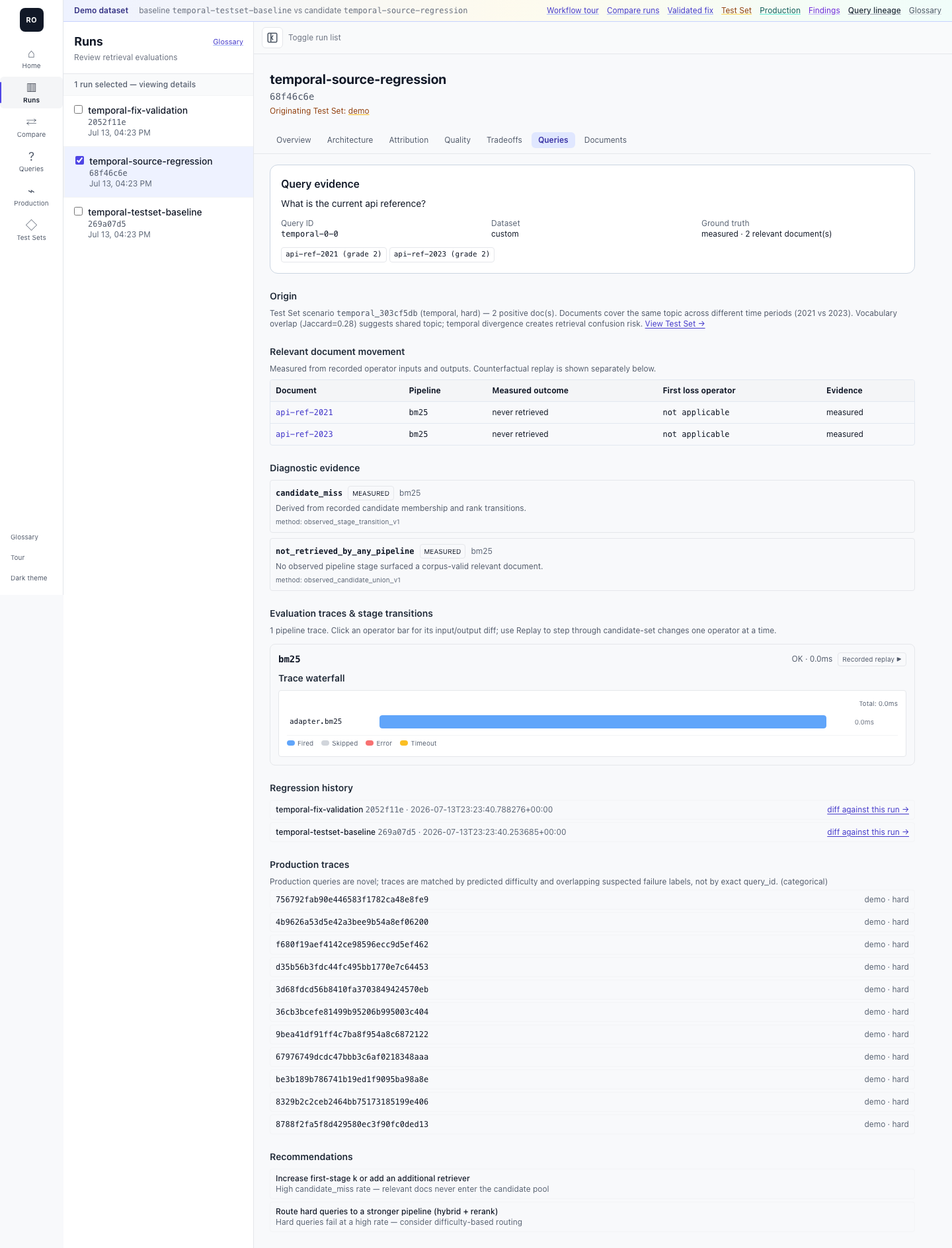
Watch the short regression-to-validation workflow.
Core capabilities
| Task | What retobs provides |
|---|---|
| Evaluate | Callable-first or advanced YAML execution with per-query metrics, canonical manifests, complete/partial traces, and reports. |
| Compare | Explicit baseline/candidate orientation, validity gating, corrected paired statistics, config/topology differences, and affected queries. |
| Debug | Query-to-operator-to-candidate evidence with exact and aggregate PipelineGraphV2 views. |
| Production | Sampled traces, drift/hotspot methods, windows, thresholds, denominators, and supporting trace links. Quality is absent without joined ground truth. |
| Test Sets | Corpus-derived stress queries with dataset/query label provenance, validation coverage, exact Run links, and paginated tables. |
Primary dashboard navigation is Home, Runs, Compare, Queries, Production, Test Sets. Forge, TraceLens, Advisor, and Benchmarks remain internal/legacy vocabulary rather than separate products.
Integration support
First-class paths are plain Python, HTTP, FastAPI, LangChain, and LlamaIndex. Haystack, DSPy, and OpenAI Agents are supported examples with a narrower maintenance guarantee. See the support matrix and the agent quickstart.
To inspect before changing a project:
retobs integrate . --plan
retobs verify --db .retobs/results.db
Agents can call MCP plan_integration, apply the returned patch, then call verify_integration. A result is ready, partially_instrumented, not_verified, or failed; zero observed runs is never ready.
Trust model
- Measured means persisted execution, qrel, metric, or candidate-transition evidence.
- Statistical means a declared paired procedure with sample size, effect, correction, and power state.
- Replayed means a supported counterfactual under listed assumptions.
- Heuristic and inferred are visibly labeled and never promoted to causal proof.
- Unavailable is a first-class result; retobs does not manufacture a delta or quality score.
Wall-clock, critical-path, and operator-sum latency are distinct fields. Production proxy signals are not Recall. Generated/extractive labels are not called gold until validated. Full rules are in Evidence and trust.
Reports and CI
Terminal, JSON, Markdown, and standalone HTML share one report model:
retobs report RUN_ID --format html --output retobs-run.html
retobs compare BASELINE CANDIDATE \
  --format markdown --output retobs-comparison.md \
  --fail-on regression-or-no-decision
See the PR workflow and CI gating reference.
Local-first scope
SQLite and PostgreSQL stores are supported. The dashboard is single-tenant and has no authentication by default; do not expose it directly to an untrusted network. Query text, document identifiers/metadata, traces, and generated Test Set content may be sensitive. See Data and privacy and Security policy.
Documentation
- Start
- Golden workflow
- Concepts
- CLI/SDK/MCP reference
- Advanced YAML guide
- Architecture
- Migration and deprecations
- Releases
License: MIT.
Project details
Verified details
These details have been verified by PyPIProject links
GitHub Statistics
Maintainers
Release history Release notifications | RSS feed


Download files
Download the file for your platform. If you're not sure which to choose, learn more about installing packages.
Source Distribution
Built Distribution
Filter files by name, interpreter, ABI, and platform.
If you're not sure about the file name format, learn more about wheel file names.
Copy a direct link to the current filters
File details
Details for the file retrieval_observatory-0.5.0.tar.gz.
File metadata
- Download URL: retrieval_observatory-0.5.0.tar.gz
- Upload date:
- Size: 663.6 kB
- Tags: Source
- Uploaded using Trusted Publishing? Yes
- Uploaded via: twine/6.1.0 CPython/3.13.12
File hashes
| Algorithm | Hash digest | |
|---|---|---|
| SHA256 |
7154f8ed7e9e4e8da20b116fafb7b70c19833a0c28fe24222fb3cec83a7f0bf5
|
|
| MD5 |
2de1e9ee4104eb503aeb1321fad09bf8
|
|
| BLAKE2b-256 |
afbfbce77f5ec331c19e023c3f57a56f9775270d3b5e0c3a24810ac43b9e809b
|
Provenance
The following attestation bundles were made for retrieval_observatory-0.5.0.tar.gz:
Publisher:
publish.yml on AmeyaKI/retrieval-observatory
-
Statement:
-
Statement type:
https://in-toto.io/Statement/v1 -
Predicate type:
https://docs.pypi.org/attestations/publish/v1 -
Subject name:
retrieval_observatory-0.5.0.tar.gz -
Subject digest:
7154f8ed7e9e4e8da20b116fafb7b70c19833a0c28fe24222fb3cec83a7f0bf5 - Sigstore transparency entry: 2166910466
- Sigstore integration time:
-
Permalink:
AmeyaKI/retrieval-observatory@72d41883f24677a624e1e7212d8bdbd2cbc0e82d -
Branch / Tag:
refs/tags/v0.5.0 - Owner: https://github.com/AmeyaKI
-
Access:
public
-
Token Issuer:
https://token.actions.githubusercontent.com -
Runner Environment:
github-hosted -
Publication workflow:
publish.yml@72d41883f24677a624e1e7212d8bdbd2cbc0e82d -
Trigger Event:
push
-
Statement type:
File details
Details for the file retrieval_observatory-0.5.0-py3-none-any.whl.
File metadata
- Download URL: retrieval_observatory-0.5.0-py3-none-any.whl
- Upload date:
- Size: 794.0 kB
- Tags: Python 3
- Uploaded using Trusted Publishing? Yes
- Uploaded via: twine/6.1.0 CPython/3.13.12
File hashes
| Algorithm | Hash digest | |
|---|---|---|
| SHA256 |
0a689a2ffca9858283f11c37170257312a7c9baa2f311f8b4857cd943f113da2
|
|
| MD5 |
1bf091ee0f007b1907c23b188ec27572
|
|
| BLAKE2b-256 |
c12dd2320915502d948ac3433bae3bad5c3b812e0f73e4160c4a649d96c623d6
|
Provenance
The following attestation bundles were made for retrieval_observatory-0.5.0-py3-none-any.whl:
Publisher:
publish.yml on AmeyaKI/retrieval-observatory
-
Statement:
-
Statement type:
https://in-toto.io/Statement/v1 -
Predicate type:
https://docs.pypi.org/attestations/publish/v1 -
Subject name:
retrieval_observatory-0.5.0-py3-none-any.whl -
Subject digest:
0a689a2ffca9858283f11c37170257312a7c9baa2f311f8b4857cd943f113da2 - Sigstore transparency entry: 2166910471
- Sigstore integration time:
-
Permalink:
AmeyaKI/retrieval-observatory@72d41883f24677a624e1e7212d8bdbd2cbc0e82d -
Branch / Tag:
refs/tags/v0.5.0 - Owner: https://github.com/AmeyaKI
-
Access:
public
-
Token Issuer:
https://token.actions.githubusercontent.com -
Runner Environment:
github-hosted -
Publication workflow:
publish.yml@72d41883f24677a624e1e7212d8bdbd2cbc0e82d -
Trigger Event:
push
-
Statement type:






