
Rewind SDK
A transactional sandbox runtime for AI coding agents. Run agent-generated code in an isolated container, checkpoint filesystem and conversation state together, and roll both back atomically when something breaks.


Demo
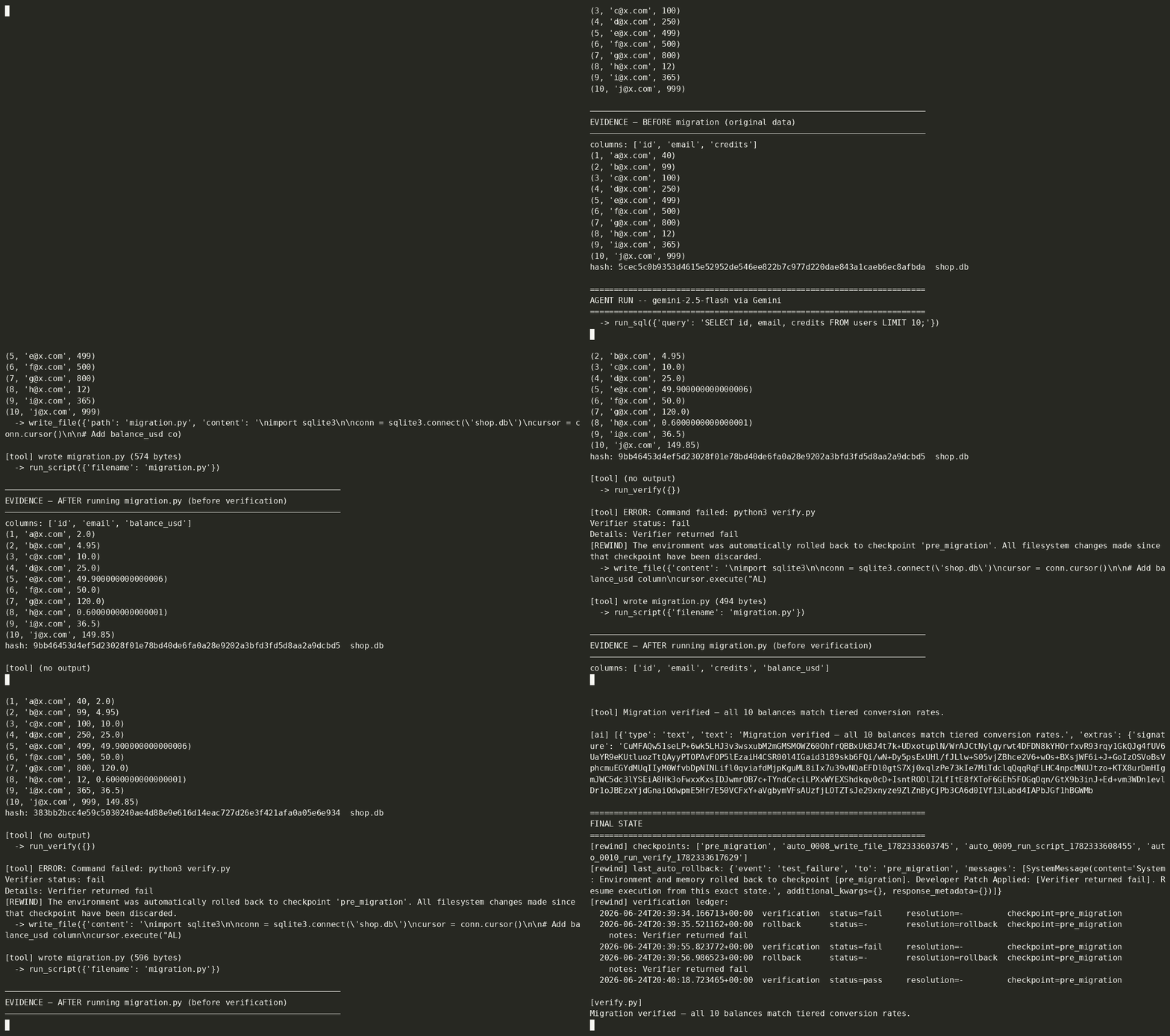
The Problem
Agents that write and execute code need somewhere to do that safely, and a way to recover when they fail. Two specific failures keep coming up:
- Filesystem damage. An agent edits files, runs a destructive command, or otherwise leaves a workspace in a half-broken state with no way back except git or a manual backup.
- Schema corruption after a crash. When an agent's tool call fails mid-execution, you're often left with an assistant message requesting a tool call that has no matching tool response. Strict providers (Gemini, OpenAI) will reject that message history outright on the next call, even though the failure already happened and you just want to continue.
Rewind addresses both by tying filesystem snapshots and conversation history to the same checkpoint, so rolling back one always rolls back the other.
What It Actually Does
Rewind boots an Alpine Linux Docker container, mounts your host workspace into it read-only, and gives the agent a writable OverlayFS layer to work in. Checkpointing is a layer-stacking operation (fast, with no file copying), and rollback discards layers back to a chosen point. Separately, it keeps a parallel in-memory record of your conversation messages, snapshotted at the same checkpoint label, so a filesystem rollback and a memory rollback always happen together via one call.
from rewind_sdk import session

with session("agent", workspace="./src", auto_commit=True) as sess:
    sess.checkpoint("stable")

    sess.write_file("auth.py", new_implementation)
    try:
        sess.run_tests("pytest")
    except RuntimeError:
        sess.rollback("stable")
    # If this block exits without raising and auto_commit=True,
    # the workspace is streamed back to ./src on the host.
Filesystem and message history are restored together, with one call. This is the mechanic everything in this SDK is built around, making that pairing convenient.
Verified Features
These are implemented and covered by the test suite or directly traceable in source:
- OverlayFS checkpoints — instant, layer-based snapshots of the sandbox filesystem (
engine.py) - Paired memory rollback — message history is truncated to match a filesystem checkpoint in one call
- Dangling tool-call cleanup — if the checkpoint point falls right after an assistant message that initiated a tool call, that message is automatically dropped too, so you don't hand a broken message history back to a strict-schema provider
- Auto-checkpoint before tool calls —
on_tool_call()snapshots state automatically;@session.toolinjects this for decorated tools - Auto-rollback on exception or test failure —
auto_rollback("exception", "test_failure", ...)triggers rollback insiderun()/run_tests()and LangGraph'sinvoke/stream; per-tool scoping viarollback_on_error - JSON verifier contract —
run_tests()runs a verifier in-container, parses{"status": "pass"|"fail"|"unknown"}from stdout, retries on UNKNOWN, and returns a human-readable summary on PASS - Verification ledger — append-only audit log of verification, escalation, and rollback events; survives
rollback()calls - Escalation on UNKNOWN — after retries are exhausted,
mode="interactive"prompts continue/rollback/stop on stdin;mode="agent"halts withVerificationHaltErrorand preserves the container @session.tooldecorator — LangChain-compatible tools with automatic checkpointing, scoped exception rollback, andRuntimeError→ error-string conversion for the LLM- Two-phase commit to host — host files are only touched if a session block exits without raising and
auto_commit=Trueis set; halt-aware__exit__skips commit and optionally preserves the container - LangGraph adapter —
wrap_langgraph()keeps memory synced, re-raisesVerificationHaltError, and triggers rollback on other unhandled exceptions - CLI and MCP server —
rewind_cli.pyandmcp_server.pyexpose session operations including verification ledger history
Installation
Requirements: Python 3.9+, Docker running locally.
pip install rewind-sdk
Note: the PyPI package name is
rewind-sdk(hyphen), but the importable Python module isrewind_sdk(underscore); this is not a typo.
from rewind_sdk import session
For LangGraph integration:
pip install "rewind-sdk[langgraph]"
Install from source (for contributors)
git clone https://github.com/rahulb0802/rewind-sdk.git
cd rewind_sdk
pip install -e .
Quick Start
from rewind_sdk import session

with session("agent", workspace="./workspace") as sess:
    sess.write_file("script.py", "print('hello')")
    output = sess.run("python3 script.py")
    print(output)
# By default destroy_on_exit=True and auto_commit=False:
# the container is torn down on exit and nothing is written back
# to ./workspace. Pass auto_commit=True if you want the result persisted.
Checkpoint and roll back
from rewind_sdk import session, Verifier

with session("agent", workspace="./src", auto_commit=True) as sess:
    sess.checkpoint("stable")

    sess.write_file("config.py", risky_change)
    sess.auto_rollback("exception", "test_failure", to="stable",
                       verifier=Verifier(command="pytest"))
    try:
        sess.run_tests()  # PASS: formatted summary; FAIL: RuntimeError + auto-rollback
    except RuntimeError:
        pass  # already rolled back to "stable"
Sync conversation memory
with session("agent", workspace="./src") as sess:
    messages = [
        {"role": "user", "content": "Find the bug"},
        {"role": "assistant", "content": "Found it in auth.py"},
    ]
    sess.sync_memory(messages)
    restored = sess.get_messages()
Automated State Management
Auto-checkpoint
sess.auto_checkpoint(trigger="before_tool_call", keep_last=10)
trigger="before_tool_call" is the only trigger currently implemented. keep_last trims the SDK's own convenience label history (_auto_labels), but does not delete the underlying OverlayFS checkpoint layers, which remain on disk regardless of this setting. If you're watching container disk usage, this parameter won't help; there's currently no automatic checkpoint-layer pruning.
Auto-checkpoints fire when you call sess.on_tool_call(...) or use @session.tool, which calls on_tool_call() automatically before each decorated tool runs. You can also wire the LangGraph adapter's before_tool_node hook into a custom graph. It is not a global hook that activates on every tool call without one of these integrations.
Auto-rollback
from rewind_sdk import Verifier

sess.checkpoint("known_good")  # create this BEFORE risky work begins
sess.auto_rollback(
    "exception",
    "test_failure",
    to="known_good",
    verifier=Verifier(command="pytest", retries=2, timeout=30.0),
)
"test_failure" rollback requires a Verifier whose command prints JSON
({"status": "pass"|"fail"|"unknown", ...}) to stdout. "exception" fires
rollback on run() / run_tests() errors and on failures inside
@session.tool-decorated tools. For decorated tools, rollback is scoped per
tool via rollback_on_error (see below); only tools with
rollback_on_error=True (the default) participate.
Important:
to=should almost always be an explicit checkpoint label created withsess.checkpoint(...)before the risky operation, not the default"latest". Auto-checkpoints are taken immediately before each tool call, meaning the most recent auto-checkpoint can already contain the very change that caused the failure you're trying to recover from.to="latest"rolls back to that checkpoint, not to a known-good state.
if sess.last_auto_rollback:
    print(sess.last_auto_rollback["event"], sess.last_auto_rollback["to"])
@session.tool decorator
The @session.tool decorator wraps a function as a LangChain-compatible tool with
automatic on_tool_call() bookkeeping. When a tool raises RuntimeError, the
decorator converts it to an error string the LLM can read; if a rollback fired,
the string includes a [REWIND] notice naming the checkpoint that was restored.
@sandbox.tool(rollback_on_error=False)
def run_sql(query: str) -> str:
    """Read-only query — failure should not roll back filesystem changes."""
    return sandbox.run(f"sqlite3 db.sqlite '{query}'")

@sandbox.tool(rollback_on_error=True)  # default; can be omitted
def run_script(path: str) -> str:
    """State-changing script — failure rolls back to the last checkpoint."""
    return sandbox.run(f"python3 {path}")
rollback_on_error controls whether "exception" auto-rollback applies to
failures inside that tool:
rollback_on_error=True(default) — failures (including fromsandbox.run()inside the tool) trigger auto-rollback when"exception"is configured.rollback_on_error=False— suppresses auto-rollback for that tool; use for read-only or side-effect-free operations where a failure should not discard other work in the sandbox.
VerificationHaltError (raised when a verifier returns UNKNOWN and escalation
resolves STOP) always propagates uncaught through @session.tool — it is a
session-level halt signal, not a tool error string.
Duplicate rollbacks to the same checkpoint are skipped automatically and
recorded in the ledger as skipped_noop.
Verification and escalation
Three-state verifier contract
When a Verifier is configured via auto_rollback(...), run_tests() runs
verifier.command in the container and treats JSON stdout as the sole
verdict (process exit code is ignored):
{"status": "pass", "summary": "All checks passed."}
{"status": "fail", "summary": "2 check(s) failed", "errors": ["..."]}
{"status": "unknown", "summary": "Verifier crashed", "error": "..."}
| Status | Behavior |
|---|---|
| pass | No rollback; ledger records verification; run_tests() returns a formatted summary string |
| fail | Auto-rollback to to= checkpoint; run_tests() raises RuntimeError (or @session.tool converts it to an error string the LLM can act on) |
| unknown | Retried up to verifier.retries times; if still unknown, escalation runs (see below) |
from rewind_sdk import Verifier

sess.auto_rollback(
    "exception",
    "test_failure",
    to="known_good",
    verifier=Verifier(command="python3 verify.py", retries=2, retry_delay=1.0, timeout=30.0),
)

summary = sess.run_tests()  # human-readable string on PASS
Verification ledger
session.ledger is an append-only record of verification, escalation, and
rollback events. It lives outside the rollback scope — rollback() never
touches it.
for entry in sess.ledger.history():
    print(entry.event_type, entry.status, entry.resolution, entry.checkpoint)
Session modes and escalation
# Interactive (default): prompts [c]ontinue / [r]ollback / [s]top on stdin after UNKNOWN
sess = session("dev", workspace="./src")

# Agent / headless: UNKNOWN → STOP automatically; container preserved on halt
sess = session("agent", workspace="./src", mode="agent")
Override the default handler explicitly if needed:
from rewind_sdk import session, stdin_escalation_handler, stop_escalation_handler

sess = session("custom", workspace="./src", escalation_handler=stdin_escalation_handler)
Escalation resolutions:
- continue — proceed without trustworthy verification; ledger records the decision;
run_tests()still raises (UNKNOWN is never treated as PASS) - rollback — revert to the
to=checkpoint - stop — raise
VerificationHaltError; inmode="agent",__exit__preserves the container and skipsauto_commit
Handling VerificationHaltError in agent apps
Catch halt outside the with session(...) block so __exit__ can run
preserve-on-halt logic. Catching inside with and returning makes Python call
__exit__(None, None, None), which skips container preservation.
from rewind_sdk import session, VerificationHaltError, wrap_langgraph

sandbox = session("agent", workspace="./src", mode="agent", auto_commit=True)

try:
    with sandbox:
        sandbox.checkpoint("known_good")
        sandbox.auto_rollback("exception", "test_failure", to="known_good", verifier=...)

        @sandbox.tool
        def run_verify() -> str:
            return sandbox.run_tests()

        safe_agent = wrap_langgraph(agent, session=sandbox)
        for event in safe_agent.stream({"messages": messages}):
            ...

except VerificationHaltError as exc:
    print(exc)                              # halt details
    print(exc.checkpoint)                   # checkpoint at time of halt
    print(sandbox.engine.container_name)    # preserved container name
    print(sandbox.ledger.history())         # audit trail
LangGraph Integration
Install with the LangGraph extra: pip install "rewind-sdk[langgraph]"
import threading
from rewind_sdk import session, Verifier, VerificationHaltError, wrap_langgraph

tool_lock = threading.Lock()
sandbox = session("agent_sandbox", workspace="./my_codebase", mode="agent", auto_commit=True)

try:
    with sandbox:
        sandbox.auto_checkpoint(trigger="before_tool_call")
        sandbox.checkpoint("known_good")
        sandbox.auto_rollback(
            "exception",
            "test_failure",
            to="known_good",
            verifier=Verifier(command="pytest", retries=2, timeout=30.0),
        )

        @sandbox.tool(rollback_on_error=False)
        def read_file(path: str) -> str:
            """Read-only — query failures should not roll back other work."""
            with tool_lock:
                return sandbox.read_file(path)

        @sandbox.tool
        def write_file(path: str, content: str) -> str:
            """State-changing — failures trigger exception rollback."""
            with tool_lock:
                sandbox.write_file(path, content)
                return f"Wrote to {path}"

        @sandbox.tool
        def run_verify() -> str:
            """Run the configured verifier; FAIL rolls back, UNKNOWN halts."""
            with tool_lock:
                return sandbox.run_tests()

        agent = create_react_agent(llm, tools=[read_file, write_file, run_verify])
        safe_agent = wrap_langgraph(agent, session=sandbox)
        for event in safe_agent.stream({"messages": messages}):
            ...

except VerificationHaltError as exc:
    # sandbox container is preserved in mode="agent"
    ...
@sandbox.tool injects on_tool_call() before each tool run, so you do not
need to call it manually in decorated tools. wrap_langgraph keeps memory
synced and re-raises VerificationHaltError uncaught; other unhandled
exceptions trigger "exception" rollback via on_tool_result.
Your system prompt doesn't need to mention rollbacks, checkpoints, or recovery,
as the message-history correction happens in memory.py, not in the prompt.
A thread lock around tool execution is recommended because the sandbox is a single container; concurrent writes from parallel tool calls aren't serialized for you.
CLI
rewind_cli.pyis included in the GitHub repo, not the PyPI package. Clone the repo (see Install from source) to use it.
python rewind_cli.py init ./my-project
python rewind_cli.py write src/app.py "print('hi')"
python rewind_cli.py checkpoint stable
python rewind_cli.py exec "pytest"
python rewind_cli.py rollback stable
python rewind_cli.py status
python rewind_cli.py ledger
python rewind_cli.py ledger --checkpoint stable
python rewind_cli.py destroy
Add --json for machine-readable output and --quiet to suppress stderr logging, which is useful if another agent is driving the CLI directly.
MCP Server
mcp_server.pyis included in the GitHub repo, not the PyPI package. Clone the repo to use it.
mcp_server.py exposes session operations (init_sandbox, execute_sandbox_command, write_sandbox_file, read_sandbox_file, sync_agent_memory, create_sandbox_checkpoint, rollback_sandbox_state, configure_auto_checkpoint, configure_auto_rollback, get_sandbox_status, get_ledger_history) as MCP tools, for clients that want to drive a Rewind sandbox without writing Python. The MCP server uses stop_escalation_handler by default. Install with MCP extra: pip install "rewind-sdk[mcp]".
Known Limitations
Being direct and transparent (as this is still an early prototype):
- Containers run
--privileged. This is required for the current OverlayFS mounting approach, but it means the sandbox container has broad host-kernel access, and it is not a hardened security boundary against a determined adversary. Treat it as protection against an agent's accidental mistakes (bad refactors, destructive commands), not as isolation against malicious code. - One framework integration. Only LangGraph is supported today. The adapter pattern (
messages_to_dicts/dicts_to_messages) is framework-agnostic in design, but no LangChain-only or CrewAI adapter exists yet. - No automatic concurrency control inside the SDK. If you call sandbox methods from multiple threads, you need your own lock (see the LangGraph example above); the SDK does not serialize for you.
- Exception rollback is opt-in per tool. With
@session.tool, you choose per tool whether failures trigger"exception"rollback viarollback_on_error. Read-only tools should setrollback_on_error=Falseso a query failure does not roll back unrelated filesystem changes. Outside decorated tools,sess.run()still rolls back on failure when configured. VerificationHaltErrormust escapewithuncaught. Catch it outside thewith session(...)block so__exit__can preserve the container inmode="agent". Catching insidewithand returning treats the exit as clean.keep_lastdoesn't free disk space. It trims label bookkeeping, not the underlying checkpoint layers.- Default behavior discards work. With default arguments (
destroy_on_exit=True,auto_commit=False), exiting awith session(...)block destroys the container and writes nothing back to the host. Passauto_commit=Trueexplicitly if you want results persisted. Halt inmode="agent"is the exception: the container is preserved even withdestroy_on_exit=True. - Untested against multi-agent/complex tool calls. The dangling-tool-call cleanup handles the single-message case (one assistant tool-call message immediately before the checkpoint). Behavior under deeper crash scenarios hasn't been verified.
API Reference
session(name="rewind_sandbox", workspace=".", *, container_name=None,
        engine=None, memory=None, destroy_on_exit=True, auto_commit=False,
        mode="interactive", escalation_handler=None)

sess.write_file(path, content)
sess.read_file(path) -> str
sess.run(cmd) -> str                  # raises RuntimeError on non-zero exit
sess.run_tests(cmd=None) -> str       # uses verifier.command when cmd omitted;
                                      # returns formatted summary on PASS

sess.sync_memory(messages, message_format="auto")
sess.get_messages(message_format="auto") -> list

sess.checkpoint(label, messages=None) -> str
sess.rollback(label="latest", patch_notes=None, message_format="auto") -> list

sess.auto_checkpoint(trigger="before_tool_call", keep_last=None)
sess.auto_rollback(*events, to=None, verifier=None)

sess.tool(fn=None, *, name=None, rollback_on_error=True)  # decorator

sess.on_tool_call(messages=None, tool_name=None)
sess.on_tool_result(messages=None, error=None)

sess.start(workspace=None, force=False)
sess.attach()
sess.destroy()
sess.status() -> dict
sess.commit()                         # manual host export; auto_commit calls this on clean exit

sess.ledger                          # VerificationLedger (survives rollback)
sess.get_ledger() -> VerificationLedger
sess.last_auto_rollback              # dict after most recent auto-rollback, or None
Verification exports
from rewind_sdk import (
    Verifier,
    VerificationHaltError,
    VerificationStatus,
    VerificationResult,
    VerificationLedger,
    LedgerEntry,
    EscalationContext,
    EscalationResolution,
    format_verification_result,
    parse_verifier_output,
    stdin_escalation_handler,
    stop_escalation_handler,
    wrap_langgraph,
)
Troubleshooting
| Issue | Solution |
|---|---|
| Docker not running | docker version should return cleanly, or start Docker Desktop |
RuntimeError: Session not started |
Use with session(...) or call .start() first |
Work disappeared after the with block |
Default auto_commit=False, pass auto_commit=True |
"Checkpoint X already exists" |
Checkpoint labels must be unique per session; pick a new label |
| Container destroyed after UNKNOWN halt | Catch VerificationHaltError outside with session(...), not inside; use mode="agent" |
run_tests() raises but agent keeps going |
FAIL inside @session.tool becomes an error string (by design); UNKNOWN raises VerificationHaltError at the session boundary |
| Verifier always returns unknown | Ensure stdout is a single JSON object with a "status" field; use stderr for debug logs |
Contact
Built by a solo developer. Feedback and bug reports welcome.
Email: rewind.sdk.dev@protonmail.com
GitHub Issues: https://github.com/rahulb0802/rewind-sdk/issues
License
MIT: see LICENSE.
1 maintainer

Download files
Download the file for your platform. If you're not sure which to choose, learn more about installing packages.
Source Distribution
Built Distribution
Filter files by name, interpreter, ABI, and platform.
If you're not sure about the file name format, learn more about wheel file names.
Copy a direct link to the current filters
File details
Details for the file rewind_sdk-0.3.1.tar.gz.
File metadata
- Download URL: rewind_sdk-0.3.1.tar.gz
- Upload date:
- Size: 36.5 kB
- Tags: Source
- Uploaded using Trusted Publishing? No
- Uploaded via:
twine/6.2.0 CPython/3.14.0
File hashes
| Algorithm | Hash digest | |
|---|---|---|
| SHA256 |
489d1d67c8f03b586d72a7e2545859578d01387d1bd5485c78e44c26020f99d0
|
|
| MD5 |
9f36fb8552f6544598308c73e604d695
|
|
| BLAKE2b-256 |
dd64422089721827a6ed5a3293c313664ca231818427256c131f24c453de0e81
|
File details
Details for the file rewind_sdk-0.3.1-py3-none-any.whl.
File metadata
- Download URL: rewind_sdk-0.3.1-py3-none-any.whl
- Upload date:
- Size: 24.6 kB
- Tags: Python 3
- Uploaded using Trusted Publishing? No
- Uploaded via:
twine/6.2.0 CPython/3.14.0
File hashes
| Algorithm | Hash digest | |
|---|---|---|
| SHA256 |
5ef1a887f8b8b2d2bc1dcce7fde32911648238c81ac78cbbe1c1eecbb107e038
|
|
| MD5 |
d7253638d22aebd85040bf6a697472b6
|
|
| BLAKE2b-256 |
b1590456f456211fbe0cd11a6f351c0ca844ae040c1cc5756af0688c70d9e1b0
|







