
Easily create gradients under the form of a list with given-input colors

Project description
rgb-gradient
A Python package to create gradients.
Installation
pip install rgb-gradient
Usage
from rgb_gradient import get_linear_gradient

intermediate_colors = [(255, 0, 0), '#c86496', (160, 150, 80), '#14f0b4', '#0000ff'] # colors format rgb or hex

gradient = get_linear_gradient(colors=intermediate_colors, nb_colors=10, return_format='hex')

print(gradient)
Output:
['#ff0000', '#dc4161', '#c86496', '#b1816e', '#a09650', '#65bc7a', '#14f0b4', '#13e7b7', '#0a74db', '#0000ff']
Specification
| Parameters | Type/Format |
|---|---|
colors |
A list containing:• tuples (3 int elements from 0 to 255)or/and • string (representing the hexadecimal color value under the format '#rrggbb'e.g. red = '#ff0000').Requirements: len(colors) <= nb_colors and len(colors) >= 2 |
nb_colors |
An int indicating how many colors will compose the gradient (including the colors already given).Requirements: nb_colors >= 3 and nb_colors >= len(colors) |
return_format |
A string to indicate in which format the colors composing the gradient are returned.It can take the value 'rgb' (decimal format) or 'hex' (hexadecimal format).Default value: 'rgb'Requirements: return_format == 'rgb' or return_format == 'hex' |
How it works
The RGB color model is composed of 3 values (red, green, blue) from 0 to 255. With that in mind, we can easily represent a color as a point on a 3D plan.
With the input of the previous example, it looks like that:
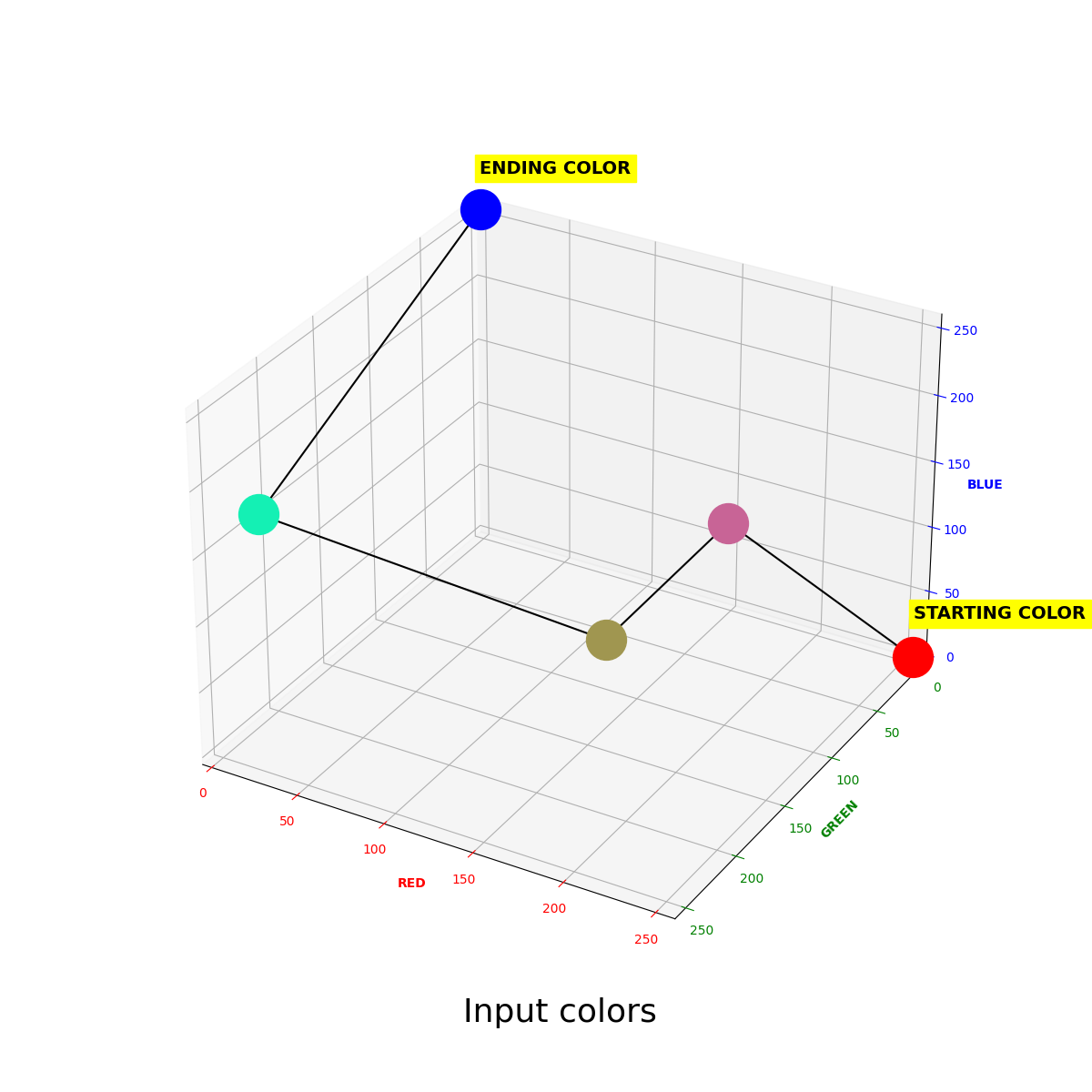
The get_linear_gradient function first determine the global distance from the first point to the last one, passing through the other colors given (if any).
See on the image above, the global distance is all black lines added together.
With that distance, we can figure out how far from the starting point to place each missing point (simply place a point every global_distance/(nb_points_to_add+1)).
Here's the colors we got by calling the function get_linear_gradient with the arguments of the previous example:
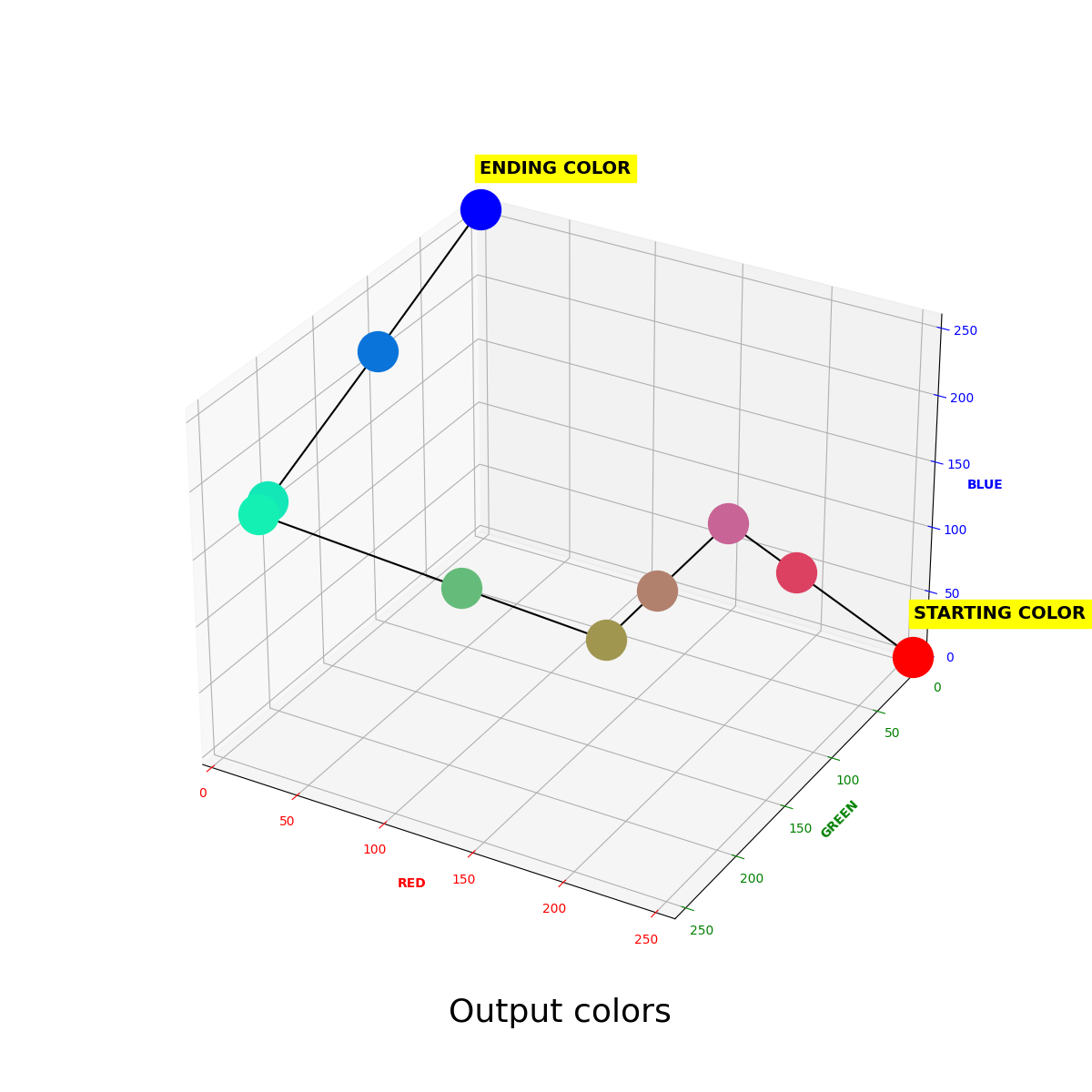
We can see a total of 10 colors, including 5 colors given and 5 new colors.
Tips
Ok, that doesn't look like a real gradient for now. Let's call get_linear_gradient again with a total of 1000 colors (nb_colors=1000).
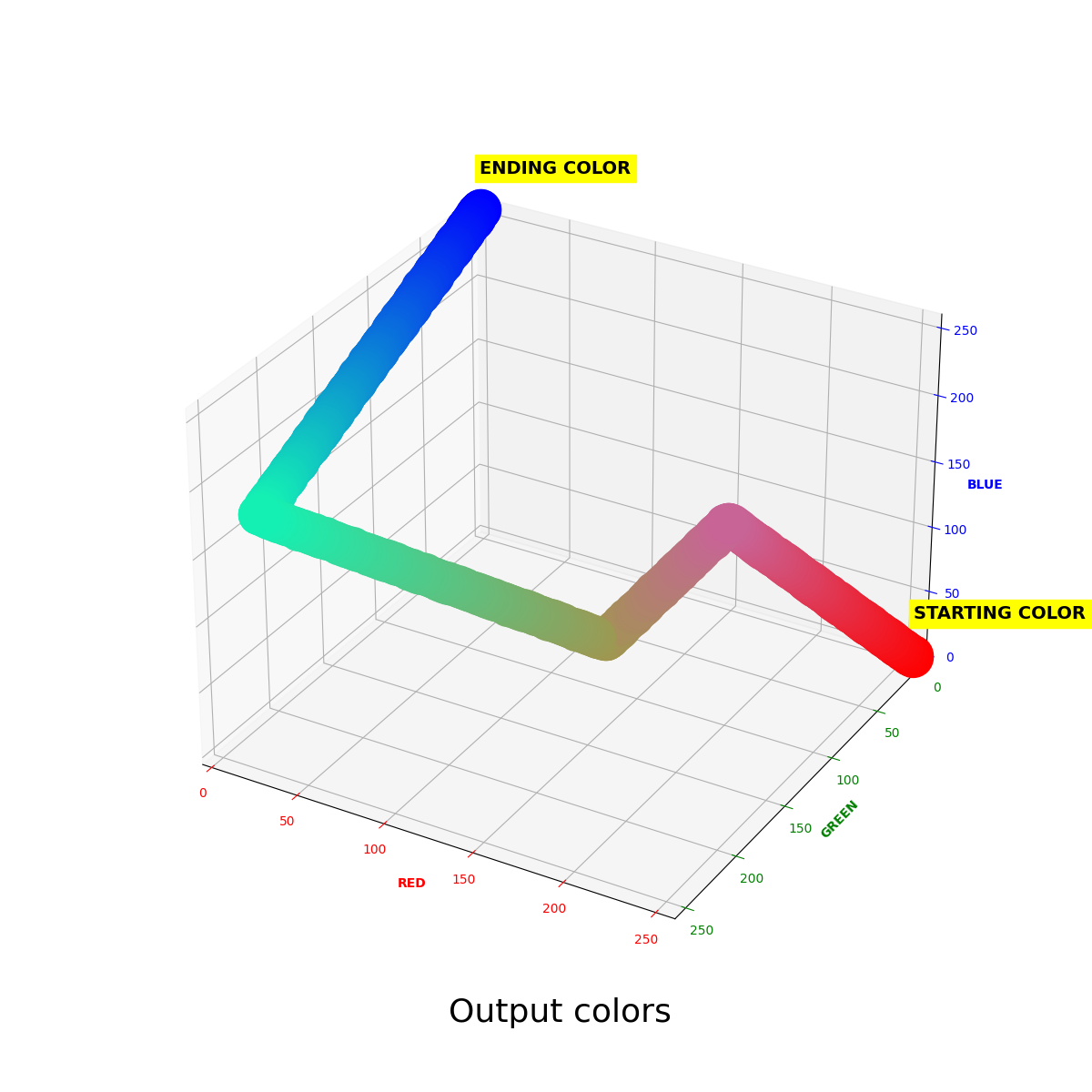
Yeah, this is better ;) Of course, the more you ask for colors, the better your gradient will be.
Support
If you need help or found a bug, consider opening an issue on the project.
License
The source code for this project is licensed under the GPLv3 license, which you can find in the LICENSE file.
Release history Release notifications | RSS feed


Download files
Download the file for your platform. If you're not sure which to choose, learn more about installing packages.
Source Distribution
Built Distribution
Filter files by name, interpreter, ABI, and platform.
If you're not sure about the file name format, learn more about wheel file names.
Copy a direct link to the current filters
File details
Details for the file rgb-gradient-0.0.2.tar.gz.
File metadata
- Download URL: rgb-gradient-0.0.2.tar.gz
- Upload date:
- Size: 41.8 kB
- Tags: Source
- Uploaded using Trusted Publishing? No
- Uploaded via: twine/4.0.2 CPython/3.10.12
File hashes
| Algorithm | Hash digest | |
|---|---|---|
| SHA256 |
354123801d490dd949158ec307a6aea308335fc4783445c7cc5e6c6be8a6fa06
|
|
| MD5 |
b508992b1fbb7958c46cde6a5ad4d913
|
|
| BLAKE2b-256 |
43a3bc2c14f0bf95c2d508d4c58d2ad76fdeb9af7fc77c3bf985e0e0d8b27892
|
File details
Details for the file rgb_gradient-0.0.2-py3-none-any.whl.
File metadata
- Download URL: rgb_gradient-0.0.2-py3-none-any.whl
- Upload date:
- Size: 28.7 kB
- Tags: Python 3
- Uploaded using Trusted Publishing? No
- Uploaded via: twine/4.0.2 CPython/3.10.12
File hashes
| Algorithm | Hash digest | |
|---|---|---|
| SHA256 |
4ca92c36cc6a97d7b41e47ec5316c5aeb683648cb166ff8d7c3506c4dccc3b5d
|
|
| MD5 |
dd99e2465f00d580e0eeaaefee39de06
|
|
| BLAKE2b-256 |
4cbc78211bab5d25b3297e04f99159300feb44d6c14a984df3d0683e8170b9e7
|






