
postgres backend implementation for rhosocial-activerecord, providing a robust and optimized postgres database support.
Project description
rhosocial-activerecord-postgres ($\rho_{\mathbf{AR}\text{-postgres}}$)






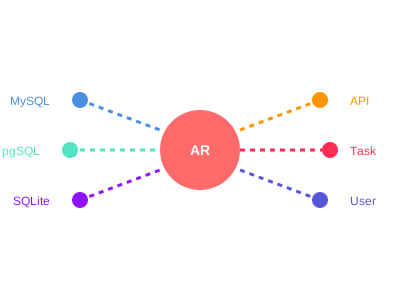
postgres backend implementation for rhosocial-activerecord, providing a robust and optimized postgres database support.
Postgres Backend Implementation Guide
Overview
This postgres backend implementation provides both synchronous and asynchronous support using the psycopg (psycopg3) driver.
Key Features
- ✅ Dual Implementation: Both sync (
PostgresBackend) and async (AsyncPostgresBackend) - ✅ Shared Logic: Common functionality in
PostgresBackendMixin - ✅ Full Transaction Support: Including savepoints and DEFERRABLE mode
- ✅ Rich Type Support: Arrays, JSONB, UUID, ranges, network types, geometry
- ✅ Complete Capability Declaration: CTEs, window functions, JSON operations, etc.
- ✅ Native Driver: Uses psycopg3 directly, no ORM dependencies
Installation
pip install rhosocial-activerecord-postgres
Dependencies:
rhosocial-activerecord>=1.0.0,<2.0.0psycopg>=3.2.12
Usage Examples
Synchronous Usage
from rhosocial.activerecord.model import ActiveRecord
from rhosocial.activerecord.backend.impl.postgres import (
    PostgresBackend,
    PostgresConnectionConfig
)

# Configure connection
config = PostgresConnectionConfig(
    host="localhost",
    port=5432,
    database="mydb",
    username="user",
    password="password",
    options={
        "sslmode": "prefer",
        "connect_timeout": 10,
        "application_name": "my_app"
    }
)

# Create backend
backend = PostgresBackend(connection_config=config)

# Configure model
class User(ActiveRecord):
    __table_name__ = "users"
    name: str
    email: str

User.configure(backend)

# Use the model
user = User(name="John", email="john@example.com")
user.save()

# Query with CTEs (postgres 8.4+)
results = User.query().with_cte(
    "active_users",
    User.query().where(is_active=True)
).from_cte("active_users").all()

# Use JSONB operations (postgres 9.4+)
users = User.query().where(
    "metadata->>'role' = ?", ("admin",)
).all()
Asynchronous Usage
import asyncio
from rhosocial.activerecord.async_model import ActiveRecord
from rhosocial.activerecord.backend.impl.postgres import (
    AsyncPostgresBackend,
    PostgresConnectionConfig
)

async def main():
    # Configure connection
    config = PostgresConnectionConfig(
        host="localhost",
        port=5432,
        database="mydb",
        username="user",
        password="password",
    )

    # Create async backend
    backend = ActiveRecord(connection_config=config)

    # Connect explicitly for async
    await backend.connect()

    # Configure model
    class User(ActiveRecord):
        __table_name__ = "users"
        name: str
        email: str

    User.configure(backend)

    # Use the model asynchronously
    user = User(name="Jane", email="jane@example.com")
    await user.save()

    # Async queries
    users = await User.query().where(is_active=True).all()

    # Cleanup
    await backend.disconnect()

# Run async code
asyncio.run(main())
Transaction Usage
Synchronous Transactions:
# Get transaction manager
tm = backend.transaction_manager

# Basic transaction
with tm:
    user1 = User(name="Alice")
    user1.save()
    user2 = User(name="Bob")
    user2.save()
# Auto-commit on context exit

# Explicit control
tm.begin()
try:
    user = User(name="Charlie")
    user.save()
    tm.commit()
except Exception:
    tm.rollback()
    raise

# With savepoints
tm.begin()
user1 = User(name="Dave")
user1.save()

savepoint = tm.savepoint()
try:
    user2 = User(name="Eve")
    user2.save()
    tm.release_savepoint(savepoint)
except Exception:
    tm.rollback_savepoint(savepoint)

tm.commit()

# With isolation level and deferrable mode
tm.set_isolation_level(IsolationLevel.SERIALIZABLE)
tm.set_deferrable(True)
with tm:
    # Deferrable serializable transaction
    pass
Asynchronous Transactions:
async def async_transaction_example():
    # Get async transaction manager
    tm = backend.transaction_manager

    # Basic async transaction
    async with tm:
        user1 = User(name="Alice")
        await user1.save()
        user2 = User(name="Bob")
        await user2.save()
    # Auto-commit on context exit

    # Explicit control
    await tm.begin()
    try:
        user = User(name="Charlie")
        await user.save()
        await tm.commit()
    except Exception:
        await tm.rollback()
        raise

    # With savepoints
    await tm.begin()
    user1 = User(name="Dave")
    await user1.save()

    savepoint = await tm.savepoint()
    try:
        user2 = User(name="Eve")
        await user2.save()
        await tm.release_savepoint(savepoint)
    except Exception:
        await tm.rollback_savepoint(savepoint)

    await tm.commit()
Postgres-Specific Features
Array Types:
from rhosocial.activerecord.model import ActiveRecord

class Article(ActiveRecord):
    __table_name__ = "articles"
    title: str
    tags: list  # Will use postgres array type

article = Article(
    title="postgres Arrays",
    tags=["database", "postgres", "arrays"]
)
article.save()

# Query arrays
articles = Article.query().where(
    "? = ANY(tags)", ("postgres",)
).all()
JSONB Operations:
from rhosocial.activerecord.model import ActiveRecord

class Product(ActiveRecord):
    __table_name__ = "products"
    name: str
    attributes: dict  # Will use JSONB type

product = Product(
    name="Laptop",
    attributes={
        "brand": "Dell",
        "specs": {
            "cpu": "Intel i7",
            "ram": "16GB"
        }
    }
)
product.save()

# Query JSONB
products = Product.query().where(
    "attributes->>'brand' = ?", ("Dell",)
).all()

# JSONB contains
products = Product.query().where(
    "attributes @> ?", ('{"brand": "Dell"}',)
).all()
Range Types:
from datetime import date
from rhosocial.activerecord.model import ActiveRecord

class Booking(ActiveRecord):
    __table_name__ = "bookings"
    room_id: int
    date_range: tuple  # Will use DATERANGE type

booking = Booking(
    room_id=101,
    date_range=(date(2024, 1, 1), date(2024, 1, 7))
)
booking.save()

# Query ranges
bookings = Booking.query().where(
    "date_range @> ?", (date(2024, 1, 3),)
).all()
Configuration Options
Connection Options
config = PostgresConnectionConfig(
    host="localhost",
    port=5432,
    database="mydb",
    username="user",
    password="password",
    options={
        # SSL/TLS
        "sslmode": "prefer",  # disable, allow, prefer, require, verify-ca, verify-full

        # Connection timeout
        "connect_timeout": 10,

        # Application identification
        "application_name": "my_app",

        # Client encoding
        "client_encoding": "UTF8",

        # Connection pooling (if supported)
        "pool_min_size": 1,
        "pool_max_size": 10,
        "pool_timeout": 30.0,
    }
)
Postgres Version Compatibility
| Feature | Minimum Version | Notes |
|---|---|---|
| Basic operations | 8.0+ | Core functionality |
| CTEs | 8.4+ | WITH clauses |
| Window functions | 8.4+ | ROW_NUMBER, RANK, etc. |
| RETURNING clause | 8.2+ | INSERT/UPDATE/DELETE RETURNING |
| JSON type | 9.2+ | Basic JSON support |
| JSONB type | 9.4+ | Binary JSON, better performance |
| UPSERT (ON CONFLICT) | 9.5+ | INSERT ... ON CONFLICT |
Recommended: Postgres 12+ for optimal feature support and performance.
Architecture Notes
Backend Structure
PostgresBackendMixin (Shared Logic)
    ├── Configuration validation
    ├── Version parsing
    ├── Capability initialization
    ├── Type converter registration
    └── Error mapping

PostgresBackend (Sync)           AsyncPostgresBackend (Async)
    ├── Inherits Mixin                 ├── Inherits Mixin
    ├── Inherits StorageBackend        ├── Inherits AsyncStorageBackend
    ├── Sync connection management     ├── Async connection management
    ├── Sync query execution           ├── Async query execution
    └── Sync transaction manager       └── Async transaction manager
Transaction Structure
PostgresTransactionMixin (Shared Logic)
    ├── Isolation level mapping
    ├── Savepoint name generation
    ├── SQL statement building
    └── Deferrable mode support

PostgresTransactionManager       AsyncPostgresTransactionManager
    ├── Inherits Mixin                 ├── Inherits Mixin
    ├── Inherits TransactionManager    ├── Inherits AsyncTransactionManager
    ├── Sync transaction operations    ├── Async transaction operations
    └── Sync constraint management     └── Async constraint management
Testing
The backend includes comprehensive test coverage for both sync and async implementations:
- Connection lifecycle tests
- CRUD operation tests
- Transaction tests (with savepoints)
- Type conversion tests
- Capability declaration verification
- Error handling tests
- Concurrent operation tests
Run sync tests:
pytest tests/rhosocial/activerecord_test/feature/backend/postgres/test_backend_sync.py
Run async tests:
pytest tests/rhosocial/activerecord_test/feature/backend/postgres/test_backend_async.py
Migration from Old Implementation
If you have an existing postgres backend implementation, here's how to migrate:
Old code:
from rhosocial.activerecord.backend.impl.postgres import PostgresBackend

backend = PostgresBackend(...)
New code (no changes needed for sync):
from rhosocial.activerecord.backend.impl.postgres import PostgresBackend

backend = PostgresBackend(...)  # Same API
New async support:
from rhosocial.activerecord.backend.impl.postgres import AsyncPostgresBackend

backend = AsyncPostgresBackend(...)
await backend.connect()
Known Limitations
- Connection Pooling: Basic implementation, consider using external pooling (pgbouncer) for production
- Async Context: Async backend requires explicit
await backend.connect()call - Type Converters: Some postgres-specific types may need custom converters
Contributing
Contributions are welcome! Please ensure:
- Tests pass for both sync and async implementations
- Code follows project style guidelines
- Documentation is updated
- Changelog fragments are created
License
Copyright © 2025 vistart
Project details
Release history Release notifications | RSS feed


Download files
Download the file for your platform. If you're not sure which to choose, learn more about installing packages.
Source Distribution
Built Distribution
Filter files by name, interpreter, ABI, and platform.
If you're not sure about the file name format, learn more about wheel file names.
Copy a direct link to the current filters






